
Band reunions are rock music’s most dangerous magic trick. Done right, they feel like a portal opening in the sky: the old chemistry returns, the crowd loses its collective mind, and everyone briefly forgets about back pain, streaming royalties, and the price of parking. Done wrong, they feel like a family Thanksgiving where the guitars are loud, the smiles are contractual, and someone is definitely not over what happened in 1997.
The best band reunions are not just nostalgia machines. They prove that the songs still have teeth. The worst ones prove that time is undefeated, lawyers are powerful, and not every feud should be solved with a festival deposit. From Guns N’ Roses turning chaos into stadium gold to OutKast making fans wonder whether André 3000 wanted to be anywhere except onstage, music history is full of comebacks that were either glorious, awkward, emotionally confusing, or all three before the second chorus.
Below is a deep dive into the most badass band reunions, the most disappointing reunions, and the strange middle ground where fans got exactly what they asked forthen immediately began arguing about it online.
What Makes a Band Reunion Badass?
A badass reunion does three things. First, it respects the past without embalming it. Second, it gives fans the songs they came for without sounding like a museum exhibit with a drum riser. Third, it proves that the band members still share something beyond a bank account and a group text labeled “Tour?”
The magic is usually physical. You hear it when the first riff lands and the room reacts before the brain can catch up. Great reunions make old songs feel dangerous again. They do not need to pretend the musicians are still 25. In fact, the best reunions often work because the artists are older, sharper, and less interested in posing. The songs carry history, and so does the audience.
The Most Badass Band Reunions
Guns N’ Roses: Chaos Finally Learned How to Be Punctual
For years, a classic Guns N’ Roses reunion felt less like a concert possibility and more like a weather event: technically imaginable, but mostly discussed by people who enjoy danger. Then Axl Rose, Slash, and Duff McKagan actually got back together for the “Not in This Lifetime…” tour, a title that doubled as a joke and a public apology from the universe.
The result was not just a reunion. It was a monster. The band filled stadiums, delivered marathon setlists, and reminded everyone why their catalog still sounds like a motorcycle fight in a cathedral. The most shocking part was not that the shows were big. It was that they were professional. Axl showed up. Slash sounded feral. Duff brought cool-headed muscle. The whole thing felt like the world’s loudest group therapy session, except the therapy worked and sold a terrifying number of tickets.
Badass rating: extremely high. Disappointment risk: somehow lower than expected, which may be the biggest surprise in the history of hard rock scheduling.
Led Zeppelin: One Night, One Legend, No Victory Lap
Led Zeppelin’s 2007 reunion at London’s O2 Arena was the kind of event that makes rock fans speak in sacred tones usually reserved for rare vinyl and lost guitar picks. Robert Plant, Jimmy Page, and John Paul Jones reunited with Jason Bonham, son of the late John Bonham, for a tribute to Atlantic Records co-founder Ahmet Ertegun.
The genius of the reunion was its restraint. They did not stretch it into a nostalgia caravan. They did not turn it into “Led Zeppelin: The Spreadsheet Years.” They showed up, played a full set, hit moments of real fire, and left the myth standing taller than before. “Kashmir” reportedly carried the weight of a mountain moving through smoke, while the show’s imperfections made it feel human rather than plastic.
That is the rarest kind of reunion: one that leaves fans wanting more while making a strong argument that more might have ruined it. Badass because it happened. Even more badass because it stopped.
The Police: Three Men, One Massive Tour, Several Miles of Tension
The Police reunion tour of 2007–08 proved that a band does not need to be emotionally cozy to be musically effective. Sting, Andy Summers, and Stewart Copeland had enough internal tension to power a small city, but that friction was always part of their sound. Their songs were sleek, nervous, reggae-tinted, and rhythmically sharp, like pop music doing pushups in a locked room.
The reunion tour became a blockbuster, packing arenas and stadiums while reminding fans that “Roxanne,” “Message in a Bottle,” and “Every Breath You Take” are not just radio staplesthey are precision machines. Were they best friends? Probably not. Did that matter once Copeland started hitting the drums like he was trying to win an argument with physics? Also no.
This reunion was badass because it did not require sentimental pretending. The Police returned as The Police: brilliant, tense, controlled, and slightly allergic to hugging.
Pixies: Indie Rock’s Favorite Weird Uncle Came Back
When Pixies reunited in 2004, the response was not just enthusiastic; it was reverential. Their original run had influenced alternative rock so deeply that half the bands of the 1990s sounded like they had built homes on Pixies property. Frank Black, Kim Deal, Joey Santiago, and David Lovering returned at a time when younger fans had discovered them through influence, reputation, and obsessive music-nerd evangelism.
The reunion worked because the songs were still strange in the best way. “Where Is My Mind?” had become an anthem for beautiful confusion, but the band’s catalog was deeper, sharper, and more explosive than one famous closing scene could contain. Their quiet-loud dynamics still hit like a trapdoor opening under the floor.
Were they warm and chatty? Not exactly. Pixies were never built to be your camp counselors. They came back, played the songs with force, and reminded everyone that weirdness ages better than trend-chasing.
Misfits: Horror Punk Crawled Out of the Grave
The original Misfits reunion at Riot Fest was the kind of punk-rock event that sounded fake until it actually happened. Glenn Danzig, Jerry Only, and Doyle Wolfgang von Frankenstein sharing a stage again after decades of lawsuits, lineup weirdness, and horror-punk mythology? That was not just a reunion. That was a comic book panel with amplifiers.
The performance worked because the Misfits catalog is built for communal shouting. The songs are short, fast, spooky, and ridiculous in the most lovable way. A Misfits reunion does not require delicate emotional nuance. It requires skull logos, distorted guitars, and a crowd yelling along like a zombie choir with excellent taste in T-shirts.
Badass? Absolutely. Elegant? No, thank goodness.
My Chemical Romance: Emo Grew Up and Brought Fire
My Chemical Romance’s reunion could have gone wrong in several ways. Nostalgia for the 2000s is powerful, but it can also turn into costume karaoke. Instead, the band came back with a sense of purpose. Their reunion shows felt less like a throwback and more like a reminder that the emotional intensity of their music was never a phase for the fans who lived inside it.
Gerard Way’s stage presence, the band’s theatrical instincts, and the deep connection between audience and catalog made the comeback feel huge. “Welcome to the Black Parade” did not return as a relic; it returned as a battle flag. The band also avoided sounding trapped by its own eyeliner era. The reunion had humor, darkness, grandeur, and enough catharsis to make an arena feel like a group diary with pyrotechnics.
This was a badass reunion because it understood the assignment: honor the old wounds, but do not reopen them just for branding.
blink-182: The Classic Trio Found the Joke Again
When Mark Hoppus, Tom DeLonge, and Travis Barker reunited, blink-182 fans got back the version of the band that lived rent-free in their teenage brains. Their 2023 Coachella appearance had the energy of a surprise party thrown by three guys who still know exactly how dumb and touching their own band can be.
The secret was balance. Travis Barker remained a drumming machine. Hoppus brought warmth and glue. DeLonge returned with the nasal UFO-surfer charisma that makes blink feel like blink. The jokes were juvenile, because of course they were. Asking blink-182 to become tasteful adults is like asking a skateboard to become a mortgage advisor.
But beneath the banter was real emotion: illness, absence, friendship, and the strange grace of getting another chance. That made the reunion more than pop-punk nostalgia. It felt earned.
Oasis: The Gallaghers Finally Shared the Same Weather System
For years, an Oasis reunion seemed impossible because Liam and Noel Gallagher appeared capable of turning a cup of tea into a constitutional crisis. Their split had become part of the band’s legend, and fans treated reunion rumors like annual folklore. Then the 2025 reunion finally happened, and the shock was not merely that the brothers stood on the same stage. It was that the shows reportedly sounded strong.
Oasis reunions are tricky because the band’s appeal has always depended on scale: huge choruses, huge attitude, huge crowds, huge sibling tension. If that machinery sputters, the whole thing becomes karaoke at aircraft-hangar volume. But when it works, it is communal thunder. “Wonderwall,” “Live Forever,” and “Champagne Supernova” are not subtle songs. They are crowd architecture.
The reunion’s badass factor came from improbability. Sometimes rock history gives fans exactly what they want, and everyone is too stunned to complain for at least five minutes.
The Most Disappointing Band Reunions
OutKast: Brilliant Catalog, Strange Vibes
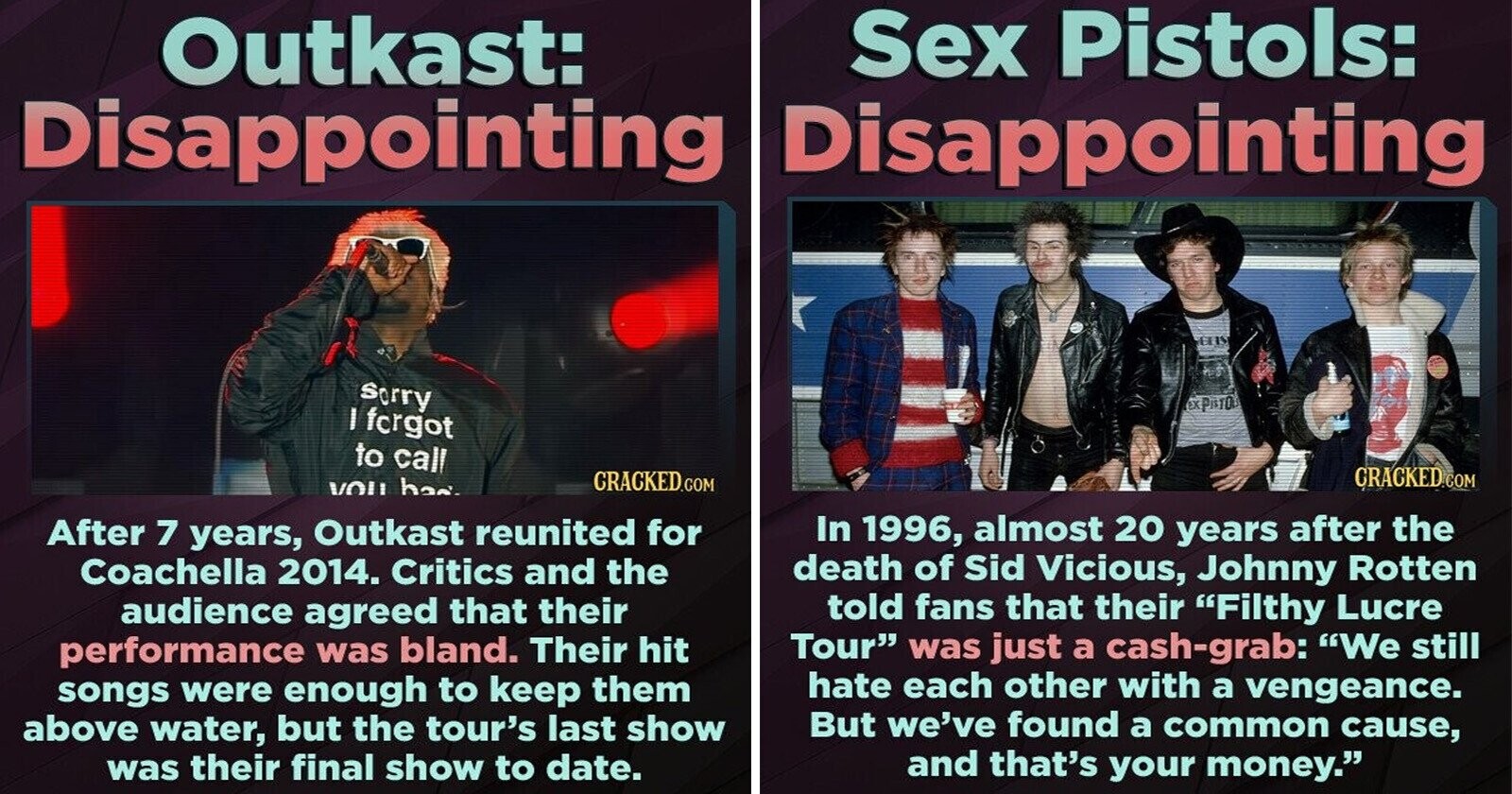
OutKast’s 2014 reunion should have been a victory parade for one of hip-hop’s most inventive duos. André 3000 and Big Boi helped reshape Southern rap, pop, funk, and weirdness itself. On paper, a festival comeback made perfect sense. In practice, the early Coachella performance felt oddly stiff to many viewers, as if the songs had arrived but the joy was still stuck in traffic.
The problem was not the music. OutKast’s catalog remains absurdly rich: explosive, funny, cosmic, streetwise, and stylish enough to make most reunion setlists look underdressed. The issue was chemistry. Big Boi seemed ready to celebrate. André looked more complicatedpresent, talented, but emotionally elsewhere. That tension made the reunion fascinating, but not always satisfying.
To be fair, later shows reportedly improved. Still, the first impression mattered. Fans wanted a rocket launch. They got a brilliant machine that needed a few more turns of the key.
LCD Soundsystem: Great Shows, Weird Timing
LCD Soundsystem’s reunion is one of the strangest cases because the performances were good and the criticism was still understandable. James Murphy had staged a grand farewell at Madison Square Garden in 2011, complete with documentary treatment and emotional finality. Then, not very many years later, LCD was back.
Musically, the reunion made sense. The band could still lock into those anxious, euphoric dance-rock grooves. Fans could still lose themselves in the pulse. But emotionally, some people felt played. If the farewell was not really farewell, what exactly had everyone been crying about?
This reunion was disappointing not because the band sounded bad, but because it messed with the sacred contract of the goodbye. When you sell fans a funeral, you cannot casually return from the grave holding a festival laminate.
Rage Against the Machine: The Comeback That Could Not Catch a Break
Rage Against the Machine’s reunion had all the ingredients for a historic return: political fury, monster riffs, a catalog that had only grown more relevant, and an audience ready to scream along like civilization had just failed another exam. Then reality tackled the tour.
The band’s plans were delayed by the pandemic, and when shows finally happened in 2022, Zack de la Rocha suffered a serious leg injury early in the run. He continued performing seated, which was heroic in its own way, but the injury eventually forced major cancellations. The disappointment was not about effort. It was about lost potential.
Rage sounded necessary. That made the cancellations sting more. Some reunions disappoint because the band is lazy. This one disappointed because the universe apparently saw the schedule and said, “Absolutely not.”
Van Halen: Too Much History, Not Enough Healing
Van Halen’s reunion history is complicated enough to require a family tree, a legal pad, and possibly a referee. The David Lee Roth reunion gave fans plenty of classic material and some thrilling Eddie Van Halen moments. But it also carried obvious baggage: missing bassist Michael Anthony, uneven vocals, personality clashes, and the constant sense that everyone was smiling with one eye on the exit.
The Sammy Hagar-era reunion attempts had their own painful shadows, including public comments later describing the experience as deeply unhappy. After Eddie Van Halen’s death, hopes for a tribute-style reunion also ran into disagreements. That is the tragedy of Van Halen reunions: the songs are immortal, but the relationships often seemed too bruised to hold them comfortably.
Fans wanted celebration. They sometimes got brilliance, sometimes awkwardness, and often a reminder that virtuoso guitar cannot fix every human problem.
Talking Heads: The Reunion That Was Not a Reunion
Talking Heads gave fans a rare public reunion in 2023 around the restored release of “Stop Making Sense.” David Byrne, Tina Weymouth, Chris Frantz, and Jerry Harrison appeared together, spoke warmly, and seemed far more comfortable than longtime followers might have expected.
It was wonderful. It was also not the reunion many fans secretly wanted. No tour. No new album. No sudden return of the big suit under arena lights. Just a mature, thoughtful celebration of one of the greatest concert films ever made.
Calling that disappointing may be unfair, but fandom is not always fair. The public appearance proved that the members could share a room. Naturally, fans immediately began dreaming about them sharing a stage. The band, wisely or frustratingly, did not turn the moment into a cash-grab tour. Depending on your perspective, that is either noble restraint or the sound of your dream gently closing the door.
Why Some Band Reunions Work and Others Collapse
The best band reunions usually happen when the musicians understand what fans want but refuse to become servants to nostalgia. They play the hits, yes, but they also bring adult perspective. They know the songs are no longer just theirs. They belong to weddings, breakups, road trips, bad apartments, first concerts, and the person you were before life started charging service fees.
The worst reunions fail when the emotional math is wrong. Sometimes one member wants closure while another wants cash. Sometimes the audience wants youth restored, which is not available at any merch table. Sometimes the band can still play, but the friendship has expired. A reunion is not just a setlist. It is a public test of chemistry.
That is why one-night reunions can be so powerful. Led Zeppelin protected the myth by not overexplaining it. Talking Heads protected theirs by not forcing a tour. On the other hand, long reunion tours can also triumph when the band finds fresh purpose, as Guns N’ Roses, My Chemical Romance, and blink-182 showed. There is no single formula. There is only the question every fan asks when the lights go down: Do we still believe this?
Fan Experiences: What Band Reunions Feel Like From the Crowd
Seeing a reunited band live is different from seeing a band that never went away. There is a charge in the air before the first note, a mix of excitement and fear. Fans are not only hoping for a good show; they are hoping their memories survive contact with reality. That is a lot to put on four people with guitars and knee braces.
The best reunion experiences feel communal. You look around and see multiple generations singing the same chorus for completely different reasons. Older fans may be remembering the first time they heard the album in a car with terrible speakers. Younger fans may be seeing a legendary band they discovered through playlists, parents, movies, or the sacred algorithm. For three minutes, nobody cares. The song belongs to everyone.
There is also a strange tenderness to watching older musicians perform young music. A punk song written in anger at 22 sounds different at 52. A breakup anthem becomes less about one person and more about the entire ridiculous business of being alive. Great artists do not try to hide that change. They let the years sit inside the performance. That is why a reunion can feel deeper than the original era. The song has survived. So have the fans.
But disappointing reunion experiences are uniquely painful. A bad regular concert is just a bad night. A bad reunion can feel like someone scratched your favorite memory. Maybe the singer cannot reach the notes. Maybe the band members avoid eye contact like divorced parents at graduation. Maybe the setlist is designed by committee and has all the spontaneity of a tax form. The crowd still cheers, because fans are generous, but you can feel the energy sag when nostalgia realizes it has been overcharged.
Ticket prices make the emotional stakes even higher. Modern reunion tours are often expensive, and fans arrive expecting not just music but meaning. They paid for parking, fees, babysitters, flights, hotels, and one T-shirt priced like a minor appliance. If the band phones it in, the disappointment lands hard. A reunion does not have to be perfect, but it has to feel honest.
The most memorable reunion shows usually include one unplanned-feeling moment: a smile between old bandmates, a crowd taking over a chorus, a deep cut nobody expected, a visible crack in the armor. Those moments tell fans that the night is alive. Not just branded. Not just sponsored. Alive.
That is the real reason band reunions matter. They are not only about famous people getting back together. They are about time briefly folding in half. The past walks onstage, plugs in, and tries to prove it can still make noise. Sometimes it roars. Sometimes it wheezes. Sometimes it does both in the same song. Either way, we keep showing up, because when a reunion works, it feels like getting one impossible encore from a version of life we thought had already left the building.
Conclusion: The Reunion Is the Final Boss of Rock Nostalgia
The most badass band reunions succeed because they transform nostalgia into energy. They do not simply remind fans of what used to be great; they create a new great moment in real time. Guns N’ Roses turned chaos into a stadium empire. Led Zeppelin gave the world one last thunderclap. The Police proved tension can still groove. Pixies and Misfits showed that cult bands can return with their weirdness intact. My Chemical Romance and blink-182 proved that emotional fandom does not expire when the eyeliner fades.
The most disappointing reunions, meanwhile, remind us that wanting something badly does not guarantee it should happen. OutKast’s comeback had the songs but not always the spark. LCD Soundsystem’s return was musically strong but emotionally awkward after such a dramatic farewell. Rage Against the Machine was derailed by injury rather than apathy. Van Halen’s reunion history showed how heavy old wounds can become. Talking Heads teased fans with warmth but stopped short of the stage comeback many still crave.
In the end, a band reunion is a gamble between memory and reality. When it wins, it is glorious. When it loses, at least fans get something to argue about foreverwhich, in rock culture, is practically a bonus track.














