
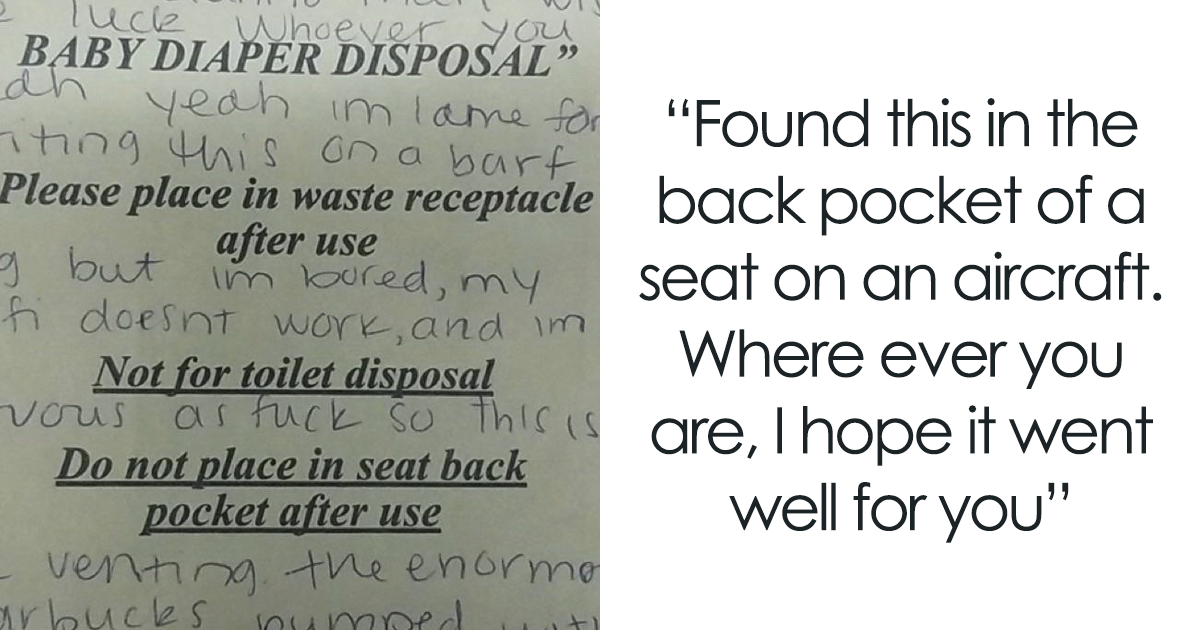
Every once in a while, the internet receives a tiny mystery and immediately behaves like a retired detective with unlimited coffee. No crime scene tape. No dramatic thunder. Just a handwritten note found in the seat pocket of an airplane, a nervous confession, and one unanswered question: who wrote it?
The story that captured online attention was simple enough to fit on a barf bag, which is possibly the least glamorous stationery ever invented. A woman named Andrea, apparently flying with a serious case of butterflies, wrote a note confessing that she had a crush on a guy nearby. The message was later discovered by an airline worker cleaning the aircraft and shared online, where thousands of strangers suddenly became emotionally invested in Andrea’s romantic fate.
It was sweet, awkward, mysterious, and extremely internet-friendly. In other words, it had all the ingredients required for people to drop whatever they were doing and begin assembling theories like they were trying to solve a cold case with Wi-Fi.
Why One Airplane Note Turned Into A Viral Mystery
The charm of the airplane note lies in how small it is. Nobody needed a celebrity, a scandal, or a perfectly edited video. The internet had a handwritten confession, a first name, and a setting that already feels like a movie: two strangers sharing the same temporary metal tube in the sky, surrounded by snack carts, turbulence, and people pretending not to listen.
Airplanes are strange little social laboratories. For a few hours, passengers sit inches away from people they may never see again. You learn someone’s coffee order, their sleep style, their level of commitment to armrest warfare, and occasionally, if fate is feeling mischievous, that someone nearby has a crush.
Andrea’s note resonated because it felt refreshingly human. In an age of dating apps, read receipts, carefully filtered selfies, and messages drafted by committee in group chats, a handwritten note has a chaotic purity. It says, “I am nervous, I am sincere, and I am apparently trusting my emotional future to airplane cleaning procedures.” That is bravery. Or madness. Possibly both.
The Power Of A Tiny Public Clue
When the note appeared online, people did what people online do best: they cared too much, very quickly. Commenters wanted to know whether Andrea actually handed over the message, whether the crush ever read it, whether they exchanged numbers, whether they got coffee after landing, and whether this was the beginning of a love story or simply a legendary missed connection.
That emotional investment is not surprising. The internet loves unfinished stories. A complete story gives us satisfaction; an incomplete story gives us a hobby. Andrea’s airplane note offered just enough detail to spark imagination, but not enough to close the case. It was the narrative equivalent of leaving one sock in the dryer: everyone knows something happened, but nobody can explain where the missing piece went.
Unlike many viral travel stories, this one was not about a reclining seat battle, a barefoot passenger, or someone treating the aisle like a yoga studio. It was gentle. It invited curiosity instead of outrage. The note did not demand a villain. It asked for an ending.
Why Airplane Stories Spread So Fast Online
Airplane stories tend to go viral because almost everyone understands the setting. Even people who rarely fly know the awkward choreography: boarding too early, stowing a bag while seventeen people judge your technique, deciding whether to wake a seatmate for the bathroom, and pretending the person coughing three rows back is absolutely not the main character of your immune system’s origin story.
Flights compress strangers into an intimate space with strict rules and limited escape routes. That makes small moments feel larger. A kind gesture becomes memorable. A rude habit becomes outrageous. A handwritten note becomes folklore.
In recent years, social media has repeatedly turned in-flight moments into public entertainment: passengers passing notes to strangers, travelers posting mysterious messages found on seats, and viewers debating whether a romantic gesture is adorable, awkward, or a little too bold. The airplane has become one of the internet’s favorite stages because everything happens under pressure: limited time, limited space, and limited legroom.
The Internet Sleuth Effect: Cute, Funny, And A Little Complicated
The hunt for Andrea is a perfect example of the internet sleuth effect. People see a fragment of a story and instantly want to fill in the blanks. Sometimes this collective curiosity can be wholesome. People reunite lost items with owners, identify forgotten photos, or help strangers find sentimental objects. At its best, the internet can be a giant neighborhood bulletin board with better snacks.
But there is also a line between curiosity and intrusion. Trying to identify someone from a private note, even a sweet one, raises obvious questions. Did Andrea want the world to know? Did the man she liked want to become part of an online romance investigation? Was the note intended to be a public artifact, or was it simply a nervous private moment that accidentally escaped into the digital jungle?
That tension is what makes the story interesting beyond the “aww” factor. The internet often treats mysteries as community puzzles, but real people live on the other side of those clues. A first name, a flight route, a photo, or a handwritten message can become searchable faster than the original person ever expected.
What Makes Handwritten Notes So Irresistible?
A handwritten note has personality. It includes pauses, crossed-out thoughts, uneven letters, and the unmistakable energy of a person trying to be brave while their brain is shouting, “Abort mission.” Unlike a text message, it cannot be edited endlessly. Unlike a social media post, it is not polished for an audience. It feels immediate and slightly risky.
That is why Andrea’s airplane note hit people right in the feelings. It reminded readers of school crushes, passed notes, missed chances, and the ancient emotional sport of wondering, “Should I say something?” Many adults like to pretend they have evolved beyond that panic. They have not. They have simply upgraded from notebook paper to typing “hey” and deleting it twelve times.
The note also carried the romance of impermanence. A flight ends. People scatter. Gate numbers change. Phone batteries die at the exact moment they are most needed. In that temporary world, a note becomes a tiny rebellion against silence.
The Role Of Airplane Etiquette In Viral Passenger Moments
Of course, not every airplane interaction should become a grand romantic gesture. Airplane etiquette matters because passengers are sharing a confined space where comfort depends on mutual restraint. A cute note is one thing. Cornering someone, invading personal space, filming strangers without care, or making other passengers uncomfortable is another.
The best version of an airplane note is low-pressure. It gives the other person a choice. It does not demand attention, trap someone in conversation, or turn the cabin into a live dating show hosted by row 17. A respectful note says, “Here is a small opening if you are interested.” A bad note says, “Congratulations, you are now emotionally trapped until landing.” There is a difference, and frequent flyers can feel it in their tray tables.
Andrea’s note became beloved because it appeared vulnerable rather than pushy. The internet loves bravery, but it especially loves bravery wrapped in awkwardness. That is why people rooted for her. She was not trying to be perfect. She was trying to say the thing before the chance disappeared.
Why People Needed To Know How It Ended
The biggest reason the story spread was not the note itself. It was the missing ending. Did Andrea give it to him? Did he smile? Did he write back? Did they talk at baggage claim? Did he never see it because he was too busy fighting with an overhead bin? The uncertainty created a vacuum, and the internet hates a vacuum unless it is reviewing one on a shopping site.
Humans are wired for narrative completion. We want beginnings, middles, and endings. Andrea gave us the beginning. The airplane gave us the setting. The missing ending invited everyone else to become a screenwriter. Some imagined a romantic success. Others pictured a hilarious failure. A few likely built a five-season streaming drama in their heads before lunch.
That is the beauty of a small viral mystery: it becomes a mirror. Optimists see destiny. Cynics see cringe. Romantics see a missed connection. Practical people wonder why anyone was writing on a barf bag in the first place. Everyone brings their own baggage, and for once, it fits under the seat in front of them.
Modern Romance Is Weird, And This Note Proves It
Modern dating can feel like applying for a job where the hiring manager ghosts you after three interviews and still watches your Instagram stories. That may be why Andrea’s note felt so refreshing. It skipped algorithms, profile prompts, and suspiciously perfect hiking photos. It was one person taking a chance in real life.
There is something appealing about that. Not because everyone should start tossing notes across cabins like paper airplanes of destiny, but because directness has become rare. A small, sincere message can feel almost radical when so much communication is filtered through screens.
At the same time, the viral reaction shows how quickly private vulnerability can become public property. A note meant for one person became entertainment for thousands. That does not erase its sweetness, but it does add complexity. The internet can turn a soft moment into a stadium event.
What This Viral Airplane Note Says About Us
The search for Andrea says less about one passenger and more about the rest of us. People are hungry for stories that feel spontaneous, harmless, and human. They want evidence that strangers still notice each other, that courage can fit on a scrap of paper, and that not every viral moment has to involve outrage, chaos, or someone putting bare feet where bare feet should never go.
It also shows how online communities transform ordinary objects into emotional artifacts. A barf bag became a symbol of bravery. A seat pocket became a message in a bottle. An airline worker’s discovery became a shared mystery. The internet did not just read the note; it adopted it, fed it snacks, and demanded updates.
That collective reaction can be funny, charming, and occasionally overwhelming. It is one of the contradictions of digital culture: people crave authentic moments, but once those moments appear, they can be amplified until the original human being is almost lost behind the meme.
Lessons From The Airplane Note Mystery
1. Small gestures can become big stories
Andrea probably did not sit down thinking she was about to create an internet mystery. She was likely just nervous and trying to express a feeling. That is the funny thing about viral moments: they rarely announce themselves. They sneak in quietly, usually wearing bad handwriting.
2. Respect makes boldness charming
A romantic gesture works best when it leaves room for a polite no. Whether on a plane, in a coffee shop, or at an airport gate, the key is to avoid pressure. Confidence is attractive. Making someone wish they had booked a different flight is not.
3. The internet should practice curiosity with brakes
It is natural to wonder who Andrea was and what happened next. But curiosity should not become a hunt that ignores consent. Enjoying a mystery is fine. Turning a private person into a target is where the fun stops and the group project gets weird.
4. Real life still has room for movie moments
For all the jokes about awkwardness, Andrea’s note worked because it reminded people that real life can still surprise us. Even in a cramped cabin with recycled air and questionable pretzels, someone might decide to be brave.
Experiences Related To The Viral Airplane Note
Anyone who has flown enough knows that airplanes produce stories with almost suspicious efficiency. You board expecting a quiet trip and leave with a memory, a complaint, or a new belief that humanity should pass a basic etiquette test before touching a boarding pass.
One common experience is the silent friendship formed between seatmates who never exchange names. Maybe one person helps lift a bag into the overhead bin. Maybe another offers a tissue during turbulence. Maybe a passenger quietly points out that your headphone cable is caught in the armrest before you accidentally launch your phone into row 12. These moments are tiny, but they matter. They make travel feel less mechanical.
Then there are the missed connections. A traveler notices someone reading the same book, wearing a funny shirt, or laughing at the same in-flight safety announcement. For a few hours, there is a possibility. Then the plane lands, everyone stands up too early, and the moment dissolves into the universal chaos of people retrieving luggage as if the aircraft is on fire. Andrea’s note speaks to that exact fear: the chance that if you do not say something now, you may never get another opportunity.
Many travelers have also experienced the opposite side of airplane interaction: the uncomfortable approach. A stranger talks too much, ignores body language, or treats a captive audience like a networking event with seat belts. That is why the note format can be surprisingly considerate. It allows expression without forcing conversation. The recipient can respond, smile, ignore it, or quietly preserve their peace with the dignity of a person who paid extra for a window seat.
There is also something uniquely emotional about traveling. Airports are full of beginnings and endings: reunions, goodbyes, business trips, vacations, emergencies, big moves, and long-awaited returns. People are often tired, hopeful, anxious, or sentimental. A note written in that environment carries extra weight because travel already makes life feel cinematic. Even the fluorescent lighting seems to whisper, “Something could happen here,” which is generous of it, considering airport lighting usually makes everyone look like they have just lost an argument with a printer.
For readers, the best takeaway from Andrea’s story is not necessarily “write a confession on your next flight.” It is this: small moments are worth noticing. Compliment someone kindly. Thank a crew member. Help a nervous flyer. Smile when it is welcome. And if you do decide to write a note, keep it respectful, simple, and pressure-free. The goal is not to create a viral investigation. The goal is to be human in a place where everyone is temporarily sharing the same sky.
The internet may never find Andrea, and maybe that is perfectly fine. Some stories are better as mysteries. Not every note needs a sequel. Not every stranger needs to be identified. Sometimes the most satisfying ending is knowing that, somewhere on an airplane, one nervous person was brave enough to write down what many people only think.
Conclusion
The internet’s fascination with the person who left this note in an airplane is easy to understand. The story is funny, tender, awkward, and unfinishedthe perfect combination for online curiosity. Andrea’s handwritten confession turned an ordinary flight into a tiny legend, proving that even in the age of instant messages and viral videos, a simple note can still make thousands of people stop scrolling and start rooting for a stranger.
At its heart, the viral airplane note is not just about romance. It is about courage, privacy, timing, and the strange emotional magic of travel. It reminds us that the smallest gestures can carry the biggest stories, especially when they are found in the least poetic place imaginable: an airplane seat pocket.














