
A solar eclipse can make reasonable people behave strangely. The sky darkens, the temperature drops, birds become confused, and suddenly somebody decides that generations of ophthalmologists have been running an elaborate conspiracy on behalf of the eclipse-glasses industry.
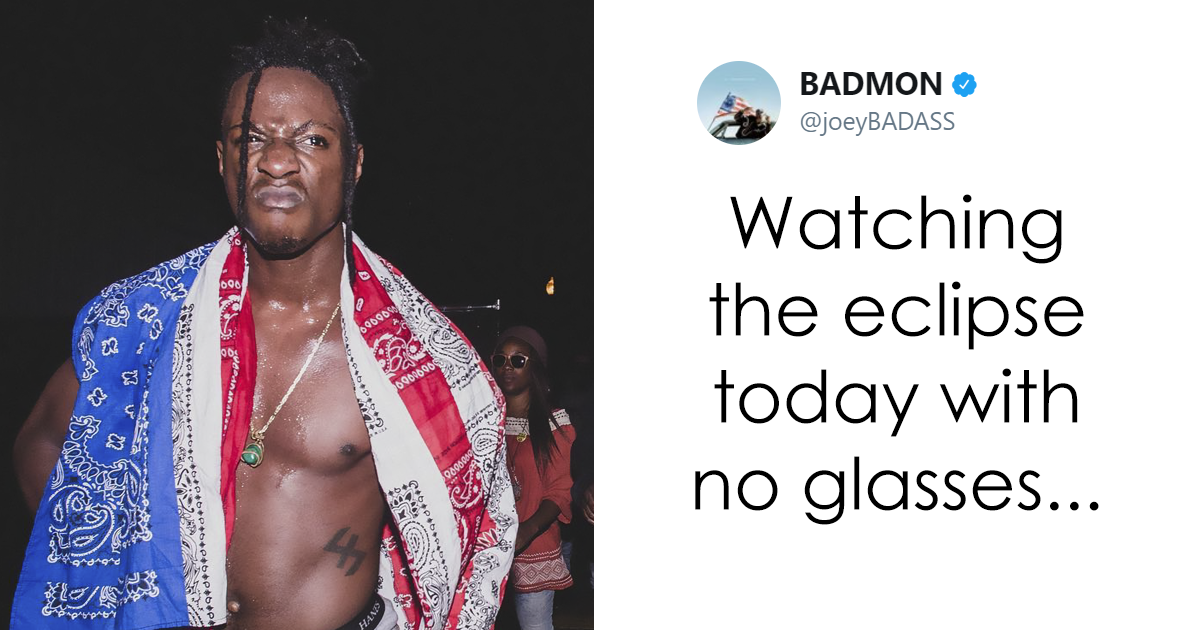
In August 2017, rapper Joey Bada$$ became the celebrity face of that particular brand of confidence. Before the widely watched solar eclipse crossed the United States, he questioned whether protective eyewear was really necessary. His reasoning was simple: ancient people had witnessed eclipses without modern glasses, and surely they had not all gone blind.
Then several of his scheduled performances were canceled because of what he described as “unforeseen circumstances.” The internet connected the dots at Olympic speed. A rapper had challenged the sun, the rapper had canceled shows, and therefore the sun had apparently won.
It was a perfect instant-karma storyexcept that it was not the complete truth.
How Joey Bada$$ Became the Internet’s Eclipse Warning Label
A bold question meets a very bright object
On August 21, 2017, millions of people across the United States stepped outside to watch the first total solar eclipse visible from coast to coast in decades. Schools organized viewing parties, offices temporarily stopped pretending to work, and stores sold out of certified solar viewers.
Joey Bada$$ took a different approach. In social-media posts, he wondered whether he was crazy for watching the eclipse without glasses. He also suggested that earlier civilizations had experienced eclipses without access to modern protective equipment.
The flaw in that argument is large enough to block the sun. The fact that people in the past lacked a safety product does not mean the hazard did not exist. Our ancestors also lacked bicycle helmets, smoke detectors and reliable dental anesthesia. History contains many fascinating traditions, but “they probably survived” is not a medical standard.
Fans responded with warnings, jokes and increasingly desperate attempts to explain that the sun does not negotiate. The rapper, however, appeared unconvinced.
Three canceled shows created a viral conclusion
Shortly afterward, Joey announced that he would miss scheduled performances in Cleveland, Chicago and Toronto while touring with Logic. He did not initially say that an eye injury was responsible. He referred only to unforeseen circumstances.
That cautious wording did not slow the internet. The timing seemed almost too perfect: first came the public skepticism about eclipse glasses, then came the canceled appearances. Entertainment outlets and social-media users began treating solar eye damage as the obvious explanation.
The jokes practically wrote themselves. Nicknames referring to blindness circulated. Memes portrayed the sun as an undefeated heavyweight champion. Joey later posted photographs wearing unusual glasses and joked about following a doctor’s instructions, which encouraged the story without clearly confirming a diagnosis.
For several days, the viral narrative was irresistible. A famous musician had ignored basic scientific advice and immediately paid the price. It had drama, comedy, a moral lesson and a blazing celestial antagonist that could not be reached for comment.
The Twist: Joey Bada$$ Later Said He Never Injured His Eyes
Nearly five years later, the story changed.
In June 2022, Joey Bada$$ said that he had not suffered eye damage during the 2017 eclipse. According to his later account, blogs created the connection between his posts and the canceled shows, and he allowed that version to spread because it gave him a convenient reason to leave Logic’s Everybody’s Tour.
He also clarified that he had no personal problem with Logic. The tour simply was not working well for him at that point. In other words, the supposed case of immediate eclipse karma was really a mixture of suggestive timing, media speculation, social-media humor and a celebrity who decided not to correct a useful rumor.
That distinction matters. There was never a publicly verified medical diagnosis establishing that Joey Bada$$ had developed solar retinopathy from looking at the eclipse. The original viral articles generally inferred the injury from the sequence of events rather than confirming it through medical records or a direct statement.
The episode is therefore funny for two different reasons. In 2017, people laughed because they thought someone had challenged basic eye safety and lost. In 2022, the joke shifted toward how quickly an unverified explanation could harden into accepted fact.
Still, Joey’s eventual admission should not be interpreted as evidence that staring at an eclipse is safe. He may not have damaged his vision, but the medical risk is real, documented and potentially permanent. Escaping injury once does not turn a dangerous decision into a sound experiment.
Why Looking Directly at a Solar Eclipse Can Damage Your Eyes
The retina can be injured without an immediate warning
The retina is the light-sensitive tissue lining the back of the eye. It converts incoming light into signals that the brain interprets as vision. At the center of the retina is the macula, which supports detailed central vision used for reading, driving and recognizing faces.
Looking directly at the sun can expose retinal tissue to an overwhelming amount of light energy. This may produce solar retinopathy, sometimes called eclipse retinopathy. The injury primarily involves photochemical damage rather than the dramatic sensation of an eyeball literally catching fire.
One reason the danger is easy to underestimate is that the retina does not contain pain receptors that reliably warn you while the damage is occurring. A person may stare for several seconds, feel no sharp pain and assume nothing bad happened. Symptoms can appear later, after the regrettable decision has already been converted into biological consequences.
Possible symptoms of solar retinopathy
Symptoms may affect one or both eyes and can include blurred central vision, unusual sensitivity to light, altered color perception, distorted shapes and a dark or blank area near the center of the visual field. Straight lines may look curved. Printed words may appear incomplete. Faces may become difficult to recognize clearly.
Some people also report headaches, although pain alone does not confirm retinal damage. Eye strain from spending a long time looking upward or focusing through dark viewers can also produce temporary discomfort.
Anyone who develops a persistent blind spot, distorted vision or significant blurring after looking at the sun should contact an eye-care professional promptly. An ophthalmologist may use a dilated examination and retinal imaging, including optical coherence tomography, to evaluate the macula.
Recovery is possible, but it is not guaranteed
Some people with solar retinopathy experience partial or substantial improvement over weeks or months. Others are left with lasting visual disturbances. There is no universally proven treatment that can reliably reverse the retinal injury, which makes prevention considerably more attractive than hoping the eye repairs itself.
Unfortunately, “I’ll just get it treated later” is not a strong plan when the available treatment may consist largely of monitoring the damage. The retina is sophisticated neurological tissue, not a phone screen that can be replaced during lunch.
How to Watch a Solar Eclipse Without Starting Your Own Viral Cautionary Tale
Use genuine solar viewers
Ordinary sunglasses are not adequate for direct solar viewing, no matter how dark or expensive they are. Safe direct viewing requires special-purpose eclipse glasses or handheld solar viewers that meet the ISO 12312-2 safety requirements and come from a trustworthy supplier.
A printed certification claim alone is not a magical shield. Counterfeit products can carry convincing labels, so viewers should be obtained from reputable manufacturers or vendors identified by established astronomical organizations.
Inspect the filter before use. Do not use it if the material is scratched, punctured, torn or separating from its frame. Put the viewer on before looking toward the sun, and turn away before removing it.
Totality is a narrow exception
During a total solar eclipse, viewers located inside the path of totality may briefly remove their solar filters only when the moon completely covers the sun’s bright surface. The moment even a small portion of the bright sun reappears, the protection must go back on.
During a partial or annular eclipse, there is no safe unfiltered viewing period. The sun may look dimmer or thinner, but the exposed portion remains intense enough to injure the retina.
Clouds are not certified safety equipment either. A hazy sky can reduce visible brightness while still allowing harmful solar energy to reach the eyes.
Binoculars and cameras require front-mounted filters
Never look at the sun through a camera lens, telescope or binoculars while wearing eclipse glasses. Magnifying optics concentrate sunlight and can damage both the viewer and the eyes behind it.
Any optical device aimed at the sun needs an appropriate solar filter securely mounted over the front, where light enters the instrument. Filters placed only at the eyepiece can crack or fail under concentrated heat.
For a low-cost alternative, use an indirect viewing method such as a pinhole projector. It may not look as fashionable as futuristic eclipse glasses, but neither does explaining to an eye doctor that you trusted a snack-box telescope built from optimism.
Why the “Instant Regret” Story Spread So Quickly
It had an irresistible cause-and-effect structure
Online stories spread most efficiently when they can be reduced to a simple sequence: person ignores warning, person experiences consequence, audience receives satisfying lesson. Joey’s posts and canceled shows fit that template almost perfectly.
The gap between correlation and confirmation disappeared because the emotional logic felt complete. People had spent days hearing safety warnings. When a celebrity publicly questioned those warnings and then withdrew from performances, the public was primed to interpret the cancellation as proof.
It was more entertaining than the less dramatic alternative: a touring musician left several dates for unspecified personal or professional reasons while the internet constructed a medical explanation.
Humor made the speculation feel like evidence
Memes are excellent at compressing an idea, but they are not particularly skilled at preserving uncertainty. Once thousands of jokes repeated that the rapper had hurt his eyes, the repetition created a sense that the underlying event had been verified.
Joey’s own joking photographs added ambiguity. To a casual reader, images of special glasses seemed like confirmation. They could also be read as a performer playing along with the attention. Without a documented diagnosis, the public was interpreting a bit rather than reviewing evidence.
Corrections rarely travel with the same energy
The original narrative arrived with a rare eclipse, celebrity posts, canceled concerts and instant punchlines. The correction arrived years later as a series of social-media explanations. Unsurprisingly, many people still remember the first version.
This is a common feature of online information. A vivid claim establishes the mental picture; a later correction asks readers to rebuild it. The first process is effortless. The second feels suspiciously like homework.
What the Incident Teaches About Confidence, Science and Online Media
The most useful lesson is not simply “do not stare at the sun,” although that remains an excellent starting point. The story also demonstrates how personal confidence can be mistaken for expertise.
Scientific warnings do not become less valid because they sound overly cautious. Safety recommendations often appear boring precisely because specialists have already studied the exciting ways something can go wrong.
The incident also shows why readers should distinguish between what was confirmed and what was inferred. Joey definitely questioned the need for eclipse glasses. He definitely canceled shows soon afterward. However, the claim that diagnosed eye damage caused those cancellations was speculation, and he later denied that it happened.
Media literacy does not require distrusting everything. It requires checking whether the conclusion is supported by direct evidence. A neat timeline can suggest a possibility, but it cannot perform an eye examination.
Related Experiences: What Eclipse Day Actually Feels Like
Eclipse safety instructions can sound excessive before the event begins. Then the moon starts moving across the sun, daylight takes on an unfamiliar metallic quality, shadows sharpen, and nearly every person nearby develops an overwhelming urge to look up.
That urge is what makes preparation important. In the excitement of the moment, people do not want to read a safety manual or investigate whether the glasses purchased from a mystery seller are legitimate. They want to see the sky immediately, preferably while recording a vertical video that will later contain six seconds of blurry darkness and somebody shouting, “Is it happening?”
A well-organized viewing experience feels surprisingly calm. Everyone receives approved solar viewers in advance. Adults show children how to put them on before turning toward the sun. Damaged filters are discarded. People take short looks, turn away and describe what they saw instead of treating the event like an endurance contest.
The first view through real eclipse glasses can be startling. Almost everything disappears. The surrounding sky becomes black, while the sun appears as a small, sharply defined disk, usually orange or pale white depending on the filter. As the moon advances, the disk becomes a crescent. Through proper filters, the scene looks clean and controlled rather than painfully bright.
At community events, strangers often share viewers, compare photographs and help one another understand the stages of the eclipse. Libraries, schools, museums and astronomy clubs can turn a potentially risky spectacle into an accessible science lesson. The atmosphere becomes part festival, part outdoor laboratory and part collective reminder that humans remain extremely impressed whenever two circles overlap in the sky.
Problems usually begin when someone arrives without protection and improvises. They may stack sunglasses, hold up a tinted bottle, look through photographic film or attempt a fast naked-eye glance. These methods feel plausible because they reduce visible brightness, but visible comfort is not proof of adequate filtration.
Another common experience is anxiety after an accidental glance. A person may look up for a moment, remember every warning at once and spend the rest of the afternoon testing each eye against a white wall. Panic itself can make normal visual effects seem ominous.
A brief accidental glance does not automatically mean permanent injury, but deliberate or repeated viewing increases risk. Anyone worried about persistent visual changes should stop performing homemade vision tests and contact a qualified eye-care professional. Searching for reassurance through increasingly alarming photographs on the internet rarely improves either eyesight or blood pressure.
For photographers, eclipse day introduces a different kind of temptation. The event feels too important not to capture, yet cameras and telescopes need proper filtration just as eyes do. Experienced observers prepare their equipment early, practice focusing and secure filters over the front of every optical device. Inexperienced observers often spend totality arguing with autofocus.
The most memorable experience may be putting the camera down. During totality, when it is safe to look without a filter from within the path of totality, the solar corona appears around the black silhouette of the moon. The horizon may glow like sunset in several directions. Temperatures fall, insects become active and crowds that were noisy seconds earlier may become silent.
That moment does not require bravado. It requires timing, location and respect for the return of direct sunlight. As soon as the bright photosphere begins to emerge, the glasses go back on.
The Joey Bada$$ episode remains useful because it captures two recognizable experiences at once: the temptation to dismiss a warning that seems inconvenient and the internet’s temptation to turn incomplete information into a complete story. Both temptations are powerful. Neither should be trusted with your retinas.
Conclusion
The viral version of the story suggested that Joey Bada$$ looked directly at the 2017 solar eclipse, injured his eyes and immediately canceled performances. His later explanation revealed a more complicated reality: he said he suffered no eclipse-related eye damage and allowed the rumor to circulate because it provided a convenient exit from a tour that was not working for him.
That correction changes the celebrity story, but it does not change the science. Directly viewing the sun without proper protection can cause solar retinopathy, central blind spots, distorted vision and permanent visual loss. The safest approach is wonderfully unglamorous: use trusted solar viewers, follow established guidance and resist the belief that confidence has optical-filtering properties.
Editorial note: The original 2017 coverage frequently presented the connection between the eclipse and the canceled shows as speculation. In 2022, Joey Bada$$ publicly stated that he had not suffered eye damage and had used the resulting rumor as a convenient excuse to leave the tour. This article distinguishes that later clarification from the genuine medical dangers of unsafe solar viewing.












