
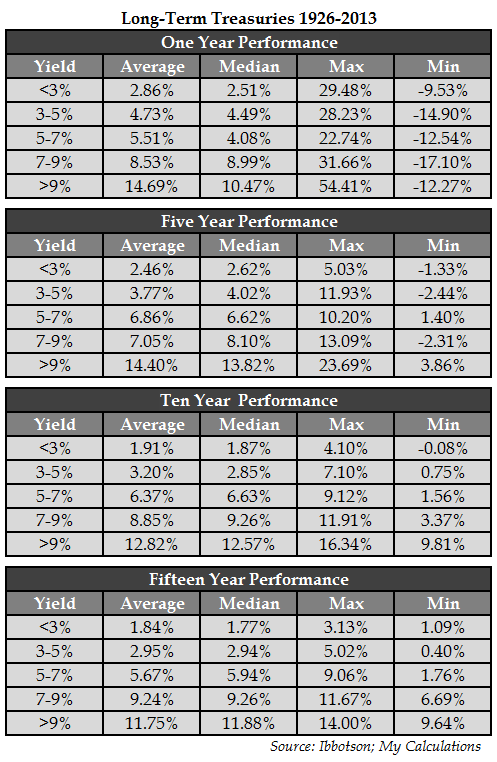
Long-term U.S. Treasuries have a reputation for being the responsible adult in an investment portfolio. They pay their bills, rarely create credit drama, and do not appear on social media promising to turn $500 into a beach house by Friday. Yet long-term Treasury returns can be surprisingly lively.
A 20- or 30-year Treasury bond may provide dependable interest and repayment of principal at maturity, but its market price can rise or fall sharply along the way. The return an investor ultimately receives depends on the purchase yield, holding period, inflation, reinvestment rates, taxes, and whether the bond is owned directly or through a fund.
Based on yields available in June 2026, a reasonable long-horizon expectation for long-term Treasuries is approximately 4% to 5% per year before inflation and federal taxes. That is not a promise. Over a single year, returns could easily be negative or climb into double digits as interest rates move.
The Practical Answer: Expect Income Near 5%, but Not a Smooth Ride
On June 25, 2026, the U.S. Treasury yield curve showed a yield of 4.87% for 20-year Treasuries and 4.86% for 30-year Treasuries. A diversified portfolio of bonds maturing in more than 20 years had a similar average yield to maturity of roughly 4.9%.
Those starting yields provide the most useful anchor for estimating long-term Treasury returns. An investor purchasing a bond near par and holding it to maturity can expect a nominal return close to its yield to maturity, assuming all coupon payments are made and reinvested at the rate used in the calculation.
That suggests the following broad expectations:
| Investment horizon or scenario | Reasonable return expectation | Main driver |
|---|---|---|
| One year, yields unchanged | Approximately 4.5% to 5% | Coupon income |
| One year, yields fall by 1 percentage point | Roughly 20% to 22% | Income plus price appreciation |
| One year, yields rise by 1 percentage point | Approximately -8% to -11% | Income offset by price decline |
| Ten years or longer | Approximately 4% to 5% annualized | Starting yield and reinvested income |
| Long-term real return | Approximately 1% to 2.5% annualized | Nominal yield minus inflation |
These ranges are illustrations, not forecasts. Long-term bonds are less like a sleepy savings account and more like a calm-looking dog that suddenly decides the mail carrier represents a national emergency.
Where Long-Term Treasury Returns Come From
A Treasury bond’s total return has three major components. Understanding them prevents investors from confusing the coupon rate with the return actually earned.
1. Coupon income
The U.S. Treasury currently issues bonds with maturities of 20 or 30 years. The coupon rate is fixed at auction, and interest is paid every six months. If an investor owns $10,000 of a Treasury bond with a 4.8% coupon, the bond pays approximately $480 per year, divided between two payments.
Coupon income is the most predictable part of the return. It also provides a cushion when market prices decline moderately.
2. Changes in the bond’s market price
Treasury prices generally move in the opposite direction of market interest rates. When newly issued bonds offer higher yields, an older bond with a lower coupon becomes less attractive and its price falls. When market yields decline, the older bond’s fixed payments become more valuable and its price rises.
An investor holding an individual bond until maturity may ignore these temporary price movements. The Treasury still repays the face value at maturity. However, an investor who sells early, owns a bond fund, or checks an account balance every seven minutes will see the volatility in full Technicolor.
3. Reinvestment of interest payments
Yield-to-maturity calculations assume coupon payments can be reinvested at a comparable rate. If future rates fall, those payments may earn less. If rates rise, reinvestment income may be higher.
This reinvestment effect becomes meaningful over decades. It is one reason the final result may differ from the yield quoted on the purchase date.
Why Starting Yield Is the Best Long-Term Clue
For high-quality bonds, the initial yield has historically been a useful indicator of returns over periods similar to the portfolio’s duration. Price changes can dominate short-term results, but income becomes increasingly important as the holding period lengthens.
Current yields are substantially more supportive than the exceptionally low yields available during the early 2020s. When investors purchased long Treasuries yielding around 1% or 2%, there was little income to absorb a rise in rates. Today, a yield near 4.9% provides a larger buffer.
Major asset managers have consequently projected that high-quality U.S. bonds could return around 4% annually over the coming decade. Long Treasuries begin with a somewhat higher yield, but they also carry greater interest-rate sensitivity than a broad investment-grade bond portfolio.
Therefore, expecting roughly 4% to 5% annually over a long holding period is more defensible than expecting the spectacular gains that could occur during a sudden rate decline.
Duration Risk: Why “Safe” Bonds Can Lose Serious Money
Duration estimates how much a bond’s price may change when interest rates move by one percentage point. A duration of 15 suggests that the price could move approximately 15% in the opposite direction of a one-point change in yields.
A leading long-term Treasury ETF had an effective duration of about 15.5 years in June 2026. That means a 1% rise in long-term yields could produce a price decline of roughly 15%, before coupon income and convexity are considered. A 1% decline could generate a comparable price gain.
Consider a simplified 30-year Treasury purchased at par with a 4.86% coupon. After one year, assuming 29 years remain:
- If its yield remains 4.86%, the approximate total return is 4.86%.
- If its yield falls to 3.86%, the approximate total return rises to about 22%.
- If its yield climbs to 5.86%, the approximate total return falls to about -9%.
The calculation includes the year’s coupon income but excludes taxes, transaction expenses, and differences in reinvestment timing. The lesson is simple: long-term Treasuries have low credit risk, not low price volatility.
How Inflation Changes the Real Return
Nominal returns tell investors how many additional dollars they earned. Real returns describe how much additional purchasing power those dollars provide.
At a nominal yield of approximately 4.9%, average inflation of 2.5% would leave a real return near 2.3% before tax. Inflation of 4% would shrink the real return to less than 1%. Persistent inflation above 5% could produce a negative real return even if every payment arrives exactly as promised.
In May 2026, headline consumer inflation was 4.2% over the previous 12 months, while core inflation was 2.9%. A single year does not determine the inflation rate over a 30-year bond’s life, but it illustrates why investors should not treat the quoted yield as guaranteed purchasing-power growth.
The 30-year Treasury Inflation-Protected Securities real yield was approximately 2.7% in late June 2026. Comparing that with the nominal 30-year yield implied long-run inflation compensation of roughly 2.1 percentage points. The comparison is useful, although market liquidity, inflation-indexing details, and adjacent trading dates prevent it from being a perfectly clean forecast.
Individual Treasury Bonds Versus Long-Term Treasury Funds
Individual bonds
An individual Treasury bond has a defined maturity date. Investors know the coupon payments and face value that will be repaid, provided the bond is held until maturity. This structure can be useful for funding a known future liability, such as retirement spending, a charitable gift, or a planned inheritance.
The drawback is concentration in one maturity and limited flexibility. Selling before maturity may lock in a loss if market rates have risen.
Mutual funds and ETFs
Long-term Treasury funds hold portfolios of bonds and continually replace securities as they age. They provide diversification, regular liquidity, and convenient reinvestment. However, most do not mature on a specific date. Investors cannot simply wait for the fund itself to repay a fixed face value.
A long-duration ETF may therefore remain sensitive to interest rates indefinitely. Its income will gradually adapt to new yields, but its share price can experience large drawdowns. Fund expenses also reduce the return slightly.
Four Scenarios for Future Long-Term Treasury Returns
Scenario 1: Rates remain near current levels
If long-term yields stay between approximately 4.5% and 5%, investors should receive returns dominated by coupon income. Annual results would likely hover near the starting yield, with moderate price fluctuations.
Scenario 2: Inflation cools and rates decline
If inflation returns convincingly toward 2% and economic growth weakens, long-term yields could decline. Long Treasuries would likely generate substantial capital gains. A one-point decline could create a total return near 20% in a single year.
The celebration comes with a catch: once yields fall, future expected returns also decline. The capital gain effectively pulls some return forward.
Scenario 3: Inflation stays stubbornly high
If inflation remains elevated, investors may demand yields above 5%. Long Treasury prices would probably fall, perhaps sharply. New buyers and funds reinvesting cash would eventually benefit from higher income, but existing holders could experience uncomfortable short-term losses.
Scenario 4: A recession or financial shock occurs
Long Treasuries have often rallied when investors seek highly liquid government securities during economic stress. That pattern is not guaranteed, particularly when the shock itself is inflationary. Still, a traditional recession accompanied by falling inflation could create strong long-bond returns.
Experiences and Lessons From Long-Term Treasury Investors
The following examples are hypothetical composites based on common investor behavior rather than personal testimonials.
The retiree matching future expenses
Imagine a retiree who wants a predictable stream of income and plans to leave the bond’s principal to family members. She purchases an individual 30-year Treasury yielding close to 5%. Market rates rise six months later, and the quoted value of the bond drops noticeably.
At first, the decline looks alarming. Yet her financial plan does not require selling the bond. The coupon payments continue, and the Treasury is scheduled to repay the face value at maturity. For this investor, the daily market price is mostly background noise. Her real concerns are inflation, longevity, and whether locking money away for decades reduces flexibility.
The ETF buyer who expected cash-like stability
Another investor buys a long-term Treasury ETF because government bonds sound conservative. He is surprised when rising yields produce a double-digit decline. The bonds did not default, miss payments, or suffer a credit downgrade. The loss came almost entirely from duration.
This experience teaches an important distinction: a safe borrower does not guarantee a stable market price. Long Treasury funds may fluctuate as much as some conservative stock portfolios, especially during periods of rapid inflation or monetary-policy change.
Long Treasuries demonstrated this dramatically from late 2021 through 2022, when long-bond investors experienced a real loss of roughly one-third. That was not the behavior many people expected from the supposedly boring side of their portfolio.
The investor who waited too long in cash
A third investor keeps everything in short-term Treasury bills because their yields are attractive and their prices barely move. She plans to buy long bonds after the Federal Reserve begins reducing rates.
The challenge is that markets rarely wait for an official announcement. Long-term yields may decline before short-term policy rates are cut. By the time the economic news feels comfortable, long Treasury prices may already have risen substantially.
Her experience highlights reinvestment risk. Short-term bills provide flexibility, but they must be renewed frequently. If rates fall, yesterday’s appealing cash yield can disappear faster than free snacks at an office meeting.
The investor who builds a maturity ladder
A more cautious investor divides a fixed-income allocation among bonds maturing at different dates. Some money remains in short-term securities, some goes into intermediate Treasuries, and a smaller portion purchases long bonds.
This ladder does not maximize returns in every scenario. Instead, it reduces dependence on a single interest-rate forecast. If yields rise, maturing short-term securities can be reinvested at higher rates. If yields fall, the long bonds may appreciate and continue paying their locked-in coupons.
For many investors, that balanced experience is easier to tolerate than making one enormous wager on where 30-year yields will go next.
The high-tax-state investor
Treasury interest is subject to federal income tax but exempt from state and local income taxes. An investor living in a high-tax state may therefore keep more after-tax income from a Treasury than from a bank certificate or corporate bond offering the same stated yield.
The benefit depends on the investor’s location, account type, and tax bracket. Treasuries held inside a tax-advantaged retirement account do not receive an additional benefit from the state-tax exemption because current investment income is already sheltered.
How to Form a Realistic Return Expectation
Investors evaluating long-term Treasury bonds should begin with the yield to maturity, not a recent performance chart. Past capital gains produced by declining yields cannot be repeated unless yields decline again.
Next, compare the investment’s duration with the planned holding period. Money needed within three years generally should not depend on the market price of a bond with 20 or 30 years remaining.
Investors should also estimate returns in real, after-tax terms. A 4.9% nominal yield may be attractive when inflation averages 2%, but much less impressive when inflation remains above 4%.
Finally, position size matters. Long Treasuries can provide income, diversification, recession protection, and liability matching. They can also create large temporary losses. Using them as one part of a diversified fixed-income allocation is generally less fragile than treating them as an all-or-nothing prediction about interest rates.
Conclusion
At yields near 4.9%, long-term Treasuries offer a more attractive income foundation than they did during the low-rate years. Investors holding for a decade or longer can reasonably expect nominal returns in the neighborhood of 4% to 5% annually, with real returns likely around 1% to 2.5% if inflation gradually settles near historical policy targets.
The path will not be smooth. A one-percentage-point decline in yields could produce a gain exceeding 20%, while a comparable increase could create a meaningful one-year loss. Long-term Treasury returns are therefore best understood as dependable cash flows wrapped in a highly rate-sensitive market price.
For investors who can tolerate volatility, need long-dated income, or want protection against a disinflationary recession, long Treasuries may serve a valuable purpose. For investors who require stable principal next year, they are not cash wearing a slightly fancier jacket.
Note: This article is for educational purposes and does not constitute personalized investment, legal, or tax advice. Expected returns are estimates, and actual results may differ materially.














