Historic buildings are experts at first impressions. They arrive with carved stone, dramatic staircases, secret corridors, towering ceilings, and enough architectural swagger to make your own home feel like a cardboard box with Wi-Fi. From grand Gilded Age mansions to former prisons and immigration hospitals, these places are remarkable reminders of how people once lived, worked, suffered, celebrated, and occasionally made deeply questionable plumbing decisions.
But admiring a historic landmark and moving into one are two very different things. A building can be stunning, culturally important, and wonderfully photogenic while also being drafty, expensive, confusing, damp, isolated, overcrowded, or built around a waterfall that seems determined to become part of the living room.
Why Some Historic Buildings Are Better as Places to Visit
Historic architecture offers something modern construction cannot easily replicate: evidence of another era. You can see the priorities of wealthy industrialists, prison reformers, immigrants, architects, government officials, and ordinary families in the walls, staircases, heating systems, and room layouts they left behind.
Still, old buildings are often high-maintenance roommates. They may have limited insulation, complicated restoration rules, outdated plumbing, narrow stairs, huge heating bills, and enough hidden corners to lose a backpack, a cat, or your entire sense of direction. The following historic buildings are breathtaking, important, and absolutely worth visiting. Living in them, however, would require patience, a large maintenance crew, and perhaps a personal relationship with a plumber.
1. Alcatraz Cellhouse, California
Alcatraz Island is one of America’s most recognizable historic sites. Sitting in San Francisco Bay, the former prison complex has a dramatic location, spectacular views, and an unmistakable aura of isolation. The main cellhouse was built in the early twentieth century and later became the federal prison associated with famous inmates, strict routines, and attempted escapes.
As a piece of historic architecture, Alcatraz is fascinating. As a home? Not a chance. The cells were small, basic, and designed for confinement rather than comfort. Privacy was almost nonexistent, the building was heavily controlled, and the surrounding water was cold enough to make even a determined escape attempt feel like a very bad episode of a survival show.
Imagine waking up with a view of San Francisco but being unable to enjoy it because you are surrounded by steel bars, concrete, and institutional hallways. Gorgeous scenery is wonderful, but it loses a little charm when your living room is also a cell.
2. Eastern State Penitentiary, Pennsylvania
Eastern State Penitentiary in Philadelphia looks almost like a Gothic castle from the outside. Its high stone walls, towers, and massive gatehouse create a dramatic silhouette that has made it one of the country’s most memorable historic prison sites. When it opened in 1829, it represented a new and controversial model of incarceration centered on isolation and labor.
The prison’s radial layout was innovative for its time. Cellblocks spread outward from a central hub, allowing guards to observe multiple corridors. Architecturally, it was an ambitious experiment. Emotionally, it was an extremely bleak place to live. The early system kept people isolated in individual cells, often with little social interaction.
There is a reason modern apartment listings emphasize “community spaces” and “natural light.” Eastern State had neither in the warm, welcoming sense. It may be visually striking today, but it remains a powerful reminder that clever design can still be deeply uncomfortable when the building’s purpose is control rather than home.
3. Old New-Gate Prison and Copper Mine, Connecticut
Some historic buildings make you think, “What a beautiful old house.” Old New-Gate Prison and Copper Mine makes you think, “Who decided an abandoned mine was a reasonable place to keep human beings?” The site began as an early colonial copper mine before Connecticut converted it into a prison in the eighteenth century.
Its underground passages, shafts, rock walls, and damp spaces give the site a haunting sense of history. It is also a very clear example of why “unique property features” should not include “former mine used as a prison.” The underground environment was dark, wet, confined, and harsh.
Modern homeowners complain about basements with poor ventilation. Old New-Gate takes that complaint and launches it directly into the eighteenth century. The site is historically important because it reveals how punishment, labor, and confinement were understood in early America. It is not, however, a place anyone should envy as a residence.
4. Ellis Island Hospital Complex, New York Harbor
Ellis Island is famous as a gateway for millions of immigrants entering the United States. Its grand Beaux-Arts architecture and waterfront setting create an almost cinematic scene. Yet beyond the better-known immigration station stood a hospital complex where people were examined, treated, quarantined, or held while officials decided whether they could continue their journey.
The buildings are historically powerful because they represent both hope and uncertainty. For many people, Ellis Island was the threshold between an old life and a new one. For others, illness, medical inspections, or immigration rules meant long delays and frightening separation from family members.
Living there permanently would be emotionally exhausting. The hospital complex was not designed as a home; it was a place of waiting, medical care, bureaucracy, and uncertainty. Add exposure to New York Harbor weather and old institutional buildings without modern climate control, and suddenly your current apartment’s slightly noisy refrigerator seems charming.
5. 97 Orchard Street, New York City
The Tenement Museum’s historic building at 97 Orchard Street offers one of the clearest windows into immigrant working-class life in nineteenth- and early twentieth-century New York. Thousands of people from many countries lived in the building between 1863 and 1935, often in small apartments with limited light, limited fresh air, and limited privacy.
Each apartment was compact, typically divided into only a few rooms. Families worked, cooked, slept, raised children, and sometimes ran home businesses in spaces that would make a modern studio apartment look downright luxurious. Water access and sanitation were also far more difficult than most people today would tolerate for a single afternoon, much less a lifetime.
97 Orchard Street is an important historic home because it tells the stories of ordinary people rather than only wealthy families. But living there would mean navigating crowded rooms, hot summers, difficult household labor, and a level of personal togetherness that would make even the most social person crave a quiet bench in the park.
6. Winchester Mystery House, California
The Winchester Mystery House in San Jose is one of the most unusual historic homes in the United States. Built by Sarah Winchester, the mansion became famous for its maze-like design, unusual staircases, unexpected doors, decorative details, and decades of construction.
The house contains around 160 rooms, which sounds impressive until you realize that more rooms also mean more cleaning, more repairs, more furniture, more doors, and more opportunities to walk into a hallway and wonder whether you have accidentally entered a parallel universe.
Stories about spirits and secret instructions have long surrounded the house, but its real appeal is its eccentric architecture. Stairs can lead in strange directions. Doors may open onto unexpected spaces. Corridors feel more like a puzzle than a practical floor plan. It is a wonderful place to tour, especially for anyone who loves Victorian architecture. It would be a terrible place to live if you are the kind of person who wants to find the bathroom before breakfast.
7. Fallingwater, Pennsylvania
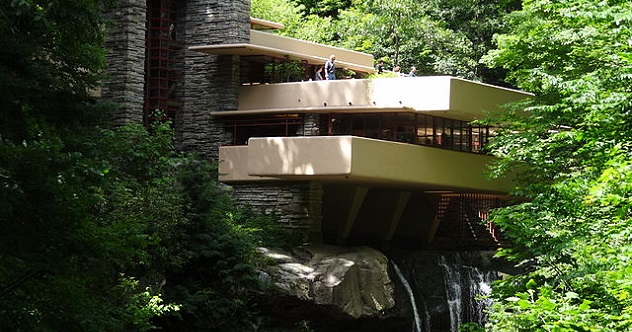
Frank Lloyd Wright’s Fallingwater is one of the most admired homes in American architecture. Designed in the 1930s for the Kaufmann family, the house is famous for its dramatic terraces, stone walls, horizontal lines, and its astonishing placement directly above a waterfall.
That last part is also the issue. Living above a waterfall sounds magical for approximately seven minutes. Then you remember that water has opinions. It flows, splashes, seeps, freezes, expands, and looks for every possible opening in a roof, wall, terrace, or window frame.
Fallingwater has required major preservation efforts over the years because its bold design creates real maintenance challenges. The building is a masterpiece of organic architecture, blending house and landscape in a way few structures ever have. But owning it would mean accepting that your home is not merely near nature. Nature is basically your downstairs neighbor, your sound machine, and your maintenance supervisor.
8. The Breakers, Rhode Island
The Breakers in Newport is one of the most famous Gilded Age mansions in America. Built for the Vanderbilt family in the 1890s, the enormous summer home was designed to project wealth, social power, and the kind of confidence that says, “Yes, this hallway is larger than your entire house.”
The mansion is spectacular, filled with lavish decoration, grand public rooms, elaborate stairways, and oceanfront views. But living there would mean managing a building that behaves more like a luxury hotel, museum, and small city than a family home.
Historic estates of this scale require boiler systems, staff areas, restoration work, groundskeeping, security, and endless cleaning. You would not simply “do chores” at The Breakers. You would probably need a department of chores, a director of chores, and a quarterly board meeting about chandelier dust.
9. Hearst Castle, California
Hearst Castle rises above the California coast like a fantasy assembled by someone with unlimited ambition, excellent taste, and no fear of adding one more guest room. Designed by architect Julia Morgan for William Randolph Hearst, the estate includes 165 rooms, expansive gardens, terraces, pools, and a vast collection of art and antiques.
It is an extraordinary achievement in historic architecture. It is also so enormous that living there would feel less like owning a house and more like being appointed governor of a very decorative kingdom. The property took decades to build, and its hillside location adds another layer of logistical complexity.
Imagine trying to tell a guest where the powder room is. “Take the third staircase past the Roman sculpture, turn left at the indoor mosaic, and keep walking until you begin to question your life choices.” Beautiful? Absolutely. Practical? Only if you have a map, a staff directory, and good walking shoes.
10. Biltmore House, North Carolina
Biltmore House in Asheville is often described as America’s largest home, and it certainly looks the part. Built for George Vanderbilt, the French Renaissance-inspired estate sits among thousands of acres of gardens, woodlands, trails, and carefully designed landscapes.
The house is a wonder of craftsmanship, featuring grand halls, libraries, formal rooms, art collections, and enough architectural detail to make you stare at the ceiling for ten minutes before remembering you were supposed to be walking somewhere.
But the scale is almost comically impractical for modern living. Heating, cleaning, securing, restoring, and furnishing such a massive home would require a permanent team of specialists. Even choosing a snack would become an expedition. By the time you reached the kitchen, you might forget whether you wanted crackers or a sandwich.
Biltmore is a brilliant historic estate and a landmark of American design. Still, most people would be happier enjoying it as visitors, then returning to a home where the laundry room is not located in a different postal code.
What These Historic Buildings Teach Us About the Past
The most remarkable historic buildings are not always the most comfortable ones. Their value often comes from the way they preserve difficult truths, unusual design choices, social divisions, personal ambitions, and technological limits from earlier eras.
Prisons such as Alcatraz, Eastern State Penitentiary, and Old New-Gate Prison reveal how societies treated people in confinement. Ellis Island’s hospital complex reflects the fear, hope, and uncertainty tied to immigration and public health. Tenements like 97 Orchard Street show the hard realities of urban working-class life. Grand homes such as The Breakers, Hearst Castle, and Biltmore reveal the scale of wealth and labor behind America’s most extravagant estates.
Even buildings created as private homes can become cautionary tales about maintenance. Fallingwater proves that breathtaking architecture can come with breathtaking repair bills. Winchester Mystery House proves that more rooms do not necessarily create a better home. Sometimes they just create more places to misplace your keys.
Experiences That Make Historic Buildings Feel Alive
Visiting historic buildings can be one of the most memorable ways to understand the past because architecture makes history physical. You do not simply read that people lived in cramped apartments, waited anxiously in immigration stations, or maintained enormous estates. You stand in the rooms. You see the staircases. You notice how little light reaches a narrow hallway or how long it takes to walk from one side of a mansion to the other.
A visit to a former prison can be especially powerful. The architecture often makes the original purpose impossible to ignore. Narrow cells, iron bars, central guard stations, and thick stone walls create an atmosphere that books cannot fully reproduce. These spaces can encourage visitors to ask difficult questions about justice, punishment, solitude, and the treatment of incarcerated people. The best experience is not one that turns suffering into spectacle; it is one that helps people understand the human consequences of historical systems.
Historic homes create a different kind of experience. Walking through a grand mansion can feel like entering a film set, but the most interesting details are often the practical ones. Look beyond the ballroom. Notice service corridors, bell systems, kitchens, laundry rooms, staff stairs, boiler rooms, and storage areas. These features reveal how many people and how much labor were needed to keep an extravagant household running smoothly.
Tenement buildings and immigrant sites often leave an even deeper impression because they show how ordinary families adapted to limited space and difficult conditions. Visitors may see compact kitchens, shared water sources, small bedrooms, and work areas inside apartments. These details make it easier to understand how housing, employment, health, and family life were connected. A room that looks tiny today may have supported an entire household, a business, and several generations of dreams.
Historic architecture is also best experienced slowly. Instead of rushing from room to room, pause to look at door handles, window frames, floorboards, ventilation systems, and stair widths. Ask why the rooms were arranged in a certain way. Consider who could use each space and who could not. A mansion may have grand public rooms for entertaining while the people who cooked, cleaned, repaired, and carried supplies used hidden service areas.
Photography can help preserve memories, but observation matters even more. A beautiful ceiling is impressive. A ceiling that reveals old craftsmanship, wealth, labor, and changing tastes is a story. A cracked wall is not just damage; it may show the ongoing challenge of preserving an old structure in a changing climate. A worn staircase may quietly record decades of footsteps.
The best historic building experiences leave you with more than photos. They make you curious about the people who built, maintained, occupied, and transformed the space. They remind you that architecture is not just about walls and roofs. It is about human choices, human needs, and the complicated stories that remain long after the original residents are gone.
Conclusion: Marvel at the Architecture, Keep Your Modern Plumbing
These awe-inspiring historic buildings are worth visiting because they offer more than dramatic facades and impressive rooms. They preserve stories of wealth, hardship, innovation, migration, confinement, artistic ambition, and human endurance.
From the isolated cells of Alcatraz to the sprawling hallways of Biltmore House, every site on this list proves that beauty and comfort do not always travel together. Some buildings are best admired from a respectful distance, with a tour ticket in hand and a reliable modern home waiting afterward.
Historic architecture can inspire us, challenge us, and occasionally make us grateful for central heating, sensible floor plans, and bathrooms that are easy to find. That may not be glamorous, but neither is getting lost in your own mansion before coffee.