
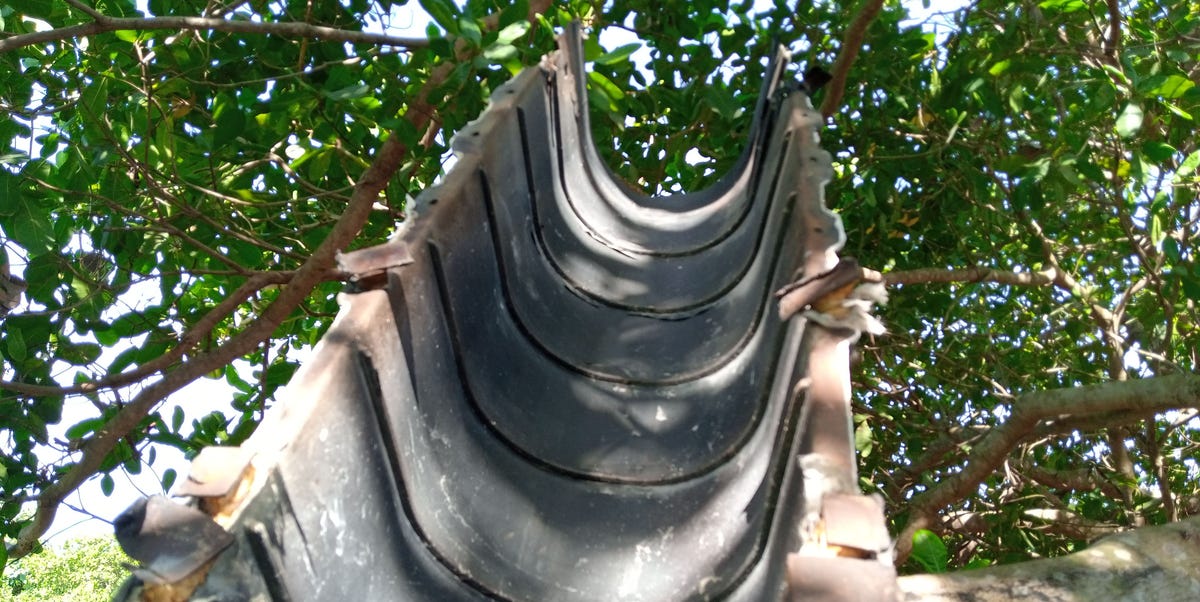
The good news: your chances of being harmed by falling space junk are still wildly, astronomically tiny. The bad news: “astronomically tiny” is not the same thing as “zero,” and the risk isn’t spread evenly across the globe. Some places are simply more likely to be under the invisible “reentry belt” where old rocket hardware has a better shot at coming down overhead.
If you’re thinking, “Waitrockets fall back down?” Yes. A lot of them do. Not the whole rocket, but pieces of upper stages (and sometimes big satellite parts) that were left in orbit to eventually reenter on their own. Most of it burns up. Some of it doesn’t. And as launches ramp up, the math gets less comforting.
First, what counts as an “old rocket chunk”?
When people say “space junk,” they often imagine tiny paint flecks zipping around at orbital speed. But the pieces that matter for ground safety are usually much bigger: spent rocket bodies (upper stages), tanks, engine components, and structural hardware that’s tough enough to survive the heat and stress of reentry.
Many missions end with an upper stage still in orbit. Sometimes that stage is deliberately deorbited into a remote ocean corridor. Other times it’s left to decay naturally, reentering days, months, or years later. That second optionan uncontrolled reentryis where uncertainty lives. You don’t get to pick the landing zone when physics is driving.
The “where you live” part: Earth has a space-debris latitude belt
Here’s the key idea: uncontrolled reentries can only happen under the ground track of the object’s orbit. That’s why so many reentry updates show a wide orange band across the map instead of a neat bullseye. The band is usually defined by the object’s orbital inclinationhow far north and south it travels.
Why so many reentry maps look like “between about 52°N and 52°S”
A huge number of objects in low Earth orbit fly at inclinations that keep them within roughly the mid-latitudes. A classic example is the International Space Station’s inclination (~51.6°), and many objects share similar ranges. For an uncontrolled reentry, that often translates into a “could come down anywhere” belt from around 52° north latitude to 52° south latitude.
That’s not a small slice of Earthit includes most of the world’s population centers. But it still excludes the far north and far south. If you live in those higher latitudes, you are (statistically) less likely to be under the path of many common low-inclination reentries.
So where is the risk higher?
Globally, multiple analyses have found that risk is weighted toward latitudes closer to the equatorpartly because of common orbital inclinations, and partly because there are many densely populated regions in that band. In plain language: the “reentry belt” overlaps where a lot of people live, and that overlap is not evenly distributed.
In the United States specifically, this doesn’t mean “you should panic in Florida and relax in Maine.” It means that if you line up U.S. locations by relative exposure to typical reentry corridors, the southern tier tends to sit more squarely inside the high-traffic latitude band than the far north.
If you want the quick, practical version of “live here,” it looks like this:
- Higher relative exposure (U.S. examples): South Florida, the Gulf Coast, South Texas, Southern California, Hawaii, and U.S. territories closer to the tropics (like Puerto Rico and Guam).
- Lower relative exposure (U.S. examples): the far northern U.S. (especially Alaska) and areas closer to the upper edge of many common reentry bands.
Again: “higher relative exposure” does not mean “likely.” It means “less unlikely,” which is the most space-junk sentence ever written.
How risky is it, really? Understanding the numbers without needing a PhD
Space agencies and regulators often talk about casualty risk using a metric called casualty expectation: the statistical chance that a reentry could injure or kill at least one person somewhere on Earth.
In U.S. safety practice, a commonly referenced benchmark for uncontrolled reentries is a maximum casualty risk on the order of 1 in 10,000 for a given reentry event. Above that threshold, controlled reentry (or design changes) are expected. Think of it as a “this is too spicy for random reentry” rule.
The tricky part is that a single event might be “acceptable” by that metric, while the cumulative risk rises as the number of events rises. If you multiply a tiny risk by a growing pile of reentries, you eventually get a number that’s hard to wave away with a shrug and a “space is big.”
Also, the consequences can be wildly uneven. Most debris falls into oceans or remote areas. But rare outcomes exist: a fragment landing in a city, or (even more worrying to safety analysts) interacting with busy airspace. Low probability doesn’t always mean low consequence.
Why some debris survives at all (and what survives isn’t the “cute” kind)
Reentry is essentially a violent, high-speed argument between metal and atmosphere. Many objects break up at high altitudes, shedding fragments that burn up or slow down dramatically. But certain components are stubborn: dense metals, tanks, pressure vessels, and engine parts can make it through.
Analysts often estimate that a meaningful fraction of a rocket body’s mass can survive reentryespecially for larger stages. “Meaningful,” in this context, means “enough to ruin your day if gravity schedules an appointment with your roof.”
The risk isn’t just about mass; it’s about the footprint of surviving fragments. Debris can be scattered along a long path on the ground, sometimes hundreds (or even thousands) of miles long. That’s why reentry predictions are so frustrating: even when you know the timeframe, the breakup and winds add uncertainty.
Real-world example: yes, someone has been hit by space junk
The most famous case is from 1997, when Lottie Williams in Oklahoma was reportedly struck (glancingly, and without serious injury) by a small piece of debris later linked to a Delta II rocket. This story is often cited because it’s a rare example of a human being physically contacted by reentering orbital debris.
The point isn’t “this happens all the time.” The point is “this can happen,” and it happened to someone who was just… outside. No dramatic soundtrack. No heroic slow-motion dive. Just a weird day at the park.
Why the risk is rising: more launches, more hardware, more “eventually”
The space economy is booming. More countries and companies launch more often, and mega-constellations add volume. Even when satellites are designed to burn up, the sheer count matters. And rocket bodies remain a special concern because upper stages can be large, durable, and more likely to leave survivable components.
There’s also a timing wrinkle: reentry rates can be affected by changes in the upper atmosphere driven by solar activity. When the atmosphere “puffs up” slightly during high solar activity, drag increases and can pull objects down sooner than expected. That doesn’t automatically increase danger, but it does complicate predictions and increases the cadence of “things coming back.”
Airplanes: the overlooked part of the conversation
When people imagine space debris risk, they picture a chunk landing in someone’s backyard. But researchers and aviation authorities have also raised concerns about debris passing through busy flight corridors. Even a small fragment interacting with an aircraft at cruising altitude is a nightmare scenario.
Because reentry timing can be uncertain, authorities may close or reroute airspace during certain events, and those decisions can ripple into delays and operational headaches. As launches and reentries increase, the aviation side of the risk conversation is getting louder.
What’s being done (and what still needs to be done)
1) Controlled reentries (a.k.a. “aim it at empty ocean”)
The cleanest solution is simple in concept: plan the mission so the stage deorbits into a remote ocean corridor. It costs extra fuel, engineering effort, and operational planning, but it dramatically reduces uncertainty about where debris might land.
2) Design-for-demise (make it burn up better)
Engineers can design components to melt, fragment, or ablate more completely during reentryreducing the number of heavy survivors. This doesn’t eliminate risk, but it can lower the casualty expectation and reduce the “hard parts” that like to make it to the ground.
3) Policy and standards that treat cumulative risk like it matters (because it does)
A per-event threshold can look reasonable on paper while the long-term aggregate risk grows with the launch rate. That’s why some researchers argue that the world needs more consistent standardsand fewer “we’ll deal with it later” reentries as the number of missions climbs.
If you see a fireball or find debris, here’s the not-dumb way to handle it
Most bright streaks in the sky are meteors. Some are controlled reentries. A few could be uncontrolled debris events. If you see something dramatic, enjoy the sky showbut don’t treat it like a scavenger hunt afterward.
- Don’t touch suspicious debris. Old tanks and hardware can contain hazardous residues or sharp edges.
- Document safely. Photos from a distance help authorities or researchers identify what it is.
- Report it. Contact local emergency management or law enforcement if you believe it’s space-related debris.
- Don’t sell it on the internet as “authentic alien toaster.” That last part is not a law. It’s just good taste.
The bottom line: you’re not doomed, but geography does tilt the odds
For most people, the risk remains extremely small. But it’s not evenly distributed, and it’s not static. If you live closer to the equator (or within commonly used orbital inclination bands), your relative exposure is higher. In the U.S., that generally means the southern states and tropical territories sit more squarely under the busiest latitude corridors than the far north.
The bigger story isn’t fearit’s responsibility. As space gets busier, “uncontrolled” shouldn’t be the default ending for large hardware. Good engineering and sensible standards can keep the sky exciting without turning it into a lottery nobody asked to join.
of Real-World “Experience” Around Reentries (What It’s Like When the Sky Gets Weird)
Even though most people will never touch a piece of rocket debris, plenty of people have had a very specific, very human experience with reentries: that moment when the night sky suddenly looks like it’s auditioning for an action movie. A large reentry can appear as a slow, bright fireballsometimes breaking into multiple fragments that move together like a glittering parade. If you live in places that already pay attention to launches (think Florida’s Space Coast, South Texas, Southern California, Hawaii, and major coastal areas), you’re more likely to see neighbors posting, “Did anyone else just see THAT?” before your brain finishes deciding whether to be amazed or mildly insulted.
In the southern U.S., the “space awareness” experience is different from the far north. The culture around launches means people are already trained to look up, listen for booms, and track mission timelines. Add social media and real-time apps, and you get an informal neighborhood alert system: someone’s cousin’s friend saw a streak, somebody shares a blurry video, and then a local meteorologist has to clarify, “No, it’s not a meteor shower, and also no, it’s not the apocalypse.” It’s a strange kind of community bondinghalf science club, half group chat chaos.
There’s also the “after” experience, which is less cinematic and more practical. When debris is suspected, local authorities may get calls about odd metal fragments, scorched composite pieces, or mysterious cylindrical tanks. People are curiousunderstandably!but professionals will often warn against handling unknown debris. The most realistic “experience” in a debris-adjacent area isn’t finding a trophy in your yard; it’s watching a news segment where officials calmly explain that a weird object on a beach might be man-made and should be treated like any other potentially hazardous material.
And then there’s the aviation side. Even if you never see a fireball, reentry uncertainty can still touch your day: flights delayed, airspace rerouted, and pilots receiving alerts. If you live near major flight corridorslike the Southeast, Gulf routes, or West Coast lanes the experience may show up as travel disruption rather than skywatching. That’s part of why aviation researchers and regulators are paying more attention now: it’s not just “what lands on the ground,” it’s what passes through the layers of air we rely on for daily life.
Ultimately, the most common human experience tied to this topic is emotional whiplash: awe at the beauty of physics in motion, followed by a very reasonable question“Should we be doing this in a more controlled way?” It’s a fair question. And the fact that it’s being asked more often is, weirdly, a sign of progress: people are looking up, paying attention, and expecting modern industriesyes, even the space industryto manage risk like grown-ups.














