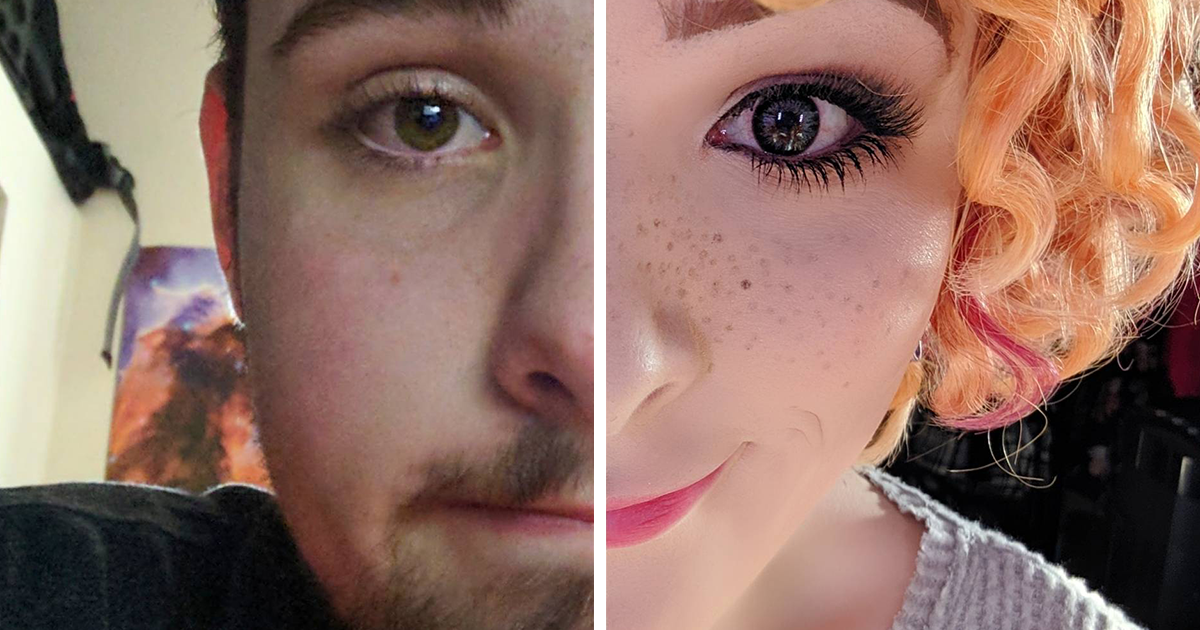
Most people use their camera roll to save vacation sunsets, questionable restaurant meals, and twelve nearly identical pictures of a pet refusing to look at the lens. Taylor Aves used hers for something far more personal: documenting more than two years of discovering, accepting, and expressing herself as a transgender woman.
Her transition timeline drew widespread attention because it was not simply a dramatic “before and after” reveal. It showed an unfolding life. Across the photographs, viewers could see changes in her appearance, posture, styling, confidence, and smile. More importantly, Taylor described an internal shift from feeling disconnected from life to finally recognizing the person in the mirror.
Although “MTF journey” remains a popular search phrase, many people prefer terms such as trans woman, feminizing transition, or simply transition. Language is personal, and the most respectful approach is to use the words an individual chooses for herself.
Who Is Taylor Aves?
Taylor was 22 and living in Colorado when her transition photographs received broad online attention in 2020. She had begun transitioning in 2018 and regularly shared progress images, reflections, and “Transition Tuesday” updates on social media.
Before beginning hormone therapy, Taylor described living with persistent gender dysphoria and a sense that she was performing a role rather than participating fully in her own life. After starting treatment, she said the emotional difference arrived before many of the visible physical changes. She compared the earlier discomfort to background noise that had been present for so long she had stopped noticing it.
As the months passed, Taylor reported softer skin, reduced muscle mass, breast development, changes around her hips, and a growing sense that her reflection finally made sense. She also described becoming more comfortable experiencing and expressing emotions rather than suppressing them. By the end of her public account, her central message was not that she had become an entirely different person. It was that she finally felt present, authentic, and able to live as herself.
Why Her Two-Year Transition Timeline Resonated
The internet loves a transformation picture. Renovated kitchens, restored furniture, fitness milestones, heroic haircutsthe formula is familiar. Yet a gender transition timeline carries a different emotional weight because the most important transformation may not be the one visible in the photographs.
Taylor’s images showed gradual physical changes, but viewers also noticed something harder to measure: she appeared increasingly relaxed. Her expressions became less guarded. Her personal style became more confident. The camera stopped looking like an object she had to tolerate and began looking like a witness she trusted.
That distinction matters. A transition is not successful because strangers consider someone conventionally attractive or because a photograph receives thousands of approving comments. A transition belongs to the person undertaking it. Its value may be found in comfort, safety, emotional clarity, social recognition, or the simple relief of no longer pretending.
The Photos Made Slow Change Visible
Daily life can hide gradual progress. When someone sees the same face every morning, small changes may feel almost invisible. A photograph taken several months earlier can reveal what the bathroom mirror cannot.
By recording her journey over an extended period, Taylor created a visual archive. The timeline allowed her to compare stages without relying on memory, which can be unreliable when emotions are intense. It also illustrated an important reality: transition rarely happens in one cinematic burst accompanied by perfect lighting and inspirational background music. It happens through appointments, awkward experiments, ordinary mornings, paperwork, patience, and occasional encounters with a doorframe that suddenly feels closer than it used to.
Her Story Focused on Recognition, Not Reinvention
Outside observers sometimes describe a trans person as “becoming someone new.” Many transgender people describe the experience differently. Transition may feel less like inventing a new identity and more like removing layers that prevented an existing identity from being seen.
Photographer Allison Lippy expressed a similar idea when documenting her own gender transition. She used self-portraiture to understand changes that were physical, emotional, and social, while also creating the kind of positive representation she had lacked while growing up. Her project demonstrates how photography can function as both a personal record and a form of public storytelling.
What Happens During a Feminizing Transition?
There is no universal transgender transition timeline. Some trans women pursue hormone therapy, while others do not. Some change their name, clothing, hairstyle, pronouns, or legal documents. Some seek voice training, hair removal, counseling, or surgery. Others select only the steps that feel useful, affordable, accessible, and safe.
Medical organizations emphasize individualized care rather than a mandatory sequence. Personal goals, age, genetics, health history, finances, family circumstances, location, and access to knowledgeable clinicians can all shape the process. A person remains fully transgender regardless of whether she uses hormones or has surgery.
Social Transition
Social transition can include using a new name, changing pronouns, updating clothing or grooming choices, and coming out to friends, relatives, classmates, or coworkers. These actions may happen all at once, in stages, or only within selected spaces.
For one person, telling a close friend may be the first major milestone. For another, the first meaningful moment may be hearing her correct name at a coffee shop. These experiences may sound ordinary, but ordinary recognition can be powerful when someone has spent years feeling unseen.
Feminizing Hormone Therapy
Feminizing hormone therapy commonly involves estrogen and, depending on the individual, medication that reduces or blocks testosterone. Possible effects include softer or less oily skin, breast development, reduced muscle mass, changes in body-fat distribution, slower body-hair growth, and changes in sexual function.
These effects do not arrive on an identical schedule. Some may begin within the first several months, while their maximum development may take two to five years. Breast growth and body-fat redistribution, for example, can continue well beyond the first anniversary of treatment. Genetics, hormone levels, age, health, and individual biology all influence the outcome.
Hormone therapy also requires medical supervision. Clinicians may monitor hormone levels, cardiovascular risk factors, liver health, and other relevant measures. Estrogen can affect fertility, and people who may want genetically related children in the future should have an opportunity to discuss fertility preservation before beginning treatment. Taking medication obtained from unverified sources or changing a dose without professional guidance can create avoidable risks.
Voice and Communication
Transition is not limited to appearance. Some trans women explore voice and communication training because estrogen generally does not reverse every vocal change produced by a testosterone-driven puberty.
A qualified speech-language pathologist may help a client work safely with pitch, resonance, intonation, articulation, vocal quality, and nonverbal communication. The goal is not to enforce one stereotypical “female voice.” It is to help the person develop a voice that feels comfortable, sustainable, and congruent with her identity.
Legal and Practical Changes
Name changes, identification documents, workplace records, insurance files, school systems, and financial accounts can become a second transition running alongside the personal one. Unfortunately, bureaucracy has never met a meaningful life event it could not decorate with three forms, two photocopies, and one mysteriously unavailable employee.
These administrative steps are not necessary for someone’s identity to be valid. However, accurate documents can reduce uncomfortable explanations and make travel, employment, medical care, and everyday transactions easier.
Why Documenting a Transition Can Be Powerful
Transition photos may help the person creating them as much as the audience viewing them. They can preserve milestones, reveal progress, organize memories, and provide reassurance during periods when change feels frustratingly slow.
Researchers studying online gender-transition narratives have found that social platforms can serve as diaries, information sources, community spaces, and channels for emotional support. Online resources are especially important for people who do not have knowledgeable clinicians, supportive relatives, or visible transgender communities nearby. At the same time, public sharing can expose creators to harassment, invasive questions, misinformation, and unwanted redistribution of their photographs.
A Timeline Can Offer Hope Without Becoming a Promise
Seeing Taylor’s progress may reassure another trans woman who is wondering whether change is possible. However, no online timeline should be treated as a forecast. Two people can begin similar treatments on the same day and experience different results.
Comparison becomes harmful when inspiration quietly turns into a deadline. There is no rule saying someone must look a particular way after six months, one year, or two years. Hormones are not a social-media filter, and pubertyfirst or secondhas never shown much respect for a content calendar.
Representation Can Replace Isolation With Possibility
For people who grew up without openly transgender role models, seeing a real transition story can provide language for feelings that were previously difficult to explain. It can turn an abstract possibility into a recognizable human life.
Support also matters beyond the screen. Research from The Trevor Project has repeatedly associated family support, respectful pronoun use, and accepting communities with better mental-health outcomes among transgender and nonbinary young people. Visibility cannot solve every problem, but it can help people understand that they are not alone and that a meaningful future is possible.
How to Respond Respectfully to a Public Transition Story
A public photograph is not an invitation to investigate every private detail. Viewers can appreciate a transition story without asking about genitals, surgery, fertility, medication doses, former names, or sexual activity. A useful test is simple: Would this question be appropriate to ask a stranger who was not transgender? When the answer is no, the keyboard can enjoy a well-earned day off.
Respectful engagement includes using the person’s current name and pronouns, avoiding demeaning descriptions, and remembering that medical procedures do not determine whether someone is “really” a woman. Compliments should focus on the person rather than treating her body as a public science experiment.
It is also considerate to avoid reposting transition photographs without permission. An image shared within one community or at one stage of someone’s life may later circulate far beyond its intended audience.
Experiences Commonly Associated With a Two-Year MTF Journey
The following section is a composite reflection based on commonly described transition experiences. It is not presented as a quotation from Taylor or as a universal medical timeline.
Beginning: Excitement Arrives With Uncertainty
The beginning of a feminizing transition can feel strangely quiet. A person may spend years imagining the moment she starts, only to discover that the first dose of medication looks remarkably ordinary. There may be no fireworks, no orchestra, and no magical gust of wind rearranging the curtains. There is simply a pill, patch, injection, or prescriptionand the knowledge that a long-delayed step has finally become real.
Relief may appear alongside anxiety. Questions arrive quickly: Will the treatment work? How will relatives respond? What happens at work? Will strangers notice? What if changes come too slowly? What if they come faster than expected?
During this period, keeping a private journal or taking occasional photographs can provide structure. The record may capture more than appearance: sleep, mood, energy, confidence, social experiences, and questions for the next medical appointment.
The First Six Months: Small Changes Feel Enormous
Early changes may be subtle enough that nobody else notices them. Skin may feel different. Body odor may change. Emotional patterns may seem unfamiliar. Breast tenderness can make everyday movements surprisingly educational. A backpack strap, enthusiastic hug, or badly judged doorway may suddenly demand diplomatic negotiations.
At the same time, social transition may produce more immediate effects than medication. Hearing the correct name from a trusted friend can be deeply affirming. Being misgendered can feel especially painful after someone has begun taking visible steps toward living openly.
Clothing and makeup may involve trial and error. Early experiments are not always destined for a fashion museum, but they can be important. Personal style is learned through practice, and every woman has encountered at least one outfit that looked more persuasive in her imagination.
Six Months to One Year: Progress Becomes Easier to See
By this stage, comparison photographs may reveal changes that were difficult to notice day by day. Facial appearance may seem softer because of skin changes, grooming, hair styling, weight distribution, or a more relaxed expression. Breast development and reduced upper-body muscle may become more apparent.
Confidence may grow, but it does not always move in a straight line. A wonderful week can be followed by a difficult afternoon. Someone may feel comfortable with friends yet anxious in a public restroom, medical office, airport-security line, or family gathering.
Transition can also change relationships. Some connections become stronger because honesty creates greater intimacy. Others weaken when people refuse to adapt. Grieving those relationships does not mean the transition was a mistake. It means loss can remain painful even when the decision leading toward authenticity was necessary.
The Second Year: Patience Becomes Part of the Process
The second year may bring additional physical development, but it can also challenge unrealistic expectations. The dramatic excitement of beginning has passed, while some desired changes may still be incomplete. This is where online comparisons can become particularly tempting.
A healthier approach is to remember that transition is not a competition. One woman’s twelve-month photograph says nothing about what another woman “should” look like. Lighting, age, genetics, medication, surgery, styling, camera angles, filters, finances, and access to care all affect what appears on a screen.
Many people use the second year to refine rather than reinvent. They may settle into a comfortable hairstyle, update documents, practice their voice, reconsider fertility goals, explore surgery, or decide that they are content without additional medical procedures.
The most meaningful milestone may be surprisingly ordinary: realizing that an entire morning passed without thinking about gender. There was breakfast, traffic, work, a forgotten password, and perhaps a small argument with a printer. Life was not organized around transition that day. It was simply life.
The Lesson Behind the Timeline
A two-year collection of photographs can show remarkable change, but the final image is never truly final. Bodies continue to age. Identities become more nuanced. Confidence grows, retreats, and grows again. Transition does not end the moment a person reaches a certain appearance.
The deeper goal is not perfection. It is congruencethe experience of moving through the world without constantly negotiating a painful distance between identity and presentation.
Taylor’s journey resonated because her photographs captured more than physical feminization. They recorded relief becoming visible. Her story reminded viewers that authenticity may emerge gradually: one appointment, one photograph, one honest conversation, and one increasingly genuine smile at a time.
Conclusion
“Transgender Girl Recorded Her MTF Journey For Over 2 Years” may sound like the title of a dramatic internet makeover, but Taylor Aves’ story carries a more meaningful message. Her timeline was not about replacing one person with another. It was about allowing the person who had always existed to become visible.
Her experience also shows why transition timelines should be approached with both hope and perspective. Photographs can document progress, build community, and reduce isolation, but they cannot define a universal schedule. Every transgender woman has different goals, resources, health considerations, relationships, and ideas about what living authentically means.
The most respectful response is not to judge whether a transition looks sufficiently dramatic. It is to recognize the courage involved in living honestlyand perhaps to appreciate that a genuine smile can reveal more than any before-and-after photograph ever could.
Editorial note: This article synthesizes Taylor Aves’ publicly shared account with reporting and educational guidance from 12 established sources, including Bored Panda, National Geographic, WPATH, the Endocrine Society, UCSF Gender Affirming Health Program, Mayo Clinic, Healthline, GLAAD, the American Psychological Association, The Trevor Project, the American Speech-Language-Hearing Association, and the American Society for Reproductive Medicine. It is educational content and not individualized medical advice.