
Let’s begin with a polite, necessary disclaimer: there is no Olympic podium for ugly cities. No mayor wakes up to discover their skyline has won bronze in the International Concrete Panic Championships. “Ugly” is usually a lazy catchall for places shaped by industry, postwar rebuilding, highways, overcrowding, pollution, harsh density, awkward planning, or the architectural crime known as parking lots with ambition. In other words, when people call a city ugly, they are often reacting to history wearing a hard hat.
That is exactly why this idea is so irresistible. What happens if we stop judging these cities like grumpy real estate agents and start looking at them like painters? If a place known for smoke, sprawl, brutal concrete, visual chaos, or hard-edged infrastructure were filtered through the eyes of a master artist, would it still seem ugly? Or would it suddenly become moody, dramatic, electric, even glorious?
So we imagined a lineup of cities often criticized for their rough aesthetics, then handed each one to a famous artist whose visual language could transform insult into interpretation. The result is part travel fantasy, part art-history fever dream, and part reminder that beauty is often just context with better lighting.
Why “Ugly” Cities Fascinate Us So Much
The funny thing about urban beauty is that it is rarely just about looks. People respond to mood, rhythm, scale, greenery, traffic, texture, and whether a place feels alive or exhausted. A city can be architecturally important and still get mocked. It can be economically powerful and visually overwhelming. It can be full of culture and still photographed at the exact moment when the sky resembles dishwater and the overpass resembles a threat.
Many places labeled unattractive earned that reputation honestly enough: they industrialized fast, sprawled faster, and patched themselves together with practical decisions that were not designed to make tourists gasp with delight. But practical does not mean meaningless. Steelworks, viaducts, apartment towers, port cranes, transit lines, and civic blocks all tell stories. Painters have spent centuries proving that soot, fog, density, and strange geometry are not aesthetic dead ends. They are raw material.
That is the spirit of this experiment. We are not “fixing” these cities. We are re-seeing them.
1. Detroit, Michigan, as Painted by Edward Hopper
A city of industry becomes a cathedral of stillness
Detroit already carries Hopper energy without even trying. Its industrial heritage, broad streets, powerful riverfront presence, and skyline of strong silhouettes make it feel like a place built for lonely light. In a Hopper version of Detroit, the Renaissance Center would rise not as corporate glass but as a solemn lighthouse for capitalism having second thoughts. Factory windows would glow amber at dusk. Gas stations would become accidental theater sets. Parking decks would suddenly look philosophical.
Hopper would not paint Detroit as broken. He would paint it as paused. That is the difference. The streets would be wide, the storefronts half-lit, the shadows long enough to deserve their own ZIP code. People would appear, but sparingly: one bus driver, one woman in a diner, one man in a cap standing under a streetlamp as if waiting for history to return his call. The city’s roughness would become emotional precision.
And honestly, Detroit by Hopper would be devastatingly beautiful. Not cheerful-beautiful. More like, “I stood here for five minutes and now I need to rethink my life” beautiful.
2. São Paulo, Brazil, as Painted by Jean-Michel Basquiat
Megacity chaos turned into visual jazz
São Paulo is one of those places that overwhelms the eye before your brain has time to file a complaint. It sprawls. It surges. It stacks concrete, signage, speed, towers, graffiti, and relentless motion into a kind of urban percussion. Critics see visual overload. Basquiat would see a ready-made canvas.
In his hands, São Paulo would become a storm of crowns, scribbles, arrows, headlines, fractured faces, and jagged color fields. Elevated roads would slash across the frame like impatient brushstrokes. Apartment blocks would become rhythmic grids. Street art would not sit politely at the edge; it would take over the composition and kick the frame on the way out. Traffic would not be rendered as cars but as a pulse, a staccato language of pressure and movement.
Basquiat’s gift was making intensity legible. He could turn noise into statement. Under his palette, São Paulo would look less like a city accused of being too much and more like the exact place where modern life finally admits it is running on caffeine, ambition, and unfinished thoughts.
3. Birmingham, England, as Painted by Pablo Picasso
Postwar geometry with a Cubist grin
Birmingham’s reputation has long been tangled up with industry, rebuilding, road systems, and a city center that many people have described with all the tenderness of a tax audit. Yet that patchwork quality is exactly why Picasso would have a field day. Birmingham is a city of fragments: Victorian remnants, modern inserts, concrete volumes, glass surfaces, rail lines, canals, and civic ambition colliding in one persistent, adaptable whole.
Picasso would not try to smooth Birmingham out. He would break it apart even further and somehow make it make more sense. Office blocks would tilt into bold planes. Flyovers would slice through the picture like assertive diagonals. The old and new fabric of the city would overlap like multiple viewpoints in one restless mind. A bus, a pub sign, a canal bridge, and a municipal tower would all occupy the same visual sentence, because Cubism never trusted a single angle anyway.
The result would be a Birmingham that looked less mocked and more intellectually charged. A city once criticized for harshness would become an argument about form, perspective, and reinvention. Which is a very fancy way of saying Picasso would turn urban awkwardness into swagger.
4. Mexico City, Mexico, as Painted by Claude Monet
Atmosphere, haze, and grandeur in shifting light
Mexico City is often discussed through its extremes: immense scale, traffic, density, inequality, layered history, and urban sprawl that seems to stretch toward the horizon and then keep going out of habit. But Monet loved places where atmosphere complicated the view. He knew that light is not decoration; it is the subject.
A Monet version of Mexico City would be all shimmer and vibration. Morning haze would soften hard edges. Colonial facades, modern towers, jacaranda blooms, rooftop water tanks, and distant mountains would melt into a trembling spectrum of lavender, peach, silver, and dusty blue. The city’s size would not feel oppressive. It would feel almost tidal, as if urban form were moving like weather.
Even congestion would become painterly. A crowded avenue at sunset would read as bands of reflected color rather than automotive despair. Smog, which in real life deserves criticism and policy, would in a Monet canvas become a veil of tonal uncertainty. That is the dangerous magic of great painting: it can make even a difficult atmosphere look like a revelation.
5. Houston, Texas, as Painted by Jackson Pollock
Freeways, floodplains, and energy rendered as motion
Houston has a skyline that can look glamorous from the right angle and a metropolitan footprint that can look like urban planning played by improv rules. It is a place of towers, highways, heat, ship-channel muscle, sprawling development, and endless reinvention. Which is to say: Jackson Pollock would not paint Houston. He would attack it with thrilling affection.
This Houston would be a giant field of drips, arcs, loops, splatters, and sudden collisions of line. Interchanges would not be drawn neatly because that would miss the point. They would explode across the canvas like decisions made at 70 miles per hour. Energy infrastructure, bayous, suburbs, and downtown glass would dissolve into one enormous all-over composition with no polite focal point and absolutely no interest in behaving.
And yet, like Pollock’s best work, the chaos would not be random. The eye would keep discovering structure inside the frenzy. Houston would become less a city you “read” and more a city you experience with your nervous system. Messy? Sure. But also muscular, alive, and impossible to ignore.
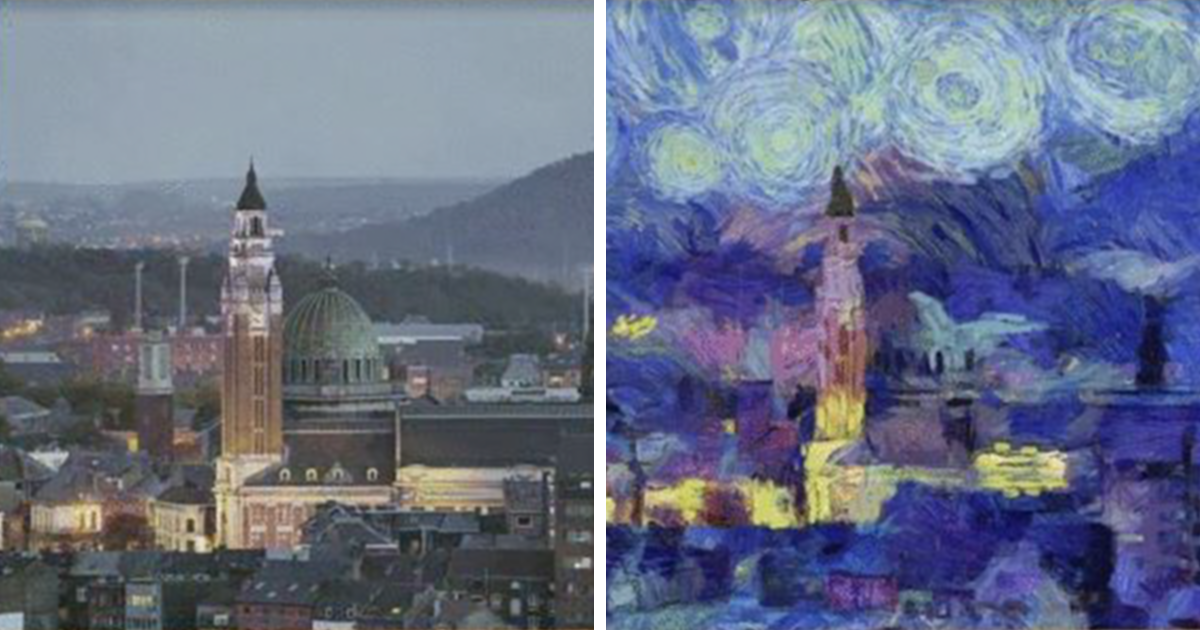
6. Charleroi, Belgium, as Painted by Vincent van Gogh
Industrial melancholy set on fire with color
Charleroi’s coal-and-steel image has made it a frequent target in conversations about unattractive cities. It wears the visual memory of heavy industry openly: river, infrastructure, working-class neighborhoods, and the mood of a place that has known hard labor and economic transition. Van Gogh would not run from that heaviness. He would electrify it.
Picture smokestacks under a roiling cobalt sky. Picture slag heaps transformed into rolling, almost sacred topography. Picture narrow streets and old brick facades alive with feverish yellows, viridian shadows, and orange lamps that seem to pulse like living things. Van Gogh had a gift for taking ordinary structures and charging them with spiritual weather. Charleroi by Van Gogh would feel restless, haunted, and fiercely human.
This might be the most surprising transformation of the bunch. A city often seen as drab would become emotionally incandescent. The industrial scar would still be there, but now it would read like struggle made visible rather than scenery best ignored from a train window.
7. Naples, Italy, as Painted by Wassily Kandinsky
Traffic, topography, and noise translated into pure feeling
Naples is one of those cities that defeats neat description. It is historic and chaotic, gorgeous and gritty, theatrical and exhausting. Narrow streets climb hillsides, scooters perform miracles of survival, old palaces rub shoulders with everyday disorder, and Vesuvius looms nearby like a geological editor refusing to cut drama from the script. Some visitors call it glorious. Others call it visual bedlam. Kandinsky would call it Tuesday.
In a Kandinsky interpretation, Naples would become a symphony of color and form untethered from literal realism. Church domes might register as floating circles. Steep streets would become urgent diagonals. Laundry lines, traffic, market stalls, harbor light, and volcanic presence would transform into abstract tensions of red, blue, black, and gold. The city’s energy would no longer be described. It would be felt directly.
That may be the best artistic match of all for Naples. It is not a place that politely waits to be understood. It rushes at you all at once. Kandinsky knew that feeling. He painted inner vibration, not tidy surfaces. Naples would thrive in that language.
8. Brasília, Brazil, as Painted by Gustav Klimt
Monumental modernism meets decorative seduction
Brasília is admired by architects and side-eyed by plenty of ordinary humans. Its planned axes, monumental civic buildings, and disciplined geometry can feel visionary or sterile depending on your mood, hydration, and tolerance for grand urban symbolism. That tension makes it perfect for Gustav Klimt.
Klimt would take Brasília’s cool modernist bones and wrap them in sumptuous ornament. The clean lines of Niemeyer’s curves would still be there, but now they would shimmer with gold leaf, patterned tessellations, jewel tones, and surfaces so decadent they might require their own velvet rope. Government buildings would stop feeling remote and start looking mythic, almost ceremonial. The city’s vast open spaces would become fields of decorative rhythm rather than emptiness.
Most importantly, Klimt would restore sensuality to a place often accused of being too cerebral. Brasília would still look planned, but not cold. Formal, but not detached. Monumental, but suddenly delicious. Which may be the nicest thing anyone has ever said about an administrative axis.
So, Are These Cities Ugly or Just Unfinished in Our Imagination?
That is really the whole game, isn’t it? Cities do not sit still long enough to be judged once and for all. They grow, erode, improvise, contradict themselves, and keep absorbing the values of whoever gets to build next. A place mocked for concrete today may be praised tomorrow for authenticity. A district dismissed as shabby may later be treated like a design pilgrimage site with very expensive coffee.
The painters in this thought experiment do not erase the challenges of these cities. Detroit still carries industrial memory. São Paulo still overwhelms. Birmingham still wrestles with the legacy of rebuilding. Mexico City still bears the burden of vast urban scale. Houston still sprawls. Charleroi still carries the gravity of industry. Naples still surges chaotically. Brasília still splits opinion like a professional hobby.
But once art enters the frame, the insult starts to wobble. What looked harsh becomes textured. What looked messy becomes energetic. What looked cold becomes dramatic. Sometimes the difference between ugly and unforgettable is not the city itself. It is the eye you bring to it.
Extra Reflections: What It Feels Like to Walk Through a City People Love to Mock
There is a strange freedom in visiting a city with a bad visual reputation. Nobody hands you the usual script about postcard angles and “must-see romantic vistas.” Nobody expects you to faint elegantly at the first plaza. Instead, you arrive with lower expectations and sharper senses. You start noticing details that polished cities often train you to ignore: the mural tucked beside a repair shop, the geometry of stacked balconies, the weird nobility of a transit hub at dusk, the way steam, rain, and sodium light can turn a brutal block into cinema.
In cities people call ugly, beauty tends to appear sideways. It hides in textures before landmarks. You notice repetition: windows, pipes, wires, viaduct shadows, industrial rails, market tarps, apartment grids. Then you notice interruption: a jacaranda tree, a neon sign, a tiny church, a corner bakery, a flash of tile, a wall painted with impossible confidence. The visual experience is less “behold perfection” and more “keep looking, I dare you.” And that, honestly, is more fun.
There is also a human honesty to these places. Cities that have been over-photographed into mythology can sometimes feel like they are performing themselves. Cities with rougher reputations often feel more off-guard. They are busy being cities rather than auditioning to become desktop wallpapers. You see people moving with purpose. You hear systems at work. You feel the friction between infrastructure and daily life. It is less flattering, maybe, but also more intimate.
That intimacy changes the way you remember them. You may not come home saying, “Every view was perfect.” You come home saying, “That place stayed with me.” The memory is built from sensation: diesel in the air near a port, the throb of a train line, sunlight flashing on office glass, graffiti climbing a retaining wall, the sound of cutlery in a narrow lunch spot under a concrete tower. The city imprints itself not as a clean composition but as a sequence of encounters.
Art helps explain why. Painters have never depended on obvious prettiness. They chase tension, contrast, atmosphere, rhythm, color, loneliness, spectacle, imbalance, and surprise. So when we imagine supposedly ugly cities painted by great artists, we are really admitting something bigger: our definitions of beauty have been too timid. We have been asking cities to look finished, symmetrical, charming, and easy. But many of the most memorable places on earth are none of those things. They are layered. Stubborn. Overbuilt. Scarred. Alive.
And maybe that is the real experience at the heart of this topic. The moment you stop demanding instant charm from a city and start reading it like a work of art, the entire place opens up. Concrete becomes tone. Traffic becomes movement. Disorder becomes composition. History stops sitting quietly in museums and starts appearing in facades, road widths, rail yards, and skylines. Suddenly the city everyone dismissed as ugly is offering you something prettier cities often cannot: complexity without apology.
So yes, we imagined these cities painted by famous artists. But the joke may be on us. Because once you learn how to look, many of them were halfway to masterpieces already.














