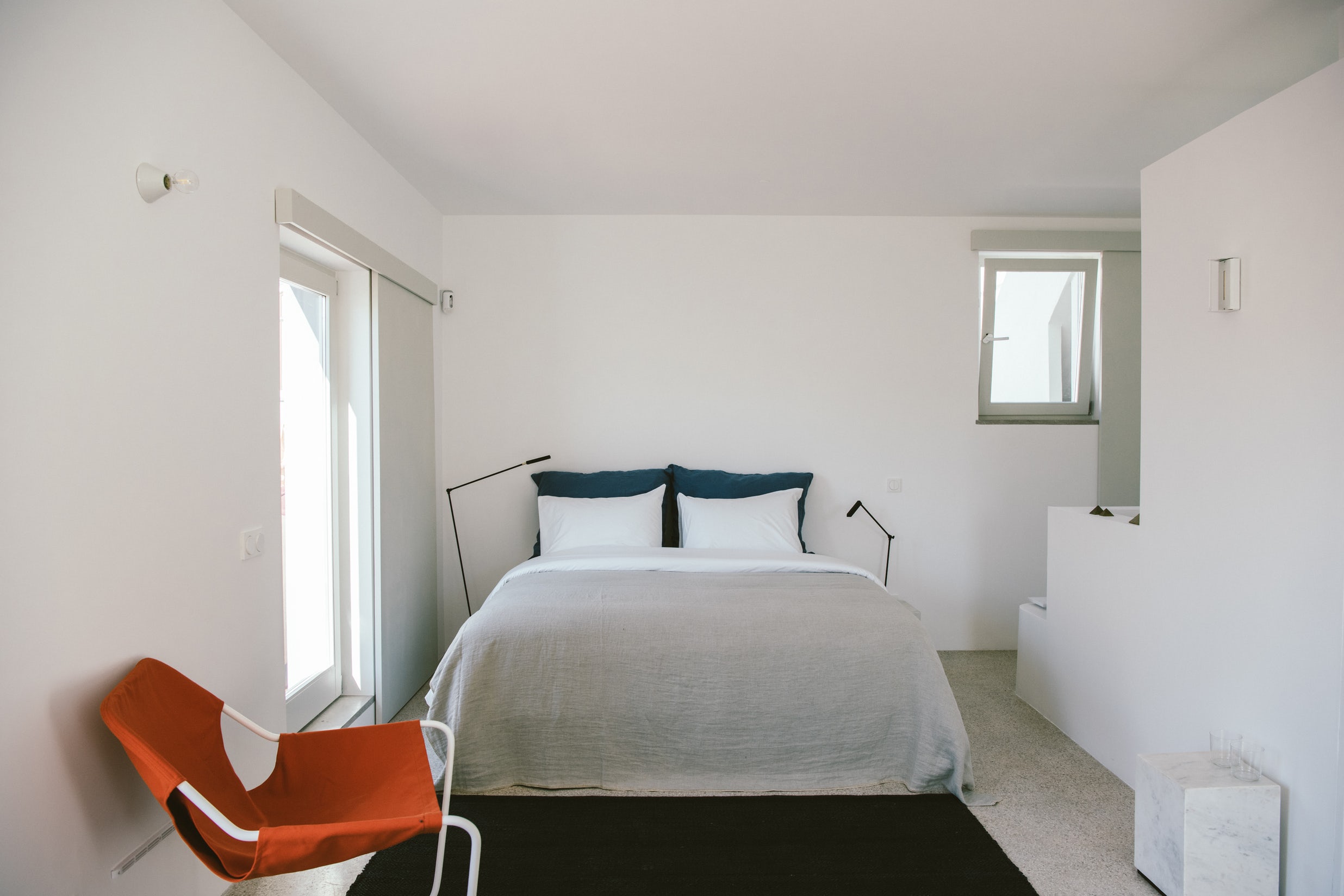
A quiet bedroom, a restrained palette, and one unapologetically bright chair: sometimes that is all it takes to turn a pleasant interior into a room people remember. At Casa Três, a restored merchant’s house in Portugal’s Algarve, the Paulistano chair performs this little design miracle without shouting, waving, or arriving with twelve decorative pillows.
Its paprika-colored sling introduces warmth to pale walls, cool flooring, dark wood, and simple linens. Yet the chair does not feel like a random splash of color. Designed in Brazil in 1957 by architect Paulo Mendes da Rocha, it carries enough structural clarity and cultural history to hold its own in a minimalist escape.
This is the real lesson behind the room: minimalism becomes more interesting when every object earns its place, and one exceptional piece is allowed to misbehave just a little.
The Design Sighting That Started the Search
The chair first attracted attention in photographs of Casa Três, where its slim white frame and reddish-orange canvas stood out against an otherwise muted bedroom. Remodelista identified it as the Paulistano chair, shown in a bright paprika-like finish that gives the room a concentrated jolt of energy.
It is easy to understand why readers wanted to know more. The bedroom contains no obvious visual gimmicks. There is no enormous mural, extravagant chandelier, or rug patterned like an escaped zoo animal. Instead, the chair becomes the focal point because the surrounding interior gives it breathing room.
This is design reconnaissance at its most useful. Rather than copying an entire room, it isolates the object doing the heavy lifting and asks why it works. The answer involves color, silhouette, materials, history, and the confidence to stop decorating before the room begins resembling a furniture showroom during a clearance event.
Inside Casa Três: A Minimalist Escape with a Past
Casa Três is located in Vila Real de Santo António, near the eastern edge of Portugal’s Algarve and across the Guadiana River from Spain. The building began as a merchant’s house before being renovated into an open, spacious guest property. Its historic location and traditional exterior give way to contemporary rooms organized around light, air, and an interior courtyard.
The house accommodates six guests in three bedrooms, each with an en suite bathroom and its own lounge area. An old citrus tree, a small outdoor pool, concrete stairs, and sunlit roof terraces establish a rhythm that feels both architectural and relaxed. This is not minimalism designed to make visitors afraid to put down a coffee cup. It is minimalism designed for actual living.
A restrained palette with natural variation
Throughout the house, pale surfaces amplify daylight while wood, terrazzo, concrete, woven materials, and carefully selected furniture prevent the interior from becoming sterile. The rooms are visually quiet, but they are not flat. Texture supplies much of the decoration.
This approach reflects a broader principle of successful minimalist interior design. Clean lines, limited ornament, natural materials, and neutral colors may establish the framework, but depth comes from contrast, texture, proportion, and objects with recognizable character.
Why the chair belongs there
The Paulistano chair complements Casa Três because it shares the house’s architectural logic. Both combine strong structure with apparent ease. Both use relatively few materials. Both reveal how they are made instead of hiding everything beneath layers of upholstery, trim, and decorative fussiness.
The chair’s color is the surprise, but its construction is the reason the surprise feels intelligent rather than decorative. Remove the bright canvas and the underlying object is almost diagrammatic: one fluid metal frame supporting a relaxed sling.
Meet the Paulistano Chair
Paulo Mendes da Rocha designed the Paulistano armchair in 1957 for the living areas of the Athletic Club of São Paulo. Its form was created from a bent steel bar supporting a suspended leather seat and back. The design pushed a simple structural idea remarkably far while remaining functional and comfortable.
Mendes da Rocha was associated with the Paulist school of Brazilian architecture, a movement known for direct construction, bold engineering, exposed materials, and an interest in architecture’s social role. He later received the 2006 Pritzker Architecture Prize, one of the profession’s most significant honors.
A chair designed like a small building
Many furniture designers begin with cushions, upholstery, or a desired decorative shape. Mendes da Rocha approached the Paulistano more like an architect. The frame establishes a structural boundary, while the sling responds to the body within it.
That distinction explains the chair’s visual lightness. A conventional lounge chair often occupies space as a solid volume. The Paulistano outlines space. Light passes around and beneath it, allowing the floor and wall to remain visible. In a modest bedroom or compact living area, that transparency can make the furniture feel less intrusive.
Simple materials, sophisticated behavior
The current Paulistano collection is produced in multiple versions with steel structures and removable, replaceable covers. Depending on the model, the sling may be made for indoor or outdoor use. The chair is also represented in the collection of New York’s Museum of Modern Art, where the original is documented as a 1957 design made with tubular steel and canvas.
The simplicity is slightly deceptive. Bending steel into a continuous, balanced structure requires precision. The sling must hang at the correct angle, distribute weight, and remain comfortable without the usual arsenal of foam blocks, springs, webbing, and mysterious staples hiding underneath.
Why a Bright Brazilian Chair Works in a Minimal Room
Color becomes stronger when it is scarce
In a colorful room, another red or orange chair may simply join the crowd. In a neutral room, the same chair becomes an event. Casa Três demonstrates how visual scarcity can intensify color.
The warm upholstery also responds beautifully to the Algarve setting. Sunlight strengthens paprika, terracotta, rust, and coral tones, while pale walls and cool floors keep them from feeling heavy. The result suggests heat, clay, citrus, and late-afternoon light without covering the room in coastal decorations or placing a miniature fishing boat on the dresser.
The silhouette prevents the color from becoming bulky
Bright upholstered furniture can dominate a small room when it has thick arms, a tall back, and a dense base. The Paulistano avoids this problem. Its open steel frame and suspended seat allow the color to appear as a single floating plane rather than a large visual block.
This makes it especially effective as a minimalist accent chair. The color is bold, but the amount of material is controlled. The chair delivers personality without consuming the entire visual conversation.
Curves soften straight architecture
Minimalist rooms often rely on rectangular beds, straight walls, square windows, flat cabinetry, and linear lighting. Too many hard lines can make an interior feel rigid. The Paulistano’s looping frame introduces a continuous curve, while the sling naturally folds around the sitter.
The chair therefore provides two forms of contrast at once: warm color against pale surroundings and relaxed curves against architectural geometry. Neither contrast requires extra clutter.
History adds emotional weight
A well-designed room should not depend entirely on objects with famous names. Nevertheless, a design with a genuine story can bring depth to an otherwise restrained interior. The Paulistano connects a Portuguese guesthouse to Brazilian modernism, midcentury experimentation, and the work of an architect concerned with structure and public life.
That history helps the chair feel collected rather than merely purchased. It looks as though somebody chose it for a reasonwhich, in a strong interior, is generally the point.
How to Re-create the Look Without Copying the Room
The goal is not to reproduce Casa Três bolt for bolt. A successful interpretation should borrow its design logic, not impersonate it while wearing a fake mustache.
1. Establish a quiet background
Begin with a limited base palette. Warm white, chalk, pale gray, sand, oatmeal, soft beige, and natural wood all create room for a vivid chair. The background does not need to be completely colorless, but it should remain visually calm.
Keep major surfaces simple. A lightly textured wall, plain linen curtains, a natural rug, and an unpatterned bedspread will allow the accent chair to remain the focus.
2. Choose one dominant accent color
Paprika is effective because it is warm, earthy, and bright without appearing fluorescent. Similar options include burnt orange, tomato red, saffron, ocher, cobalt blue, deep green, or sunlit yellow.
Resist the urge to repeat the color on every available object. One small echoa book spine, ceramic bowl, or narrow stripe in an artworkis usually enough. Five matching accessories can turn an elegant color relationship into a coordinated gift basket.
3. Look for an airy frame
A sling chair, cantilever chair, woven lounge chair, or metal-framed armchair can provide the same visual openness. Prioritize designs that reveal the floor and do not create a heavy block in the room.
Before buying, measure the chair’s overall width, depth, seat height, and back height. A low lounge chair may appear compact from the front while extending farther into the room than expected.
4. Balance softness and structure
The Paulistano succeeds because its rigid frame supports a flexible seat. Re-create this relationship elsewhere by pairing crisp architecture with slouchy linen, smooth plaster with woven fiber, or terrazzo flooring with a soft wool rug.
A minimalist room requires fewer objects, which means each material becomes more noticeable. Wrinkled linen can look relaxed and luxurious; cheap synthetic fabric may simply look as though it lost an argument with a clothes dryer.
5. Leave negative space around the chair
Do not wedge a sculptural chair between a dresser, floor lamp, laundry basket, luggage rack, and ambitious houseplant. Give it enough empty floor and wall space for the outline to remain legible.
Negative space is not wasted space. It is what allows the eye to understand the shape, color, and purpose of the furniture.
Choosing Between an Original, a Vintage Find, and an Alternative
An authentic Paulistano is a premium design purchase. For some owners, its provenance, construction, replaceable cover, and connection to Mendes da Rocha justify the investment. For others, the more useful lesson is the chair’s design formula rather than ownership of the exact model.
When an original makes sense
Consider the licensed chair when you value collectible design, intend to keep it for many years, and have verified that its reclined position suits your body. A famous silhouette is not automatically comfortable for every person, particularly those who prefer upright seating or need firm arm support when standing.
When to shop vintage
Vintage examples may offer patina and earlier materials, but condition matters. Inspect the frame for corrosion, cracks, uneven bends, or questionable repairs. Check whether the sling has stretched and whether replacement covers are available for that specific production version.
When an alternative is smarter
A well-made sling chair with an open frame can capture the atmosphere at a more accessible price. Focus on honest construction rather than a suspiciously exact imitation. The most convincing alternative will share the Paulistano’s principleslightness, tension, simplicity, and comfortwithout pretending to be something it is not.
Practical Placement Ideas
In a bedroom
Place the chair near a window, at the end of the bed, or in a quiet corner with a small side table. It can hold a book, a folded blanket, or an actual human beingan achievement many bedroom chairs never experience because they are promoted immediately to Clothing Mountain.
In a living room
Use the chair at an angle rather than pushing it flat against a wall. Its curved frame is easier to appreciate from a three-quarter view. Pair it with a restrained sofa and a low table so its scale feels deliberate.
In a reading area
Add a focused floor lamp and a small table that is easy to reach from the reclined seat. Because sling chairs encourage a relaxed posture, test the reading angle before committing to the arrangement.
In an outdoor setting
Only use a version specifically manufactured for exterior conditions. Even outdoor-rated materials benefit from protection against prolonged moisture, harsh sunlight, salt exposure, and winter weather. A chair may be modernist, but it has not developed the ability to negotiate with mildew.
Experiencing the Room: What This Minimal Escape Teaches in Practice
Imagine entering the Casa Três bedroom after walking through the sunlit streets of Vila Real de Santo António. Outside, the town offers patterned pavements, bright façades, marina air, and the sharp southern light of the Algarve. Inside, the visual volume drops. Pale walls, simple bedding, cool flooring, and uncluttered surfaces slow the eye almost immediately.
Then the chair appears.
Its paprika sling does not destroy the calm. Instead, it gives the calm a center. Without the chair, the bedroom might still feel elegant, but the memory of it could dissolve into a pleasant collection of pale surfaces. With the chair, the room gains a visual landmark. Guests may not remember the precise dimensions of the bedside table, but they remember the bright Brazilian seat waiting near the wall.
This experience reveals that minimalism is not primarily about owning as little as possible. It is about making perception easier. When there are fewer competing objects, visitors notice how sunlight moves, how fabric drapes, how a frame meets the floor, and how one color changes from morning to evening.
In early daylight, a paprika chair may look fresh and energetic. Under warmer afternoon light, it can shift toward terracotta. At night, with a soft lamp nearby, it may become deeper and more intimate. The object remains the same, yet the room allows it to participate in the daily cycle of light.
The chair also changes how the bedroom is used. A comfortable seat creates an invitation to pause before unpacking, read for twenty minutes, tie a shoe without balancing like a flamingo, or sit quietly while another guest gets ready. That small functional addition makes the room feel less like temporary lodging and more like a private retreat.
There is also pleasure in discovering that the chair has a history beyond the room. Learning that it originated in 1950s São Paulo and was designed by an architect known for bold concrete and steel buildings deepens the encounter. The chair stops being merely “the red one” and becomes a compact piece of architectural thinking.
At home, the same experience can be created without an Algarve courtyard or a passport. Clear one corner. Remove the undersized decorations that have gathered there through mysterious household migration. Add a single chair with a strong silhouette, a color you genuinely enjoy, and enough comfort to encourage use.
Live with it before adding anything else. Notice how the color responds to daylight. Observe whether the chair improves movement through the room or blocks it. See whether people choose to sit there without being instructed. Good furniture should not require a presentation deck explaining its purpose.
The most important experiential lesson is restraint after success. Once the chair brings the room to life, stop. Do not immediately add a matching lamp, matching throw, matching vase, matching tray, and matching commemorative paprika-colored wastebasket. Let the contrast remain singular.
Casa Três shows that a memorable room can emerge from a simple sequence: preserve the architecture, control the palette, respect natural light, select materials with texture, and introduce one object with enough identity to animate the whole composition. The pleasure comes not from having more to see, but from being able to see more clearly.
Conclusion: One Chair, One Color, Plenty of Character
The bright Paulistano chair at Casa Três proves that minimalist interior design does not require a lifetime commitment to beige. A restrained room can welcome color, history, humor, and personalityprovided they arrive through objects chosen with care.
The chair works because every part contributes. Its warm sling contrasts with the muted bedroom, its open frame preserves visual space, its curves soften straight architecture, and its Brazilian modernist history gives the object meaning beyond decoration.
For anyone creating a minimal escape, the takeaway is refreshingly manageable: simplify the background, invest attention in materials, leave space around important objects, and choose one piece capable of carrying the room. Then put down the shopping cart and walk away. The room is finished.