Some kitchen objects perform a job and quietly disappear into a cabinet. A traditional English teakettle does the opposite. It sits on the stove looking useful, dignified, and faintly prepared to offer sensible advice about the weather.
These kettles are not necessarily the fastest way to produce hot water. An electric model may beat them to the boil, switch itself off, and never demand that you listen for a whistle. Yet speed is only part of the equation. A classic stovetop kettle turns making tea into a small domestic ritual: fill, heat, wait, hear the signal, pour, and pause.
This comfort-focused guide explores five memorable styles associated with the traditional English kitchen: cast iron, stainless steel with a copper base, enamel with a wooden handle, handcrafted copper, and hard-anodized aluminum. Some of the original models that inspired these categories have become difficult to find, but their practical qualities and visual appeal remain highly relevant.
Why Traditional English Teakettles Still Feel So Comforting
A teakettle has one primary purpose: heating water. It should not be confused with a teapot, which holds tea leaves or tea bags while they steep. Most ceramic teapots are not designed for direct stovetop heat, no matter how confidently they appear to be sitting near the burner.
The appeal of a traditional stovetop tea kettle comes from the way function and atmosphere overlap. A broad metal body gathers heat, the handle frames the silhouette, and a whistle or plume of steam announces that the water is ready. The process is visible and audible. It gives the kitchen a pulse.
Traditional kettles can also be more durable than appliance-heavy alternatives because they contain no electronic controls, heating coils, cords, or illuminated buttons. There is less to fail, although there is also no automatic shutoff. You must remain nearby, which may be inconvenient during a frantic morning but pleasantly grounding during a quiet afternoon.
5 Traditional English Teakettles Worth Celebrating
1. The Traditional Cast-Iron Teakettle
A cast-iron kettle has the visual authority of an object that expects to be handed down. The traditional model once offered by English furniture and homeware company Another Country was especially restrained, with a dark finish, compact body, and country-house character that avoided excessive decoration.
Cast iron is valued for its ability to retain heat. Once the kettle becomes hot, the water tends to stay warm longer than it would in a thin, lightweight vessel. That is useful when one person wants tea now and another family member announces, ten minutes later, that they would also like a cupas though the kettle operates a private emergency service.
The tradeoff is weight. A substantial cast-iron kettle can feel reassuring on the stove but demanding in the hand, particularly when filled to capacity. Buyers should also determine whether a particular model is intended to boil water or simply keep it warm. Some decorative cast-iron vessels are better classified as teapots and should not be placed directly over a flame.
Best for: Traditional kitchens, slow tea rituals, and households that value heat retention.
Comfort factor: Its dark, grounded silhouette looks perfectly at home beside an old range, a loaf of bread, and a window covered in rain.
2. The Stainless-Steel Kettle With a Copper Base
The BonJour two-quart teakettle represents a practical meeting of materials. Its stainless-steel body offers a clean, durable surface, while its copper-covered base improves heat responsiveness. Its long, curved spout also gives it a profile somewhere between a traditional kettle and a modern gooseneck design.
Stainless steel is a sensible everyday choice because it resists rust, handles frequent use, and generally requires less delicate care than polished copper. A copper base can help transfer heat quickly across the bottom, although the copper exterior may gradually darken or develop a patina. Some owners polish it faithfully. Others allow it to age and declare the result “character,” which is often what happens when polishing loses the argument.
A narrow spout offers greater control than a short, wide opening. That makes this type of kettle useful for filling a small teapot or preparing pour-over coffee. However, highly precise gooseneck designs may pour more slowly, and not every copper-bottomed kettle works on an induction cooktop. Compatibility should be confirmed before purchase.
Best for: Everyday tea drinkers who want classic styling without the heft of cast iron.
Comfort factor: The combination of warm copper and bright stainless steel feels familiar, polished, and quietly elegant.
3. The Gray Enamel Stove Kettle With a Wooden Handle
An enamel kettle with a pale wooden handle may be the coziest design in this collection. A soft gray model formerly sold by Forest paired an uncomplicated enamel body with carved wood, creating the sort of kettle that looks as though it belongs in a cottage kitchen even when the nearest cottage is several time zones away.
Enamel-on-steel kettles are typically lighter than cast iron and can heat relatively quickly. The steel provides strength and conductivity, while the enamel coating creates a smooth, nonreactive surface available in colors that range from restrained cream to exuberant red.
Enamel does require considerate handling. Dropping the kettle or striking it against a cast-iron grate can chip the coating. Abrasive scrubbers may scratch the finish, and the kettle should generally be washed by hand and dried thoroughly. A wooden handle may remain more comfortable than a bare metal one, but it should still be tested cautiously because nearby fittings can become hot.
This style is particularly attractive for small kitchens because it doubles as decoration. Instead of hiding it after breakfast, owners tend to leave it on the stove, where it contributes color and texture without consuming additional counter space.
Best for: Cottage-style interiors, compact kitchens, and anyone seeking a lightweight traditional kettle.
Comfort factor: Enamel and wood soften the utilitarian form, making the kettle feel less like equipment and more like part of the room.
4. The Simplex Handcrafted Copper Kettle
Few English teakettles have the heritage or visual presence of a Simplex. Newey & Bloomer has produced its famous kettles in Birmingham, England, using traditional metal-spinning methods associated with the brand since the early twentieth century. The classic whistle is incorporated into the lid rather than attached to a conventional spout cap.
The limited-edition Simplex Jubilee kettle once highlighted in the original comfort collection featured an especially formal silver-plated finish. Current Simplex designs continue the broader tradition through polished copper and chrome-plated variations, including models developed for different types of stovetops.
Copper responds to heat rapidly, which is excellent for boiling performance. It is also visually expressive. New copper shines like jewelry; aged copper develops deeper tones and a natural patina. Neither condition is inherently better. The choice is between regular polishing and accepting that time has joined the design team.
The critical buying detail is the base. Some traditional copper kettles are intended for gas stoves, while others use a coiled base designed for solid hotplates or range cookers. Copper alone is not induction compatible, so an induction-ready construction must be specifically stated.
Best for: Serious Anglophiles, heritage-design enthusiasts, and buyers seeking a long-term kitchen centerpiece.
Comfort factor: The whistle, craftsmanship, and gradually changing finish turn an ordinary cup of tea into a small ceremony.
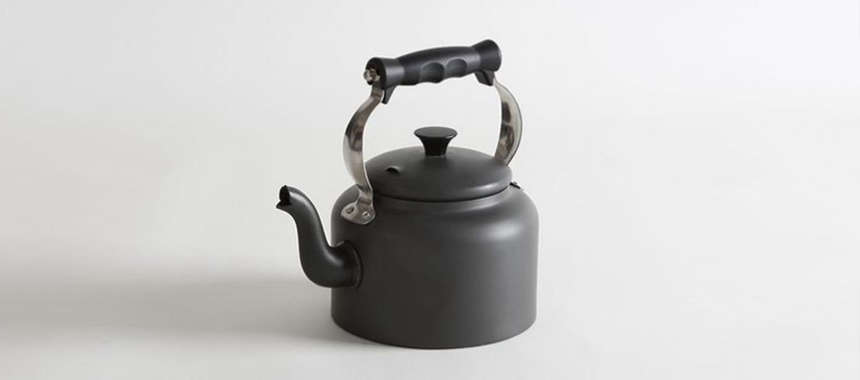
5. The AGA Hard-Anodized Kettle
The AGA hard-anodized kettle is a sturdy, purposeful alternative to polished copper and colorful enamel. Traditionally designed to work efficiently on an AGA range cooker’s boiling plate, it uses a thick, flat base to maximize contact with the hot surface.
Hard-anodized aluminum is aluminum that has undergone an electrochemical process to produce a harder, more durable exterior. It retains aluminum’s relatively light weight and excellent heat conductivity while offering greater resistance to everyday wear than untreated metal.
The traditional three-liter AGA version is generous enough for several mugs, a large teapot, or cooking tasks that require hot water. That capacity is useful in a busy household, although a full three-liter kettle is naturally heavier and may take longer to boil than a partially filled one.
Its matte, dark finish is less decorative than gleaming copper, but that restraint is part of its charm. It looks like a tool built to be used every day rather than admired from a velvet cushion. A hard-anodized kettle should usually be cleaned according to the manufacturer’s instructions with mild soap and a nonabrasive cloth or nylon pad.
Best for: AGA owners, large households, and people who favor robust performance over ornament.
Comfort factor: It has the reassuring practicality of a kitchen object that expects to work for decades.
How to Choose the Right Traditional Stovetop Tea Kettle
Match the Kettle to Your Cooktop
Gas and conventional electric stoves accept many traditional kettle designs. Induction cooktops are more selective because they require a magnetic base. Stainless steel may be induction compatible, but not every stainless-steel product is. Copper, aluminum, and glass need a bonded magnetic layer before they can work on induction.
Owners of range cookers should look for a broad, completely flat base. Better surface contact improves heat transfer and reduces rocking.
Choose a Realistic Capacity
A kettle between 1.5 and 2 quarts is practical for many households. It can prepare several cups without becoming awkwardly heavy. A larger three-quart model is useful for families, frequent guests, French press coffee, oatmeal, and cooking.
More capacity is not automatically better. Boiling unnecessary water wastes time and energy. The ideal kettle holds enough for a normal tea round with a little room left below the maximum fill line.
Inspect the Handle and Spout
The best handle provides enough clearance to keep your knuckles away from the hot body. Wood and heat-resistant synthetic grips can improve comfort, while all-metal handles may require an oven mitt. Folding handles simplify filling and storage but should lock securely when raised.
A good spout pours in a controlled stream without dribbling down the kettle. Whistling covers should open without placing fingers directly in the path of steam. Steam burns are an impressively unpleasant way to discover that a lever is poorly positioned.
Decide How Much Maintenance You Will Tolerate
Stainless steel is generally the easiest material to live with. Enamel needs protection from chips and abrasive cleaners. Cast iron demands careful drying unless fully enameled. Copper rewards polishing but does not require it unless a bright finish is important to you. Hard-anodized aluminum should be cleaned gently to preserve its surface.
The most beautiful kettle is not the one that looks best in a product photograph. It is the one you will still enjoy cleaning after the twentieth pot of tea.
Using a Traditional Kettle for Better Tea
Begin with fresh, cold water and fill only to the level required. Keep the water below the maximum line or the base of the spout. Overfilling can interfere with the whistle and may cause boiling water to spit from the opening.
Place the kettle on a burner that does not extend beyond its base. On a gas stove, large flames can heat the handle, discolor the finish, and waste energy. Never leave a stovetop kettle unattended, even when it has a whistle. A whistle is an alert, not an automatic shutoff system.
Once the water is ready, move the kettle off the heat. Black tea and many herbal infusions tolerate freshly boiled water. Green, white, and delicate oolong teas are usually better with slightly cooler water. After boiling, waiting briefly before pouring can prevent those leaves from producing an unnecessarily bitter cup.
Prewarming the teapot is another traditional step worth keeping. Swirl a small amount of hot water inside the pot, discard it, add the tea, and then pour the brewing water. The warmed vessel loses less heat during steeping.
Cleaning and Descaling a Traditional Teakettle
Minerals in hard water gradually form a pale, chalky layer inside a kettle. This limescale is not a sign that the kettle has developed a mysterious interior frost, but it can slow heat transfer and affect the taste of the water.
Descaling frequency depends on local water hardness and how often the kettle is used. Monthly cleaning is a reasonable starting point in a hard-water area. A diluted solution of white vinegar and water or a manufacturer-approved citric-acid descaler can dissolve mineral deposits. After treatment, rinse the kettle thoroughly, boil fresh water, and discard it before preparing tea.
Do not assume that one cleaning method suits every material. Acidic solutions, polishing products, and soaking instructions can differ for copper, enamel, cast iron, and anodized aluminum. The manufacturer’s care directions should take priority.
For exterior cleaning, use warm water, mild dish soap, and a soft cloth. Avoid steel wool and harsh scouring powder on finished surfaces. Dry the kettle before returning it to the stove, especially around seams, rims, and lid fittings.
Real-World Experience: What Living With a Traditional Teakettle Feels Like
The first noticeable difference is not taste or boiling speed. It is sound. An electric kettle often produces a low mechanical rumble followed by a click. A traditional stovetop kettle creates a sequence: a faint metallic murmur, a growing vibration, and finally a whistle that can range from polite to “the railway platform is now closing.” That progression makes the act of waiting feel intentional.
The second difference is visibility. A traditional kettle remains in the room even when it is not working. A cream enamel model can brighten a dark range. Copper reflects afternoon light. Matte cast iron makes a modern kitchen feel more grounded. Because the kettle is always on display, scratches and patina stop looking like defects and begin to record use.
On a quiet morning, the slower routine is genuinely pleasant. Filling the kettle discourages multitasking for a few minutes. While it heats, there is time to choose a tea, warm a mug, open the curtains, or stare into the refrigerator without finding anything new. The whistle marks a transition between waking up and beginning the day.
The limitations become more obvious during busy periods. There is no automatic shutoff, so leaving the kitchen is unwise. A large cast-iron or three-liter kettle can feel heavy when full. Metal handles and fittings may become hotter than expected. Decorative shapes are sometimes less comfortable to pour than modern ergonomic designs. Traditional charm does not exempt a kettle from gravity or thermodynamics.
Capacity also changes the experience. A small kettle is quick and manageable for one or two people but requires another round when guests arrive. A larger kettle handles a full teapot easily, yet filling it to the top for a single mug feels excessive. After several uses, most owners stop measuring and learn the sound and balance of the amount they need.
Guests tend to notice a traditional kettle. It becomes a conversation piece without requiring the host to announce that it is a conversation piece. A handcrafted copper model may invite questions about where it was made. An enamel kettle may remind someone of a grandparent’s kitchen. Even a dark, workmanlike AGA kettle communicates permanence in a room increasingly filled with replaceable electronics.
Maintenance eventually becomes part of the routine. Enamel gets wiped before splashes bake onto it. Stainless steel collects fingerprints. Copper loses its mirror finish. Limescale appears with astonishing confidence. None of this is difficult, but traditional kettles reward steady, gentle care rather than occasional aggressive rescue missions.
The most satisfying ownership experience comes from selecting a kettle that fits the household rather than an imagined lifestyle. A delicate silver-plated showpiece may be delightful for weekend tea but stressful in a chaotic family kitchen. A durable stainless-steel or hard-anodized model may produce less visual drama while being far more comfortable to use three times a day.
After the novelty fades, a good traditional kettle becomes almost invisible in the best way. The hand knows where to grip it. The ear recognizes its pre-whistle murmur. The owner knows exactly how much water will fill the blue teapot or the two large morning mugs. Comfort comes not merely from nostalgia, but from repetition: the same useful object performing the same reassuring task, day after day.
Conclusion
The finest traditional English teakettles combine usefulness with emotional durability. Cast iron offers weight and warmth. Stainless steel with a copper base balances convenience and classic style. Enamel and wood bring cottage charm. A handcrafted Simplex turns boiling water into a celebration of British metalwork, while the AGA hard-anodized kettle delivers hardworking range-cooker practicality.
Choose according to your cooktop, household size, preferred weight, and willingness to maintain the finish. Then use it often. A traditional teakettle is most beautiful when it is not treated as a museum object but as a dependable participant in breakfast, rainy afternoons, late-night conversations, and every “I think I’ll make tea” moment in between.
Note: Product availability, construction, prices, and cooktop compatibility may change. Confirm current manufacturer specifications before purchasing or using any kettle.