
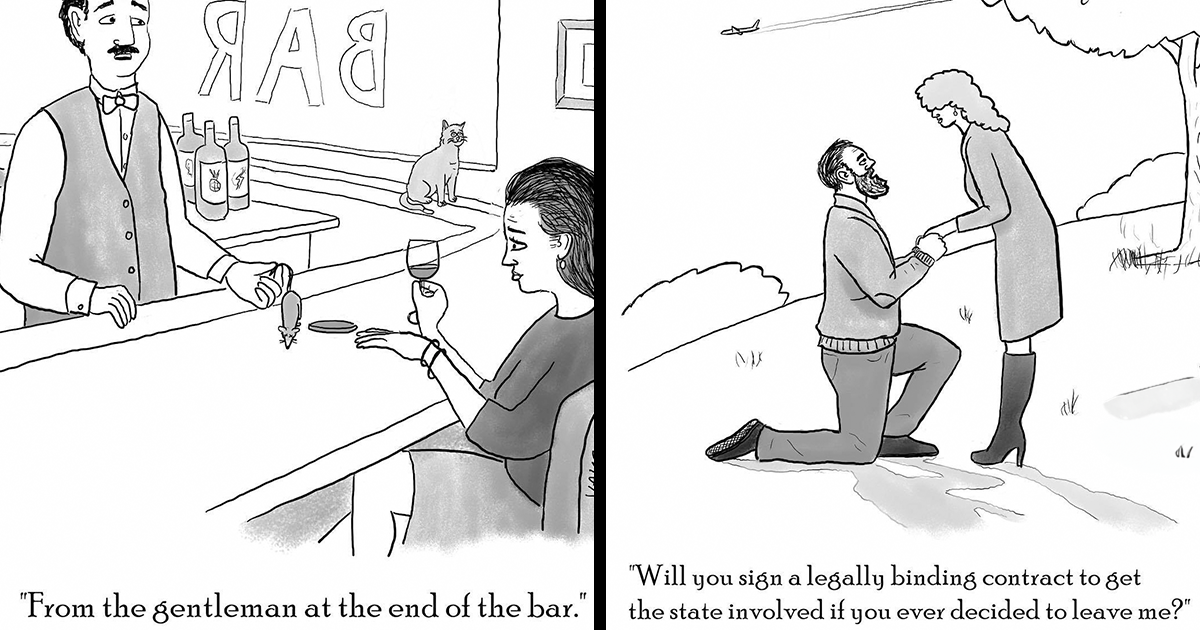
Some comics need a sprawling plot, a heroic journey, and at least one character dramatically staring into the rain. Vaughan Tomlinson’s single-panel comics need far less real estate. One frame, one clever setup, one tiny twistand suddenly your coffee is in danger because you laughed at the exact wrong moment.
The charm of 50 Single-Panel Comics That Are Humorous And Silly By Vaughan Tomlinson comes from how quickly the jokes land. These are not comics that ask readers to study a complex universe or memorize a cast of suspiciously marketable characters. They are compact little comedy machines. You look, you process, you grin, and then you realize the joke has quietly rearranged your brain furniture.
Vaughan Tomlinson is a South African cartoonist and illustrator based in New York City, known for a style that blends observational humor, surreal situations, deadpan dialogue, and everyday absurdity. His work has appeared across major publications and humor platforms, including outlets associated with magazine cartoons, editorial illustration, and digital comic culture. His ongoing comic work, especially the single-panel series Oddly Enough, shows a sharp instinct for turning ordinary life into something delightfully sideways.
In other words, Tomlinson takes the world we knowoffices, families, animals, social habits, awkward conversations, tiny failures, big egosand adds just enough nonsense to make it feel more honest. Sometimes the silliest version of life is also the most accurate one.
Why Single-Panel Comics Still Work So Well
Single-panel comics are the espresso shots of visual comedy: small, intense, and capable of waking up the room. Unlike comic strips, which build humor through multiple beats, a one-panel cartoon must do almost everything at once. The artwork establishes the scene, the caption or dialogue delivers the twist, and the reader supplies the final spark of understanding.
That compression is what makes the form so satisfying. A good single-panel cartoon does not simply tell a joke; it creates a tiny world where the joke becomes inevitable. The reader sees the setup and punchline together, but the mind still experiences a split-second journey. First comes recognition. Then confusion. Then the click. Then laughter, or at least the dignified nose-exhale we pretend is not laughter while scrolling at work.
Tomlinson’s comics fit neatly into this tradition. They often use clean compositions, expressive characters, and a calm visual tone that makes the absurdity even funnier. The joke rarely screams. It politely taps you on the shoulder, hands you a ridiculous idea, and walks away before you can ask follow-up questions.
Who Is Vaughan Tomlinson?
Vaughan Tomlinson is a cartoonist and illustrator whose work sits comfortably in the world of magazine-style humor. He is associated with New York’s cartooning scene and has built a recognizable voice through single-panel cartoons, editorial gags, and illustrated humor. His cartoons have been connected with respected publications and platforms such as The Guardian, The Times, The Wall Street Journal, Reader’s Digest, Private Eye, The Oldie, Weekly Humorist, Air Mail, Alta, Comics Kingdom, CartoonStock, and others.
That range matters because Tomlinson’s humor has the flexibility to travel. Some cartoonists are strongest in one narrow lane: political satire, workplace jokes, animal humor, or social commentary. Tomlinson’s strength is broader. He can joke about modern life without sounding like a lecture, use silliness without becoming random, and add a surreal twist without making readers feel as though they have accidentally opened a philosophy textbook written by a raccoon.
His series Oddly Enough captures much of that spirit. The title itself is a useful description of his comic universe. Things are odd, yes, but oddly understandable. A strange situation appears, and instead of rejecting it, the reader thinks, “Actually, that makes a dangerous amount of sense.”
What Makes These 50 Comics Humorous And Silly?
The phrase “humorous and silly” may sound simple, but in Tomlinson’s work it points to a smart kind of comedy. His silliness is not careless. It is structured, timed, and balanced. The jokes often begin with familiar settings: a conversation, a domestic moment, a professional situation, a social ritual, or a classic cartoon scenario involving animals, history, monsters, ghosts, or people behaving with the confidence of someone who absolutely should have read the instructions.
Then comes the twist. A character misunderstands reality. A normal phrase becomes literal. A social habit is exaggerated until it looks ridiculous. A creature behaves like an office employee. A human behaves like a creature. A situation that should be dramatic becomes weirdly administrative. A tiny caption shifts the entire meaning of the drawing.
That is the secret sauce. Tomlinson does not merely draw funny-looking characters and hope the eyebrows carry the joke. He uses the relationship between image and language. The art sets up a visual expectation; the caption nudges that expectation off a curb. The reader enjoys the fall.
The Beauty Of The One-Frame Punchline
In a single-panel comic, there is no room for filler. Every element must earn its keep. The character’s posture, the setting, the facial expression, the prop in the corner, the wording of the lineeverything contributes to the joke’s tiny ecosystem.
Tomlinson’s panels often feel calm on the surface. That calmness makes the absurdity sharper. A character might respond to a bizarre problem as if it were routine. A strange scene may be presented with the emotional temperature of a dentist confirming your appointment. This deadpan quality is one reason the humor works so well. The cartoon does not beg the reader to laugh. It simply opens the door and lets the absurdity enter wearing sensible shoes.
Many of the best single-panel cartoons depend on restraint. If the drawing is too busy, the joke gets buried. If the caption explains too much, the joke suffocates. Tomlinson’s style usually avoids both problems. He trusts the reader to connect the dots, which is always flattering. Readers enjoy feeling clever, even when the cleverness arrives because a cartoon goat said something unexpectedly profound.
Everyday Absurdity: Tomlinson’s Favorite Playground
One reason Tomlinson’s comics are so shareable is that they turn everyday absurdity into quick comedy. Modern life is packed with small contradictions. We want convenience but hate being interrupted. We demand authenticity while editing our personalities for public consumption. We seek peace, then voluntarily read comment sections. We treat technology like magic until it asks us to update a password, at which point civilization collapses.
Tomlinson’s comics often capture that feeling. They do not need to mention every trend directly. Instead, they approach human behavior from an angle. A joke about a relationship may also be a joke about communication. A cartoon about an animal may quietly mirror office politics. A historical or fantasy setup may reveal something painfully modern. The silliness becomes a disguise for observation.
This is why the cartoons can feel light and sharp at the same time. They are easy to read but not empty. Beneath the goofy surface is a clear sense that people are strange little engines of contradiction. We want to be wise, cool, efficient, loved, organized, original, and relaxed. We also forget why we walked into the kitchen. Tomlinson’s comedy lives in that gap.
Why Readers Love Collections Like This
A collection of 50 single-panel comics gives readers the pleasure of variety without demanding a long commitment. Each cartoon is a separate joke, so the experience feels snackable. You can read three and return later. Or, more realistically, you can tell yourself you will read three, then look up twenty minutes later wondering why your lunch break has become a cartoon festival.
The format also works beautifully online. Digital readers scroll quickly, and a single-panel comic can stop that scroll with one strong image. The joke is immediate. The visual impact is clear. The caption is short enough to digest before the next notification tries to steal your soul.
For SEO and user experience, humor collections have another advantage: they encourage engagement. Readers often compare favorites, share panels with friends, and return to the page when they want a quick mood lift. A funny one-panel comic is portable. It can travel across social feeds, messages, newsletters, and office chats where someone says, “This is literally us,” even when the cartoon features two medieval knights discussing branding strategy.
The Role Of Silliness In Smart Comedy
Silliness is sometimes underrated because it looks easy. Anyone can be random. Not everyone can be funny. Good silly comedy has internal logic, even when the surface is ridiculous. It creates a world where the absurd premise feels natural enough for the punchline to land.
Tomlinson’s cartoons often understand this perfectly. The situation may be strange, but the emotional truth is familiar. A character may be in an impossible scene, but the embarrassment, frustration, pride, confusion, or tiny social panic feels real. That blend of unreal setup and real feeling is what gives the cartoons their comic snap.
Think of it as serious craftsmanship wearing a fake mustache. The joke looks casual, but the timing is precise. The best single-panel cartoons feel effortless only because the hard work is hidden. The artist has to decide what to show, what to omit, how much context to give, and where the reader’s attention should land first. A weak single-panel cartoon is a sentence with a doodle. A strong one is a trapdoor.
Visual Style: Simple Enough To Read, Expressive Enough To Remember
Tomlinson’s visual style supports the humor rather than competing with it. His characters are expressive, but the expressions rarely feel overcooked. The lines and compositions are typically clear enough for instant reading, which is essential in one-panel cartooning. The goal is not to dazzle readers with decorative overload. The goal is to deliver the joke cleanly and make the absurd world feel alive.
That does not mean the art is plain. On the contrary, the strongest cartoon art often looks simple because it has been refined. A face can communicate defeat with a few marks. A slouch can tell a whole story. A raised eyebrow can do the emotional work of a courtroom monologue. In single-panel comics, clarity is not a limitation. It is the engine.
Tomlinson also uses familiar cartoon settings effectively. Domestic interiors, offices, natural environments, fantasy scenes, waiting rooms, historical moments, and social spaces all become stages for comedy. The setting gives the reader a quick entry point. The punchline then turns that entry point into a surprise exit.
Humor That Feels Both Modern And Classic
One of the interesting qualities of Tomlinson’s work is that it feels modern without being trapped in a single news cycle. Many of the jokes could sit comfortably beside classic magazine cartoons because they rely on human behavior rather than disposable references. At the same time, the tone feels current: dry, self-aware, lightly absurd, and aware of how strange everyday life has become.
This balance helps explain why his cartoons appeal to a wide audience. Readers who enjoy old-school single-panel humor can appreciate the clean setup and punchline. Readers who live online can enjoy the quick delivery and relatable weirdness. The cartoons do not require a manual. They simply reward attention.
That is a rare skill. Topical jokes can expire quickly. Purely random jokes can fade after one glance. Observational absurdity lasts longer because humans remain impressively committed to being ridiculous. As long as people continue having meetings, relationships, pets, ambitions, anxieties, passwords, and opinions, cartoonists like Tomlinson will have material.
Examples Of Themes Readers May Notice
1. Social Awkwardness
Many single-panel comics thrive on awkwardness because awkwardness is universal. Tomlinson often finds comedy in the small gaps between what people say and what they mean. A polite exchange can become hilarious when the context is slightly wrong. A casual remark can reveal a character’s entire personality, which is efficient and mildly terrifying.
2. Animals Acting Human
Cartoon animals have always been excellent comedy partners. They allow artists to exaggerate human habits from a safe distance. When animals negotiate, complain, flirt, panic, or overthink, readers recognize themselves while enjoying the emotional protection of fur, feathers, or scales.
3. Office And Work Culture
The modern workplace is a buffet of absurdity. Meetings, performance reviews, team-building language, productivity rituals, and corporate optimism all provide fertile ground for comedy. Tomlinson’s style is well suited to this territory because he can make a businesslike situation feel faintly unhinged without losing the joke’s neatness.
4. History, Myth, And Fantasy
Another common pleasure in single-panel cartoons is taking grand settings and giving them ordinary concerns. Mythological figures, ancient people, monsters, ghosts, or fairy-tale characters can become funny when they behave like modern humans. The contrast does the heavy lifting, and the caption seals the deal.
5. Tiny Emotional Truths
Some of the best silly cartoons work because they contain a tiny emotional truth. They capture insecurity, overconfidence, boredom, confusion, jealousy, denial, or the universal desire to look competent while internally making dial-up modem noises. Tomlinson’s humor often lands because it recognizes these moments without making a speech about them.
Why Vaughan Tomlinson’s Comics Are Great For A Quick Mood Reset
There is a reason readers turn to funny comics during stressful days. Humor gives the brain a small reset. It interrupts tension, reframes frustration, and reminds us that the world is not only a place of deadlines, bills, and mysterious refrigerator smells. It is also a place where a single drawing can make an entire afternoon feel lighter.
Tomlinson’s cartoons are particularly good for this because they are quick without feeling disposable. You do not need to prepare yourself. You do not need to catch up on lore. You simply arrive, accept the premise, enjoy the twist, and leave a little happier. That is a valuable service. Not every piece of art needs to change your life. Some art just needs to rescue five minutes of your day from becoming soup.
Experience Section: Reading 50 Vaughan Tomlinson Comics In One Sitting
Reading a large batch of Vaughan Tomlinson’s single-panel comics is a little like attending a party where every guest is strange, charming, and suspiciously good at one-liners. At first, you think you know what to expect. A funny drawing appears. A caption delivers the joke. You smile. Simple enough. Then the next cartoon arrives from a completely different angle, and suddenly you are laughing at a social situation involving characters who should not logically be having that conversation at all.
The experience is enjoyable because the rhythm keeps changing. Some panels hit with a clean verbal twist. Others rely more on visual contrast. Some feel like tiny social commentaries. Others are gloriously silly in the way only a confident cartoon can be. The collection does not need a grand narrative arc. The arc is emotional: curiosity, surprise, recognition, laughter, repeat.
One of the best parts of reading these comics is noticing how fast your brain becomes trained to look for the turn. You start scanning the image, hunting for the detail that will unlock the joke. Is it the character’s expression? The setting? The object in the corner? The wording of the caption? The fun comes from that little detective moment. You are not just receiving a joke; you are solving it. Fortunately, nobody gives you a badge, because that would make explaining your afternoon to coworkers more difficult.
Another relatable experience is choosing favorites. With a 50-comic collection, readers naturally start ranking panels in their heads. One joke may win because it feels clever. Another may win because it is perfectly dumb in the best possible way. Another may feel painfully accurate, the kind of cartoon you send to a friend with the message, “Unfortunately, this is us.” That shareability is part of Tomlinson’s appeal. His comics often feel personal without being specific. They capture patterns of behavior we recognize from ourselves, our friends, our families, our colleagues, and possibly that one neighbor who treats recycling bins like a competitive sport.
For writers, artists, marketers, and content creators, there is also a lesson in Tomlinson’s work: simplicity is powerful when it is precise. A single-panel comic has no room to ramble. It must make choices. The idea has to be clear, the setup has to be immediate, and the punchline has to reward the reader. That same principle applies to blog writing, social media captions, headlines, product copy, and even emails. Say the thing cleanly. Remove the clutter. Let the twist land.
Personally, the most enjoyable part of spending time with these comics is the way they make ordinary life feel newly ridiculous. After reading enough of them, normal situations start to look like potential cartoons. A printer jam becomes a tragedy in three facial expressions. A supermarket checkout line becomes a study in human patience. A calendar invite with no agenda becomes modern horror. Good humor changes how you see things, and Tomlinson’s cartoons do that without shouting. They simply invite you to notice how much comedy is already hiding in plain sight.
That is the lasting experience of 50 Single-Panel Comics That Are Humorous And Silly By Vaughan Tomlinson. The collection is not just a gallery of quick jokes. It is a reminder that silliness can be intelligent, that short-form comedy can have craft, and that one panel can contain an entire little universe. Sometimes the world does not need a long explanation. Sometimes it needs one excellent cartoon and a caption sharp enough to trip over.
Conclusion
Vaughan Tomlinson’s single-panel comics prove that humor does not need to be loud, long, or overloaded to be memorable. With a clean visual setup, a smart caption, and a wonderfully odd perspective, his cartoons turn everyday situations into miniature comedy events. The silliness is part of the intelligence. The absurdity is part of the truth.
For readers who enjoy funny one-panel cartoons, clever visual jokes, silly comics, and observational humor with a surreal edge, Tomlinson’s work is an easy recommendation. These 50 comics offer quick laughs, but they also show the discipline behind short-form cartooning. Every panel has to work fast. Every line has to matter. Every joke has to earn its tiny square of space.
And when it all works, the result is delightful: a brief pause in the day, a sudden grin, and the comforting realization that life may be absurdbut at least someone is drawing it properly.
Note: This original article is based on publicly available information about Vaughan Tomlinson’s cartooning career, his single-panel humor, and the broader tradition of magazine-style comics. It does not reproduce or quote the original comics.














