
SaaS growth looks glamorous from the outside. Revenue climbs, the team expands, investors smile for photographs, and somebody inevitably orders a neon sign for the office. Behind the scenes, however, scaling a software company involves constantly rebuilding the organization while customers, competitors, and quarterly targets continue moving.
That tension made the scaling sessions at SaaStr Annual 2021 especially valuable. Held in the San Francisco Bay Area, the three-day event brought together thousands of SaaS founders, executives, investors, and operators for tactical discussions about growth, product development, sales, customer success, and leadership. The program included more than 100 sessions and hundreds of speakers, but several presentations stood out for addressing the less glamorous machinery behind sustainable SaaS growth.
The following six SaaStr Annual 2021 sessions form a practical scaling curriculum. Together, they cover organizational design, sales execution, employee development, engineering culture, retention, pricing, international expansion, and subscription analytics. In other words, nearly everything that starts creaking when a startup discovers that “just hire more people” is not actually a strategy.
Research basis:
Why These SaaStr Annual 2021 Scaling Sessions Still Matter
The technology market has changed since 2021, but the fundamental problems of SaaS scaling have not. Companies must still decide when to hire executives, how quickly to expand a sales team, which customer segments deserve investment, and whether their pricing model captures the value their product creates.
The strongest sessions did not treat growth as a single number. They showed that annual recurring revenue is an output produced by an interconnected system. Product quality affects adoption. Adoption affects retention. Retention affects customer lifetime value. Culture affects product quality. Hiring affects all of the above and, when handled badly, can affect the office snack budget with frightening speed.
A useful way to read these sessions is not as six isolated presentations, but as six parts of the same operating model. David Sacks explains what the organization may need to look like. Mark Roberge explains how not to drive the sales organization into a ditch. Wade Foster and Scott Voigt examine the people and engineering systems that support growth. Karen Peacock shows how customer and revenue data reveal the next growth opportunity. Adam Tesan then expands the view to pricing, markets, churn, and business-model evolution.
1. The SaaS Org Chart by Series With David Sacks
Presented by: David Sacks, General Partner at Craft Ventures
Scaling Requires a Different Organization at Every Stage
David Sacks’ masterclass tackled a deceptively simple question: What should a SaaS organization look like as it moves from Series A to Series B, Series C, and eventually an IPO?
His framework offered approximate benchmarks rather than commandments carved into a venture-capital tablet. A Series A SaaS company might have roughly 40 to 50 employees, while a Series B organization could grow to approximately 100 to 125. By Series C, the business might employ 300 to 400 people, with much more specialization across product, engineering, sales, marketing, customer success, finance, and operations.
The lesson was not that founders should copy a diagram box by box. It was that organizational structure must evolve with the complexity of the business. At Series A, department heads and individual contributors may report directly to the CEO. By Series B, functional teams require experienced executives and middle managers. At Series C, the company needs a more complete leadership team, specialized roles, international capabilities, and clearer layers of accountability.
Do Not Hand Out Grand Titles Like Party Favors
One particularly practical recommendation involved executive titles. Early employees may be excellent leaders for the company’s current stage without necessarily being ready to run a 200-person department later. Using flexible titles such as “Head of Sales” can preserve room for future promotions or outside executive hires.
Sacks also emphasized keeping product leadership close to the founder or CEO. For product-driven SaaS businesses, product management should not disappear inside engineering. The founder must remain connected to customer problems, product priorities, and the company’s long-term vision.
Core takeaway: Build the organization needed for the next stage, not the imaginary global empire featured in your most enthusiastic investor deck.
Session sources:
2. The Most Common SaaS Sales Potholes With Mark Roberge
Presented by: Mark Roberge, Managing Director at Stage 2 Capital and former HubSpot CRO
More Salespeople Do Not Automatically Create More Sales
Mark Roberge’s session examined six common mistakes that damage SaaS sales performance. His message was wonderfully inconvenient: Many growth problems cannot be fixed by hiring another battalion of account executives.
One pothole is the traditional sales compensation plan. Paying representatives primarily for new logos can encourage large initial contracts that customers never fully adopt. Poor utilization then increases the risk of contraction or churn. A healthier compensation structure can reward expansion revenue and long-term customer value, aligning the sales team with the economics of recurring revenue.
Roberge also warned against raising prices without a sustainable competitive moat. Higher contract values look delightful in a spreadsheet, but an unsupported price increase may lengthen sales cycles, reduce close rates, and invite cheaper competitors. A stronger approach is often to begin with an accessible entry point and expand revenue as the customer receives more value.
Confirm Product-Market Fit Before Pressing the Accelerator
Another major mistake is prioritizing acquisition before customer value. Retention is one of the clearest measurements of product-market fit, but because it is a lagging indicator, founders should identify an earlier behavioral signal that predicts long-term use.
Only after the company has evidence of product-market fit and a repeatable go-to-market motion should it scale sales hiring. Roberge suggested adding representatives gradually and monitoring ramp time, productivity, retention, and unit economics instead of hiring a huge team immediately after a funding round.
He also challenged the common practice of promoting the best salesperson into management. Great representatives close deals; great managers recruit, coach, forecast, and develop other people. Occasionally one person can do both, but the transformation should be tested rather than assumed.
Core takeaway: Scale a proven sales system. Hiring faster merely helps an unproven system lose money with greater enthusiasm.
Session source:
3. The Secrets to Scaling Zapier to 500 Employees
Presented by: Wade Foster, Co-Founder and CEO of Zapier
Early Employees Often Hold the Best Scaling Lessons
Wade Foster built his presentation around advice collected from 20 of Zapier’s earliest employees. The result was less like a polished executive manifesto and more like a practical field manual written by people who had personally watched systems break, teams reorganize, and yesterday’s clever workaround become tomorrow’s essential infrastructure.
Several lessons centered on imperfection. Early-stage teams should create solutions that get them most of the way to the goal instead of overengineering a flawless system. During hypergrowth, an organizational solution may remain useful for only six months. That is not necessarily failure; it is evidence that the company has changed.
Zapier’s experience also highlighted the importance of hiring and onboarding. Team members need clear evaluation standards, new hires must understand the company’s values, and onboarding should include opportunities to work closely with experienced colleagues. In a distributed organization, documentation and asynchronous communication become operational infrastructure rather than optional administrative hobbies.
Keep Employees Connected to Customers
Zapier historically exposed employees across the organization to customer support. This helped people understand how the product was actually used and where customers experienced friction. The practice reinforces a useful scaling principle: The larger a company becomes, the easier it is for employees to become experts in internal processes while knowing surprisingly little about the customer.
Other employee lessons included measuring outcomes rather than visible effort, delegating as teams grow, hiring experienced but still hands-on leaders, preserving values while changing operating mechanics, and avoiding unnecessary hiring without a clear six-month plan for each role.
Core takeaway: Systems will change repeatedly, but strong values, customer exposure, documentation, and thoughtful onboarding give employees a stable foundation.
Session and supporting sources:
4. When Great Code Meets Great Culture With FullStory
Presented by: Scott Voigt, Co-Founder and CEO of FullStory
Engineering Quality Is a Team Behavior
Scott Voigt’s FullStory session connected two subjects that companies often discuss separately: technical quality and organizational culture. In practice, they constantly shape one another. Code is not produced in a vacuum by mysterious keyboard wizards. It reflects how teams communicate, review decisions, share context, handle mistakes, and balance speed against reliability.
FullStory’s documented engineering practices provide a useful example. The company adopted pre-commit code reviews not simply to catch bugs, but to share knowledge and establish common quality standards. A thoughtful review process helps engineers understand why a decision was made, gives junior employees access to experienced perspectives, and reduces the number of critical systems understood by only one heroicand probably exhausteddeveloper.
The broader lesson is that culture should appear inside daily workflows. A company cannot claim to value collaboration while rewarding people for guarding information. It cannot claim to value customers while treating usability problems as somebody else’s department. It cannot claim to value quality while making every deadline an emergency.
Create a Product Flywheel Around Empathy
FullStory’s approach also emphasizes collaboration among engineering, product, design, and customer-facing teams. Engineers who understand the user’s experience make better trade-offs. Designers who understand technical constraints create more realistic solutions. Product leaders who combine behavioral data with qualitative context can prioritize problems with greater confidence.
This creates a flywheel: Better collaboration produces better code; better code produces a more reliable product; the product generates clearer customer insight; and those insights guide the next round of improvements.
Core takeaway: Engineering culture is not office décor for developers. It is a production system that determines how quickly a company can learn without filling every release with exciting new emergencies.
FullStory session and company-practice sources:
5. Shifting to the Next Gear With Intercom CEO Karen Peacock
Presented by: Karen Peacock, CEO of Intercom
Company-Wide Averages Can Hide the Real Story
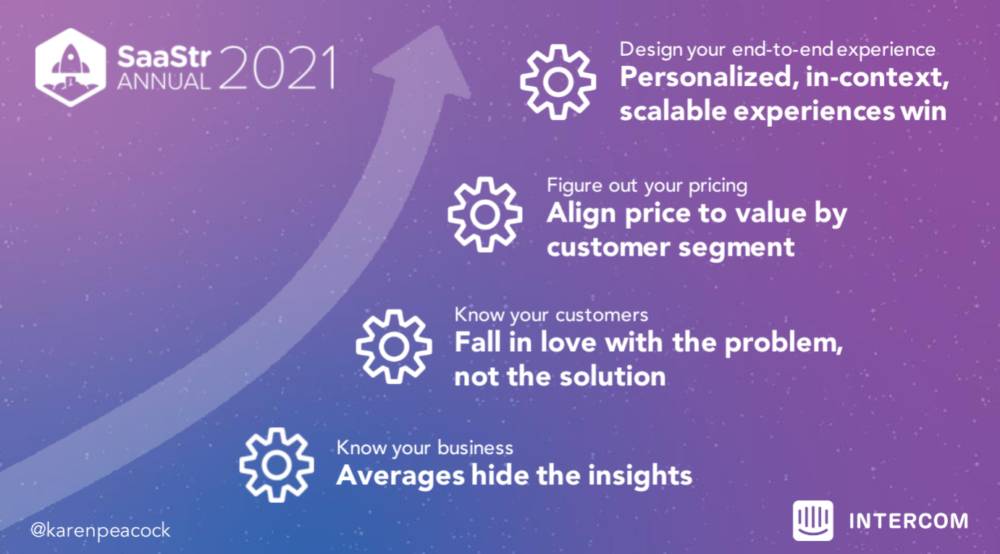
Karen Peacock’s session focused on turning good revenue growth into great revenue growth. Her first recommendation was to understand the business at a deeper level than total ARR.
Founders should examine gross revenue retention and net revenue retention, then segment those metrics by product, customer size, geography, buyer type, or sales motion. A healthy company-wide average may conceal one high-performing segment and another quietly leaking customers through a hole large enough to accommodate the entire customer success team.
Segment-level analysis allows leaders to identify where retention, expansion, or acquisition is strongest. The company can then invest in attractive segments, repair weak experiences, reconsider packaging, or stop pursuing customers who are unlikely to succeed with the product.
Study Customer Behavior, Not Just Customer Requests
Peacock illustrated the danger of taking customer requests too literally with an example from her time at Intuit. Customers asked for budgeting functionality, but the resulting tool received little use. By examining behavior, the team discovered that the underlying problem involved paying and reconciling bills. A cash-management solution addressed the actual need more effectively.
The principle is simple: Fall in love with the customer’s problem rather than a particular solution. Surveys tell teams what customers say. Behavioral data can reveal what customers repeatedly struggle to accomplish.
Align Pricing, Packaging, and Customer Value
Intercom’s pricing framework began with the value metric, such as contacts, storage, seats, transactions, or API usage. The next layer was packaging: grouping capabilities into offers suited to distinct customer segments. Only then should the company establish the price.
Peacock also emphasized designing an end-to-end customer experience. Marketing, sales, onboarding, product use, support, renewal, and expansion should feel like one connected journey. Retention is not a customer success department’s solo performance; it is the cumulative result of every customer interaction.
Core takeaway: Sustainable growth comes from understanding which customers succeed, what they are trying to accomplish, and how the entire business helps them reach that outcome.
Session source:
6. Mastering Hypergrowth With Chargebee CRO Adam Tesan
Presented by: Adam Tesan, then Chief Revenue Officer at Chargebee
Five Levers for Sustained SaaS Growth
Adam Tesan’s Chargebee session expanded the discussion from internal execution to the commercial levers that sustain hypergrowth. The framework centered on five strategies: experimenting with pricing, entering global markets, expanding revenue while reducing churn, using subscription analytics to improve operational rigor, and adapting the business model as the market changes.
Pricing experimentation matters because a SaaS company’s original plans rarely remain perfect as the product and customer base evolve. Teams should test packaging, value metrics, contract structures, and add-ons rather than treating the pricing page as a historic monument that may not be disturbed.
International growth can significantly expand the addressable market, but it requires more than translating a homepage. Companies must consider currencies, payment methods, taxes, regulations, billing expectations, customer support, and local purchasing behavior.
Retention and Expansion Must Share the Stage With Acquisition
Hypergrowth is easier when existing customers generate additional revenue. Cross-selling, upselling, usage growth, add-ons, and upgraded plans can raise net revenue retention while reducing dependence on new-logo acquisition.
Subscription analytics help operators see where growth is coming from and where revenue is disappearing. Leaders should monitor churn by segment, expansion revenue, failed payments, plan performance, customer lifetime value, and cohort behavior. Without those details, a company may celebrate rising ARR while ignoring deteriorating economics underneath it.
Finally, the business model must remain adaptable. Customer expectations, competitive pressure, and product usage may justify a move toward usage-based pricing, hybrid subscriptions, new acquisition channels, or entirely new packages.
Core takeaway: Hypergrowth is not a single campaign. It is a coordinated system of pricing, localization, retention, analytics, and business-model experimentation.
Session and supporting sources:
What the Six Scaling Sessions Have in Common
Although the speakers approached scaling from different disciplines, their recommendations share several themes.
Scale Evidence, Not Optimism
Before expanding a team, confirm that the underlying motion works. Before raising prices, confirm that customer value supports the increase. Before entering another market, confirm that billing and support can handle it. Enthusiasm is useful for rallying a team, but it is not a replacement for retention data.
Design for the Current Stage
A Series A company should not operate like a public corporation. Processes should be strong enough for current needs but flexible enough to change. The goal is not to eliminate future reorganization. The goal is to avoid making every reorganization feel like an unscheduled natural disaster.
Treat Retention as a Company-Wide Metric
Sales compensation, onboarding, engineering quality, customer support, pricing, and product design all influence retention. A recurring-revenue company cannot separate customer value from growth because the customer gets another opportunity to reconsider the relationship at every renewal.
Build Learning Into the Operating System
The most durable advantage may be the ability to learn faster. Code reviews share technical knowledge. Customer support exposes teams to user problems. Segmented revenue analysis reveals promising markets. Pricing experiments test willingness to pay. Strong organizations do not merely execute a plan; they continuously improve the plan.
Practical Experience: Applying the SaaStr 2021 Scaling Lessons
The most useful way to apply these sessions is to imagine a growing SaaS company somewhere between early traction and repeatable scale. It has a promising product, several enthusiastic customers, a recent funding round, and a leadership team now receiving 47 Slack messages before breakfast.
The first temptation is usually premature complexity. The founders see the SaaS org chart and immediately begin recruiting vice presidents for departments that currently contain two people and a shared spreadsheet. A better application of the David Sacks framework is to identify the functions that must exist, assign clear ownership, and delay unnecessary hierarchy. Titles should reflect real responsibility rather than the founder’s desire to make the careers page look impressively crowded.
The second temptation arrives after funding: Hire salespeople as quickly as possible. Mark Roberge’s framework suggests running a controlled scaling test instead. Add a small number of representatives, measure how quickly they become productive, and determine whether pipeline generation can support them. When new hires repeatedly miss quota because there are not enough qualified opportunities, the problem is probably not a mysterious shortage of motivational speeches.
Next comes operational strain. The onboarding process that worked for 12 employees becomes chaotic at 40. Zapier’s experience suggests creating a functional version quickly, documenting it, assigning owners, and planning to revisit it. Companies often waste months designing a “permanent” process for an organization that will look completely different by the next quarter.
Engineering teams experience a similar problem. As deadlines multiply, code reviews and design discussions can appear to slow delivery. In reality, eliminating them may create a brief burst of speed followed by duplicated work, fragile systems, and developers spending Friday evening investigating why the billing service believes every customer lives in Antarctica. FullStory’s example shows how quality practices can improve both technical reliability and shared understanding.
Customer and revenue analysis should then guide the next investment. Suppose overall net revenue retention is 108 percent. That sounds healthy until the business discovers that enterprise customers retain at 125 percent while small agencies retain at 72 percent. Karen Peacock’s segmentation approach turns a comforting average into an actionable decision. The company can improve the small-agency experience, redesign that package, or concentrate resources on the enterprise segment.
Finally, Chargebee’s framework encourages the company to look beyond acquisition. Perhaps international demand is increasing, but customers abandon checkout because local payment methods are unavailable. Perhaps the entry plan is popular but contains no natural expansion path. Perhaps usage data supports a hybrid pricing model. Each issue represents a growth opportunity that does not require purchasing another truckload of advertising impressions.
The practical experience across all six sessions is that scaling works best as a sequence of measured experiments. Add capacity, observe the result, improve the system, and repeat. The companies that struggle are often not moving too slowly. They are moving quickly without enough feedback, which is simply a more energetic way to become lost.
Conclusion
The top scaling sessions from SaaStr Annual 2021 offered a clear warning against growth theater. A larger team, a more expensive product, and a rapidly rising sales budget may create the appearance of scale without building a scalable company.
Real SaaS scaling requires an organization appropriate for its stage, a repeatable sales model, disciplined hiring and onboarding, a culture that supports technical quality, deep customer understanding, strong retention, and a willingness to experiment with pricing and business models.
The six speakers approached the subject from different angles, but their collective message was consistent: Growth becomes sustainable when customer value, employee capability, and operational discipline improve together. Revenue is the scoreboard. The systems behind it are the game.
Note: Session titles and speaker roles in this article reflect the SaaStr Annual 2021 program. The analysis also incorporates official session recaps and related company materials available after the event.














