Outdoor lighting should create ambiance, not a nightly expedition involving slippers, mosquitoes, and a desperate search for the correct extension cord. The best outdoor smart plugs of 2025 let you control patio lights, holiday decorations, fountains, pumps, and other compatible devices from an app, a voice assistant, or an automatic schedule.
Unlike ordinary indoor smart outlets, outdoor models are designed to resist dust, rain, snow, and temperature swings. The strongest options also offer independently controlled outlets, sunset-based routines, dependable wireless connections, and enough electrical capacity for common yard equipment.
This guide compares six standout products using manufacturer specifications, independent product evaluations, ecosystem compatibility, weather resistance, app quality, and everyday usability. Smart plugs are best suited to devices that resume operation when power is restored, such as string lights, simple fountains, and many holiday displays. Appliances requiring another button press after receiving power may remain stubbornly “dumb,” no matter how smart the plug claims to be.
The Best Outdoor Smart Plugs of 2025 at a Glance
| Outdoor Smart Plug | Best For | Outlets | Weather Rating | Smart-Home Support |
|---|---|---|---|---|
| TP-Link Tapo P400M | Best overall | 2, independently controlled | IP65 | Matter, Apple Home, Alexa, Google Home, SmartThings |
| TP-Link Kasa EP40 | Best value | 2, independently controlled | IP64 | Alexa, Google Assistant |
| Wyze Plug Outdoor | Best for energy monitoring | 2 | IP64 | Alexa, Google Assistant |
| Lutron Caséta PD-15OUT | Best for dependable whole-yard control | 1 | IP65 | Lutron, Alexa, Apple Home, Google Home through hub |
| Ring Outdoor Smart Plug | Best for Ring households | 2, independently controlled | IP66; IP64 while in use | Ring, Alexa |
| Kasa KP405 Outdoor Dimmer | Best for dimmable outdoor lights | 1 | IP64 | Alexa, Google Assistant, SmartThings |
How We Chose the Best Outdoor Smart Plugs
A good outdoor Wi-Fi plug must do more than survive a light drizzle and respond when the moon is in the correct phase. We prioritized products with clear weather-resistance ratings, recognized electrical certifications, useful automation features, and established smart-home platforms.
Weather Resistance
An IP64 rating generally indicates protection against dust and splashing water, while IP65 adds resistance against water jets. Neither rating means a device should be submerged, placed in standing water, or installed with its outlets pointing toward the sky like tiny rain collectors.
Wireless Reliability
Most outdoor smart plugs use 2.4GHz Wi-Fi because it reaches farther than 5GHz and passes through walls more effectively. Some models use a dedicated radio hub instead. The latter approach adds cost but can improve consistency in larger homes or crowded Wi-Fi environments.
Automation and Ecosystem Support
Basic schedules are useful, but sunrise and sunset triggers are better because they automatically adapt as daylight changes throughout the year. Matter-certified products receive extra credit for working across multiple compatible ecosystems. Matter’s multi-admin design can also allow one device to be shared among different smart-home platforms rather than trapping the entire household inside one app.
Outlet Control and Electrical Capacity
Dual-outlet plugs are most useful when each receptacle can be operated separately. Load limits also matter: plugging equipment into a smart outlet does not magically repeal the laws of electricity. Users should compare the connected device’s voltage, amperage, motor rating, and wattage with the plug manufacturer’s specifications.
1. TP-Link Tapo P400M: Best Outdoor Smart Plug Overall
Best for: Most homes, mixed smart-home ecosystems, outdoor lighting, and seasonal decorations.
The TP-Link Tapo P400M is the most complete outdoor smart plug for 2025 because it combines strong physical protection, two independently controlled outlets, long-range Wi-Fi, and Matter certification. It works with Apple Home, Amazon Alexa, Google Home, Samsung SmartThings, and the Tapo app, making it far less likely that a future platform change will turn your smart yard into an expensive collection of ordinary extension cords.
TP-Link rates the P400M at IP65 and lists an operating range from -4°F to 122°F. Its two outlets share a maximum load of 15 amps or 1,800 watts. Dual antennas provide a claimed range of up to 300 feet in an open area, although walls, siding, landscaping, and network congestion will affect real-world performance.
The Tapo app supports schedules, remote control, scenes, away mode, and individual outlet operation. Sunrise and sunset automation is particularly useful for landscape lights because the schedule follows seasonal daylight instead of requiring manual adjustments every few weeks.
Independent reviewers have also praised the P400M’s compatibility, dual outlets, app features, and durable construction. The main physical drawback is its relatively short cable, which may limit placement inside unusually shaped weatherproof outlet covers.
Pros
- Matter-certified for broad smart-home compatibility
- Two outlets with separate controls
- IP65 weather resistance
- Excellent scheduling and automation options
- Strong documented Wi-Fi range
Cons
- Uses 2.4GHz Wi-Fi only
- Short attached power cord
- No built-in energy-monitoring dashboard
2. TP-Link Kasa EP40: Best Value Outdoor Smart Plug
Best for: Shoppers who want dependable dual-outlet control without paying for Matter.
The Kasa EP40 delivers many of the P400M’s core benefits at a frequently lower selling price. It has two independently controlled outlets, requires no hub, and works through the polished Kasa app. Alexa and Google Assistant support cover the two most common voice-control platforms, although Apple Home users should choose a HomeKit- or Matter-compatible alternative.
The EP40 carries an IP64 rating and uses a fire-resistant UL94-V0 polycarbonate shell. Its total maximum load is 15 amps or 1,875 watts, and TP-Link specifies an operating temperature range of -4°F to 122°F. Its built-in wireless amplifier is designed to provide a signal at distances up to 300 feet in open conditions.
Setup is straightforward, and each outlet can have its own timer, schedule, or voice command. That means one side can run string lights after sunset while the other briefly powers a fountain during the afternoon. No more choosing between atmosphere and aquatic enthusiasm.
Consumer Reports has highlighted the EP40 as an outdoor model that is easy to set up and operate. A 2025 CNET-derived roundup also selected it as an especially accessible overall choice based on price and usability.
Pros
- Competitive price
- Two individually controlled outlets
- No hub required
- Reliable Kasa app
- High total load rating
Cons
- No Matter support on the standard EP40
- No native Apple Home compatibility
- IP64 rather than IP65 protection
3. Wyze Plug Outdoor: Best for Energy Monitoring
Best for: Tracking outdoor electricity consumption and creating usage alerts.
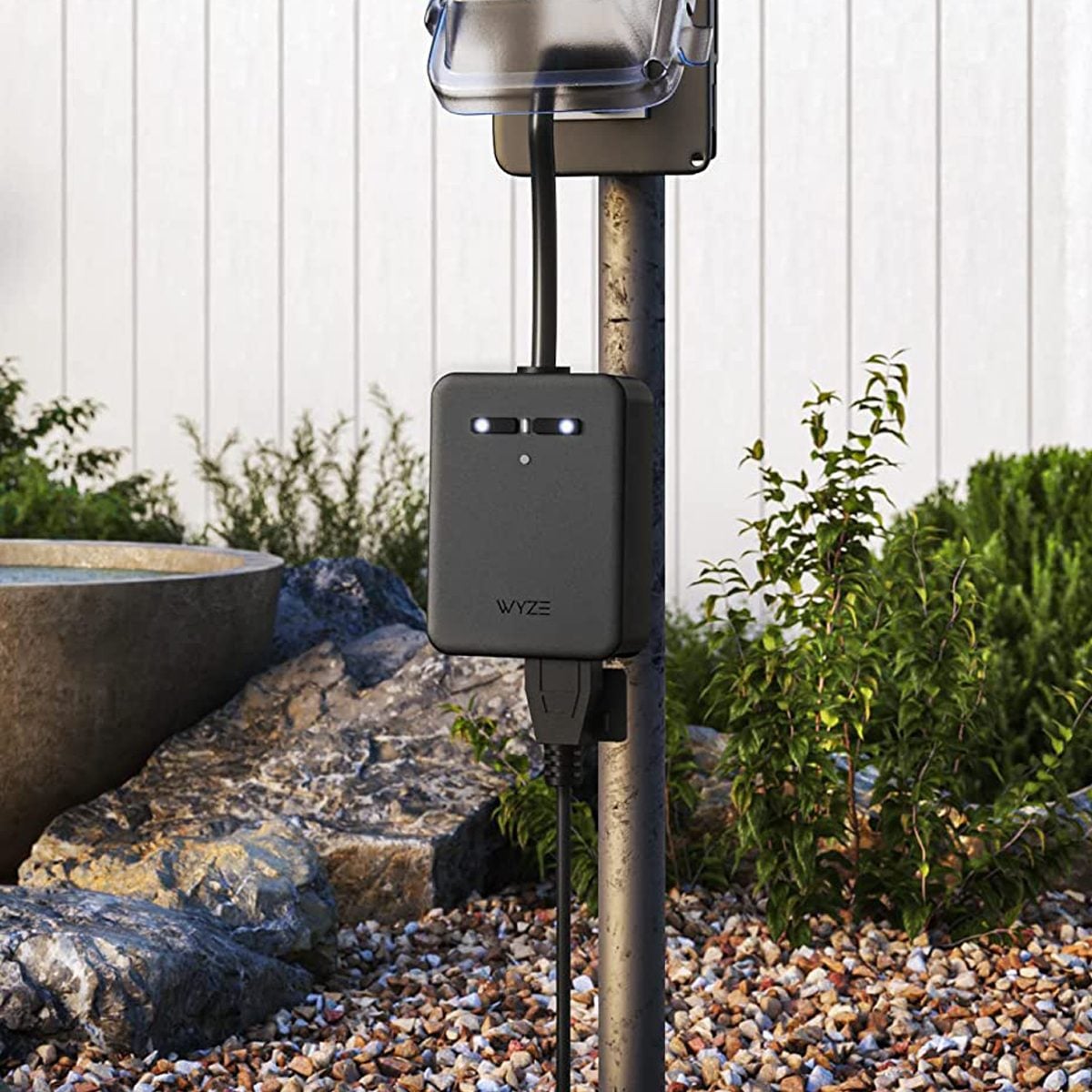
Outdoor smart plugs are often marketed as energy-saving devices, but most simply provide schedules without showing how much electricity a connected device consumes. The Wyze Plug Outdoor goes further with historical energy data and configurable consumption alerts inside the Wyze app.
This feature is valuable for holiday displays, fountains, decorative lighting, and other equipment that quietly runs longer than expected. Energy monitoring cannot reduce a bill by itselfit is a measuring tool, not a tiny accountantbut it can reveal which schedules deserve adjustment.
The Wyze model has an IP64 weather rating, a 15-amp maximum output with overload protection, and support for motors up to one-half horsepower. It operates from -4°F to 120°F and connects over 2.4GHz Wi-Fi. Wyze also claims up to 300 feet of wireless range in open space.
Two outlets provide flexible outdoor control, while schedules and remote operation cover the basics. Alexa and Google Assistant are supported, but there is no native Apple Home or Matter integration. The Wyze app is capable, although buyers who already use another smart-home brand may dislike adding yet another icon to the crowded app drawer.
Pros
- Energy-use history and consumption alerts
- Two outdoor outlets
- Long claimed Wi-Fi range
- Overload protection
- Useful automation for the price
Cons
- No Matter or Apple Home support
- Energy data is mainly useful inside the Wyze ecosystem
- Only 2.4GHz Wi-Fi is supported
4. Lutron Caséta PD-15OUT: Best for Dependable Whole-Yard Control
Best for: Existing Caséta households, large lighting systems, pumps, and users who prioritize reliability.
The Lutron Caséta PD-15OUT is expensive compared with ordinary Wi-Fi plugs, and it offers only one outlet. Why include it? Because Lutron’s Clear Connect radio system has a strong reputation for consistent lighting control without depending on a busy home Wi-Fi network.
The outdoor plug can pair directly with Pico remotes and Caséta motion sensors. Adding a Lutron Smart Hub enables app control, schedules, scenes, remote access, and integrations with major smart-home platforms. A physical Pico remote is surprisingly useful outdoors: guests can operate patio lights without downloading an app, creating an account, or attending a seminar titled “Welcome to My Wi-Fi.”
Lutron uses a solid-core, fully encapsulated construction designed to protect the internal electronics from moisture, dust, and dirt. The unit is IP65 rated and supports lighting loads up to 15 amps, as well as compatible motors and pumps up to one-half horsepower. Lutron recommends outdoor-rated 14-gauge, 15-amp extension cords when an extension is necessary.
The main disadvantages are price, the single outlet, and the hub requirement for full remote functionality. Nevertheless, users already invested in Caséta will find it difficult to beat for predictable operation.
Pros
- Reliable dedicated RF communication
- Rugged IP65 construction
- Works with Pico remotes and motion sensors
- Supports compatible motors and pumps
- Excellent addition to an existing Caséta system
Cons
- Higher purchase price
- Only one outlet
- Smart Hub required for full app and ecosystem features
5. Ring Outdoor Smart Plug: Best for Ring Households
Best for: Homes already using Ring cameras, lighting, sensors, or Alexa routines.
The Ring Outdoor Smart Plug makes the most sense when the Ring app is already the command center for exterior security and lighting. Its two outlets can be controlled independently or together, allowing users to coordinate patio lights, decorations, or other compatible equipment with Ring schedules and Alexa commands.
Ring rates the housing at IP66 when closed and IP64 while connected to devices. The plug supports a combined load of up to 15 amps or 1,875 watts, including compatible one-half-horsepower motor loads. Its operating range runs from -4°F to 122°F.
The physical design is large but practical. A right-angle plug and 6.5-inch cable help it hang below an outdoor outlet enclosure, while large manual controls make it possible to operate each receptacle without reaching for a phone.
The catch is connectivity. Smart controls require a Ring Bridge, and the product is primarily designed for Ring and Alexa rather than Apple Home, Google Home, or broad Matter-based installations. New buyers starting from zero should generally choose Tapo. Existing Ring users, however, gain unified schedules and fewer apps.
Pros
- Two independently controlled outlets
- Strong weather-resistance ratings
- Convenient Ring and Alexa integration
- High combined electrical capacity
- Useful physical outlet controls
Cons
- Ring Bridge required for smart operation
- Large enclosure
- Limited appeal outside the Ring ecosystem
6. Kasa KP405 Outdoor Dimmer: Best for Dimmable Outdoor Lights
Best for: Patio string lights, decorative bulbs, and adjustable outdoor ambiance.
Most outdoor smart plugs operate like digital light switches: fully on or fully off. The Kasa KP405 adds actual brightness control for compatible dimmable lighting. It is an excellent choice for turning bright party lights into subtle dinner lighting without climbing onto a chair or negotiating with a mysterious inline dimmer.
The Kasa app supports remote dimming, schedules, timers, and voice commands through Alexa or Google Assistant. SmartThings integration expands its automation potential, while preset brightness levels make it easy to switch among different scenes.
The KP405 is IP64 rated and operates between -4°F and 122°F. However, it is a specialty lighting controller rather than a general heavy-duty outdoor outlet. Its documented limits include 300 watts for incandescent lighting and 150 watts for compatible LED or CFL loads.
Not every LED string is designed for external dimming. Incompatible products may flicker, buzz, fail to reach low brightness levels, or stage a tiny outdoor disco without permission. Confirm that the connected lights are explicitly marked as dimmable and remain within the KP405’s stated load limits.
Pros
- Real brightness adjustment
- Good scheduling and scene controls
- Alexa, Google Assistant, and SmartThings support
- Weather-resistant design
- Excellent for patio atmosphere
Cons
- Only one outlet
- Lower load limits than general-purpose plugs
- Requires compatible dimmable lights
- No Matter or native Apple Home support
Other Outdoor Smart Plugs Worth Considering
The GE Cync Outdoor Smart Plug is a credible hub-free alternative with two individually controlled outlets, schedules, remote access, and newer Matter-compatible versions. It is especially appealing to households already using Cync bulbs or switches. The Tapo P400M ranks higher because its documented IP65 protection, long-range design, and mature automation tools form a more complete package.
Meross outdoor plugs also deserve consideration from Apple Home users. Several models support HomeKit, Alexa, Google Assistant, and SmartThings, usually at competitive prices. Model names and regional versions can be confusing, however, so buyers should verify that the exact listing supports their preferred ecosystem before ordering.
How to Choose the Right Outdoor Smart Plug
Choose Your Smart-Home Platform First
Matter-certified plugs are the safest choice for households mixing Apple Home, Alexa, Google Home, and SmartThings. A dedicated ecosystem product can still be excellent when the household is already committed to Ring, Lutron, Wyze, or Kasa.
Count the Devices You Need to Control Separately
Two outlets are not automatically useful if they always switch together. For separate lighting zones, decorations, or fountains, confirm that each receptacle appears as an individual device in the app.
Look for Sunset and Sunrise Scheduling
Fixed schedules become inaccurate as daylight changes. Solar-based routines automatically follow local sunset and sunrise times, reducing the need for seasonal adjustments.
Check the Outdoor Outlet Cover
Measure the available space before buying. The smart plug, attached cord, and device plugs must fit without forcing the weatherproof cover against a cable. A right-angle connector or short hanging cord usually works better than a rigid block.
Match the Electrical Rating
Do not assume a 15-amp headline applies to every possible load. Lighting, resistive appliances, transformers, and motor-driven equipment may have different limits. Starting current can also be much higher than normal running current.
Outdoor Smart Plug Safety Tips
Always connect an outdoor smart plug to a properly installed, grounded, GFCI-protected receptacle. Keep outlets facing downward, close unused rubber covers, and prevent plugs or extension-cord connections from resting in snow, puddles, or wet soil.
Use only outdoor-rated extension cords with sufficient amperage and wire gauge. Inspect cables for cuts, crushed insulation, loose connectors, discoloration, or heat damage before each seasonal installation. Electrical-safety organizations also recommend keeping cords away from doors, windows, and locations where they can be pinched or walked on.
Avoid controlling space heaters, grills, high-powered air conditioners, medical equipment, or safety-critical devices with a general smart plug unless both manufacturers explicitly approve the combination. Remote automation is convenient, but “Alexa, start the unattended heater” is not the kind of futuristic sentence homeowners should aspire to say.
Final Verdict
The TP-Link Tapo P400M is the best outdoor smart plug of 2025 for most people. Matter support, IP65 weather resistance, dual independent outlets, broad ecosystem compatibility, and flexible scheduling make it the easiest model to recommend.
The Kasa EP40 is the better value when Matter and Apple Home are unnecessary. Choose the Wyze Plug Outdoor for energy monitoring, the Lutron Caséta PD-15OUT for dependable hub-based control, the Ring Outdoor Smart Plug for an established Ring property, or the Kasa KP405 when dimming is the main attraction.
The right outdoor Wi-Fi plug should disappear into your routine. Once schedules are configured, the yard simply lights up at the correct time, the fountain stops running all night, and holiday decorations switch off before the neighbors begin drafting a petition.
Real-World Experience: What Living With an Outdoor Smart Plug Is Actually Like
The following experience notes summarize common real-world installation and ownership patterns rather than claiming a single controlled laboratory test.
The first surprise is that outdoor smart plug performance often depends more on Wi-Fi placement than on the plug itself. A product may advertise hundreds of feet of open-air range, but most homes contain brick, metal siding, coated windows, insulation, appliances, and at least one wall that apparently moonlights as a radio bunker. Before installing a plug at the far end of a yard, connect a phone to the home’s 2.4GHz network and test the signal in that location with cellular data disabled.
Setup is usually easiest near the router. Pair the plug indoors or at a nearby exterior outlet, install firmware updates, name each receptacle, and create basic schedules before moving it to its final location. This avoids standing in the rain repeatedly tapping “Try Again” while the app insists that the device is definitely, absolutely, spiritually ready to connect.
Naming also matters more than expected. Labels such as “Outdoor Plug One” become confusing when several devices appear in Alexa, Google Home, or Apple Home. Specific names“Patio String Lights,” “Front Shrubs,” or “Fountain Pump”produce more reliable voice commands and make automation screens easier to understand. Avoid giving a plug and its room exactly the same name because some voice assistants respond by asking which identical object you meant.
Sunset scheduling is the feature that creates the greatest everyday improvement. A fixed 6:00 p.m. routine may work in winter but switch lights on while the sun is still shining during summer. Sunset-based automation follows changing daylight automatically. A useful starting point is turning lights on 15 to 30 minutes before sunset and off at a fixed bedtime. Holiday displays can use a later weekend shutoff without illuminating the neighborhood until breakfast.
Dual outlets are genuinely valuable only when the software treats them separately. In a typical patio arrangement, one receptacle might power string lights every evening, while the second operates a fountain for shorter daytime periods. Independent control prevents both devices from following the same wasteful schedule. It also allows one outlet to remain unused and covered until seasonal decorations arrive.
Energy-monitoring features can reveal surprising habits. A modest lighting display may use little electricity, while an older pump or large inflatable runs for many hours. The useful lesson is not that every watt must be eliminated. Instead, usage data helps owners decide whether a device needs to run for six hours, three hours, or only during the period when anyone is actually outside to enjoy it.
Physical installation deserves patience. The smart plug should hang with its receptacles facing downward, and the attached cable should not be sharply bent by the outlet cover. Unused ports need their rubber caps closed firmly. Extension-cord connections should be kept elevated and away from irrigation spray, roof runoff, puddles, and melting snow. Weather-resistant does not mean amphibious.
Hub-based models provide a different ownership experience. Wi-Fi plugs are cheaper and simpler for one or two locations, but a Lutron or Ring system can feel more organized when a property already contains matching lights, cameras, sensors, and remotes. Dedicated hubs also reduce the number of individual Wi-Fi clients competing for attention. The trade-off is an additional box, another power adapter, and a higher initial cost.
Finally, the most satisfying outdoor smart plug is usually not the model with the longest specification sheet. It is the one that stays connected, fits beneath the weatherproof cover, works with the household’s existing apps, and runs for months without requiring attention. Good automation is pleasantly boring. The lights turn on, the devices turn off, and nobody has to wander into a cold yard because a plastic reindeer refuses to observe bedtime.