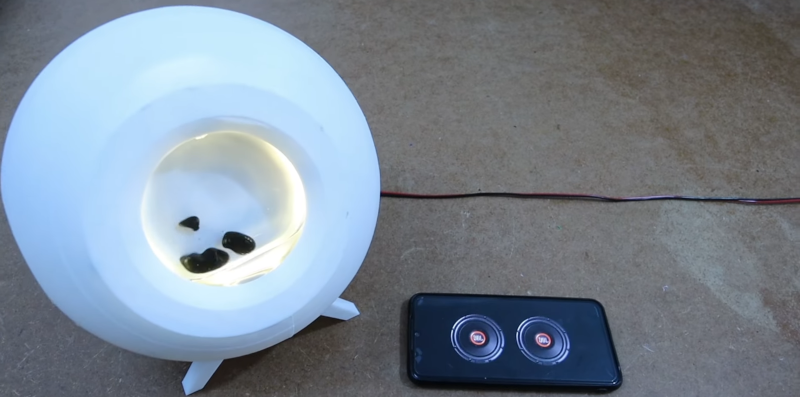
Some speakers play music. Some speakers look good on a shelf. And then there is the glorious oddball category: a speaker that makes black magnetic liquid wiggle, spike, bounce, and perform tiny alien ballet moves while your playlist does its thing. A speaker with dancing ferrofluid is not just a gadget. It is audio, physics, design, and “wait, is that thing alive?” energy packed into one desktop-sized conversation starter.
At its core, this project combines a Bluetooth speaker with a sealed ferrofluid display. The sound comes from ordinary speaker drivers, while the visual magic comes from an electromagnet controlled by the music signal. When the beat hits, the magnetic field changes. When the field changes, the ferrofluid responds. The result is a living-looking blob that jumps to bass, trembles to vocals, and occasionally throws a dramatic tantrum during electronic music.
For makers, this idea is irresistible because it turns invisible sound into visible motion. For science fans, it is a compact demonstration of magnetism, fluid dynamics, and audio electronics. For everyone else, it is simply cool. And sometimes, “cool” is a perfectly valid engineering goal.
What Is Ferrofluid, Really?
Ferrofluid is a liquid filled with extremely tiny magnetic particles, usually magnetite or similar iron-based material, suspended in a carrier fluid such as oil or water. These particles are so small that they do not simply sink like sand in a bottle. They remain distributed throughout the liquid, helped by surfactants that keep the particles from clumping together permanently.
When there is no nearby magnetic field, ferrofluid usually looks like a glossy black liquid. Bring in a strong magnet, however, and the liquid becomes a tiny monster from a science museum. It crawls toward the magnet, forms peaks, and creates the famous spiky “hedgehog” pattern. Those spikes are not random. They appear because the liquid is trying to balance magnetic force, gravity, and surface tension. In other words, ferrofluid is not being dramatic for attention. It is doing math with its body.
The material has a serious history. Ferrofluid was originally developed in connection with NASA research into controlling liquid fuel in low-gravity environments. Over time, the same magnetic-liquid idea found homes in engineering, electronics, seals, bearings, medical research, and audio equipment. That is a pretty good career path for something that looks like villain slime.
Why Put Ferrofluid in a Speaker?
The funny answer is: because it looks amazing. The better answer is: because speakers and ferrofluid both rely on magnetism, so the two ideas naturally shake hands.
A normal dynamic speaker works by sending an electrical audio signal through a voice coil. That coil sits in a magnetic gap. As the current changes direction and strength, the coil moves back and forth, pushing a diaphragm or cone. The moving cone pushes air, and your ears interpret those pressure changes as music, podcasts, movie explosions, or your neighbor’s questionable late-night karaoke session.
Ferrofluid already has a place in real speaker design, especially in tweeters and small drivers. Audio-grade ferrofluid can sit in the magnetic gap around a voice coil, where it helps transfer heat away from the coil and can also add damping. That improves power handling and can smooth certain driver behaviors. However, the dancing ferrofluid speaker is different. Instead of hiding the ferrofluid inside the driver, the project puts it on display in a sealed glass chamber and uses an electromagnet to animate it.
How a Dancing Ferrofluid Speaker Works
A typical DIY version uses two systems working together. The first system is the actual audio system: Bluetooth receiver, amplifier, battery or power supply, and speaker drivers. This part plays the music. The second system is the visualizer: a glass reservoir containing ferrofluid, an electromagnet mounted behind it, and a control circuit that makes the magnet respond to the music.
The Audio Path
The music begins with a Bluetooth module, phone, computer, or audio input. That signal goes to a small amplifier, which powers the speakers. For a compact desktop build, small full-range drivers or a pair of small speakers can be enough. The sound does not need to win a studio monitor shootout. It just needs to be clean, loud enough, and stable.
The Ferrofluid Path
The ferrofluid usually sits inside a sealed glass or acrylic container. Many builds use a round glass reservoir because it looks clean and gives the blob room to move. Behind that chamber sits an electromagnet. Unlike a permanent magnet, an electromagnet can be switched and controlled electronically. Increase the current, and the magnetic field grows stronger. Reduce it, and the ferrofluid relaxes.
The trick is not simply blasting the electromagnet with the full audio signal. That can create messy motion, overheating, or a blob that behaves like it has had too much coffee. Better designs filter the music first. A spectrum analyzer chip or microcontroller can isolate specific frequency bands, such as bass, mids, or treble. The circuit then uses that selected energy to drive the electromagnet.
Why Frequency Selection Matters
Ferrofluid does not respond equally well to everything. Low frequencies often create larger, slower movements. Midrange can produce lively pulsing. Higher frequencies may create trembling or subtle vibration rather than big jumps. That is why some builds include a dial that lets the user choose which part of the music controls the ferrofluid. Turn it toward bass, and the blob thumps like it is attending a nightclub. Turn it toward treble, and it shivers like it just saw its electricity bill.
Key Components in a DIY Build
A speaker with dancing ferrofluid looks futuristic, but the parts list is surprisingly understandable. The enclosure is often 3D printed, which lets the maker design dedicated spaces for the speaker drivers, electronics, reservoir, LEDs, and electromagnet. Translucent plastic can be used around the ferrofluid chamber so internal lighting spreads softly through the front panel.
The main components usually include a Bluetooth audio receiver, small amplifier board, speaker drivers, power supply, electromagnet, MOSFET or driver circuit, microcontroller or audio analyzer module, LEDs, switches, potentiometers, and the sealed ferrofluid bottle. A buck converter may be needed if the system uses different voltage rails, such as 24 volts for an electromagnet and 5 volts for logic electronics.
The MOSFET is especially important because a microcontroller pin cannot safely drive a power-hungry electromagnet directly. The microcontroller provides the control signal, while the MOSFET handles the heavier current. A flyback diode or other protection is also commonly used around coils to protect electronics from voltage spikes when the magnetic field collapses.
Design Choices That Make the Difference
The difference between “science fair blob” and “premium desk object” often comes down to design details. A clean enclosure matters. So does the position of the ferrofluid chamber. If the chamber is centered, lit evenly, and framed like a display, it becomes the star of the speaker instead of a weird accessory glued to the front.
Lighting is another powerful ingredient. White LEDs create a laboratory look. Warm LEDs make the display feel like a luxury lava lamp. RGB LEDs can look playful, but they can also become visually noisy if overused. Ferrofluid is already a diva; it does not always need a laser show behind it.
The glass chamber also matters. Ferrofluid stains easily and can stick to surfaces if the container is not prepared properly. A sealed display is much more practical than an open dish, especially if the speaker will live near keyboards, carpets, pets, or anyone wearing a white shirt. Open ferrofluid experiments are fun until one drop escapes and starts a lifelong relationship with your tabletop.
Does It Sound Good?
That depends on the build. A dancing ferrofluid speaker can sound good, but the visual feature does not automatically improve audio quality. In fact, the visual system should be treated as separate from the acoustic system. The speaker drivers still need a solid enclosure, proper mounting, reasonable amplifier power, and minimal rattles.
Small 3D-printed enclosures can sound boxy if they are too thin, poorly sealed, or full of vibrating parts. Adding internal bracing, rubber feet, gasket material, and thoughtful driver placement can improve the result. The ferrofluid display should not buzz against the case. The electromagnet should be firmly mounted. Loose wires should be secured. Nothing ruins futuristic elegance faster than a speaker that sounds like a jar of screws falling down stairs.
For best results, think of the device as a visual Bluetooth speaker rather than an audiophile reference monitor. It is perfect for a desk, workshop, bedroom, maker studio, or display shelf. It may not replace high-end bookshelf speakers, but your high-end bookshelf speakers probably cannot make magnetic goo dance to funk basslines either. Everybody has strengths.
Safety and Practical Considerations
Ferrofluid can stain skin, clothing, wood, plastic, and almost anything else it decides to befriend. Use gloves, protect the work surface, and keep the liquid sealed whenever possible. Strong neodymium magnets and electromagnets also deserve respect. They can pinch fingers, damage magnetic cards, interfere with sensitive electronics, and heat up if driven too hard.
Heat is a major concern in the electromagnet circuit. A coil running from a 12-volt or 24-volt supply can get warm quickly, especially if the control signal holds it on for long periods. Ventilation, current limiting, proper wire gauge, and conservative duty cycles all help. A fuse is not a bad idea. Neither is common sense, although sadly it is not available as a module with header pins.
Builders should also avoid placing strong magnetic fields near hard drives, pacemakers, magnetic storage media, or delicate measuring instruments. For most desktop uses, the field is localized, but caution is cheap and replacement electronics are not.
Why This Project Is So Popular With Makers
The dancing ferrofluid speaker sits at a sweet spot between art and engineering. It is not just another blinking LED strip. It has physical motion. It has texture. It has unpredictability. The same song can create different shapes depending on volume, frequency selection, fluid quantity, magnet strength, chamber geometry, and lighting.
It is also highly customizable. One maker might build a minimalist white cube with a single glowing circular display. Another might create a cyberpunk black enclosure with exposed screws and purple lighting. Someone else might make a transparent case so the circuitry becomes part of the aesthetic. The core principle stays the same, but the personality changes completely.
For STEM education, this project is gold. It demonstrates electromagnetism, audio frequency analysis, pulse-width modulation, thermal design, 3D modeling, enclosure design, fluid behavior, and user-interface thinking. Students can see cause and effect instantly. Turn the dial, change the song, adjust the volume, move the magnet, and the blob reacts. It is physics with stage presence.
Common Problems and How to Avoid Them
The Ferrofluid Sticks to the Glass
This is one of the most common issues. The container must be clean, compatible with the carrier liquid, and sometimes treated so the ferrofluid does not smear across the inside surface. Using a purpose-made sealed ferrofluid display can save time and emotional damage.
The Blob Barely Moves
The electromagnet may be too weak, too far from the chamber, or driven by the wrong frequency band. The ferrofluid amount may also be too large. A smaller blob often moves more dramatically than a heavy puddle.
The Motion Looks Chaotic
Chaotic is fun for five seconds, then it becomes visual soup. Filtering the audio signal helps. Try bass-only response first, then experiment with mids and highs. A control knob for sensitivity can also prevent the blob from overreacting to every tiny sound.
The Speaker Rattles
Check the enclosure, screws, chamber mount, wires, LED strips, and electromagnet bracket. A dancing ferrofluid speaker should have one moving performer: the ferrofluid. Everything else should stay politely seated.
Experience Notes: Living With a Dancing Ferrofluid Speaker
The first thing you notice when using a ferrofluid speaker is that people stop talking mid-sentence. The device has that effect. Someone walks into the room, sees a black liquid creature bouncing inside a glowing circle, and suddenly the conversation becomes, “What is that?” This is the real charm of the project. It makes sound visible in a way that feels organic, not digital.
During quiet acoustic music, the ferrofluid may pulse gently, almost like it is breathing. With jazz, it can twitch and sway around the rhythm section, catching little accents from the bass and drums. With electronic music, it becomes much more energetic, stretching and breaking into small shapes when the beat hits hard. Hip-hop bass lines usually produce the most satisfying movement because the low-end energy gives the electromagnet something bold to work with. Classical music can be surprisingly beautiful too, especially during sections where the dynamics rise slowly and the fluid seems to wake up in stages.
The best experience comes from tuning the response rather than leaving everything maxed out. Too much sensitivity makes the ferrofluid thrash around constantly, which is exciting at first but visually tiring. A moderate setting lets the blob rest between musical moments, so big movements feel more dramatic. It is similar to lighting design: darkness makes the spotlight matter.
Placement also changes the experience. On a work desk, the speaker becomes a tiny kinetic sculpture that reacts while you type, sketch, solder, or pretend to answer emails. On a bookshelf, it becomes a display object that invites curiosity. In a dim room, the LEDs around the reservoir make the ferrofluid look deeper and more mysterious. In bright daylight, the motion is still interesting, but the magic is less theatrical.
The device also teaches patience. Ferrofluid is messy, magnets are unforgiving, and compact enclosures always seem roomy until the wiring begins. The first prototype may not be beautiful. The second one usually gets smarter. By the third version, you start thinking like both an engineer and a stage director: Where should the viewer look? How fast should the blob move? Is the lighting helping or yelling? Is the speaker enclosure strong enough? Is the electromagnet warm? Is the whole thing delightful?
That final question matters most. A dancing ferrofluid speaker is not only about specifications. It is about wonder. It gives music a face, or at least a strange little magnetic pet. It turns a playlist into motion and makes a simple beat feel like a science trick. Even when the audio is ordinary, the experience is memorable because the speaker does something most speakers never attempt: it performs visually.
Conclusion
A speaker with dancing ferrofluid is a brilliant example of what happens when makers refuse to keep disciplines in separate boxes. It combines audio electronics, magnetic fields, fluid dynamics, 3D printing, lighting design, and a bit of showmanship. The result is not just a speaker and not just a science demo. It is a functional object with personality.
The best builds keep the sound system and visual system carefully balanced. The drivers need a stable enclosure. The ferrofluid needs a sealed, clean chamber. The electromagnet needs controlled power. The circuit needs filtering so the fluid reacts musically instead of randomly. When all those pieces work together, the result feels almost alive.
Whether you are a DIY electronics fan, a science teacher, a product designer, or someone who simply wants the weirdest Bluetooth speaker in the room, dancing ferrofluid delivers. It is proof that physics does not have to stay in textbooks. Sometimes it can sit on your desk, glow softly, and dance to your favorite song.
Note: This article is intended for educational and maker-focused publishing. Ferrofluid, strong magnets, electromagnets, batteries, and power electronics should be handled carefully, with proper ventilation, insulation, current limits, and surface protection.