
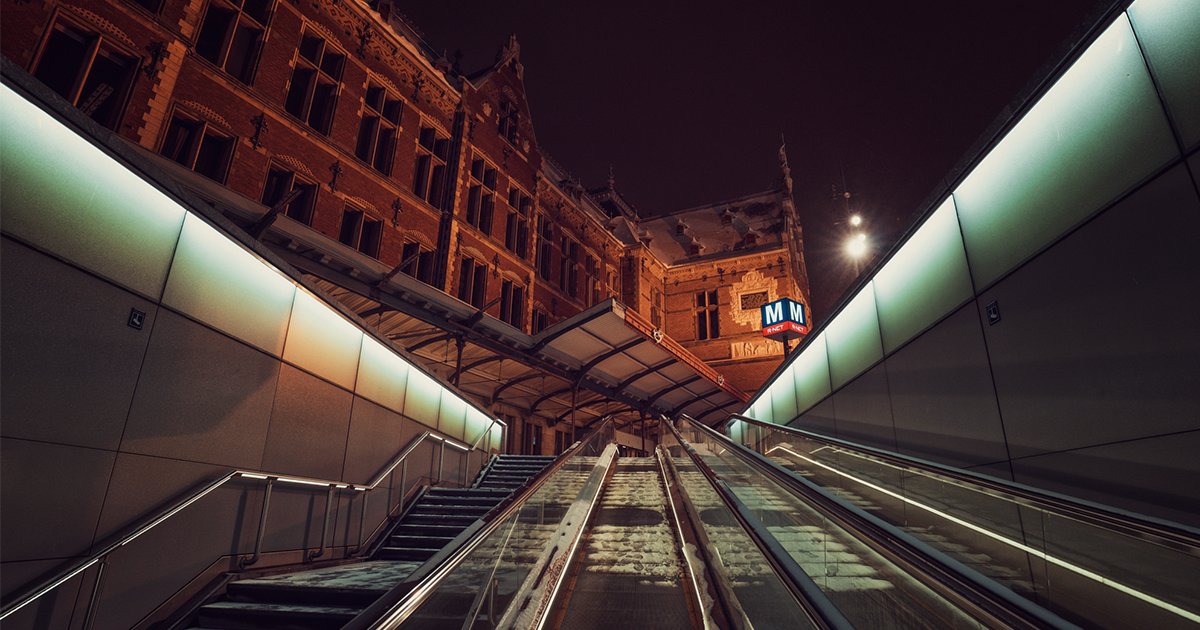
Amsterdam is not exactly famous for whispering. It is a city of bicycle bells, canal boats, café chatter, clacking tram lines, and tourists trying to look casual while standing in the middle of a bike lane. In other words, it usually behaves like a charming extrovert. But during lockdown, and especially during curfew, that extrovert went silent. That silence became the subject of one unforgettable photo series by Dutch photographer and cinematographer Stijn Hoekstra, who turned his camera toward his own hometown and documented Amsterdam in a way many people had never seen before: empty, snowy, still, and just a little haunted.
The result was a set of 22 images that felt less like ordinary street photography and more like movie stills from a beautifully lit end-of-the-world drama. The streets were bare. The bridges looked suspended in time. The city’s familiar romance was still there, but now it came with an eerie hush. It was Amsterdam, yes, but Amsterdam after someone had pressed pause on humanity.
This is what makes the series so memorable. It is not just about lockdown photography. It is about what happens when a city known for movement is suddenly defined by absence. It is about how local streets can become emotionally unfamiliar. And it is about the strange power of photography to turn a public health crisis into a visual record of memory, mood, and place.
When Amsterdam Went Quiet, A Photographer Started Listening
Like many photographers during the pandemic, Hoekstra did not have the usual menu of creative possibilities. Travel was limited, public life was reduced, and cities across Europe felt as though someone had dimmed the lights. So instead of looking outward, he looked inward. Rather than chasing a faraway destination, he explored the place he already knew well.
That shift mattered. During the early pandemic years, many photographers who were used to airports, assignments, movement, and strangers began documenting their neighborhoods, families, and hometowns. What once seemed ordinary became newly dramatic. A corner store became a symbol. A silent street became a story. In that sense, Hoekstra’s Amsterdam series belongs to a broader visual movement born during COVID: photographers rediscovering the emotional depth of what was right outside their front doors.
But Hoekstra’s work stood out because he approached Amsterdam not simply as a documentarian, but as a visual storyteller with a cinematic eye. He did not just record an empty city. He staged its mood through framing, light, weather, and timing. The city became the main character, and it played the role with impressive commitment.
The Curfew Changed Everything
Part of the power of the series comes from the historic moment behind it. The Netherlands imposed a nighttime curfew during the pandemic, restricting movement between 9:00 p.m. and 4:30 a.m. except for specific permitted reasons. That meant Amsterdam, a city known for nightlife and late energy, was suddenly stripped of one of its defining traits. Streets that normally glowed with activity instead sat nearly untouched.
For Hoekstra, the curfew provided both a limitation and a creative opening. He reportedly waited until heavy snowfall was forecast, obtained the necessary permit, and went out into the city at night. That decision turned out to be a masterstroke. Snow transformed the already empty streets into something even more surreal. It softened the edges of the city, brightened the darkness, and made familiar places look like dream sequences. Amsterdam did not just look empty. It looked suspended.
And that is a key difference. Empty can be boring. Suspended is unforgettable.
Why The 22 Photos Feel So Cinematic
1. The city becomes a set
Many viewers responded to the photos as if they were scenes from a film, and it is easy to see why. Hoekstra has a background in cinematography, and that influence shows up everywhere. The compositions are deliberate. The light feels narrative. Each image suggests that something has just happened, or is about to happen, even though no people are visible. That tension is what gives the series its emotional charge.
Normally, street photography depends heavily on human presence: expressions, gestures, collisions, chance encounters. Hoekstra flips that formula. In his Amsterdam curfew photos, the lack of people becomes the subject. Empty escalators, abandoned bikes, red-lit windows, bridges dusted with snow, and quiet streets all communicate the same strange message: the city is still here, but its pulse has been muted.
2. Snow works like a visual amplifier
Snow has a sneaky talent for making everything more dramatic. It can make a parking lot look poetic and a lamp post look philosophical. In Amsterdam, it did even more. It reflected the city lights, added texture to the streets, and created a softness that made the images feel both beautiful and unsettling. The white blanket over the city also emphasized the absence of footprints, crowds, and traffic. It was the kind of detail that made viewers stare a little longer.
3. Silence becomes visible
Great photography often makes you feel something you cannot literally see. In this case, the invisible thing is silence. The photos suggest the missing sounds of Amsterdam just as strongly as they show its empty spaces. You can almost hear what is not there: no clatter of glasses, no late-night conversations, no roar of passing bikes, no tourist laughter ricocheting off the canals. That sensory gap is what makes the images stick in the mind.
Amsterdam Looks Different When The Crowds Disappear
Another reason the series resonated so widely is that Amsterdam is one of those cities people think they already know. It has a strong global image: canals, narrow houses, cozy lights, art museums, bike culture, cafés, and postcard-level charm. In ordinary times, visitors drift through the city on foot, by bike, or by boat, and much of its identity is wrapped up in that constant movement.
During the pandemic, that familiar version of Amsterdam changed radically. Canal traffic slowed, tourism nearly vanished, and the city that often wrestled with overtourism was suddenly dealing with the opposite condition: a kind of urban under-stimulation. The contrast was striking. A place built for motion and encounter became a study in stillness.
That shift gives Hoekstra’s photos a deeper layer. They are not merely attractive images of empty streets. They are visual evidence of how fragile urban rhythms can be. The city’s architecture remained beautiful. The bridges still arched over the water. The lights still reflected on the canals. But the social machinery that made Amsterdam feel like Amsterdam had paused. The images capture that dislocation with unusual clarity.
More Than Pretty Pictures: What The Series Says About Lockdown Life
It would be easy to call these photos beautiful and stop there. They are beautiful. But beauty is only half the story. What makes the series effective is the tension between aesthetic pleasure and emotional discomfort. Viewers enjoy the symmetry, the color, the snow, and the cinematic mood. At the same time, they understand the reason the city looks this way. The beauty is inseparable from the crisis.
That contradiction defined a lot of pandemic photography. Across the world, photographers documented cleaner skylines, quieter streets, and animals appearing in unexpected places. Some people saw serenity. Others saw loss. Usually, both feelings were true at once. Hoekstra’s Amsterdam images operate in that same emotional register. They are lovely to look at, but they are built from a moment nobody was asking to experience.
That duality is part of why the series remains compelling years later. It is not just nostalgia for the weirdest chapter of recent history. It is also a reminder that visual calm can hide social upheaval. A quiet canal may look peaceful, but silence under curfew is different from silence by choice.
The Hometown Turn: Why Local Photography Became So Powerful
One of the most meaningful themes in lockdown-era photography was the return to the local. Many photographers who typically traveled far for inspiration were forced to look again at the streets they had long taken for granted. That changed not only what they photographed, but how they photographed it.
When you shoot your hometown, you carry memory into every frame. You know what a street sounds like when it is full. You know which bridge is usually crowded, which square is normally loud, which lights belong to nightlife rather than solitude. That history changes the picture. An outsider might see a beautiful empty canal. A local photographer sees an absence heavy with context.
That is what gives Hoekstra’s project emotional credibility. He is not photographing Amsterdam as a tourist fantasy. He is photographing a place he knows intimately, at a moment when it no longer behaves like itself. The result feels personal without becoming sentimental. It feels observant without becoming cold. And because the city is world-famous, the local becomes universal.
Why People Could Not Stop Looking
The internet saw a lot of pandemic images. Some were heartbreaking. Some were informative. Some disappeared into the endless scroll after three seconds of mild concern and one sip of coffee. Hoekstra’s series did not vanish so easily because it hit a rare balance: it was timely, visually strong, emotionally layered, and easy for viewers around the world to understand.
You did not need to live in Amsterdam to get it. You only needed to know what a city feels like when it is alive. Once you know that, the absence becomes instantly legible. The bridges, storefronts, and snowy roads do the rest.
There is also a reason people are drawn to images of empty famous places. They scramble expectation. A city we think of as crowded suddenly appears vulnerable, intimate, and exposed. The familiar becomes uncanny. That jolt of recognition makes viewers pay attention. It is the visual equivalent of hearing your favorite band perform in a whisper instead of an arena.
A City, A Curfew, And A Permanent Record
In the years since the height of the pandemic, daily life has largely returned, and Amsterdam once again looks like Amsterdam: lively, photogenic, slightly chaotic, and full of people who absolutely should have looked both ways before stepping into a bike lane. That is exactly why the series matters. It preserves a version of the city that many residents hope never to see again and many viewers would never otherwise believe.
Photography does its best work when it rescues fleeting realities from disappearance. Hoekstra’s 22 images do exactly that. They preserve not just a public-health moment, but a psychological one: the shock of stillness, the beauty of snow on empty streets, the unease of absence, and the surreal feeling of seeing a world-famous city holding its breath.
That is why these photos still resonate. They do not merely show Amsterdam during curfew. They show what happens when a city loses its crowd and gains a strange, temporary ghost of itself.
Experiences Related To Amsterdam Under Curfew: The Emotional Weight Of An Empty City
There is a specific kind of feeling that comes from walking through a city you know well and realizing it no longer recognizes itself. That is the emotional territory surrounding Hoekstra’s Amsterdam series, and it deserves more than a quick mention. Empty-city photography during lockdown was never only about architecture or atmosphere. It was about disorientation. The streets were still there, the lights were still on, the canal water still reflected the buildings, and yet something essential was missing. The missing ingredient was human rhythm.
People who lived through lockdown in major cities often describe the experience in oddly similar ways. Time felt stretched. Distance felt strange. Familiar routes became reflective instead of functional. A walk that once meant commuting, shopping, or meeting a friend suddenly became a small act of observation. You noticed details that had always been hidden by speed: the sound of birds in commercial districts, the glow of signs with nobody reading them, the elegance of bridges usually blocked by traffic, the lonely beauty of café chairs stacked indoors like they were waiting for applause that had been postponed.
Amsterdam is especially suited to that kind of emotional shift because it is usually so relational. The city is designed around movement and encounter. Its beauty is not static. It is activated by people biking over bridges, talking along canals, stepping into shops, boarding trams, and drifting through neighborhoods. Remove that movement and the city becomes almost theatrical, as though the set is ready but the actors never came onstage.
That theatrical quality explains why Hoekstra’s photographs feel so haunting. They tap into a shared pandemic memory: the sense that the world had become familiar and alien at the same time. Many viewers likely responded not only to Amsterdam itself, but to the emotional echo of their own hometowns during lockdown. A silent square in Amsterdam might remind someone of an empty avenue in Chicago, a darkened block in Los Angeles, or a motionless downtown in Boston. The details differ, but the sensation travels.
There is also something deeply human about wanting to record a moment you hope will never repeat. Hoekstra’s snowy night walk through curfew-stricken Amsterdam carries that impulse. The photos are art, but they are also testimony. They say: this happened, this is how it looked, this is how strange it felt. Years later, that testimony matters because memory is slippery. We remember statistics, headlines, restrictions, and routines, but images bring back the emotional weather of a period. In that sense, these 22 pictures do more than document empty streets. They preserve the feeling of living through a suspended world.
Conclusion
Stijn Hoekstra’s Amsterdam curfew photos succeeded because they did not chase spectacle. They found meaning in stillness. They showed that a hometown can become extraordinary under pressure, that absence can be as visually powerful as presence, and that lockdown photography at its best is not just documentary work. It is emotional cartography.
By photographing Amsterdam during curfew, Hoekstra captured more than deserted streets and snowy canals. He captured a once-vibrant city in a brief and unsettling state of pause. The 22-image series remains powerful because it sits at the intersection of beauty, history, and memory. It reminds us that even the most familiar places can become unrecognizable, and that sometimes the clearest portrait of a city appears when almost no one is left inside the frame.













