
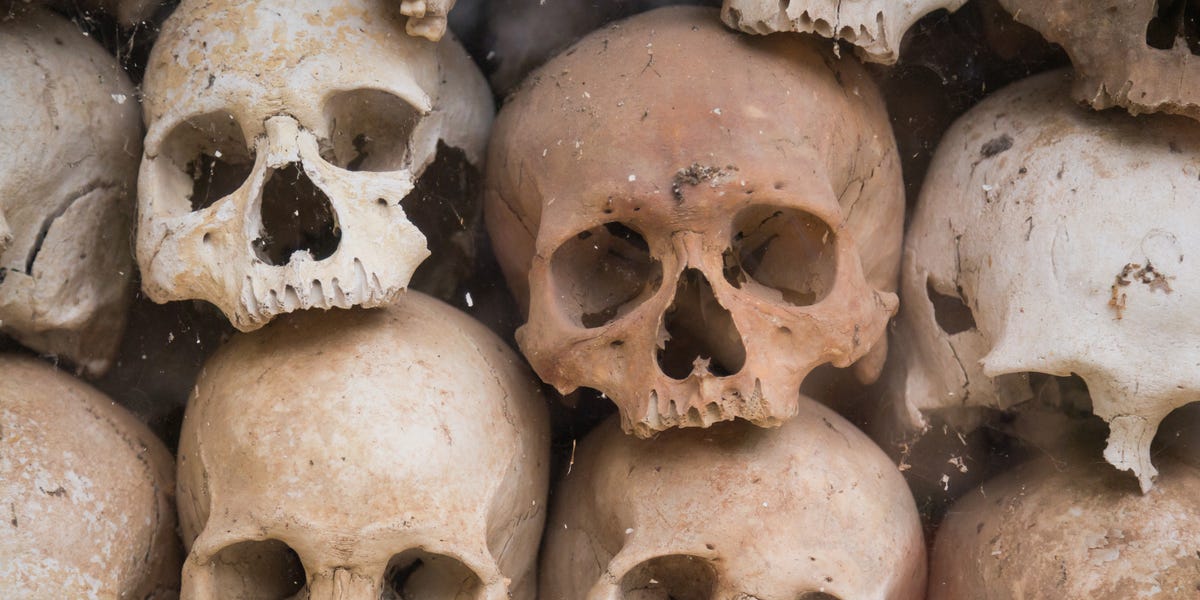
Every so often, archaeology reminds us that the past was not just pottery, grain storage, and people inventing increasingly uncomfortable shoes. Sometimes, the ground opens a very old file marked “extremely unsettling,” and inside is a discovery that forces historians to rewrite what they thought they knew. That is exactly what happened at Shimao, a massive Neolithic city in northern China, where archaeologists uncovered a pit containing roughly 80 human skulls near the settlement’s East Gate.
The phrase “pit of skulls” sounds like the name of a heavy metal album your parents would immediately dislike, but this was no fictional horror prop. The discovery belongs to one of the most important prehistoric urban sites in East Asia. Shimao, located in Shaanxi Province on the northern Loess Plateau, flourished around 2300 to 1800 B.C.E. It had stone walls, elite cemeteries, craft zones, jade objects, carved stones, and a huge stepped pyramid-like platform that likely served as a political and ritual center.
For years, the skull pit was interpreted as evidence of mass human sacrifice, possibly involving young female victims from outside the community. But new ancient DNA research has complicated that story in a major way. Genetic analysis suggests that many of the tested skulls were male, not female, and that the victims were not clearly foreign outsiders. In other words, the mystery did not shrink. It put on a bigger hat, grabbed a clipboard, and became a full archaeological investigation.
The Lost City That Was Mistaken for the Great Wall
Before Shimao became famous among archaeologists, local people saw ancient stone walls in the dusty landscape and assumed they were part of the Great Wall. That was a reasonable guess. The region sits near the edge of the Ordos Desert, where historical frontiers, walls, and military structures are easy to imagine. But the stones were far older than expected.
As researchers examined the site, they realized they were not looking at a late imperial barrier. They had found the remains of a huge fortified city from the late Neolithic period. Shimao covered about four square kilometers, making it one of the largest known prehistoric settlements in China. Its scale alone was surprising, but its design was even more eye-opening.
The city had inner and outer stone walls, gates, residential zones, elite spaces, cemeteries, craft production areas, and a central platform rising roughly 230 feet. In plain English: this was not a sleepy village with a few goats and one ambitious person stacking rocks. Shimao was a complex urban society with planning, labor organization, leadership, ritual activity, and social hierarchy.
That matters because older models of early Chinese civilization often focused heavily on the Central Plains. Shimao showed that powerful, innovative, and highly organized societies also developed in regions once treated as peripheral. The so-called edge of the map was not waiting politely for history to arrive. It was already building walls, managing labor, making art, and staging rituals that still puzzle experts today.
What Archaeologists Found Near the East Gate
The skulls were discovered near Shimao’s East Gate, also called Dongmen. This location is important. Gates are not just doors in ancient cities. They are thresholds. They control movement, announce power, and often carry symbolic meaning. If a city wants to make an impression, the gate is where it clears its throat and says, “Welcome, but also remember who is in charge.”
At Shimao, the East Gate area appears to have been a place of ritual power. Archaeologists found clusters of human skulls, with earlier reports describing around 80 skulls in several pits. Their placement beneath or near major architectural features suggested that the remains were connected to ceremonial activity, possibly rituals associated with construction, protection, or political authority.
The skull pit became one of the most discussed features of the site because it pointed to organized human sacrifice at a very early stage of Chinese urban development. Later Chinese dynasties, especially the Shang, are known for large-scale ritual sacrifice, but Shimao pushes questions about ritual violence, social rank, and state formation further back in time.
To be clear, archaeologists do not interpret such finds by simply gasping dramatically and writing “spooky stuff” in a notebook. They study location, dating, bone condition, burial arrangement, associated objects, architecture, DNA, isotopes, and comparisons with other sites. A skull pit near a gate is not just a grim discovery; it is a clue about how a society used ritual to define authority, territory, and identity.
Ancient DNA Changed the Story
For a long time, many researchers thought the skull pit victims were mostly young women, possibly captives from rival groups. That interpretation was based largely on earlier physical examination of the remains. But skeletal assessment can be difficult, especially when remains are incomplete, damaged, or limited to skulls. Ancient DNA has now added a powerful new layer of evidence.
A 2025 study published in Nature analyzed genome-wide data from ancient individuals connected to Shimao and nearby sites. The research helped reconstruct ancestry, kinship, and social organization in this late Neolithic world. One of the most striking findings involved the skull pit: among the sampled victims, the genetic evidence showed no female bias. In fact, nine out of ten tested individuals were male.
That finding overturned a major assumption. Instead of a skull pit dominated by female captives, researchers now see a more complicated pattern. Male victims were associated with the skull pit near the gate, while other sacrificial contexts at elite cemeteries appear to have involved mostly female individuals. The difference suggests that Shimao’s sacrificial practices were structured by sex, place, and ritual purpose.
Even more interesting, the DNA evidence did not show that the male victims came from a clearly separate foreign population. That does not mean we know who they were in social terms. They could have been lower-status members of the broader society, people captured from culturally similar groups, or individuals selected under rules we do not yet understand. But it weakens the simple story that “outsiders were sacrificed by locals.” As usual, the past refuses to be tidy. Archaeology asked for a straight answer and received a puzzle box.
Why Would a City Bury Skulls at a Gate?
The most likely explanation is that the skull pit was connected to a construction or foundation ritual. In many ancient societies, important buildings, walls, gates, and tombs were not treated as merely practical structures. They were charged with symbolic meaning. People might place special objects, animal remains, human remains, or ritual offerings in foundations to protect a space, bless a project, mark authority, or communicate with ancestors and spirits.
At Shimao, the East Gate was not just an opening in a wall. It was the ceremonial face of a powerful city. Anyone approaching it would have encountered monumental architecture, carved stones, and the imposing presence of a fortified settlement. The hidden skull pit may have been part of that same message: the city was protected, sacred, dangerous, and politically controlled.
Researchers have also noted that Shimao contained jade objects embedded in walls and other features that suggest protective or ritual meaning. Jade was not local to the area, so its presence reveals long-distance exchange and elite access to prestigious materials. In a society where walls, gates, jade, stone carvings, and sacrifice all appear together, architecture becomes more than construction. It becomes theater, religion, government, and billboard all at once.
That does not mean archaeologists know the exact belief system behind the skull pit. There are no surviving Shimao instruction manuals saying, “Step 1: build gate. Step 2: perform ritual. Step 3: intimidate neighbors.” Instead, scholars build careful interpretations from patterns in the evidence. The safest conclusion is that the skull pit was not random. It belonged to a deliberate ritual system connected to hierarchy and urban power.
Shimao Was Not an Ordinary Neolithic Settlement
Calling Shimao a “settlement” almost feels rude, like calling a cathedral a “room with a pointy roof.” This was a large, fortified, socially stratified urban center. Its central platform, sometimes described as a stepped pyramid, was likely home to rulers or elite families. Its walls required enormous labor. Its craft areas and elite artifacts show specialized production and long-distance connections.
The city also challenges the idea that early Chinese civilization developed in a single neat line from one core region. Shimao suggests that multiple regions contributed to the rise of complex societies in ancient China. Northern frontier zones, steppe contacts, the Loess Plateau, and Yellow River networks all mattered. History, inconveniently for anyone who loves simple diagrams, often behaves more like a crowded group chat.
The skull pit fits into this larger picture because it reflects organized power. Human sacrifice on this scale requires authority. Someone had the ability to select victims, stage rituals, control public or restricted spaces, and connect those acts to the city’s monumental architecture. Whether that authority came from kings, chiefs, priestly elites, lineage heads, or some combination remains debated, but Shimao was clearly not socially flat.
The new DNA results also reveal patrilineal patterns among Shimao communities, meaning descent and social organization appear to have emphasized male lines. This is especially relevant when paired with the sex-specific sacrifice pattern. Male victims in a gate ritual and female victims in elite burial contexts may reflect different symbolic roles within a society deeply concerned with ancestry, rank, and controlled movement of people.
Human Sacrifice and Social Hierarchy
Human sacrifice is one of the hardest topics in archaeology because it forces modern readers to confront societies whose values could be dramatically different from ours. The goal is not to sensationalize the victims or turn the discovery into ancient true crime. The goal is to understand what the practice meant in its own time.
At Shimao, sacrifice seems tied to hierarchy. Some individuals were buried in elite tombs with attendants, while others were deposited in mass ritual contexts near architecture. This separation suggests that people’s bodies were treated differently depending on status, sex, ritual function, and location. The city’s social order may have continued even in death, with elite individuals receiving elaborate treatment while sacrificed individuals served symbolic roles in ceremonies.
It is tempting to imagine the skull pit as proof of chaos, but the opposite may be closer to the truth. The evidence points to order: repeated practices, selected locations, gendered patterns, and links to monumental building. This was not random violence in a collapsing town. It appears to have been part of a structured system in a powerful city.
That makes the discovery both disturbing and historically important. The skull pit reveals that early urban life was not only about better farming, trade, and architecture. It was also about control, belief, inequality, and the use of ritual to make authority feel permanent. The stones of Shimao were not silent. They were built to speak.
What the Discovery Tells Us About Early China
The Shimao skull pit helps researchers understand the deep roots of political and ritual systems in ancient China. Later Shang society is famous for oracle bones, bronze vessels, royal tombs, and large-scale sacrifice. Shimao predates the Shang by centuries, but it shows that some ingredients of later state power were already present: monumental architecture, elite display, ritual violence, and social stratification.
This does not mean Shimao was simply a preview of the Shang. It had its own culture, geography, economy, and history. But it does show that the path toward early Chinese civilization was broader and more diverse than once assumed. Important developments were happening outside the traditional heartland, and some may have influenced later political forms.
The discovery also demonstrates the value of combining archaeology with ancient DNA. Without genetic evidence, the skull pit might still be described mainly as a deposit of female victims. DNA did not solve every mystery, but it corrected a key detail and opened new questions. Who were the male victims? Why were they chosen for the gate ritual? Why were female sacrifices associated with elite cemeteries? How did ancestry, marriage, rank, and ritual fit together?
Good archaeology rarely ends with “case closed.” It ends with better questions. Shimao’s skull pit is not just a shocking find; it is a reminder that even famous discoveries can change when new methods are applied.
Lessons From the Pit of Skulls: An Experience-Based Reflection
Reading about a discovery like Shimao is a strange experience. On one hand, the headline grabs attention instantly. A pit of skulls from a mysterious human sacrifice sounds like something designed by the internet to make everyone stop scrolling. On the other hand, once you move past the dramatic image, the story becomes quieter and more thoughtful. You begin to see not a horror scene, but a complicated human world.
For anyone who loves history, this is the real thrill of archaeology. It teaches patience. At first, a discovery may seem obvious: skulls near a gate must mean enemies, captives, punishment, or fear. Then the evidence gets better. DNA is tested. Burial patterns are compared. The architecture is studied. Suddenly, the easy explanation starts wobbling like a folding chair at a family picnic. What looked simple becomes layered.
That experience is valuable far beyond archaeology. Shimao reminds us that first impressions are often incomplete. Earlier interpretations suggested mostly female victims, but newer evidence points strongly toward male victims in the gate skull pit. This does not make earlier scholars foolish. It shows how knowledge grows. Science is not a stone tablet dropped from the sky. It is a process of testing, correcting, and occasionally saying, “Well, that was not what we expected.”
There is also a humbling emotional experience in thinking about ancient cities. We tend to imagine prehistoric people as simpler than us because they lacked modern technology. Then Shimao appears with walls, elite zones, long-distance exchange, carved stones, ritual spaces, and political organization. The people who built it did not have smartphones, but they had ambition, fear, belief, status competition, engineering skill, and probably someone complaining that the wall project was behind schedule.
Visiting or reading about archaeological sites also changes how we think about ruins. A wall is never just a wall. A gate is never just an entrance. A burial is never only a body in the ground. These things are choices made by communities. They reveal what people valued, what they feared, who held power, and who paid the price for that power. Shimao’s skull pit is difficult to think about, but ignoring it would make the past more comfortable than truthful.
The best way to approach such a topic is with respect. The people represented by the skulls were real individuals, not props in a mystery story. Their names are lost, but scientific study can still restore fragments of their identity: biological sex, ancestry, social context, and the role their remains played in a larger ritual landscape. Archaeology cannot give them back their voices, but it can prevent them from being reduced to a spooky headline.
In the end, the experience of learning about Shimao is a reminder that human civilization has always been brilliant, creative, organized, and morally complicated. The same society that built remarkable stone architecture also practiced sacrifice. The same city that traded for jade and developed elite spaces also left behind evidence of severe inequality. That uncomfortable combination is exactly why the discovery matters. It shows us the past without polishing it into a museum souvenir.
Conclusion: A Discovery That Still Has Questions to Ask
The pit of skulls at Shimao is one of the most haunting and important discoveries in Neolithic archaeology. It reveals a society with monumental architecture, elite hierarchy, long-distance connections, and ritual practices that were far more organized than a simple act of violence. The newer DNA evidence makes the story even more fascinating by challenging earlier assumptions and showing that the victims in the East Gate skull pit were mostly male, while other sacrificial contexts involved mostly female individuals.
What does it all mean? The best answer is also the most honest: archaeologists are still working it out. The skull pit may have been part of a construction ritual tied to the city gate. Female sacrifices in elite cemeteries may have been connected to ancestor veneration or the honoring of high-status people. The victims do not appear to be easily explained as foreign outsiders. Shimao’s rituals were likely embedded in a deeply stratified society where architecture, ancestry, sex, and power were tightly connected.
That is why this discovery matters. It is not merely macabre. It is a window into how early cities made authority visible, sacred, and intimidating. Shimao forces us to rethink the rise of civilization in ancient China and reminds us that the ground still holds stories capable of surprising even the experts. The past, apparently, has excellent dramatic timing.











