
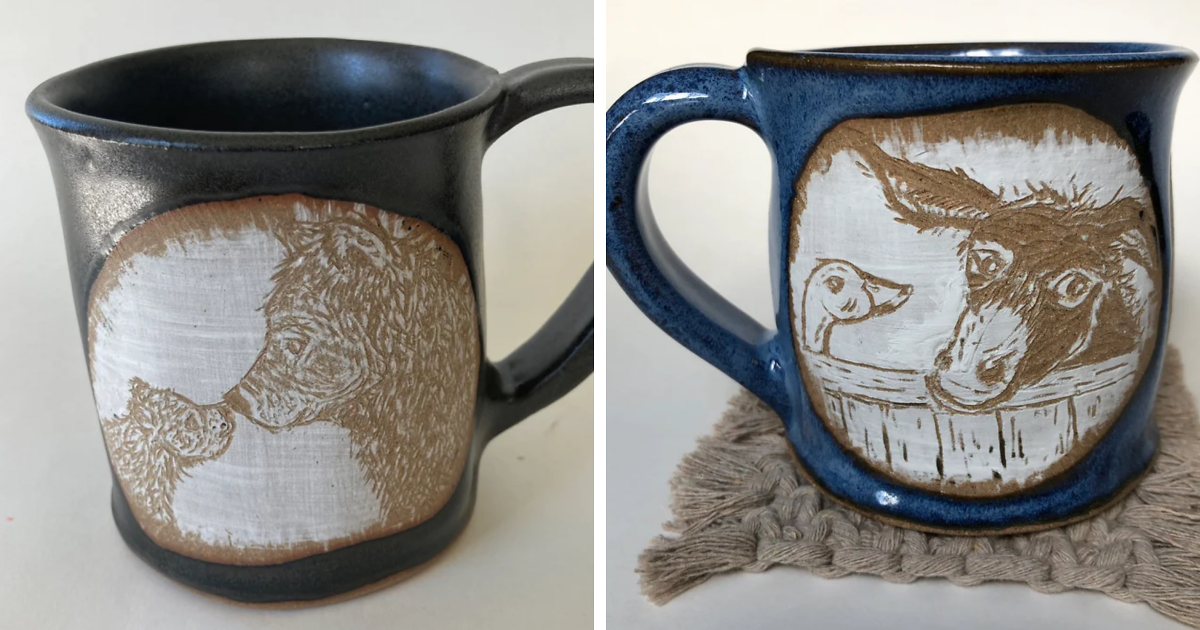
Some art hangs on a wall. Some art sits on a shelf. And some art quietly waits for you to pour coffee into it before it completely steals the show. That is the charm of wildlife pottery at its best. It takes something ordinarya bowl, a mug, a vase, a rounded clay formand turns it into a tiny habitat, a moving story, or a freeze-frame from the natural world. Suddenly, your dishware is no longer just dishware. It is a bear family in the pines, an owl watching from above, or a calf learning how to stand without falling over like a baby giraffe on roller skates.
The artist at the center of this attention-grabbing collection does exactly that. In a 12-image feature that introduced many readers to her work, Jane Whitaker of Puddleduck Pottery showed how wildlife-inspired ceramics can be both decorative and deeply narrative. Her pieces are hand-built, richly illustrated, and shaped to guide the eye around the curve of the vessel. That last detail matters. A flat canvas gives you one direction. A pot gives you a journey. You do not just glance at ityou orbit it.
That is what makes this body of work so memorable. It is not merely pottery with animals on it. It is pottery that behaves like storytelling. The form, the carving, the texture, and the imagery all collaborate. The result feels cozy, tactile, and surprisingly cinematic, which is not a phrase people usually use for a mug, but here we are.
Why This Wildlife Pottery Grabs Attention So Fast
At first glance, the appeal seems obvious: people love animals, and people love handmade things. Put the two together and you already have a strong hook. But the real reason this kind of ceramic art resonates goes deeper. Wildlife pottery taps into three timeless pleasures at once: the love of nature, the comfort of useful objects, and the delight of discovering detail.
Animal imagery has appeared on vessels for centuries because animals carry emotion, symbolism, movement, and character. A pot decorated with birds or bears does not feel static. It feels alive. Even when the vessel itself is standing perfectly still on a tabletop, the imagery suggests motion beyond the rim. A creature can be hunting, hiding, nursing its young, crossing a clearing, or peeking through leaves. That sense of suspended action creates immediate curiosity.
Then there is the format itself. Pottery is intimate. Unlike a painting you admire from several feet away, a cup or bowl invites touch. You hold it. You rotate it. You look inside it. Narrative ceramics reward that behavior. The artwork literally unfolds as your hands move. In other words, this is art that does not mind being picked up. Frankly, it is art that expects it.
That intimacy also explains why wildlife pottery can feel more personal than larger fine art pieces. A dramatic oil painting of a fox may be beautiful, but a hand-built vessel with a fox wrapped around its curve feels almost companionable. It slips into daily life. It is less “museum voice” and more “I cannot believe this cereal bowl has better storytelling instincts than half the shows on streaming.”
The Storytelling Power Behind the 12 Featured Pieces
The original 12-piece collection works so well because it avoids repetition. Instead of presenting the same animal in the same posture again and again, it explores different emotional notes from the natural world. One piece suggests hidden life beneath water. Another centers on the tenderness between a mother bear and her cub. Another captures the awkward sweetness of a giraffe greeting a newborn. There is a panda scene with bamboo, a cautious donkey, a woodland moment, a peeking bear family, curious cattle, a young elephant finding its footing, and a tense owl-versus-squirrel setup that adds a little drama to the lineup.
That variety matters because wildlife is not one mood. Nature is not only cute, only fierce, or only peaceful. It is protective, funny, tense, sleepy, hungry, awkward, and full of little surprises. Good wildlife art understands that. Great wildlife art puts all of it on one shelf and lets the viewer smile, pause, and lean in.
One of the smartest creative choices in pottery like this is the use of curved space. On a vessel, a story does not need to end where your eyes first land. It can wrap around a corner. A hidden animal can emerge on the far side. The background can become as important as the subject. Trees, water, grasses, berries, and sky are not filler; they are pacing. They guide the eye and make the reveal more satisfying.
That is why these pieces feel less like decorated pots and more like miniature worlds. The vessel shape creates suspense. You physically turn the object to find out what happens next. In the age of endless scrolling, that kind of slow, analog reveal feels almost radical. The pot says, very politely, “You are going to have to work for this one.” And honestly, that is part of the fun.
How the Craftsmanship Elevates the Wildlife Theme
Hand-Building Makes Each Piece Feel Personal
Hand-built pottery has a different personality from highly uniform production ware. It tends to preserve small signs of the maker’s decisions: a subtle asymmetry, a soft shift in contour, a slight variation in thickness, a rim with more character than perfection. In wildlife pottery, that is a strength, not a flaw. Nature is not factory smooth. A vessel that holds onto a little human touch feels more compatible with animal subjects and landscape scenes.
Because these forms are built by hand, each piece also reads as singular. That fits the one-of-a-kind appeal of art pottery. A mass-produced mug can be lovely, but it rarely feels like a once-in-the-world object. A hand-built wildlife vessel does. It carries the quiet confidence of something that did not come off an assembly line and does not need to apologize for it.
Sgraffito Gives the Surface Its Drama
A major reason the imagery looks so vivid is the sgraffito technique. In simple terms, sgraffito involves applying a contrasting surface layer and then scratching back through it to reveal the clay below. That process creates crisp lines, tonal contrast, and a sense of drawing directly into the skin of the pot. It is ideal for fur, feathers, leaves, branches, ripples, and all the tiny marks that make wildlife imagery feel textured rather than flat.
It also allows for strong visual depth. Light areas can seem to glow. Darker carved passages can push forward or recede depending on how the artist handles them. When done well, the surface can feel part illustration, part relief carving, and part painting. It is basically a three-way collaboration between drawing, sculpture, and patience.
Color and Glaze Keep the Pieces Warm Instead of Stiff
Another reason the collection avoids looking overly formal is the use of hand-painted details and glazes. Wildlife art can sometimes become too literal, as if the artist were trying to win a biology exam. These pieces do something smarter. They keep enough realism to honor the animals, but enough artistic freedom to preserve warmth and personality. The colors support mood rather than shouting for attention.
That balance is tricky. Too much detail and the surface can look crowded. Too little and the story disappears. The sweet spot is where the carving gives structure, the color adds atmosphere, and the form itself carries the narrative from one side to the other.
Why Wildlife Pottery Feels So Right for Modern Audiences
There is a reason pieces like these travel well online. They are instantly readable in a photo, but even better in person. On social media, a good wildlife vessel catches attention because it combines charm and craftsmanship in one image. You see an animal, you see clay, you see texture, and your brain immediately understands that a real person made this with real time and real skill. That combination still has magic.
At the same time, the work fits a larger cultural shift toward objects with meaning. More buyers and collectors want pieces that do more than match a color palette. They want handmade ceramics, nature-inspired decor, artisan pottery, and objects that feel connected to story and place. Wildlife pottery checks all those boxes without feeling trend-chasing. Nature has excellent staying power. Bears and owls did not need a rebrand.
There is also an emotional reason these pieces land well. Wildlife scenes often remind viewers of what daily life tends to blur out: quiet observation, seasonal rhythms, family bonds, vulnerability, instinct, and the simple fact that the natural world is always carrying on with or without our calendar alerts. A handcrafted vessel can hold that reminder in a compact, useful form. That is surprisingly powerful.
What Makes This Collection More Than Just “Cute Animal Pottery”
Let us be fair: cute animal pottery is a perfectly respectable category. But this work rises above that label because it is not relying on cuteness alone. It builds mood. It uses composition carefully. It respects negative space. It understands pacing. It lets some scenes feel tender and others feel suspenseful. Even the more playful pieces have narrative intention.
That is an important distinction. Decorative pottery becomes memorable when it has layers. The first layer is the subject matter: “Oh, that is a bear.” The second is the craftsmanship: “Wow, look at the carving.” The third is the emotional pull: “This feels like a family hiding together.” The fourth is the object itself: “And this is also a vessel I could actually live with.” When all four show up together, the piece stops being novelty and becomes art.
That is why the best response to this collection is not just “adorable,” although yes, some of it is adorable. The better response is, “This artist understands how to turn a pot into a scene.” That is the line between decoration and interpretation. And it is the reason viewers keep rotating the piece in their hands instead of setting it back down immediately.
Experiences Related to Wildlife Pottery: What It Feels Like Up Close
Seeing wildlife pottery in person is a very different experience from seeing it in a photo gallery. On a screen, you notice the design first. In person, you notice the rhythm. Your eyes follow the curve of the clay, then your hands start to understand why the artist chose that particular form. A rounded vessel softens the scene. A taller vase stretches the composition and gives trees, necks, or wings more room to breathe. Even before you read the imagery clearly, your body understands the object as something shaped with intention.
There is also a strange little moment of surprise that happens with well-made narrative ceramics. You expect a pot to have a front. Then you realize it does not. Or rather, it has several fronts. You turn it once and discover a hidden rabbit near the base, or a second animal tucked behind brush, or a patch of carved texture that suddenly becomes water instead of sky. The piece keeps changing jobs as you move around it. It is a container, then a drawing, then a sculpture, then a scene. That constant shift makes the experience feel active, almost conversational.
The tactile side matters too. Even when you are only imagining touch in a gallery or shop setting, you can sense the difference between a perfectly slick commercial surface and one that has been carved, brushed, layered, and glazed by hand. Wildlife pottery often carries just enough texture to suggest bark, fur, feathers, or grasses without becoming fussy. It invites closeness. You lean in. You slow down. You stop scanning and start looking. That alone feels luxurious in a world where most visual experiences last about as long as a sneeze.
For many people, pieces like these also trigger memory. A carved bear might call up a camping trip. An owl may remind someone of a childhood backyard. Cows, donkeys, deer, foxes, and birds all arrive with their own emotional baggage, but in a good way. Wildlife pottery does not simply show animals; it reactivates the viewer’s stored experiences with them. That is why two people can stand in front of the same mug and respond to entirely different parts of it. One sees technique. One sees story. One sees their grandmother’s cabin. One sees a future gift for the person who already owns six mugs and absolutely does not need a seventh, except this one is different and everyone knows it.
That is the secret strength of this art form. It is humble enough to live in ordinary spaces, but rich enough to create personal meaning. You do not need a giant house or a gallery wall to enjoy it. You just need the willingness to notice how much life can be packed into a clay surface. A good wildlife pot does not shout. It waits. Then, once you really look at it, it becomes the piece you remember long after flashier objects have faded into the background.
Conclusion
Artist Captures The Beauty Of Wildlife In Unique Pottery Form (12 Pics) is the kind of title that sounds like simple internet eye candy, but the work behind it has real depth. Jane Whitaker’s wildlife pottery stands out because it combines hand-built form, sgraffito detail, narrative composition, and emotional warmth in a way that feels both artistic and approachable. The 12 featured pieces move through tenderness, curiosity, tension, humor, and wonder, proving that pottery can do far more than sit quietly on a shelf looking respectable.
In the end, the success of wildlife pottery comes down to transformation. Clay becomes habitat. Surface becomes story. A vessel becomes a moment in nature that you can hold in your hands. And that, frankly, is a lot of heavy lifting for a mugbut it pulls it off beautifully.
Note: This article is written in clean publication-ready HTML body format, with source links omitted by request and stray citation artifacts removed for web posting.











