Most relationships are not built from candlelit dinners, surprise vacations, and perfectly timed movie kisses. They are built from misplaced chargers, disputed blanket ownership, mysterious snack disappearances, and the daily question, “What do you want to eat?” followed by two people rejecting every available option.
Hong Kong illustrator and comic artist Bonnie Pang understands that the smallest moments often make the best stories. In her charming webcomic series IT Guy & Art Girl, Pang transforms everyday life with her husband and their fluffy white Pomeranian, Milky, into warm, expressive, and highly relatable comics.
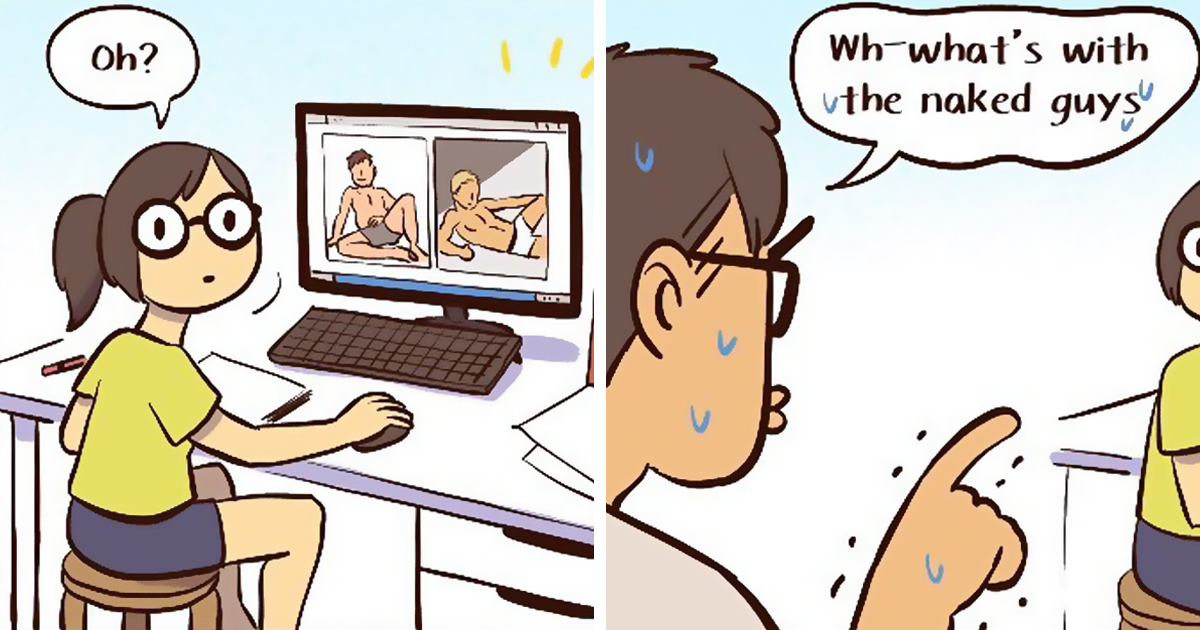
The collection of 30 adorable comics captures the gentle chaos of sharing a home with someone whose personality, habits, and professional brain operate very differently from your own. Pang is the artistic dreamer. Her husband is the practical IT specialist. Milky is the dog, household celebrity, emotional support cloud, and occasional agent of disorder.
Together, they create the kind of domestic comedy that feels less like a scripted sitcom and more like somebody secretly installed a cartoon camera in your living room.
Meet Bonnie Pang, the Artist Behind the Adorable Comics
Bonnie Pang was born and raised in Hong Kong. Although she had loved drawing since childhood, her academic path did not begin with traditional art training. She earned a bachelor’s degree in Geography and Resource Management from the Chinese University of Hong Kong before completing a master’s degree in Illustration at the Academy of Art University.
That combination makes an unusual amount of sense when looking at her work. Geography is about places, environments, relationships, and how living things interact. Pang’s comics explore similar territory, except the landscape is a shared apartment and the natural forces include affection, procrastination, technology, pet hair, and hunger.
Her professional experience includes children’s books, commercial illustration, animation concept art, public art, and personal comics. She is represented by Astound, an international illustration agency, and has worked on children’s publishing projects for clients around the world.
Pang has also created several original comics and graphic stories, including Roar Street Journal, MindBound, Chronos Express, and IT Guy & Art Girl. Her broader work is known for warm colors, lively characters, animals, gentle humor, and stories that leave readers feeling slightly better about humanity than they did five minutes earlier.
How Everyday Life Became IT Guy & Art Girl
Pang had already been making wholesome animal comics when she decided to experiment with a relationship-based series. Around the time she and her partner became engaged, she realized that years of sketchbooks contained plenty of material about their life together.
Instead of designing two glamorous human characters who somehow wake up with perfect hair, Pang represented herself and her partner through animal-like personas. Art Girl appears as a horse, while IT Guy is portrayed as a polar bear. Their contrasting forms immediately communicate their personalities: one expressive and energetic, the other calm, practical, and occasionally difficult to remove from a computer.
Milky remains recognizably Milkya white Pomeranian whose cloudlike appearance makes every entrance funnier. He does not need a complicated costume or superhero origin story. He already possesses the traditional canine superpowers of hearing a snack wrapper from three rooms away and identifying the person most likely to surrender food.
The series is rooted in real experiences, though Pang has explained that she sometimes exaggerates situations for comedic effect. That creative freedom allows her to preserve the emotional truth of an incident without treating every panel as sworn courtroom testimony.
In other words, the comics are autobiographical, but readers should not assume that IT Guy literally transforms into a polar bear whenever asked to help clean the house. Probably.
Why These 30 Adorable Comics Feel So Relatable
They Focus on Tiny Relationship Moments
Many romantic stories concentrate on beginnings: the first meeting, first date, proposal, or wedding. Pang is more interested in what happens after the grand soundtrack fades and somebody has to take out the trash.
Her relationship comics find humor in sleeping arrangements, household chores, shopping decisions, working from home, food cravings, misunderstandings, social situations, and the strange personal habits couples gradually discover about each other.
These moments seem ordinary because they are ordinary. That is precisely why they work. Readers do not need to share Pang’s exact life to recognize the emotional pattern behind a scene. One person wants attention while the other is busy. Someone claims not to be hungry and then begins eating from another person’s plate. A pet receives a level of enthusiasm normally reserved for returning astronauts.
The details may change, but the relationship dynamics travel surprisingly well.
The Personality Contrast Creates Natural Comedy
The title IT Guy & Art Girl establishes the central contrast before the first panel even begins. Art Girl represents imagination, emotion, visual thinking, and spontaneous enthusiasm. IT Guy represents logic, technical problem-solving, efficiency, and the ability to answer a simple question with an explanation containing six acronyms.
Pang does not present either personality as superior. The humor comes from watching two valid but different approaches collide.
An artist may see a blank room and imagine colors, textures, and possibilities. An IT professional may see the same room and wonder whether the Wi-Fi signal reaches the corner. One thinks about atmosphere. The other is already measuring cable length.
This contrast gives the series a dependable comic engine. Even simple decisions can become miniature negotiations, but beneath the teasing is genuine fondness. Their differences are not treated as fatal incompatibilities. They are the seasoning that makes the relationship interesting.
Milky Is More Than a Cute Supporting Character
Pets have a special talent for turning predictable routines into stories. Milky brings another emotional perspective into the comics, even when his perspective is mainly, “I noticed you have food.”
Dogs can interrupt serious conversations, demand affection at inconvenient times, choose favorite humans with questionable diplomacy, and react to ordinary events as if civilization is ending. A doorbell is not merely a doorbell. It is a national emergency requiring immediate barking.
Milky’s presence also softens the comedy. He represents companionship and the everyday rituals that form around caring for an animal. Walks, greetings, cuddles, grooming, feeding, and bedtime become shared family experiences.
Pang has said she enjoys drawing animals, particularly dogs, horses, and dinosaurs. Milky naturally fits into both her personal life and her artistic interests. Fortunately, he is easier to keep in an apartment than a dinosaur.
The Art Style Makes Simple Stories Memorable
The visual appeal of IT Guy & Art Girl comes from clarity rather than unnecessary complexity. Pang uses expressive faces, readable body language, warm colors, and clean panel arrangements to make each situation instantly understandable.
This is especially important for short webcomics. Readers often encounter them while scrolling on a phone, so the premise must be clear and the emotional beat must arrive quickly. A raised eyebrow, collapsed posture, or sudden change in scale can deliver a joke before a paragraph of dialogue could finish putting on its shoes.
The animal-based character designs also allow Pang to heighten reactions. IT Guy can appear enormous when protective, sleepy, or immovable. Art Girl can become dramatically animated when inspired, frustrated, or excited. Milky can occupy the visual center simply by being fluffy, which is admittedly an unfair but powerful advantage.
Pang’s experience illustrating children’s books is visible in her approachable storytelling. The images are inviting, the emotions are legible, and the compositions guide the eye naturally from setup to punchline.
How Bonnie Pang Creates Her Comics
Adorable does not mean effortless. Pang has described a structured process that moves from the initial idea through sketching, line art, coloring, and background work.
A short comic of approximately four to six panels can take several hours to complete. Longer stories designed for multiple social-media slides may require an entire day, sometimes divided between writing and sketching on one day and finishing the art on another.
Her ideas frequently come from daily experiences with her husband and Milky. Inspiration can also arrive through friends, online conversations, or observations of other people. When an idea appears, she records it for future use.
This habit is essential because inspiration has terrible office hours. It may show up while an artist is cooking, walking the dog, or trying to sleep, then disappear the moment a blank document opens.
Pang has said that coloring is one of the most relaxing parts of her process. By that stage, the difficult structural decisions have largely been made, and the story begins to feel complete. It is the artistic equivalent of putting frosting on a cake, except nobody asks why the blue background tastes like paint.
Why Slice-of-Life Comics Work So Well Online
Slice-of-life comics are ideally suited to digital reading because they offer complete emotional experiences in a compact format. A reader can recognize a situation, enjoy the punchline, and share it with a partner or friend within seconds.
The best examples create an immediate response: “That is exactly us.” This recognition encourages comments and conversations. Readers compare habits, tag significant others, and debate which character they resemble.
Unlike comedy based entirely on celebrity news or temporary trends, everyday relationship humor has a long shelf life. Technology changes, fashions shift, and social platforms reinvent their buttons every few months, but couples will continue arguing over blankets with remarkable consistency.
Pang’s comics also avoid making affection overly sentimental. The love in the series is usually shown through actions: preparing food, offering comfort, sharing routines, solving problems, teasing without cruelty, and accepting another person’s quirks.
That balance between sweetness and comedy keeps the work from becoming sugary. The comics are warm, but they still acknowledge that living with another person means occasionally discovering that your preferred method of loading a dishwasher is apparently “wrong.”
Everyday Happiness Is the Real Subject
Pang has described “mundane happiness” as one of the subjects she loves exploring. That phrase perfectly summarizes the appeal of IT Guy & Art Girl.
Mundane happiness is not a spectacular event. It is a familiar breakfast, a pet waiting by the door, a private joke, a quiet workday, or the comfort of sitting beside someone without needing to entertain each other.
These experiences are easy to overlook because they do not announce themselves as important. Comics can preserve them. By converting a fleeting moment into panels, Pang gives it shape, timing, color, and emotional weight.
The result is more than a collection of cute couple comics. It is a visual record of how affection appears in ordinary life: imperfect, playful, occasionally ridiculous, and frequently covered in dog hair.
Experiences Inspired by “Artist Shares Her Everyday Life In 30 Adorable Comics”
Recognizing Your Own Relationship in Someone Else’s Panels
One of the most enjoyable experiences when reading Pang’s comics is the sudden jolt of recognition. A scene may involve a couple preparing for guests, negotiating chores, struggling to get comfortable in bed, or reacting very differently to the same problem. Before the final panel arrives, readers may already know the punchline because they have lived some version of it.
This recognition can feel oddly reassuring. The little misunderstandings and eccentric habits inside a relationship sometimes appear uniquely strange from within. Then a comic reveals that thousands of other couples are also having intense debates about room temperature, snack ownership, and whether an item placed beside the trash can has technically been “thrown away.”
Shared laughter turns private frustration into something lighter. A habit may still be annoying, but now it has comedic potential.
Seeing Daily Routines as Possible Stories
The series can also change how people observe their own lives. After reading several everyday-life comics, routine events begin to look like unfinished panels.
A dog refusing to walk in the rain becomes a character conflict. A partner falling asleep during a movie becomes a setup and punchline. A failed cooking experiment becomes a dramatic survival narrative with suspicious smoke in the background.
This does not require treating loved ones like unpaid content generators. It simply means noticing that stories are already present in ordinary routines. The humor often comes from emotional contrast: confidence followed by failure, expectation followed by reality, or a serious plan interrupted by a very unserious pet.
Keeping a small note on a phone can preserve these moments. A single sentence may later become a comic, journal entry, social post, or family memory.
Learning to Exaggerate Without Losing the Truth
Pang’s approach demonstrates an important lesson for autobiographical creators: accuracy and emotional truth are not always identical.
A real disagreement may have lasted fifteen quiet minutes, but a comic can represent it as an epic standoff across a frozen wasteland. A sleepy partner may not literally transform into an immovable polar bear, but the visual exaggeration communicates exactly how the moment felt.
The most effective exaggeration strengthens recognition instead of replacing it. Readers understand that the event has been compressed and dramatized, yet the underlying emotion remains authentic.
This technique is useful beyond comics. Personal essays, humorous videos, and storytelling performances often depend on emphasizing selected details while preserving the honest core of the experience.
Appreciating the Work Behind a “Simple” Comic
Readers may scroll through a short comic in less than a minute, but its production can require hours of planning and drawing. The creator must select the strongest moment, remove unnecessary information, arrange the panels, control the timing, design expressions, choose colors, and make the final image readable on a small screen.
Knowing this can deepen the viewing experience. A pause between panels may be deliberate. A character’s position may guide the reader toward the joke. A blank background may remove distractions rather than indicate missing effort.
Short visual storytelling resembles a well-delivered joke: the finished result feels natural because the difficult construction has been hidden.
Finding Comfort in Imperfect Domestic Life
Perhaps the most lasting experience offered by these adorable comics is comfort. Pang’s illustrated household is loving, but it is not presented as flawless. People become tired, misunderstand each other, avoid chores, overreact, or behave irrationally around food. The dog has his own agenda and has apparently declined to share it with management.
Yet the overall atmosphere remains affectionate. Problems are not ignored, but neither are they inflated into proof that a relationship has failed. They become moments to navigate, remember, and occasionally draw.
That perspective can help readers appreciate their own imperfect routines. A happy life does not need to resemble a polished advertisement. It can include laundry, deadlines, technical problems, unfinished creative projects, and a Pomeranian monitoring dinner with the focus of an airport security officer.
Often, the mess is not interrupting the meaningful part of life. The mess is where the meaningful part is happening.
Conclusion
Bonnie Pang’s IT Guy & Art Girl succeeds because it understands that ordinary life is never truly ordinary when observed closely. A practical husband, an imaginative artist, and a fluffy dog provide enough personality and unpredictability to turn domestic routines into memorable visual stories.
Across these 30 adorable comics, Pang celebrates the quiet mechanics of companionship: adapting to differences, sharing responsibilities, offering comfort, laughing at mistakes, and finding joy in moments too small for traditional love stories.
Her work is cute without being empty, relatable without feeling generic, and funny without treating its characters cruelly. Most importantly, it reminds readers to notice the stories unfolding inside their own homes.
The next great comic idea may not require an intergalactic battle or mysterious superhero. It may already be sitting beside you, using your charger, stealing your blanket, or staring at your sandwich.
Editorial note: This independent profile was developed from publicly available artist biographies, professional publisher profiles, agency information, interviews, exhibition materials, and coverage of Bonnie Pang’s comics. The article uses original analysis and does not reproduce the featured comics or their dialogue.