
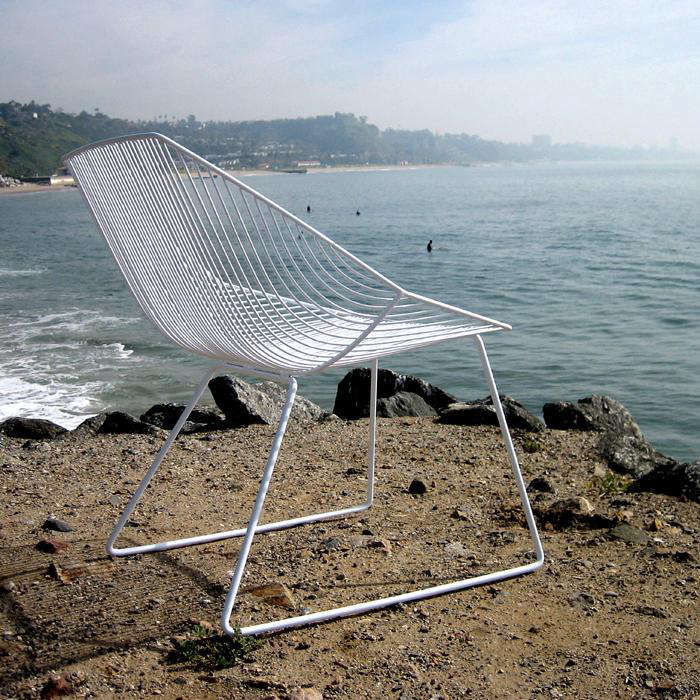
What happens when a Detroit-trained automotive sculptor, a midcentury furniture icon, and the loose indoor-outdoor spirit of Los Angeles meet in the same design studio? You get chairs that look like line drawings, behave like architecture, and bring considerably more personality to a patio than the average beige lounger.
A California Remix of a Midcentury Idea
Harry Bertoia’s wire chairs have occupied rarefied territory since Knoll introduced the collection in 1952. The Italian-born American sculptor transformed welded steel into seating that appeared almost weightless. Instead of hiding the structure beneath foam and fabric, he made the structure the main event. The chair was not merely placed in space; space passed directly through it.
Decades later, Los Angeles designer Gaurav Nanda approached that idea from a different direction. Raised around Detroit and trained in automotive design, Nanda spent approximately seven years sculpting vehicle interiors and exteriors for General Motors. His work involved turning digital wireframes and fluid surfaces into objects that had to look graceful, support real bodies, and survive daily use. Furniture, as it turned out, required a remarkably similar balancing actjust with fewer cup holders and significantly less horsepower.
Nanda founded Bend Goods in Los Angeles in 2010. His early seating acknowledged Bertoia’s breakthrough without simply tracing it. The shared vocabulary was obvious: open metal construction, sculptural silhouettes, visible welds, and a sense of lightness. The accent, however, was unmistakably LA. Bend’s designs introduced energetic geometry, saturated powder-coated colors, playful names, and forms meant to move easily between a living room and a sunlit terrace.
Why Harry Bertoia’s Wire Furniture Still Matters
A Chair Made Mostly of Space
Bertoia was primarily an artist and metalworker, not a conventional furniture stylist. Before producing his famous seating, he studied art in Detroit, worked with metal at Cranbrook, created jewelry and prints, and contributed to experimental molded-plywood work in California. When Florence and Hans Knoll later gave him room to explore at their Pennsylvania production facility, he treated furniture as another form of sculpture.
The resulting Bertoia Collection included side chairs, stools, and several lounge forms, including the celebrated Diamond Chair. Thin steel rods were welded into mesh shells that curved around the sitter. The engineering was industrial, but the visual effect was delicate. Depending on the angle, a chair might resemble a basket, a drawing, a net, or a small piece of architecture waiting patiently for someone to sit down.
The Diamond Chair and related designs now belong to major museum collections, including those of the Museum of Modern Art, the Metropolitan Museum of Art, and the Cooper Hewitt Smithsonian Design Museum. Knoll has kept the collection in production for decades. Its endurance is not a mystery: the chairs are instantly recognizable, yet transparent enough to coexist with changing interiors.
Influence Versus Imitation
Calling new work “Bertoia-inspired” should describe a design conversation, not a photocopy. The valuable lesson in Bertoia’s furniture is not that every chair needs a diamond-shaped steel grid. It is that structure, material, and empty space can do the decorative work normally assigned to upholstery.
Nanda carried that principle into a new visual language. Instead of relying on a uniform mesh, Bend Goods used tighter spacing and irregular geometric patterns. Triangles, zigzags, arches, and structural motifs became recognizable graphics. A Bend chair reads differently from across the room and up close: first as a bold silhouette, then as a collection of individual lines and intersections.
From General Motors to Bend Goods
Automotive Thinking at Furniture Scale
Nanda’s automotive background helps explain why Bend seating feels both expressive and engineered. Car designers constantly negotiate between dramatic surfaces and unforgiving practical requirements. A form can look aerodynamic on a screen, but it must eventually accommodate a driver, machinery, visibility standards, and manufacturing constraints.
A chair creates its own version of that puzzle. Its back must flex without feeling weak. Its seat must distribute weight without producing the sensation of sitting on a shopping cart. Its legs must remain stable while appearing visually light. It must also support people of different sizes, tolerate being dragged across restaurant floors, and preferably avoid snagging someone’s favorite sweater.
For the original Lucy Chair, closely spaced wires helped create a more supportive sitting surface. The seat behaves less like a handful of metal bars and more like a continuous, slightly flexible plane. After several rounds of development and prototype testing, the finished design established the combination that would define Bend Goods: intricate wirework, functional comfort, architectural form, and bold color.
The Lucy Chair Finds Its Own Identity
The Lucy Chair was the studio’s starting point and remains its clearest statement. Its asymmetric triangular pattern replaces Bertoia’s regular grid with something more animated. The lines seem to travel across the seat and back, giving the chair motion even when it is parked politely beneath a dining table.
Its importance eventually extended beyond commercial success. In 2021, a neon Lucy Chair entered the permanent collection of the Los Angeles County Museum of Art alongside Bend’s Electric Blue Cloud Bench. That acquisition placed Lucy within the documented history of Los Angeles design rather than leaving it in the broader category of attractive patio furniture.
The distinction matters. Great furniture is not defined only by sales, social-media appearances, or how frequently it turns up in stylish restaurants. It also reflects the place and period in which it was created. Lucy’s bright color, indoor-outdoor flexibility, and cheerful industrialism make sense in a city where living rooms open onto courtyards and serious architecture regularly shares space with palm trees.
The Personalities in the Early Bend Collection
Bunny Lounge Chair
The Bunny Lounge Chair demonstrates how a wire frame can feel relaxed rather than rigid. Its rounded upper shape suggests a pair of ears without turning the chair into novelty furniture. The low, open form suits a pool deck, reading corner, or casual conversation area. It has humor, but it does not arrive wearing a costume.
Farmhouse Lounge Chair
The Farmhouse Lounge Chair looks to structural framing for its personality. Its backrest draws inspiration from the geometry of traditional barns, turning a familiar bracing pattern into a graphic focal point. The result is an appealing contradiction: agricultural construction translated into colorful, cosmopolitan furniture.
Lucy Chair and Lucy Stool
Lucy is the versatile member of the group. The dining chair can introduce pattern without blocking sightlines, while stool versions bring the same energy to kitchen islands, café counters, and outdoor bars. Because the frame remains visually open, several stools can stand together without forming a heavy metal barricade around the counter.
Drum Stool and Companion Pieces
Bend’s Drum design extends the wire language into a compact multifunctional object. Depending on the setting and configuration, it can serve as a stool, ottoman, or small table. Add a cushion and it becomes a casual perch; remove it and the geometric frame takes center stage. Small-space furniture loves a second job, and the Drum appears perfectly happy to accept a third.
How the Seating Is Made
Early Bend chairs were constructed from iron rods arranged into precise patterns and joined by spot welding. Each intersection contributed to the strength of the whole shell. The furniture was then treated to resist corrosion and finished with powder coating, producing a durable colored surface suitable for indoor and outdoor settings.
Powder coating differs from ordinary wet paint. A dry finishing material is applied electrostatically and cured with heat, creating an even, resilient layer around the metal. It helps the furniture tolerate frequent handling and changing weather while delivering the saturated hues associated with the brand.
Bend Goods has since expanded beyond its original iron wire pieces into broader steel, stainless-steel, aluminum-tube, upholstered, and wood furniture collections. The common thread is still the line: how it curves, changes thickness, carries weight, and defines space.
No outdoor finish, however, possesses superhero powers. Coastal salt, standing water, abrasive dirt, and chipped coatings can shorten the life of metal furniture. Buyers should confirm the exact material and finish of the model they are considering, especially for uncovered patios or properties close to the ocean.
Why Wire Seating Works So Well in Los Angeles
Los Angeles architecture has a long history of dissolving the boundary between indoors and outdoors. Sliding glass walls, courtyards, shaded terraces, pools, and gardens often function as extensions of the living room. Furniture placed in these transitional spaces must look refined enough for an interior while remaining practical enough for sunshine, dust, and the occasional guest carrying a dangerously full glass of sangria.
Wire seating fits this environment naturally. Its open construction allows light and views to continue through the furniture. It does not visually crowd a small balcony, and it casts elaborate shadows that change throughout the day. In bright colors, the chairs become punctuation marks against concrete, stucco, tile, and greenery.
The style also complements the city’s mixture of architectural references. A geometric wire chair can sit comfortably beside a midcentury home, a Spanish Revival courtyard, an industrial loft, or a minimalist restaurant. It is modern without demanding that every object nearby submit proof of membership in the modernist club.
How to Style Bertoia-Inspired Seating
Let One Color Lead
A peacock-blue, citrus-orange, or neon-yellow chair already has plenty to say. Give it room by pairing it with pale walls, natural wood, stone, or restrained textiles. Repeating the chair color once in a small artwork, vase, or pillow can make the choice look intentional without turning the room into a paint-swatch convention.
Use Transparency in Small Rooms
Open-frame furniture is especially useful in apartments and narrow dining areas because the eye can travel through it. The actual footprint remains realphysics continues to enforce the rulesbut the visual footprint feels smaller than that of a fully upholstered chair.
Balance Metal With Softer Materials
Too many hard surfaces can make a room feel like a very fashionable waiting area. Combine wire seating with wool rugs, linen curtains, timber tables, leather accents, or generous plants. A removable cushion adds comfort and color while preserving the frame’s sculptural identity.
Mix, Rather Than Match, With Care
Bertoia-inspired seating works well in a collected interior. Try wire chairs around a solid wood table, pair one lounge chair with a low stone side table, or combine different colors of the same model. The strongest arrangements repeat one elementshape, finish, or paletteso the variety looks playful rather than accidental.
What to Check Before Buying a Wire Chair
- Authenticity: If you want a genuine Harry Bertoia design, look for authorized Knoll production and appropriate manufacturer markings. “Bertoia style” is not the same as an original licensed chair.
- Construction: Examine welds, leg alignment, frame stability, and the smoothness of exposed edges. Decorative geometry still has to hold a human being.
- Comfort: Test the chair when possible. Wire spacing, seat angle, back flex, and arm placement greatly affect how it feels after more than five photogenic minutes.
- Outdoor rating: Confirm the metal, pretreatment, finish, and manufacturer’s care instructions. Indoor suitability does not automatically imply monsoon readiness.
- Floor protection: Check the glides and replace worn pieces before a metal base begins autographing the hardwood.
- Cushions: Determine whether pads are included, removable, weather-resistant, or sold separately. A beautiful chair and its properly fitted cushion can have surprisingly separate financial lives.
The Broader Lesson of the LA Interpretation
Bend Goods shows how a designer can acknowledge a famous predecessor while creating a recognizable identity. Bertoia demonstrated that welded wire could become sculpture, furniture, and negative space at once. Nanda retained that material intelligence but shifted the composition toward asymmetry, graphic pattern, saturated color, and California informality.
The evolution also demonstrates why midcentury modern design continues to generate new work. The strongest classics are not sealed museum specimens. They establish ideas that later designers can question, redirect, and translate for different places. In Los Angeles, Bertoia’s airy metal framework acquired the visual energy of street geometry, automotive modeling, poolside living, and a city that rarely sees a reason to keep the patio out of the conversation.
Living With Bertoia-Inspired Seating: The Real Experience
The first experience of a wire chair is visual. From the doorway, it seems almost two-dimensional, like a confident sketch hovering above the floor. Walk around it and the pattern changes continuously. Lines overlap, triangles appear and disappear, and shadows create a second chair beneath the first. In strong afternoon sunlight, the shadow can be so good that the actual chair faces unexpected competition.
Sitting down produces the next surprise. A well-designed wire seat does not feel like a garden fence. Closely arranged rods spread pressure across the body, while small amounts of flex keep the shell from feeling completely rigid. The sensation is firmer than deep upholstery but more forgiving than its appearance suggests. For a long dinner, many people will still appreciate a fitted pad. For coffee, conversation, or a quick meal, the bare frame can be perfectly comfortable.
In a compact dining room, the openness is immediately useful. Four solid chairs can form a visual wall around a table; four wire chairs allow the table base, rug, and surrounding floor to remain visible. The room feels less crowded even though the seating capacity has not changed. This is particularly helpful when the table itself is heavy, dark, or sculptural.
Moving the chair between spaces reveals another advantage. Wire seating often looks equally convincing beside a desk, around a breakfast table, or on a sheltered patio. A bright chair can spend winter functioning as a bedroom accent and return outdoors when warmer weather arrives. That flexibility makes a distinctive purchase easier to justify, especially in a home where furniture is regularly rearranged for guests.
Maintenance is simple but not nonexistent. Dust collects around welds, crumbs discover geometrically improbable hiding places, and outdoor chairs eventually acquire a film of pollen or city grime. A soft cloth or brush and mild cleaning solution usually handle routine care. Abrasive tools are a poor choice because scratches can compromise the finish. Any chip that exposes metal deserves quick attention before moisture turns a tiny flaw into an enthusiastic patch of corrosion.
There are also small practical realities. Metal can become hot in direct summer sun and chilly on a cold morning. Loose clothing may occasionally catch on a poorly finished edge, which is why smooth welds and quality construction matter. Hard-floor glides need periodic inspection. None of these issues is dramatic, but furniture should be evaluated while everyone is calmnot after a chair leg has carved a tiny interstate across an oak floor.
The best experience comes when the chair is treated as both equipment and art. It should support the body, survive its intended environment, and fit beneath the table. Yet it should also be positioned where light can animate the frame and where the color or geometry contributes something meaningful. That is the pleasure of Bertoia-inspired seating from LA: even when nobody is sitting in it, the chair continues to work.
Conclusion
Bertoia-inspired seating by way of Los Angeles is not simply a midcentury revival. It is a regional reinterpretation of a powerful design principle: furniture can be strong without looking heavy, decorative without added ornament, and sculptural without abandoning comfort.
Harry Bertoia established the wire chair as a modern design archetype. Gaurav Nanda and Bend Goods pushed the format toward tighter patterns, vivid finishes, indoor-outdoor versatility, and an unmistakably playful attitude. From the foundational Lucy Chair to lounge pieces such as Bunny and Farmhouse, the collection demonstrates how influence can become invention when a designer brings a different background, city, and sense of humor to the tableor, in this case, to the chair pulled up beside it.













