
Wedding traditions have a funny way of acting like software defaults: they arrive preinstalled, everyone assumes they have to use them, and nobody asks whether there might be a better configuration. Brides are supposed to gather their girlfriends, put on matching robes, sip champagne, pose for glamorous getting-ready photos, and produce enough coordinated smiling to power Pinterest for a week.
But what happens when the bride’s closest friends are not women?
For Brazilian computer engineering student Rebeca Brantes, the solution was beautifully simple: forget the traditional bridesmaids and call the bros.
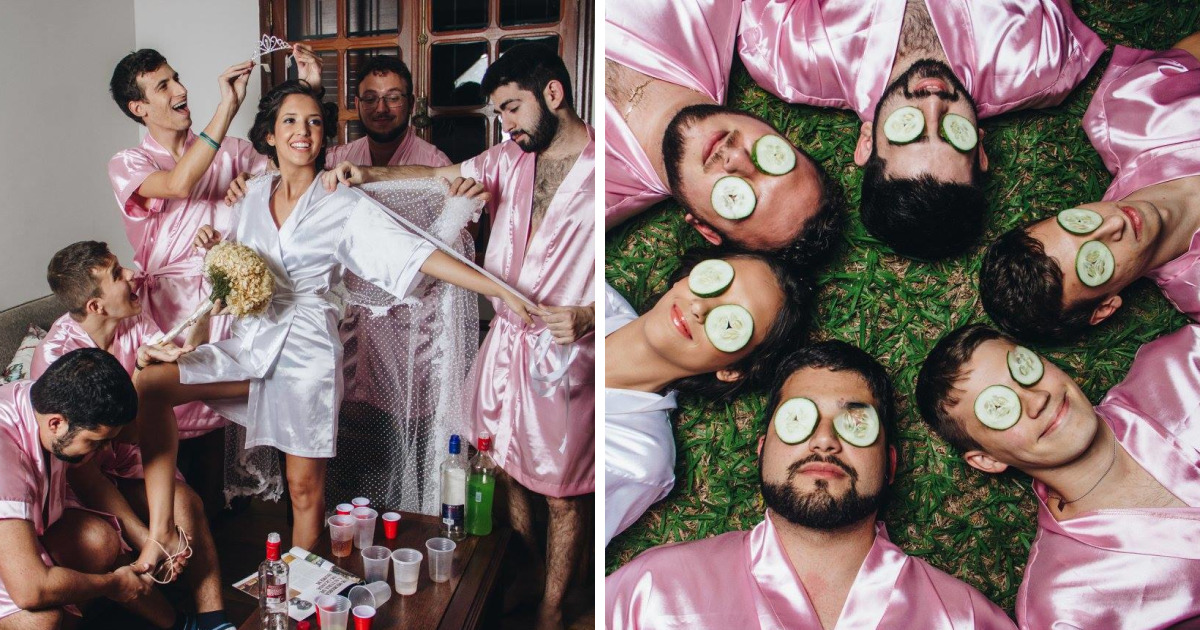
In 2017, Brantes became an internet favorite after posing for a hilarious bridal photo shoot with five of her closest male college friends. The then-24-year-old was studying computer engineering and was reportedly one of only four women in a class of 60 students. With most of her closest university friendships naturally forming with men, she decided there was no reason her wedding photographs needed to pretend otherwise.
The result was equal parts sweet, ridiculous, and refreshingly authenticand perhaps one of the strongest arguments ever made for letting your actual friends stand beside you instead of casting your wedding like a gender-specific television commercial.
How the Computer Engineer Bride Got the Idea
Shortly before her wedding, Brantes had been looking at traditional bridal preparation photos. You know the genre: the bride and her bridesmaids relaxing in matching robes, drinking something sparkling, applying makeup, laughing effortlessly, and somehow keeping everyone’s hair perfect at the same time.
She liked the idea but faced an obvious problem. Her closest girlfriends from earlier stages of life were not nearby, while most of the friends she spent her university years with were men.
Instead of abandoning the photo shoot, she redesigned it.
That is a very engineer-like response, when you think about it. Requirement identified. Constraint discovered. Alternative architecture implemented.
Brantes invited five of her closest male friends to participate, and photographer Fernando Duque helped turn the concept into a playful parody of classic bridesmaid preparation pictures. Contemporary reports described the group wearing pink robes, inspecting the wedding dress, pretending to apply makeup, shaving their legs, relaxing with cucumber slices over their eyes, drinking together, and generally committing to the assignment with admirable enthusiasm.
The Bros Did Not Half-Commit
There are two ways five male engineering friends could react when asked to participate in a bridesmaid-style photo shoot.
Option one: awkwardly stand in the background while making sure everyone understands that they are doing this ironically.
Option two: put on the pink robe, grab the makeup brush, locate the cucumbers, and become the bridesmaids they were apparently born to be.
Thankfully, Brantes’ friends selected option two.
Pink Robes, Beauty Treatments, and Plenty of Laughter
The photographs worked because the men did not appear embarrassed by the concept. They leaned into it. Instead of treating the shoot as a joke at their friend’s expense, they became part of the joke with her.
Some images recreated familiar bridal-party poses. Others intentionally exaggerated them. The contrast between several college-age guys and stereotypically feminine wedding-preparation rituals produced the obvious comedy, but the affection among the group prevented the pictures from feeling mean-spirited.
According to reporting at the time, the friends laughed so much during portions of the shoot that they occasionally had to stop before continuing. Brantes later said she still found herself laughing while looking back at the pictures.
That detail is arguably more important than the matching robes.
Wedding photography can become strangely focused on manufacturing perfection. Brantes and her friends produced something better: photographs attached to a genuine memory.
Why the Photos Went Viral
The bridal shoot quickly spread online after Brantes shared the images. Business Insider reported that the photographs had accumulated tens of thousands of Facebook shares, while other outlets around the world picked up the story.
Of course, funny pictures helped. The internet has rarely encountered grown men in coordinated pink robes without expressing an opinion.
But the story had something more durable underneath the humor.
It challenged a familiar social script without delivering a lecture about challenging social scripts.
Brantes did not need to announce that wedding parties should become more inclusive. She simply chose the people she actually loved spending time with and let the pictures demonstrate the point.
Her Computer Engineering Background Matters
The computer engineering detail is not merely a quirky headline ingredient. It helps explain how Brantes developed such a male-heavy college friend group.
At the time, she was reportedly one of four women among 60 students in her program. Her individual class was unusually lopsided, but the broader imbalance between men and women in computing and engineering has been documented for years.
U.S. Census Bureau data, for example, found women represented roughly one-quarter of computer workers and about 15 percent of engineering workers in 2019. National Science Foundation reporting has likewise continued to identify women as underrepresented in engineering and computer and information science fields.
That does not mean women engineers automatically lack female friends, obviously. Friendship is considerably more complicated than a spreadsheet. But when a student spends years attending classes, completing projects, studying, debugging code, surviving exams, and drinking unhealthy quantities of coffee with a mostly male cohort, it is hardly surprising if some of her strongest friendships emerge from that group.
Friendship Usually Follows Shared Experience
People frequently become close through repeated experiences rather than demographic matching.
A classmate who helps you solve an impossible assignment at 1 a.m. may eventually become more important than somebody who fits the traditional image of who your best friend is supposed to be.
College friends witness failed exams, successful projects, awful presentations, internships, breakups, job searches, celebrations, and approximately 400 conversations beginning with, “Why isn’t this code working?”
Those accumulated moments create friendship.
A wedding party should probably recognize that reality rather than ignore it.
Mixed-Gender Wedding Parties Are No Longer Shocking
Brantes’ photographs felt especially unconventional in 2017, but the broader idea of bridesmen, groomswomen, men of honor, best women, and mixed-gender wedding parties has become increasingly normalized.
Modern wedding guidance from The Knot, Brides, WeddingWire, and Zola generally emphasizes choosing attendants based on closeness rather than gender. Recommendations now routinely discuss how to coordinate clothing, bachelor or bachelorette events, processional arrangements, getting-ready spaces, and wedding-party titles for groups that do not follow the traditional women-on-one-side, men-on-the-other formula.
In other words, wedding etiquette has finally discovered something ordinary friendships figured out a long time ago: your best friend does not need to match your outfit category.
What Makes an Unconventional Bridal Party Work?
Choose Relationships, Not Roles
The simplest lesson from this story is also the most useful: decide who matters first and assign titles second.
If your closest friend happens to be a man, he can be a bridesman. If the groom’s closest friend is a woman, she can be a groomswoman or best woman. If neither title feels natural, “wedding party,” “honor attendant,” or simply the person’s name works perfectly well.
Nobody from the Department of Wedding Enforcement is arriving to confiscate the cake.
Coordinate Without Making Everyone Identical
A mixed-gender wedding party does not require identical clothing. A shared color palette, coordinated ties, pocket squares, boutonnieres, bouquets, fabrics, or accessories can visually connect the group while allowing people to wear clothes in which they actually feel comfortable.
Brides has specifically recommended using consistent colors or coordinated details to create cohesion while allowing different silhouettes and individual style.
Make Activities About Friendship
If your wedding party includes different genders, do not assume traditional pre-wedding events must automatically separate everybody.
A bachelor or bachelorette celebration can simply become a party with close friends. Getting ready can be organized according to comfort and logistics rather than gender. The same goes for showers, rehearsal activities, photographs, and reception entrances.
WeddingWire has similarly advised treating mixed-gender attendants as full members of the group rather than making them feel like unusual add-ons.
The Photos Were Funny Because the Friendship Was Real
There is a difference between creating something weird solely for internet attention and doing something unusual because it genuinely reflects your life.
Brantes’ shoot falls into the second category.
Remove the pink robes and cucumber slices and the central story becomes almost boringly wholesome: a woman wanted wedding memories with her best friends, and her best friends happened to be guys.
That authenticity probably explains why people responded so warmly.
Everyone understands the experience of having friendships that do not fit somebody else’s expectations. Maybe your closest friends are older. Maybe they live across the country. Maybe you met online. Maybe your sibling is your best friend. Maybe your work friends became your family. Maybe your friend group looks like several completely unrelated people were randomly selected in a supermarket parking lot.
If the relationship is meaningful, the packaging matters very little.
What Couples Can Learn From Rebeca Brantes’ Viral Wedding Shoot
The biggest takeaway is not that every bride should replace bridesmaids with five engineers wearing pink satin.
Although, admittedly, the photographs suggest this would not be the worst trend weddings have ever produced.
The real lesson is that traditions work best when they serve peoplenot when people serve traditions.
If a custom creates a meaningful moment, keep it. If it excludes somebody important, modify it. If it feels completely irrelevant to your relationship, delete it with the confidence of an engineer removing obsolete code.
A wedding becomes memorable because it resembles the couple celebrating it.
Experience-Based Lessons for Anyone Planning a Wedding With Their Bros
Stories like Brantes’ become especially useful when translated from viral entertainment into practical wedding experience. Couples planning unconventional wedding parties often discover that the biggest obstacles are not actual problems but assumptions nobody thought to question.
Experience 1: The First Conversation May Feel Stranger Than the Wedding
Imagine asking your longtime male best friend to stand on the bride’s side.
There may be a two-second pause.
He may ask whether he is technically a bridesmaid.
Someone will probably invent a terrible title.
Then everybody moves on.
In practice, unconventional decisions often feel most unusual when they are first announced. Once invitations are sent, clothing is chosen, and everyone understands the plan, the novelty rapidly disappears. By the wedding day, guests are far more interested in seeing people they care about than conducting a gender audit of the ceremony lineup.
Experience 2: Matching Personalities Beats Matching Headcounts
Couples sometimes feel pressure to create symmetrical wedding parties: five attendants for the bride, five for the groom, everybody paired perfectly for the aisle.
That may photograph neatly, but friendship does not arrive in matching packages.
If the bride has five close friends and the groom has three, eight genuine relationships are better than recruiting two ceremonial humans just to make the arithmetic attractive.
Mixed groups make that philosophy even easier to embrace. People can walk individually, enter in groups, or simply take their places before the ceremony. What seems like a major planning problem can usually be solved in about thirty seconds.
Experience 3: Give the Photographer Room to Play
One reason Brantes’ pictures became memorable was that the group committed to the concept instead of merely documenting everyone’s clothing.
The same principle works for any wedding party.
Photograph the inside jokes. Recreate the ridiculous college pose. Bring the object connected to the story everyone remembers. Take the polished portrait for the grandparents, certainlybut also capture the photograph that makes the group laugh ten years later.
Perfect posture ages. Good stories usually do not.
Experience 4: Explain Only What Actually Needs Explaining
Couples planning nontraditional weddings sometimes overprepare themselves for criticism.
Most decisions need surprisingly little justification.
“These are my closest friends” is enough.
You do not need a five-slide presentation explaining why your bridesman is standing beside you. You do not need to apologize because your maid of honor is a man, your best person is your sister, or your wedding party contains seven people on one side and three on the other.
The more naturally the couple treats the arrangement, the more naturally everyone else tends to respond.
Experience 5: Comfort Produces Better Memories Than Tradition
Wedding planning can turn otherwise reasonable adults into temporary project managers obsessed with napkin colors.
When stress rises, it helps to return to a simpler question: who do you want beside you when you’re nervous, excited, exhausted, emotional, and approximately twelve minutes behind schedule?
That is the person who belongs in your wedding party.
Not the person tradition says should be there.
Not the person required to balance a photograph.
Not somebody chosen because guests might find the arrangement easier to understand.
The person who will make you laugh when the zipper sticks, find your missing phone, tell you that your hair looks fine, bring water before you realize you need it, and prevent a minor scheduling problem from becoming an international incident.
For Rebeca Brantes, those people happened to be five guys from her college circle.
And judging by the photographs, they understood the assignment perfectly.
Conclusion
The story of the computer engineer bride who invited her bros instead of traditional bridesmaids remains charming because it combines humor with something genuinely meaningful.
Rebeca Brantes did not build her wedding party according to a template. She looked at the friendships she actually had and designed the experience around them. Five male friends put on pink robes, participated enthusiastically in a playful bridal photo shoot, and helped create pictures that traveled around the world.
Years later, the story still feels surprisingly modern.
Weddings may come with centuries of traditions, but traditions are options rather than mandatory settings. The people standing beside you should be there because they earned the position through friendship, loyalty, shared experiences, and probably at least one extremely embarrassing story.
If those people happen to be your bros, invite the bros.
Just make sure somebody remembers the cucumber slices.
Editorial note: This article is an original synthesis and analysis based on contemporaneous reporting about Rebeca Brantes’ 2017 wedding photo shoot, along with established wedding-industry guidance and U.S. data concerning gender representation in computing and engineering.











