
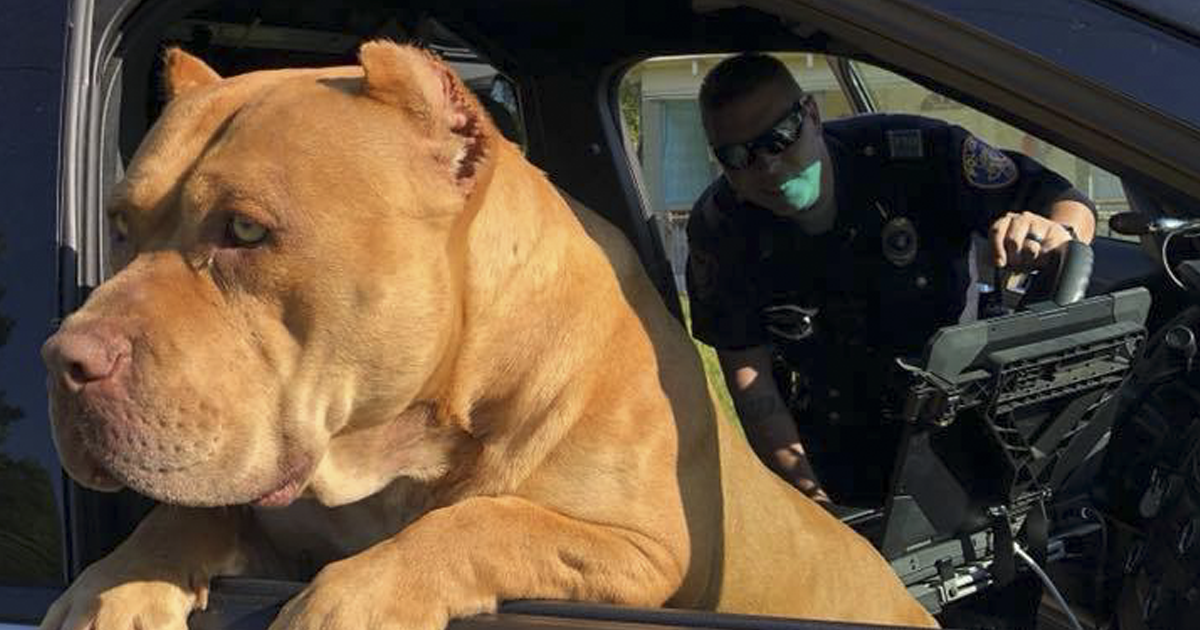
Some calls make an officer brace for chaos. This one came with a label that practically had sirens built into it: vicious dog. That phrase tends to set the imagination loose like a toddler with a drum set. You picture barking, lunging, maybe a dramatic sprint back to the patrol car. Officer Travis Frost of the Texarkana Texas Police Department likely expected some version of that when he responded to a neighborhood report about a supposedly dangerous dog.
What he got instead was a lesson in caution, body language, and the very American habit of judging a dog by its square jaw. The dog in question, later identified as an American Bully named Gold, did not launch a furry ambush. He did not snarl, snap, or deliver the kind of “attack” people feared. His move was somehow much more devastating to stereotypes: he wagged, strutted over, and made himself comfortable in the officer’s patrol car like he had somewhere important to be and assumed everyone else understood that.
That moment turned a local animal-control call into a viral story, but the real reason it stuck with people goes deeper than cute photos. It tapped into a bigger conversation about how dogs are labeled, how fear spreads faster than facts, and why responsible handling matters more than dramatic assumptions. In other words, this was not just a heartwarming dog story. It was a reminder that public safety and common sense can absolutely coexist with compassion.
The Call That Sounded Like Trouble
According to widely reported accounts of the incident, Frost arrived expecting the possibility of a dangerous encounter. He even left the door to his patrol car open so he could retreat quickly if the dog rushed him. That part matters. It shows he did not stroll in like a movie hero who had watched too many action films and mistaken confidence for strategy. He approached carefully, which is exactly what most experts recommend when dealing with an unfamiliar dog.
Then came the plot twist. Frost whistled to get the dog’s attention, and the big tan dog trotted over with a wagging tail. Not a growl. Not a charge. Not a teeth-bared audition for a horror trailer. Just a relaxed dog who seemed far more interested in attention than intimidation. After a little petting, the dog hopped into the front seat of the patrol car and made himself at home.
It was the kind of scene that writes its own headline. A call about a “vicious” dog had turned into a ride-along with a dog whose energy could best be described as “large baby who assumes every vehicle is an Uber.” Officers waited with him until animal control arrived, and before long, the story spread online because it delivered something the internet never gets tired of: an intimidating-looking animal behaving like a marshmallow.
Even better, the story had a responsible ending. The dog was identified as Gold, and he was later reunited with his owner after animal-control and shelter staff helped track down where he belonged. That detail is important because it shifts the story from pure comedy into something more useful: a case study in how calm response, proper animal handling, and pet identification can turn a potentially tense situation into a safe reunion.
Why This Story Took Off
Plenty of dog stories go viral because they are adorable. This one went viral because it challenged a script people know too well. Big, muscular, blocky-headed dogs are often treated as if they arrive in the world already guilty. To many people, one glance is enough to assign a whole personality: dangerous, unstable, aggressive, bad news. Gold’s porch-side performance politely shredded that assumption.
That does not mean every loose dog is safe. It means appearances are not a behavior assessment. A stocky dog is not automatically a threat any more than a tiny dog is automatically harmless. Anyone who has met a furious Chihuahua with the soul of a chainsaw already knows this.
The Texarkana encounter resonated because Frost balanced two things that should always go together: caution and fairness. He prepared for a bad outcome without forcing one. He watched the dog’s actual behavior instead of reacting only to its build or breed label. That is the sweet spot. Not recklessness. Not panic. Observation.
What the Incident Really Teaches About Dog Behavior
If you strip away the viral charm, the story becomes a useful lesson in reading dogs more intelligently. Animal-behavior guidance from major organizations consistently makes one point clear: dogs communicate before situations escalate. Real aggression usually comes with warning signs. A dog may stiffen, stare, growl, snarl, lunge, or show teeth. Fearful dogs may freeze, retreat, avoid eye contact, or react defensively if cornered. In short, canine behavior is more nuanced than “big dog equals bad dog.”
Gold’s behavior, at least in the reported encounter, signaled the opposite of immediate danger. He approached willingly, showed relaxed body language, accepted petting, and then climbed into the patrol car as if he had decided law enforcement was his new career path. Those are not classic signs of a dog preparing to attack.
That said, Frost’s initial caution was exactly right. Public-health guidance warns people not to assume an unfamiliar dog is safe, even if it looks friendly. A loose dog can be scared, injured, overstimulated, or protective of territory. The safe move is to stay calm, avoid sudden movements, and call animal control or local authorities when needed. That is what makes this story work so well: nobody ignored the risk, but nobody exaggerated it either.
The Difference Between “Looks Scary” and “Is Dangerous”
One of the biggest public misunderstandings around dogs is the idea that appearance tells the full story. It does not. A muscular frame, broad chest, or strong jaw may look dramatic, but those physical traits do not operate like a personality test. Behavior depends on far more than looks, including training, socialization, environment, stress, health, and the specific moment the dog is in.
That is why professionals often focus on what the dog is doing rather than what the dog resembles. Is the dog loose and frantic? Frozen and staring? Play-bowing? Backing away? Seeking contact? Guarding something? Those clues matter far more than the canine equivalent of a yearbook photo.
The Breed Stereotype Problem
Gold’s story also stepped into a long-running debate around pit bull-type dogs, American Bullies, and other bully breeds. These dogs are frequently portrayed as ticking time bombs with paws, even though many veterinary and animal-welfare groups argue that breed-based judgments are a poor shortcut for predicting risk. Their view is simple: behavior should be judged as behavior, not as a silhouette.
That is not a sentimental argument. It is a practical one. When communities focus too heavily on breed labels, they can miss the factors that really influence bite risk and public safety, including irresponsible ownership, neglect, lack of socialization, poor containment, and failure to recognize escalating stress in dogs. In other words, blaming the dog’s face can distract from the human choices that shaped the situation.
Gold’s case is a nearly perfect example of why that matters. The dog was initially described in frightening terms, and reports even misidentified him at first. But once people actually observed him, the story changed. Same dog. Same body. Completely different conclusion.
Why the Story Landed Emotionally
People did not just enjoy this story because it was cute. They enjoyed it because it felt like a small correction to a larger cultural habit. We are very good at deciding what is dangerous from a distance. We do it with neighborhoods, people, headlines, and yes, dogs. Sometimes caution is wise. Sometimes assumption is lazy. This story works because it shows the difference.
What Good Officers and Good Owners Do Differently
There is another reason this moment deserves attention: it quietly modeled best practices. Frost approached carefully. He avoided rash decisions. Animal control got involved. The dog was identified and returned home. That is how these situations should go when circumstances allow.
For owners, the story carries a few obvious lessons too. First, loose dogs create real fear, even if they are sweet. A friendly dog wandering a neighborhood can still trigger panic, traffic danger, or defensive reactions from strangers. Second, identification matters. Microchips and updated contact information can be the difference between a quick reunion and a long shelter stay. Third, reputation management starts at home. Training, containment, and socialization are not optional extras for powerful dogs. They are the everyday basics that keep both pets and people safe.
And for the rest of us? The lesson is not “run toward every unknown dog because one of them rode shotgun in Texas.” The lesson is that fear should not outrun evidence. Respect a dog’s space. Watch its behavior. Stay calm. Let trained responders do their work when needed.
The Bigger Lesson Behind the Bark
At first glance, this is a funny story about an officer who expected a canine showdown and got a cuddle campaign instead. But underneath the charm, it says something more lasting. Fear is loud. Observation is quieter. Fear writes the phrase vicious dog. Observation notices the wagging tail, the loose posture, the willingness to engage, and the total lack of attack energy.
In a world that loves snap judgments almost as much as it loves viral dog photos, that is a useful distinction. Gold did not just make people laugh. He exposed how quickly labels can harden into false certainty. And Officer Frost, to his credit, did what good responders do: he prepared for risk, then let reality speak.
Sometimes the most memorable “attack” is not teeth or chaos. Sometimes it is a full-force assault on stereotypes, delivered by a bulky dog who hops into a patrol car and acts like he has been assigned to the morning shift.
Experiences Related to This Story: Why So Many People Saw Themselves In It
One reason this story traveled so far is that it echoed experiences many people in animal care, law enforcement, rescue, veterinary work, and ordinary neighborhoods already know well. Again and again, the same pattern appears: someone describes a dog as dangerous based on size, breed label, bark, or body shape, and the fuller picture turns out to be more complicated. Not always harmless, of course, but often frightened, lost, overstimulated, under-socialized, or simply misunderstood.
Shelter workers see this regularly. A dog may look intimidating in a kennel because the environment is loud, stressful, and confusing. The same dog can become soft, social, and easy to handle once outside that pressure cooker. Delivery drivers and utility workers often report a similar split-screen reality. One loose dog may bark furiously from a yard but back away the moment a gate opens. Another may look calm but become reactive when startled. Experience teaches them what Gold’s story teaches the public: behavior is situational, and assumptions are lousy safety tools.
Animal-control officers live in that gray area every day. They are often dispatched to calls framed with maximum alarm: aggressive dog, dangerous pit bull, threatening stray. Sometimes those descriptions are accurate. Sometimes they are exaggerated by fear. Sometimes the dog is injured, hungry, or simply loose in a place where nobody recognizes it. A good response does not assume the caller is foolish, but it also does not assume the label is perfect. It investigates.
Veterinary staff know the same thing from another angle. A dog that trembles, growls, or stiffens in a clinic is not necessarily a “bad dog.” It may be terrified, in pain, or overwhelmed by restraint and unfamiliar smells. That does not make the warning signs unimportant; it makes them important in context. Reading body language, slowing down, and using fear-aware handling can completely change the outcome.
Owners of bully-type dogs probably recognized another layer of truth in Gold’s story. Many say they have watched strangers tense up before their dog has done anything at all. They know the look: the cross-the-street glance, the protective clutch of a purse, the assumption that a broad chest means a short fuse. At the same time, responsible owners also know they carry extra duty. A strong dog with a stigmatized appearance needs reliable training, secure containment, and predictable manners, because the public is already halfway to a conclusion before the leash even jingles.
There is also a reunion experience folded into this story that plenty of pet owners understand instantly. A dog gets loose. Panic begins. Hours stretch. Then a shelter, a scanner, a tag, a social post, or a microchip closes the loop. That moment of getting the pet back feels less like paperwork and more like having your nervous system returned to you. Stories like Gold’s are heartwarming not just because the dog was sweet, but because the ending was competent. Somebody responded well. Somebody identified the dog. Somebody got him home.
That is why this incident still resonates. It is funny, yes, but it also feels familiar. It captures a real-world truth: many tense animal encounters are not solved by bravado or panic. They are solved by reading the moment correctly, using the right tools, and remembering that not every alarming description tells the whole story.
Conclusion
“Cop Responds To A Call About A Vicious Dog, Doesn’t Expect This Kind Of Attack” is the kind of story that earns clicks because it is charming, but earns staying power because it means something. It reminds readers that unknown dogs deserve caution, not automatic condemnation. It shows how quickly appearance can distort judgment. And it proves that a level-headed response can turn a supposedly dangerous situation into a safe, memorable, almost ridiculously wholesome moment.
Gold did not just jump into a police car. He jumped straight into a cultural blind spot. And in doing so, he left behind a useful message for officers, owners, and nervous neighbors alike: take safety seriously, read behavior honestly, and do not confuse stereotype with evidence. Also, if you leave your car door open around a friendly dog, you may accidentally gain a temporary partner.














