
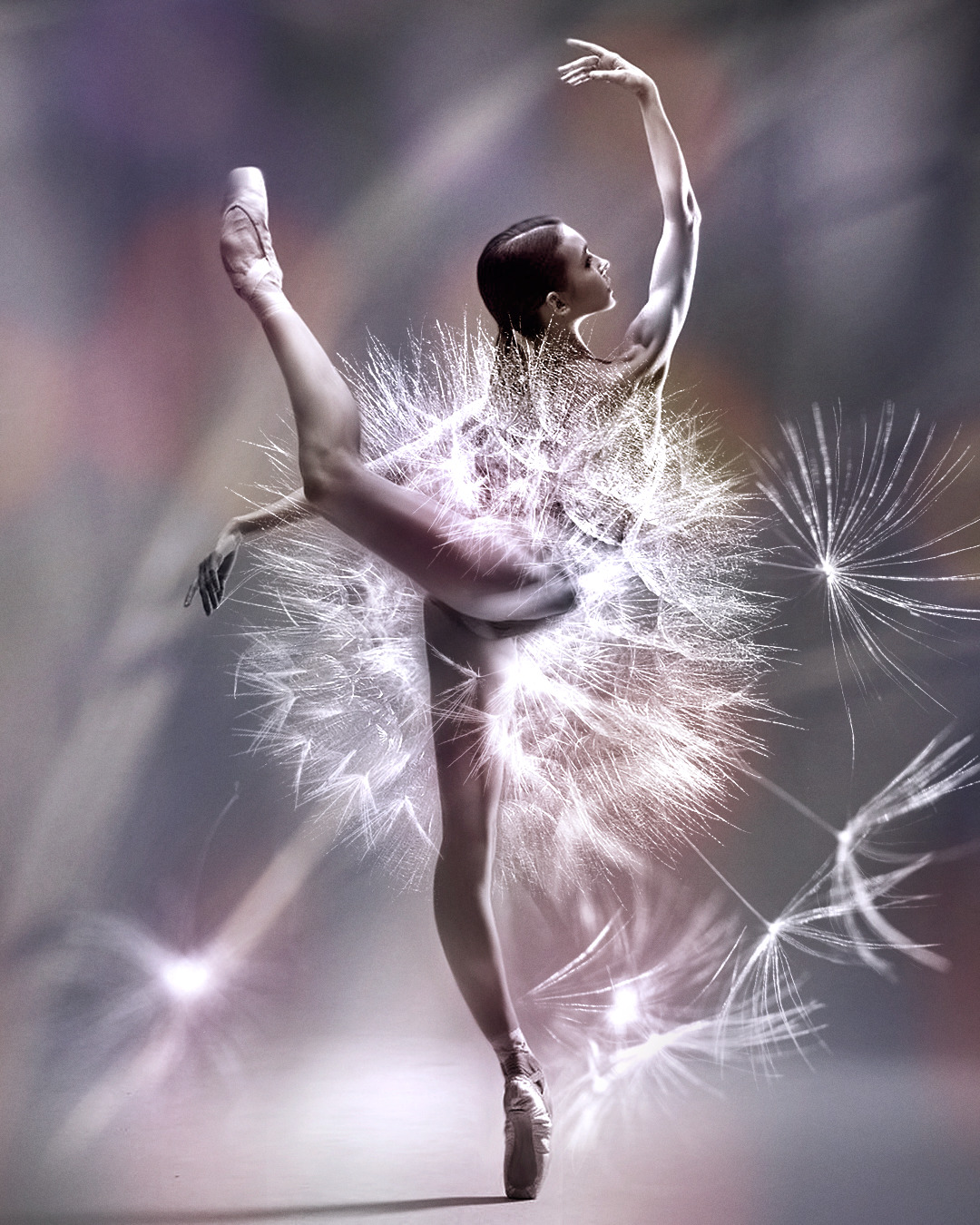
Some artistic pairings are so natural that they make you wonder why nobody handed them a bouquet and a pair of pointe shoes sooner. Ballet and flowers both speak in curves, balance, softness, and dramatic timing. One performs for a few minutes under stage lights; the other performs for a few days in a vase, a garden, or the wild corner of a sidewalk that somehow looks better than every expensive landscaping plan in the neighborhood.
Dance Of Flowers brings these two fragile worlds together in a visual project that compares the shapes of ballet dancers with the gestures of blooming flowers. A lifted arm becomes a stem leaning toward sunlight. A curved back echoes a petal opening. A poised foot and a flower bud can share the same quiet suspense: both look as though they are about to become something else.
The result is not simply “ballerinas with flowers,” which would already be lovely enough to make a stationery store faint. It is a thoughtful meditation on movement, beauty, time, memory, and the strange way nature often seems to choreograph itself without ever attending rehearsal.
Why Ballet and Flowers Belong in the Same Frame
Ballet is often associated with discipline, precision, and remarkable physical control. Every turn, extension, jump, and arabesque is carefully trained. A dancer may look effortless while performing a movement that requires strength, balance, flexibility, breath control, and a level of concentration most people reserve for parallel parking in downtown traffic.
Flowers appear to offer the opposite experience. They do not seem to practice. They do not count eight beats before blooming. They do not need a choreographer to tell them where to place their leaves. Yet flowers create their own visual language through curl, bend, asymmetry, color, and gradual transformation.
That is why the connection feels so powerful. Ballet makes human movement appear organic, while flowers make natural growth appear intentional. Put the two beside each other, and the dividing line between performance and nature starts to disappear.
In this project, the dancer is not dressed as a flower in the obvious storybook sense. Instead, the photographs invite viewers to notice how a body can repeat the same visual grammar found in petals, stems, buds, and blossoms. The comparison is subtle, elegant, and far more interesting than a giant sunflower costume with a tragic zipper in the back.
The Beauty of a Short-Lived Moment
One of the most moving ideas behind floral ballet photography is impermanence. Flowers bloom, peak, soften, and fade. Ballet careers are also physically demanding and often shorter than outsiders realize. A dancer’s body is both an instrument and a calendar, recording years of training, repetition, injury prevention, recovery, and performance.
That shared sense of temporary beauty gives Dance Of Flowers emotional weight. The project is not only about grace. It is about how grace exists because a moment cannot last forever.
A flower looks especially beautiful because we know it will change. A dancer’s suspended leap feels breathtaking because gravity will eventually collect its payment. In both cases, the viewer sees something brief and precious: a body or bloom caught at its most expressive point.
This is also why black-and-white photography works so well for the concept. Removing color shifts attention toward silhouette, texture, shadows, posture, and form. Without bright petals competing for attention, viewers can focus on the shared shape between a dancer’s arm and a flower’s stem, or between a curved torso and a blossom folding inward.
Seven Visual Conversations Between Dancers and Flowers
1. The Opening Bloom
The first visual connection often begins with expansion. A dancer opens her arms, lifts her chest, and creates the feeling of a flower unfolding toward the sun. The body appears to grow outward from a central point, just as petals emerge from the heart of a bloom.
This type of image feels optimistic. It suggests arrival, possibility, and the first warm day after a long winter. It is the visual equivalent of opening the curtains and discovering that your houseplant has somehow survived your irregular watering schedule.
2. The Curved Stem
A flower stem rarely travels in a perfectly straight line. It bends, twists, leans, and responds to light. A ballet dancer creates a similar elegance through the spine, neck, shoulders, and arms. A gentle side bend can become an echo of a tulip bowing or a lily arching under its own weight.
These images are especially effective because they show that grace does not require rigid perfection. Beauty often lives in the curve, the imbalance, and the slight surrender to gravity.
3. The Petal-Like Arm
In ballet, the arms are not simply attached accessories flapping around for moral support. They help shape the emotional atmosphere of a movement. A softly rounded arm can suggest tenderness, uncertainty, invitation, or longing.
When placed beside a flower with curled petals, the connection becomes almost immediate. The arm seems to bloom from the shoulder, while the flower appears to perform its own quiet port de bras. Neither one needs dialogue. Both are speaking through shape.
4. The Suspended Leap
A jump in ballet can look almost impossible when captured at the right moment. The dancer appears to hover, legs extended and arms reaching into open space. When compared with a flower caught in the wind, the image gains another layer of meaning.
Both subjects seem weightless, although neither truly is. The dancer will land. The flower will settle. But the photograph preserves the split second when they appear to float outside the normal rules of the world.
5. The Closed Bud
Not every beautiful image needs to be wide open and cheerful. A dancer curled inward can resemble a closed bud, protecting something delicate before it is ready to be revealed. The pose may suggest reflection, quietness, or emotional recovery.
This is where floral ballet art becomes more than decorative. It recognizes that beauty can be private. Sometimes a flower does not need to bloom loudly. Sometimes a dancer does not need to leap across the room. A small gesture can carry an entire story.
6. The Falling Petal
Some of the strongest images in a ballet and flower photography project are the ones that acknowledge decline. A lowered head, folded shoulder, or softened arm can resemble a petal falling away from the bloom.
That does not make the image sad in a simple way. Instead, it makes it honest. Flowers are beautiful while opening, while thriving, and while fading. Dancers, too, carry beauty through strength, exhaustion, change, and experience. The frame reminds us that tenderness and loss can exist together.
7. The Final Pose
The last comparison feels like a curtain call. A dancer reaches upward or outward with a sense of completion, while a flower appears fully formed and confidently present. The image does not say that beauty must stay frozen. It says that, for one brief moment, everything has arrived exactly where it belongs.
It is the visual version of a final note in music: not an ending that closes a door, but an ending that lingers in the room after everyone has stopped moving.
What Makes Floral Ballet Photography So Effective
Good ballet photography is difficult because the photographer has to understand timing. A beautiful movement can last less than a second. Good flower photography also depends on timing, because light, moisture, angle, and the condition of the bloom can change quickly.
Combining the two requires more than a pretty backdrop. The strongest floral ballet portraits are built around line, negative space, proportion, and gesture. The photographer must decide whether the dancer should imitate the flower exactly or simply suggest its energy.
A direct imitation can be visually satisfying, but a looser comparison often feels more poetic. A dancer does not need to become a rose. She only needs to make the viewer notice that a rose may have been dancing all along.
The project also benefits from restraint. Black-and-white compositions avoid turning every image into a floral fashion advertisement. Instead, they make the work feel timeless. The viewer notices the curve of a wrist, the fold of a petal, the tension in a foot, and the fragile edge of a blossom.
Flowers Have Always Carried Meaning
Flowers are never just flowers in art. Across history, they have been used to suggest love, memory, youth, loss, celebration, hope, and renewal. Their meanings can change depending on culture, color, season, and context, which makes them perfect collaborators for dance.
Ballet also relies on symbolic storytelling. A gesture can communicate fear, devotion, pride, grief, or joy without a single spoken sentence. When flowers are paired with dancers, the image becomes a double language. The body speaks through movement, and the flower speaks through association.
A rose may suggest passion. A lily may feel pure or solemn. A wildflower can imply freedom, simplicity, or resilience. A flower bending toward the ground may suggest vulnerability. The image does not need to explain every meaning directly. Its power comes from leaving room for the audience to bring their own memories into the frame.
Why This Project Feels Personal Instead of Merely Pretty
The strongest creative projects usually begin with a personal connection. Dance Of Flowers feels compelling because it treats ballet not as a distant fantasy but as something remembered, lived, and emotionally understood.
There is a difference between photographing a dancer because ballet looks glamorous and photographing a dancer because movement carries history. This series leans toward the second approach. It recognizes the effort behind beauty. It sees fragility not as weakness, but as evidence that something has been cared for deeply.
The photographs also encourage viewers to slow down. Modern life tends to reward speed, noise, and the ability to scroll past twelve beautiful things before breakfast. A project like this asks for another kind of attention. It asks viewers to look at a flower as though it has a posture. It asks viewers to look at a dancer as though she is part of nature.
That small shift in perspective is the real achievement. Once you see a flower as a dancer, you may never look at your garden the same way again.
Conclusion: Where Movement Meets Bloom
Dance Of Flowers is a celebration of two forms of beauty that seem delicate but demand extraordinary strength. Ballet dancers train their bodies to create emotion through movement. Flowers transform light, weather, growth, and time into silent visual drama.
Placed beside each other, they reveal a shared language of line, gesture, rhythm, and impermanence. The dancer becomes a blossom in motion. The flower becomes a performer without applause. Together, they remind us that grace is not always loud, permanent, or perfect. Sometimes it exists for only a moment, and that is exactly why we remember it.
Experiences and Reflections: Learning to See Flowers as Dancers
One of the most surprising experiences connected to a project like Dance Of Flowers is how it changes ordinary observation. After spending time with floral ballet imagery, it becomes difficult to look at flowers in the usual way. A drooping tulip no longer seems tired; it seems to be taking a dramatic final bow. A peony opening in the morning looks less like a garden event and more like a performer entering center stage with excellent lighting.
That shift can be especially meaningful for photographers. Many people begin photographing flowers because flowers are available, patient, and unlikely to complain about their bad side. But a floral portrait becomes more interesting when the photographer treats the subject as a moving figure rather than a still object. A stem can create a line of tension. A petal can create visual rhythm. A flower facing away from the lens can create mystery.
Dancers may recognize something familiar in flowers as well. Both are constantly changing. A dancer’s body changes through training, fatigue, injury, recovery, age, and experience. A flower changes through weather, light, water, and season. Neither one stays exactly the same from day to day. That temporary quality can be frustrating, but it can also make every performance and every bloom feel more valuable.
There is also a quiet lesson in patience. A dancer cannot master a difficult movement after watching one tutorial and eating half a protein bar. A flower cannot be rushed into blooming because someone has an important dinner party on Saturday. Both require time, care, repetition, and conditions that support growth.
For artists, this project offers a useful reminder that inspiration does not always need to come from distant or exotic places. It can begin with a familiar body, a familiar memory, or a flower bought from a corner market. The creative challenge is not always finding something new. Sometimes it is seeing something ordinary with enough attention that it becomes new again.
That may be the most lasting experience of all. Floral ballet photography teaches viewers to pause before labeling something “simple.” A flower is not only decorative. A dancer is not only graceful. Both contain structure, vulnerability, labor, movement, and history. Both can tell a story without saying a word.
Note: This article is written as a publication-ready visual arts feature inspired by the relationship between ballet movement, botanical forms, floral symbolism, and contemporary dance photography.














