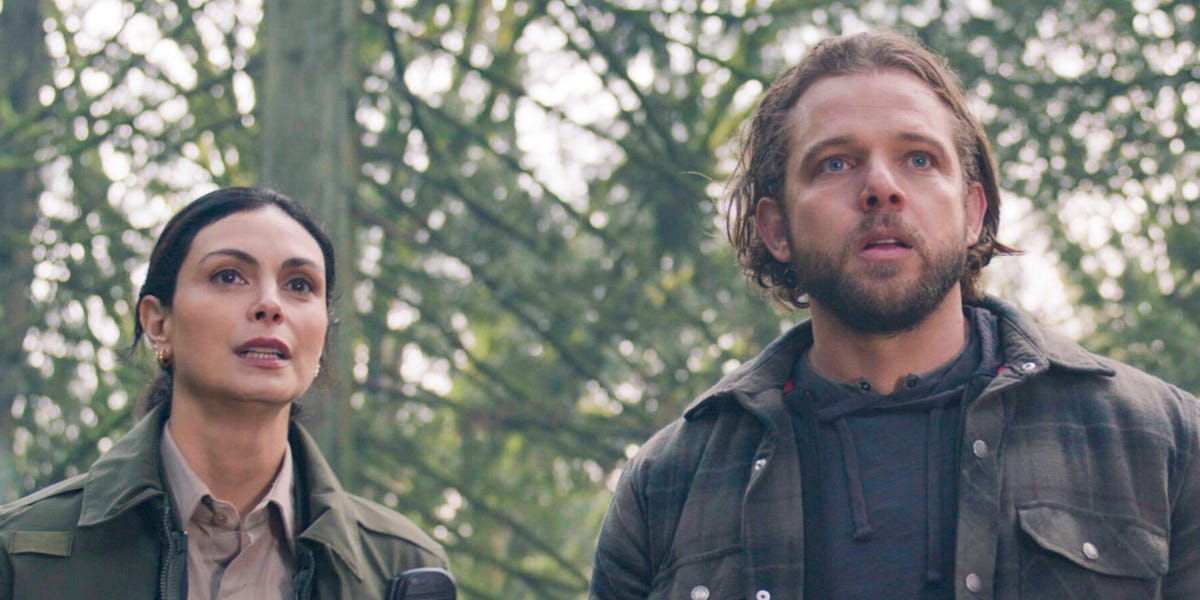
When a TV universe catches fire, the smartest move is not always to throw water on it. Sometimes, you build a sheriff’s office next door, hand Morena Baccarin a badge, and let Max Thieriot grin like a man who knows Edgewater still has plenty of secrets hiding behind the trees.
That is the energy surrounding Sheriff Country, the CBS spinoff born from the popular drama Fire Country. The original series made viewers care about convict firefighter Bode Leone, played by Max Thieriot, as he battled flames, guilt, family drama, and the kind of emotional baggage that probably deserves its own emergency response unit. Now, the franchise expands from wildfire rescues to small-town law enforcement, with Baccarin leading the charge as Sheriff Mickey Fox.
Thieriot has teased the spinoff as a chance to explore a different side of rural public service. Instead of focusing only on fire lines, emergency crews, and Cal Fire action, Sheriff Country shifts attention to the sheriff’s department, local crime, family tension, and the complicated personal history that makes Edgewater feel less like a backdrop and more like a pressure cooker with a charming zip code.
What Is ‘Sheriff Country’ About?
Sheriff Country follows Mickey Fox, a straight-shooting sheriff in the fictional California community of Edgewater. She patrols a town where everyone knows everyone, which sounds cozy until you remember that in television drama, “everyone knows everyone” usually means “everyone is hiding something.”
Mickey is not just solving crimes. She is also dealing with family issues that make a normal bad day at work look like a spa appointment. Her father, Wes, is an ex-con with an off-the-grid lifestyle and a marijuana-growing past. Her daughter, Skye, brings another emotional layer to the story, especially as the series explores addiction, trust, and the messy business of parenting when your badge does not magically fix your home life.
The show also connects Mickey directly to Fire Country. She is tied to Sharon Leone, Bode’s mother, through family history, and Bode himself remains part of the larger Edgewater world. That connection gives Sheriff Country a useful advantage: it can stand on its own as a crime drama while still giving longtime Fire Country fans a familiar emotional map.
Max Thieriot’s Role Goes Beyond Bode Leone
Max Thieriot is not only the face of Fire Country. He is also one of the creative engines behind the franchise. As star, co-creator, and executive producer of Fire Country, Thieriot helped shape a drama that blends action, redemption, family wounds, and the high-stakes world of firefighting. With Sheriff Country, he expands that same universe as a co-creator and executive producer.
That matters because the spinoff does not feel like a random network experiment with a new title slapped onto a familiar brand. It feels like a natural extension of Thieriot’s original idea: a small rural town where public servants are not superheroes, but flawed people making hard choices under pressure.
In promotional conversations around the spinoff, Thieriot emphasized the chance to show another side of law enforcement in rural communities. That promise is important. Big-city police dramas have filled television schedules for decades, but Sheriff Country aims for a more intimate scale. The crimes still matter, the stakes still rise, but the emotional damage lands differently when the suspect, victim, witness, deputy, and sheriff might all be connected by family history, old friendships, or one very awkward grocery store encounter.
Why Morena Baccarin Is the Right Lead for Mickey Fox
Morena Baccarin brings the kind of screen presence that can make a quiet stare feel like a full interrogation. As Mickey Fox, she carries both authority and vulnerability. That balance is essential because Sheriff Country is not simply about a sheriff enforcing rules. It is about a woman trying to protect a town while also confronting her own history inside it.
Mickey’s job requires confidence, but her family life requires emotional endurance. The show’s strongest hook is not just “sheriff solves case.” It is “sheriff solves case while the case reflects everything she cannot easily solve at home.” That is where Baccarin’s performance gives the series room to breathe. She can play the hard edge of a law officer, then turn around and reveal the exhaustion of a mother, daughter, and community member who does not get to clock out from Edgewater’s drama.
Mickey Fox Adds New Texture to Edgewater
On Fire Country, Edgewater is defined largely through firehouses, Cal Fire crews, family tragedy, and Bode’s redemption story. Sheriff Country widens the lens. It asks what happens when the smoke clears and someone still has to investigate the crime, question the witnesses, deal with local politics, and calm residents who know exactly whose truck was parked where last night.
This new angle gives the franchise more storytelling fuel. A fire can start a plot, but a sheriff’s investigation can uncover why it started, who benefits, who lied, and who is about to make Thanksgiving dinner extremely uncomfortable.
How ‘Sheriff Country’ Connects to ‘Fire Country’
The most obvious connection is location. Both shows are rooted in Edgewater, a fictional Northern California town where danger arrives with suspicious punctuality. But the deeper connection is family. Mickey Fox and Sharon Leone have their own complicated history, which creates a bridge between the sheriff’s department and Cal Fire.
Bode Leone also fits naturally into the spinoff’s world. He is Mickey’s nephew, and his history with the justice system gives his interactions with law enforcement extra weight. That is not a small detail. In the Fire Country universe, redemption is not a motivational poster. It is a daily negotiation between who someone was, who they are trying to become, and who the town still believes them to be.
The crossover potential is obvious, and CBS has already leaned into it. When firefighters and deputies share the same town, emergencies do not politely stay in one department’s lane. A missing-persons case can become a rescue mission. A family argument can become a public safety issue. A local festival can go from charming to chaotic before the funnel cakes cool down.
The Spinoff’s Biggest Strength: Small-Town Stakes
One reason Sheriff Country works as an idea is that small-town drama has built-in tension. In a large city, a sheriff or detective may never see a suspect again after a case ends. In Edgewater, Mickey might arrest someone on Friday and then stand behind their aunt at the pharmacy on Monday. That kind of proximity creates emotional consequences that last beyond the closing credits.
This is also where Sheriff Country can separate itself from standard procedural television. The cases are important, but the relationships make them sting. A missing teen is not just a file. A witness is not just a witness. A family secret is not just juicy gossip; it may affect how people trust the sheriff’s department, Cal Fire, and each other.
Rural Law Enforcement Gives the Show a Fresh Angle
Television has plenty of police dramas, but fewer focus on the specific pressures of rural law enforcement. A sheriff in a small county may deal with domestic disputes, drug cases, missing persons, traffic incidents, public events, court responsibilities, and community politics. That variety gives Sheriff Country plenty of story possibilities without needing to turn Edgewater into a crime capital that would make residents pack their bags by episode four.
Thieriot’s tease about showing law enforcement in small rural towns points to the series’ most promising lane. The show can explore how limited resources, personal relationships, and local history complicate every decision. Mickey may have the badge, but that does not mean every answer is clean, quick, or popular.
Why Fans Responded So Quickly
Fans of Fire Country were already invested in Edgewater before Sheriff Country arrived. That gave the spinoff a built-in audience, but it also raised expectations. Viewers did not just want a new show. They wanted a series that felt connected without feeling like a photocopy.
The early excitement around Thieriot and Baccarin’s promotional teasers showed that viewers were curious about how the franchise would evolve. The idea of watching Mickey’s “sheriff stance,” seeing Bode’s world expand, and exploring more of Edgewater’s family web gave fans plenty to discuss before the premiere.
That reaction makes sense. Fire Country thrives on emotion as much as action. Yes, the fires are dramatic. Yes, the rescues are tense. But the real fuel is the character conflict: Bode’s past, Sharon’s family pain, Manny’s leadership, Gabriela’s choices, and the community’s complicated forgiveness. Sheriff Country promises a similar emotional recipe, just with more badges, investigations, and tense front-porch conversations.
The Cast Around Mickey Fox
A spinoff only works if the lead is surrounded by characters who can create conflict, humor, loyalty, and surprise. Sheriff Country builds Mickey’s world with several key figures, including Wes, her father, and Boone, a deputy partner whose law-enforcement style creates its own dynamic. Christopher Gorham, Michele Weaver, Matt Lauria, and W. Earl Brown are among the names connected to the series, giving the show a mix of family drama, workplace tension, and local flavor.
Matt Lauria’s Boone is especially useful in the broader franchise because he creates another point of contact between the sheriff’s side and the fire side. His dynamic with Bode during crossover events brings friction, humor, and reluctant teamwork. In other words, exactly the kind of buddy-drama tension TV loves to serve hot.
Crossovers Make the Edgewater Universe Bigger
The Fire Country and Sheriff Country crossover events prove that CBS is treating this as a shared universe, not a one-off spinoff floating in a separate zip code. Crossovers allow characters like Bode, Sharon, Eve, Mickey, Boone, and Wes to collide in ways that feel organic because their jobs naturally overlap.
One major crossover centered on missing teens after a bus-related emergency, bringing firefighters and deputies together in a two-hour event. That kind of structure shows the franchise’s blueprint: one town, multiple departments, shared danger, personal stakes, and enough tension to make viewers yell advice at the television.
The best crossover stories do not merely say, “Look, familiar faces!” They reveal something new about the characters. When Bode works with Boone, his past follows him into the room. When Mickey works with Sharon, family history complicates command decisions. When emergency crews and law enforcement disagree, the clock keeps ticking anyway.
Country Music and the Edgewater Mood
The Fire Country universe has also embraced country music as part of its identity. Guest appearances from artists such as Kane Brown and Jelly Roll helped establish that musical flavor, and Sheriff Country continues the tradition with Maren Morris appearing as Hazel, a sponsor connected to Skye’s storyline. That is not just stunt casting for the sake of a headline. In this world, music helps shape the rural, emotional, lived-in atmosphere.
Country music fits Edgewater because the genre often deals with regret, resilience, family, bad decisions, second chances, and pickup trucks that may or may not be emotionally symbolic. In other words, it speaks fluent Fire Country.
What Max Thieriot’s Tease Really Promised
When Thieriot teased Sheriff Country, the key promise was not simply “more Edgewater.” It was “another angle on Edgewater.” That distinction matters. A successful spinoff must justify its existence. It cannot survive on Easter eggs and guest appearances alone.
Sheriff Country justifies itself by asking different questions. What does justice look like in a town where everyone has history? How does a sheriff enforce the law when her own family keeps pulling her into gray areas? Can Mickey protect her daughter while also protecting the community? And how much trouble can Edgewater produce before someone seriously considers moving to a quieter fictional town?
The answer, based on the franchise so far, is plenty. Edgewater is built for drama. It has fire, crime, complicated families, addiction storylines, old wounds, public service pressure, and enough secrets to keep a sheriff busy until retirement.
Why ‘Sheriff Country’ Could Have Long-Term Potential
The long-term promise of Sheriff Country lies in its flexibility. As a procedural drama, it can tell case-of-the-week stories that make each episode accessible. As a family drama, it can build season-long arcs around Mickey, Skye, Wes, Sharon, Bode, and the rest of Edgewater. As part of a shared universe, it can cross over with Fire Country when a story calls for bigger stakes.
That combination is valuable for CBS. Broadcast television still thrives on shows that viewers can enter without a giant homework assignment. Sheriff Country offers that accessibility while rewarding loyal fans who already understand the emotional geography of Edgewater.
It also gives Max Thieriot more room to shape the world he helped create. Instead of keeping Fire Country locked inside one format, the franchise can grow into a broader portrait of rural emergency response, public service, and community drama.
Viewer Experience: Why This Topic Feels Bigger Than a Simple Spinoff
Watching the buildup around Sheriff Country feels a little like seeing a familiar neighborhood add a new front porch light. The house was already there, but suddenly another corner of it becomes visible. For fans who followed Bode from the start of Fire Country, the arrival of Mickey Fox adds a new layer of curiosity. Viewers are not just asking what happens next; they are asking what else has been happening in Edgewater while the firefighters were busy running toward flames.
That is the fun of a well-built spinoff. It gives the audience the pleasure of recognition and discovery at the same time. You know the town. You know some of the family ties. You understand that Edgewater is allergic to calm Fridays. But Mickey’s world introduces different procedures, different moral dilemmas, and different kinds of danger. A fire creates immediate spectacle. A sheriff’s case can create suspicion, dread, and the slow realization that someone in town has been lying with impressive commitment.
From a viewer’s perspective, Max Thieriot’s involvement also adds confidence. Fans know he understands the emotional DNA of Fire Country. He is not just an actor passing through the franchise; he helped build its foundation. That makes his tease of Sheriff Country feel less like promotional noise and more like a creative invitation: come see the same town from a new angle.
The most satisfying experience may come from watching how the two shows talk to each other. A storyline on Sheriff Country can deepen the stakes of Fire Country, and a crisis on Fire Country can pull Mickey’s department into the action. This creates the kind of shared-universe rhythm that keeps fans engaged between episodes. It also gives entertainment writers, recap readers, and social media detectives plenty to chew on. In Edgewater, even a casual glance between two characters can feel like a clue wearing boots.
There is also something refreshing about seeing a spinoff led by a mature, complicated woman who is not presented as flawless. Mickey Fox can be strong, but she is not invincible. She can be right about a case and wrong in a family conversation. She can protect the town and still struggle to protect her daughter from pain. That human contradiction gives Sheriff Country its emotional center.
For fans who enjoy action, the show offers investigations, rescues, danger, and cross-department emergencies. For fans who prefer character drama, it offers family secrets, old resentments, addiction-related storylines, and the tension of living in a town where personal history never stays buried for long. For fans who simply want more Max Thieriot-connected television on Fridays, congratulations: Edgewater appears to be open for business.
In the end, the viewer experience surrounding Sheriff Country is about expansion without losing intimacy. The world grows, but the stories still feel personal. The cast gets bigger, but the emotional conflicts remain close enough to hurt. That is the sweet spot for this franchise, and it is why Thieriot’s tease landed with fans. He was not just promising another show. He was promising another doorway into a town that still has smoke in the air, secrets in the woods, and a sheriff who looks ready to handle both.
Conclusion
Sheriff Country gives the Fire Country universe a smart and compelling expansion. Max Thieriot’s tease pointed toward a series that would explore rural law enforcement, complicated family ties, and the hidden corners of Edgewater. With Morena Baccarin leading as Mickey Fox, the spinoff has the authority, emotion, and small-town tension needed to stand on its own.
The best part is that Sheriff Country does not abandon what made Fire Country popular. It keeps the heart, the action, the messy relationships, and the sense that every public emergency is also a private reckoning. It simply trades some of the firehouse focus for a badge, a patrol route, and a sheriff who has no shortage of trouble waiting at home and on the job.
For fans, that means more Edgewater, more crossovers, more emotional fallout, and more reasons to keep Friday nights reserved. Because in this town, peace and quiet rarely last longand honestly, that is exactly why viewers keep coming back.