Some hotels open with a ribbon cutting. Others arrive with ghosts, gossip, murals, half-remembered poems, and the faint sense that someone in the lobby may be writing a screenplay on a napkin. Freehand New York belongs proudly to the second category.
When the Freehand Hotel opened in Manhattan in 2018, it did not simply move into an old building. It stepped into the former George Washington Hotel, a historic property on Lexington Avenue that had long carried the creative dust of New York City. Writers, musicians, painters, students, wanderers, and artists had passed through its halls for decades. The building had been a hotel, a residence, and a dormitory. By the time Freehand arrived, it had plenty of stories in the wallsand possibly a few opinions about interior design.
The 2018 revamp transformed the property into Freehand New York, a design-forward hotel in the Flatiron and Gramercy area. It blended the bones of old Manhattan with the relaxed energy of a modern creative clubhouse. The result was not a stiff luxury hotel where guests whisper near the elevator. It was warmer, quirkier, more social, and more alive. Think: historic architecture meets student art, restaurant buzz, vintage character, and a lobby that seems to say, “Yes, you may sit here with a laptop for three hours, but please look interesting while doing it.”
A Landmark Building With a Creative Past
The Freehand New York occupies the former George Washington Hotel, a building that began life in the late 1920s and became part of Manhattan’s layered cultural geography. Located at 23 Lexington Avenue, near Gramercy Park, Madison Square Park, and the Flatiron District, the property sits in one of those New York neighborhoods where almost every block looks like it has appeared in a novel, a movie, or someone’s very dramatic walk home after dinner.
The George Washington Hotel became known over time as a home for writers, artists, musicians, and students. Its reputation was not manufactured in a marketing meeting. The building truly had creative residents and associations. Poet W. H. Auden lived there, as did writer Christopher Isherwood. Artist Keith Haring spent time in the building when it later served as housing connected to the School of Visual Arts. Dee Dee Ramone is also often linked to the property’s long and colorful cultural history.
That kind of background matters because hotels are rarely just beds stacked vertically. The best ones carry a mood. The George Washington Hotel had the mood of a boarding house for people who arrived in New York with more ambition than closet space. It was the kind of place where a poet could share an elevator with a musician, a painter could argue about rent, and someone somewhere was probably making coffee that tasted like determination.
The 2018 Transformation Into Freehand New York
Freehand New York opened in 2018 as part of the Freehand Hotels brand, which had already developed a reputation for stylish, social, and relatively approachable hospitality. The concept was not to create another anonymous boutique hotel with a marble lobby and personality of a polite napkin. Instead, Freehand leaned into communal energy, local culture, and design with character.
The Manhattan property contained nearly 400 rooms, ranging from traditional private rooms to bunk-style accommodations. That mix was central to the Freehand identity. It welcomed different kinds of travelers: design lovers, budget-conscious guests, solo visitors, groups of friends, business travelers tired of corporate blandness, and creative types who enjoy a hotel that looks better than their apartment.
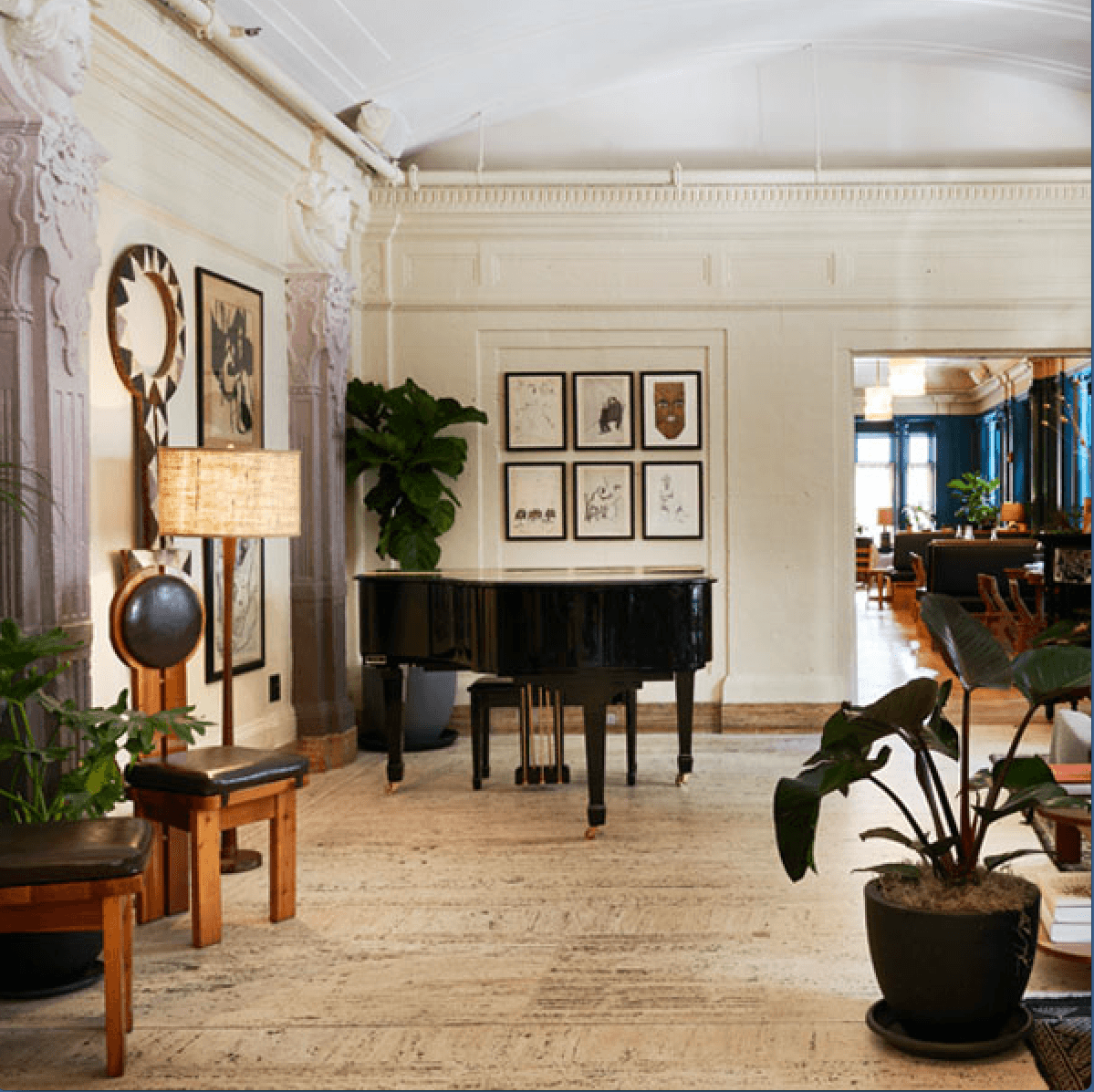
The redesign was led by Roman and Williams, the New York-based design firm known for interiors that feel layered, tactile, cinematic, and deeply atmospheric. Rather than erase the building’s history, the revamp worked with it. The hotel kept an old New York spirit while adding contemporary comfort. Wood details, warm lighting, patterned textiles, vintage-inspired furnishings, and artful public spaces gave the property a lived-in elegance.
The effect was less “brand-new showroom” and more “eccentric downtown residence where every object has a story.” That distinction is important. In hospitality design, authenticity is easy to fake and hard to feel. At Freehand New York, the design succeeded because it did not over-polish the past. It let the building remain slightly mysterious.
Roman and Williams: Designing With Memory, Not Erasers
Roman and Williams approached the Freehand Hotel with a sense of preservation and reinvention. Their interiors are known for depth: dark woods, handmade surfaces, vintage references, and spaces that feel collected rather than installed overnight by a committee armed with beige mood boards.
At Freehand New York, that philosophy matched the building beautifully. The former George Washington Hotel already had weight. It did not need a theme; it needed a careful editor. The redesign honored the past while inviting a younger, design-conscious audience to enjoy it. The public areas were made to feel social and relaxed, not precious. Guests could lounge, meet friends, work, eat, and people-watch without feeling like they had wandered into a museum where the furniture judges them.
One of the smartest moves was the hotel’s use of art. Instead of filling walls with generic prints that look like they were selected by an algorithm having a mild day, Freehand New York featured custom-commissioned work by Bard College students and alumni. This detail connected the hotel’s creative past with a new generation of artists. It also made the property feel genuinely local and evolving.
Art as the Hotel’s Living Pulse
The Bard College collaboration gave Freehand New York more than decoration. It gave the hotel a living visual identity. In many hotels, art is background noise. At Freehand, it became part of the experience. Murals, paintings, and custom pieces created a sense that the building was still collecting voices.
This mattered because the hotel’s history involved real artists and writers. The 2018 revamp could have treated that legacy as a cute paragraph in a brochure. Instead, it translated the idea into something guests could actually see. Young artists were not merely referenced; they were invited into the building’s new chapter.
That approach also fit the broader Freehand brand, which often positions its hotels as social and cultural hubs rather than just places to sleep. In New York, where even a hotel lobby can become a stage, this made perfect sense. Guests could check in, wander past original art, settle into a lounge, and feel as if they had entered a creative ecosystem rather than a transaction.
Dining: The Hotel as a Neighborhood Hangout
Freehand New York’s 2018 debut also generated attention for its food and beverage program. In New York, a hotel restaurant cannot survive on captive guests alone. Locals must want to go there. Otherwise, the restaurant becomes a lonely room where club sandwiches go to think about their choices.
The hotel partnered with restaurateur Gabriel Stulman’s Happy Cooking Hospitality, bringing a strong downtown dining sensibility into the project. The original lineup included Studio, George Washington Bar, and Simon & The Whale, with Broken Shaker planned as a rooftop addition. Each space helped the hotel become more than a place to drop a suitcase.
Studio: All-Day Ease With Global Warmth
Studio was designed as an all-day dining space, casual but stylish, with a menu influenced by global flavors. It served as the kind of place where the day could begin with coffee and pastry, drift into lunch, and somehow become an early evening conversation without anyone noticing the time.
For a hotel like Freehand, that flexibility was crucial. Travelers need spaces that work at odd hours because travel schedules are rarely elegant. Someone is always hungry at 3 p.m., jet-lagged at 7 a.m., or trying to answer emails while pretending not to listen to the couple arguing softly at the next table.
George Washington Bar: A Nod to the Building’s Past
The George Washington Bar paid tribute to the building’s former identity. Set in a space connected to the old hotel’s history, the bar carried a classic New York mood: warm, slightly moody, and ideal for conversation. Its name was not just decorative. It anchored the property’s past inside its new life.
In a city where bars often chase trends faster than anyone can spell “mixology,” the George Washington Bar felt more timeless. It suggested the kind of place where one could discuss literature, design, gossip, rent, or the eternal mystery of why New Yorkers call a 20-minute walk “nearby.”
Simon & The Whale: Restaurant Buzz at Street Level
Simon & The Whale became one of the most talked-about parts of the opening. Located at the hotel’s street level, the restaurant was designed as a neighborhood destination as much as a hotel amenity. Its Arts and Crafts-inspired interiors, warm materials, and seafood-leaning menu helped give Freehand a strong public-facing identity.
The restaurant’s presence mattered because it connected the hotel to the street. A good hotel restaurant draws locals, and locals give a hotel energy that guests can feel. Without them, even beautiful spaces can feel staged. With them, the lobby and dining rooms become part of the neighborhood rhythm.
Why the Flatiron and Gramercy Location Works
Freehand New York’s location is one of its strongest assets. The hotel sits near the boundary of Flatiron, Gramercy, and Kips Bay, with easy access to Madison Square Park, Union Square, NoMad, and downtown Manhattan. For visitors, this location offers a useful blend: central enough for sightseeing, but not trapped in the nonstop sensory blender of Times Square.
The neighborhood also fits the hotel’s creative personality. The Flatiron District has architectural drama, design showrooms, restaurants, offices, historic buildings, and a steady flow of students, professionals, and travelers. Gramercy brings a quieter residential elegance. Together, they create the right backdrop for a hotel that wants to feel both social and storied.
Guests can walk to cafés, bookstores, parks, restaurants, subway stations, and cultural landmarks. The area feels urban without being overwhelming. For a traveler who wants to experience New York as a real city rather than a checklist of attractions, Freehand’s location makes excellent sense.
A New Kind of Boutique Hotel
The Freehand model sits between several hospitality categories. It is not a traditional luxury hotel, though its design has high-end credibility. It is not simply a hostel, though shared rooms are part of its DNA. It is not only a boutique hotel, though it has the personality and visual confidence of one. It is best understood as a hybrid: stylish, communal, flexible, and culturally aware.
That hybridity made Freehand New York especially relevant in 2018. Travelers were changing. Many guests wanted design without stiffness, affordability without ugliness, and social spaces without forced networking events involving name tags. Freehand offered a hotel where different budgets and travel styles could overlap.
The bunk rooms were especially smart for groups and younger travelers. New York hotel rooms can be famously expensive and famously small. Freehand’s room variety gave guests more options without sacrificing design. Even compact rooms felt intentional rather than apologetic.
Preserving the Bohemian Spirit Without Turning It Into a Costume
One challenge in reviving a historic creative haunt is avoiding nostalgia as costume. It would have been easy to cover the walls with typewriters, fake paint splatters, and quotes from poets in curly fonts. Thankfully, Freehand New York took a more textured route.
The hotel’s creative spirit came from atmosphere, art, and usenot gimmicks. The public areas encouraged lingering. The design felt warm and layered. The art program supported contemporary artists. The restaurants drew real neighborhood interest. The building’s past was acknowledged, but not embalmed.
That is why the 2018 revamp worked as more than a makeover. It did not simply ask guests to admire history. It invited them to participate in a new version of it. You could sit in the lobby with a notebook, meet friends at dinner, study the artwork, or simply enjoy the pleasant fantasy that staying in an old artists’ hotel might make your emails more poetic.
What Guests Could Expect From the Freehand Experience
Freehand New York was built for guests who value atmosphere. The rooms were thoughtfully designed, but the hotel’s public spaces were just as important. This was a property meant to be used beyond sleeping hours. The lobby, restaurants, bar, and lounges created a sequence of experiences throughout the day.
Morning might begin with coffee and a slow look at the artwork. Afternoon could bring a walk through Madison Square Park or a subway ride downtown. Evening might include dinner at Simon & The Whale or a relaxed conversation at the George Washington Bar. The hotel encouraged guests to move between private retreat and public energy.
That rhythm is especially appealing in New York. The city can be thrilling, but it can also flatten visitors by sunset. A hotel like Freehand gives travelers a place to recover without disconnecting from the city’s creative charge. It provides shelter, but not silence. Comfort, but not dullness.
The 2018 Revamp in the Larger Story of New York Hotels
Freehand New York arrived during a period when many hotels were trying to become lifestyle brands. Some did it with rooftop pools, neon signs, and lobby playlists loud enough to reorganize your nervous system. Freehand’s advantage was that it had a real building with a real story. The hotel did not have to invent character from scratch.
New York has always had hotels that served as cultural magnets. The Chelsea Hotel is the most famous example, but the George Washington Hotel belonged to that broader tradition of residential, creative, and sometimes chaotic Manhattan spaces where people lived between art and survival. Freehand’s 2018 revamp tapped into that lineage in a polished but approachable way.
For travelers interested in design, the hotel offered a strong case study in adaptive reuse. For architecture fans, it showed how a historic building could be refreshed without becoming sterile. For food lovers, it provided multiple reasons to visit even without booking a room. For artists, it offered the pleasure of seeing a building’s creative identity renewed rather than erased.
Experiences Inspired by Freehand Hotel’s Storied Manhattan Revamp
Staying at or visiting Freehand New York is best understood as an experience in layers. The first layer is practical: the location works. You are close to subway lines, restaurants, parks, and several Manhattan neighborhoods worth exploring. The second layer is visual: the interiors feel warm, textured, and full of detail. The third layer is historical: the building has housed people who helped shape modern creative culture. The fourth layer is emotional: the hotel makes you feel like you have stepped into a New York story already in progress.
A great way to experience the hotel is to treat it not only as accommodation, but as a base for a creative Manhattan day. Start with a slow morning in the lobby or dining area. Notice the custom artwork, the woodwork, the lighting, and the way the design avoids the cold perfection of many modern hotels. This is a place where the details reward attention. Even the mood feels edited: cozy, artistic, a little retro, and quietly theatrical.
After breakfast or coffee, walk toward Madison Square Park. The route gives you a perfect introduction to the neighborhood’s architectural personality. You get old commercial buildings, classic New York street corners, glimpses of the Flatiron Building area, and enough sidewalk energy to remind you that Manhattan does not believe in sleeping in. From there, you can continue toward Union Square, browse shops, or take the subway downtown.
For design lovers, Freehand can become the starting point for a self-guided interiors tour. Pay attention to how the hotel uses history without becoming dusty. The furnishings feel collected. The art feels integrated. The public spaces encourage actual use, which is rarer than it sounds. Many beautiful hotels look impressive in photos but feel awkward in person, like a living room where nobody is allowed to sit. Freehand avoids that problem. It is photogenic, yes, but it is also comfortable.
Food is another major part of the experience. The original 2018 dining program helped position the hotel as a neighborhood hangout, not just a guest facility. That distinction changes the energy of a stay. When locals come into a hotel restaurant or bar, the property feels connected to the city around it. You are not sealed inside a tourist bubble. You are sharing space with New Yorkers, which means you may overhear business plans, dating app analysis, apartment complaints, and at least one conversation about where to find better bagels.
Writers and artists may find the building especially appealing because it invites imagination. Knowing that W. H. Auden, Christopher Isherwood, Keith Haring, and other creative figures are associated with the former George Washington Hotel adds a charge to the experience. You do not need to romanticize the past to appreciate it. The old hotel was not a perfect bohemian paradise; real creative life is usually less glamorous and more concerned with rent. But that is exactly what makes the story interesting. The building represents the practical side of art-making in New York: rooms, routines, friendships, pressure, noise, ambition, and the hope that something lasting might emerge from it.
Freehand’s 2018 revamp succeeded because it understood that a hotel can be both commercial and soulful. It can sell rooms while still honoring memory. It can welcome tourists while remaining part of the neighborhood. It can be stylish without becoming smug. That balance is difficult, and when it works, guests feel it immediately.
The best experience at Freehand New York may simply be sitting still for a while. Look around. Watch guests arrive and leave. Notice how the old building continues to do what it has always done: shelter people in transition. Some are visiting for a weekend. Some are chasing work. Some are meeting friends. Some may be writing poems, though statistically several are probably answering Slack messages. Still, the spirit remains. Freehand New York is a reminder that buildings can have second actsand in Manhattan, sometimes the second act comes with better lighting, better food, and a lobby full of stories waiting for their next sentence.
Conclusion
Freehand New York’s 2018 revamp gave the former George Washington Hotel a fresh role in Manhattan’s hospitality scene. It preserved the building’s storied connection to poets, artists, musicians, and students while introducing a modern hotel experience built around design, food, art, and community. The result was a property that felt both old and new, polished and relaxed, historic and alive.
For travelers, the hotel offered more than a place to sleep. It offered atmosphere. For New Yorkers, it created a new neighborhood destination. For design fans, it showed how adaptive reuse can honor the past without getting trapped by it. And for anyone who loves the mythology of creative Manhattan, Freehand New York proved that a good building never runs out of storiesit just waits for someone to renovate the next chapter.