
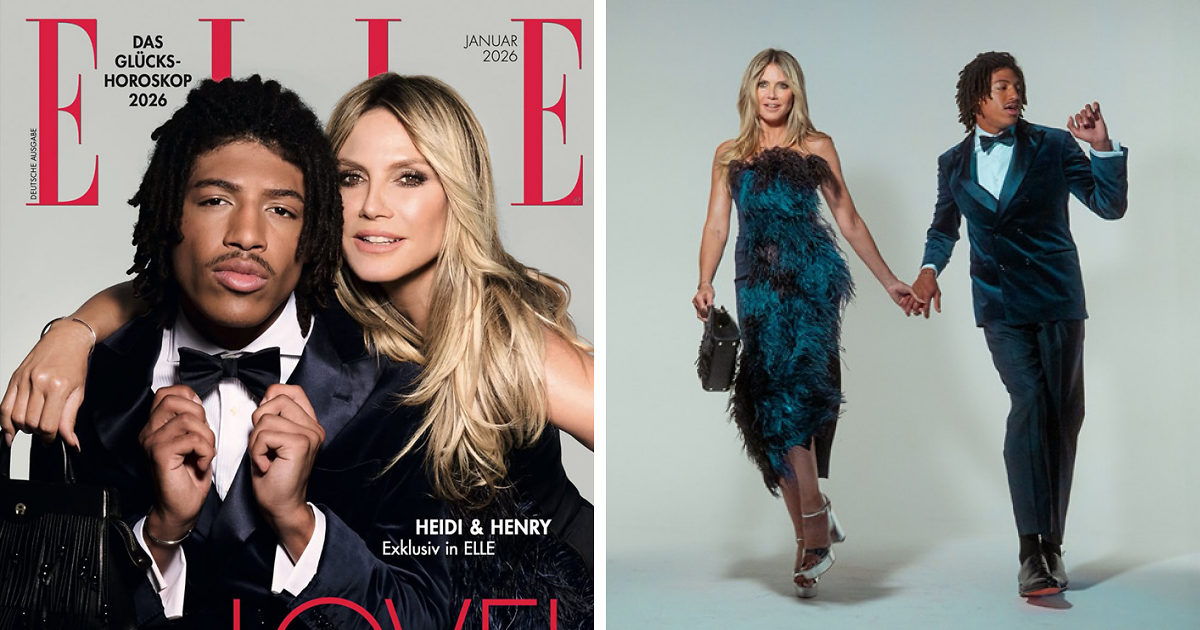
Heidi Klum has spent decades proving that a camera can be both a workplace tool and a personal playground. But when the supermodel appeared on an Elle Germany cover alongside her son Henry Samuel, the internet did what the internet does best: grabbed a cup of criticism, added two scoops of “nepo baby” debate, and stirred until everyone had an opinion.
The cover, photographed by fashion legend Rankin for the January 2026 issue, marked Heidi and Henry’s first joint magazine shoot. On paper, it was a sweet mother-son fashion moment: a world-famous model proudly sharing the spotlight with her 20-year-old son, who has recently stepped into the modeling world himself. Online, however, the reaction was not exactly a polite round of applause. Some fans praised the pair’s bond and Henry’s confident debut energy, while others slammed the appearance as another example of celebrity children receiving opportunities that unknown models spend years chasing.
The sharpest comments questioned whether Henry was “model material,” while others called the cover a symbol of nepotism in fashion. But the controversy is bigger than one photo. It touches on celebrity privilege, changing beauty standards, social media cruelty, and the complicated reality of growing up with a famous last name.
Why the Heidi Klum and Henry Samuel Elle Cover Became a Flashpoint
The Elle Germany cover arrived at a time when public patience for celebrity-family career launches is thinner than a runway sample size. Henry Samuel is not entering fashion as a complete unknown. He is the son of Heidi Klum, one of the most recognizable supermodels of the last 30 years, and Seal, the Grammy-winning singer. That family background brings instant curiosity, instant access, and instant scrutiny.
For the magazine, the pairing made editorial sense. Heidi Klum remains a major fashion and television figure, and Henry had already begun building his own modeling résumé. He made his runway debut in Paris in 2025 at the Lena Erziak Haute Couture Spring-Summer show, later appeared on the cover of Hunger magazine, and signed with Next Management. In other words, he was not simply pulled out of the family living room and placed under studio lights with a hair fan.
Still, the internet rarely reads the fine print. Many viewers saw a famous mother and her famous son on a prestigious cover and immediately interpreted the shoot as another case of inherited opportunity. The phrase “nepo baby” quickly surfaced, as it often does whenever the child of a celebrity gets a high-profile role, campaign, or magazine spread.
Who Is Henry Samuel?
Henry Samuel is Heidi Klum’s oldest son and one of her four children. His full family background has long attracted public curiosity because he comes from a blended, high-profile family. Heidi shares Henry, Johan, and Lou with Seal, while her oldest daughter, Leni Klum, has also built a modeling career after making her own fashion debut as a teenager.
Henry’s entry into modeling has been relatively recent compared with Heidi’s decades-long career. His Paris runway debut placed him in a serious fashion context, not just on a celebrity red carpet. His Hunger magazine cover gave him another stepping stone, and his agency signing suggested that he was pursuing modeling as more than a one-time experiment.
But being new is exactly what made the Elle cover controversial. For many aspiring models, landing a major magazine cover is a dream that comes after years of test shoots, castings, rejection emails, and the occasional unpaid “exposure” opportunity that pays about as well as a compliment from a houseplant. Seeing a celebrity child receive a major platform so early naturally raised eyebrows.
The “Nepo Baby” Debate Is Not Going Away
The backlash against Henry Samuel fits neatly into a much larger cultural conversation. “Nepo baby” has become one of the internet’s favorite labels for the children of actors, musicians, models, directors, and other public figures who enter similar industries. The debate is not always fair, but it is understandable.
Fashion, entertainment, and media often sell dreams of discovery. The public loves the idea that someone can be spotted in a mall, discovered on a street corner, or plucked from ordinary life because they have undeniable star quality. When a celebrity child appears to skip several steps, that dream starts to look less magical and more like a locked club with a very attractive doorman.
At the same time, nepotism is not the whole story. Having famous parents may open a door, but it does not automatically guarantee longevity. A famous last name can get attention, but it can also create brutal expectations. Henry is not being judged as a beginner; he is being compared to Heidi Klum at the height of her supermodel power, which is a bit like comparing a first driving lesson to the Monaco Grand Prix.
Heidi Klum’s Legacy Makes the Comparison Impossible to Avoid
Part of the intensity comes from Heidi Klum’s own career. She became globally known through major fashion work, including her breakthrough as a Sports Illustrated Swimsuit Issue cover model and her years as a Victoria’s Secret Angel. She later became a television force through Project Runway, Germany’s Next Topmodel, America’s Got Talent, and other projects.
Heidi is not just a model; she is a brand. She built a career on camera presence, confidence, commercial appeal, and a willingness to treat fashion as theater. Whether she is wearing couture, hosting a competition show, or arriving at Halloween dressed as something that requires an engineering permit, she understands spectacle.
That legacy creates a heavy shadow for any child entering the same field. Viewers do not look at Henry as a blank slate. They look at him through the lens of Heidi’s fame. Some expect him to instantly possess the same charisma, polish, and professional instincts that his mother developed over decades. That is not how careers work, but social media has never been famous for patience.
Was the Backlash Fair?
There is a fair conversation to be had about access in fashion. It is reasonable to ask why celebrity children receive covers and contracts while unknown talent struggles to be seen. It is fair to question whether magazines rely too heavily on famous families because familiar names generate clicks, shares, and instant headlines.
What is less fair is attacking someone’s appearance. Saying a young model is “not model material” may sound like industry critique, but online it often becomes a thin disguise for body shaming, facial criticism, and personal insults. Modeling is a visual profession, yes, but public cruelty is not a talent evaluation system. It is just a comments section wearing sunglasses indoors.
Henry Samuel is an adult and a public-facing model, so criticism of career privilege is part of the conversation. But there is a meaningful difference between analyzing nepotism and mocking a person’s looks. The first can lead to a discussion about industry fairness. The second just proves that some people should be legally required to wait ten minutes before posting.
Why the Cover Also Makes Sense for Elle
From a media strategy perspective, the cover was almost guaranteed to generate attention. Heidi Klum brings cross-generational recognition. Henry brings curiosity. Together, they create a story about family, fashion, legacy, and the next generation. That is editorial gold, even before the first angry comment loads.
Magazines today are not only selling printed pages; they are competing for digital attention. A mother-son cover involving a supermodel and her newly modeling son is built for social platforms. It sparks debate, attracts celebrity-watchers, pulls in fashion fans, and gives entertainment outlets an easy headline.
That does not mean the cover was cynical. It may have been a sincere fashion story about family and career. But sincerity and strategy can exist in the same room. In modern celebrity media, a tender family moment can also be a traffic machine. That is not a scandal; that is the business model.
Changing Standards of “Model Material”
The phrase “model material” is slippery because the definition has changed dramatically. Decades ago, mainstream fashion often pushed a narrow ideal: specific height, specific proportions, specific facial symmetry, and a very specific ability to look hungry while standing next to a chair.
Today, modeling is broader. There are runway models, commercial models, editorial models, fitness models, curve models, mature models, digital creators, and personality-driven fashion figures. A model can be chosen for bone structure, energy, identity, story, audience, or the ability to make a brand feel culturally relevant.
Henry Samuel may not fit every viewer’s idea of a classic male model, but that does not automatically disqualify him from fashion work. The industry has always involved taste, timing, branding, and connections. The difference now is that audiences can respond instantlyand loudlywhen they dislike the casting.
Heidi Klum’s Role as a Fashion Mom
Heidi has publicly supported her children’s creative paths, including Leni Klum’s modeling career and Henry’s recent steps into fashion. Her pride in Henry’s milestones has been clear, and that is not surprising. Most parents celebrate their children’s achievements; Heidi just happens to do it with professional photographers, designer clothing, and millions of people watching.
There is also a protective element. When a celebrity parent introduces a child to the public, they can help shape the narrative. A joint cover with Heidi gives Henry visibility but also places him beside someone who knows exactly how the industry works. She understands criticism, camera pressure, and the difference between a bad angle and a bad day.
Of course, the same support can fuel accusations of favoritism. That is the paradox of celebrity parenting: help your child and people say the opportunity is unearned; step back and people ask why you are not supporting them. Either way, someone online will have a dissertation-length complaint and a profile picture of a cat.
What the Outrage Says About Celebrity Culture
The reaction to the Heidi Klum and Henry Samuel cover reveals how conflicted audiences are about celebrity families. People love seeing famous families together until the family moment becomes a career opportunity. Then admiration can turn into resentment.
This tension is especially strong in fashion because modeling already feels mysterious to outsiders. Why does one person book a cover and another does not? Why does one face become “editorial” while another is ignored? The answers often involve agencies, relationships, branding, timing, taste, and luck. That uncertainty makes nepotism an easy explanation whenever a familiar surname appears.
But the public also participates in the system it criticizes. Celebrity-family content gets clicks because audiences click. Nepo-baby stories trend because people argue about them. Magazines keep booking famous relatives because famous relatives reliably create attention. The machine runs on outrage, fascination, and the human inability to scroll past a dramatic headline.
Lessons for Brands, Magazines, and Rising Models
For fashion brands and magazines, the lesson is simple: celebrity-family casting can be powerful, but it comes with baggage. Audiences now expect more transparency and more diversity in opportunity. If a publication gives a major platform to a famous child, it should be prepared for questions about access and merit.
For rising models with famous parents, the challenge is to build a body of work that eventually speaks louder than the surname. One cover may spark debate. A consistent career requires growth, professionalism, and the ability to deliver in different contexts. Henry Samuel is still early in that process.
For audiences, the lesson is to separate critique from cruelty. It is possible to discuss nepotism without attacking someone’s face, body, or worth. In fact, the critique becomes stronger when it avoids cheap shots. “Fashion should create more space for unknown talent” is a real argument. “He is not model material” is mostly a digital tomato thrown from the balcony.
Experience Section: Watching the Fashion Family-Business Debate Play Out
Anyone who follows fashion media long enough starts to notice a familiar pattern. A celebrity child steps into the spotlight, the first photos appear, fans split into teams, and suddenly the comment section becomes a courtroom. One side argues that the young star is talented, stylish, and simply using the resources available to them. The other side insists that the opportunity should have gone to an unknown model who has been working quietly for years. Both sides usually have a point, which is why the debate never dies.
The Heidi Klum and Henry Samuel cover feels especially charged because it combines family affection with professional visibility. A mother posing with her son is sweet. A supermodel mother posing with her model son on a major fashion cover is also business. That mixture makes people uncomfortable. We like success stories to feel earned, but we also love legacy stories. We want famous parents to be proud, but we do not want their children to cut the line. Fashion gives us the glamour, then asks us not to notice the velvet rope.
There is also something revealing about how quickly people judge whether someone “belongs” in modeling. Many legendary models were not universally praised at the beginning of their careers. Some were considered too unusual, too commercial, too short, too tall, too strong-featured, too plain, too something. Fashion has always been full of gatekeeping language dressed up as taste. The difference now is that the gatekeepers include millions of strangers with phones.
From a reader’s perspective, the fairest way to view Henry’s career is as unfinished. He has access, yes. He has a famous mother, yes. He also has to figure out whether he can turn early attention into actual skill, range, and staying power. That cannot be proven by one cover, and it cannot be disproven by one unkind comment thread.
The experience of watching these controversies unfold also shows how exhausting celebrity culture can be. We ask public figures to share their families, then punish the families for being visible. We demand authenticity, then accuse every emotional moment of being a publicity strategy. We want fresh faces, but we click hardest on familiar names. The result is a cycle where outrage becomes part of the marketing, even when the people involved may simply be trying to celebrate a milestone.
In the end, the Elle cover is less about whether every viewer personally approves of Henry Samuel as a model and more about what modern fame does to opportunity. The fashion industry has always been shaped by access, taste, money, and relationships. Social media did not create that reality; it just gave everyone a microphone and very few people a filter.
Conclusion
Heidi Klum’s Elle Germany cover with Henry Samuel became controversial because it sits at the intersection of family pride, celebrity privilege, and the public’s growing frustration with nepotism. Henry’s modeling career is still young, and the backlash shows just how difficult it can be for celebrity children to be judged as individuals rather than extensions of their famous parents.
There is room to question how opportunities are distributed in fashion. There is room to ask whether magazines should spotlight more unknown talent. But there is less value in turning those questions into personal attacks. If Henry Samuel continues modeling, timenot a comment sectionwill be the better judge of his potential. Until then, the cover has already done what fashion covers are designed to do: create a conversation, stir emotion, and make everyone look twice.
Note: This article is based on public reporting about Heidi Klum, Henry Samuel, their Elle Germany cover, and the broader online reaction. It analyzes the controversy without endorsing appearance-based harassment or personal attacks.













