
Every December, Hollywood turns into a snow globe that someone keeps shaking with both hands. Christmas movies pour out of every streaming service, cable channel, and studio vault: cozy small towns, big-city bakers, magical inns, misunderstood princes, haunted office parties, reindeer with emotional range, and at least one emotionally wounded architect who learns the true meaning of love through hot cocoa.
And then there is Hanukkah.
For Jewish audiences searching for a mainstream Hanukkah movie, the menu has historically looked less like a buffet and more like a sad little plate at the end of the table: Eight Crazy Nights, The Hebrew Hammer, maybe An American Tail if we are expanding the definition, and a handful of TV movies that deserve more attention but rarely get the same cultural megaphone. It is not that Hanukkah has never appeared on screen. It is that Hollywood has treated it like a novelty candle: cute, seasonal, and easy to put away by New Year’s.
The problem is not simply quantity. It is imagination. Hanukkah is a holiday built around resistance, memory, family, light, food, argument, humor, survival, and miracles that arrive late but still count. In other words, it has everything a good movie needs except a studio executive willing to say, “Yes, let’s give this the same confidence we give to the 947th Christmas romance about a woman inheriting a bakery.”
Why the Hanukkah Movie Gap Feels So Strange
Jewish stories have shaped American film from the very beginning. Jewish writers, directors, composers, producers, comedians, and performers helped build Hollywood itself. Yet mainstream holiday cinema has rarely centered Jewish celebration with the same warmth, variety, and casual confidence that Christmas receives every year.
That gap is especially odd because the American holiday movie has become one of pop culture’s most reliable machines. Christmas films are not just movies anymore; they are an ecosystem. There are theatrical classics, prestige dramas, family comedies, animated specials, horror films, romantic comedies, musicals, and made-for-TV comfort food. Christmas gets multiverse-level representation. Hanukkah often gets one episode, one joke, or one supporting character explaining what a menorah is while standing next to a much larger Christmas tree.
To be clear, Hanukkah is not “Jewish Christmas.” It is a distinct Jewish holiday with its own history and meaning. It commemorates the rededication of the Second Temple in Jerusalem and the miracle of oil lasting eight nights. But because it usually falls near Christmas, American pop culture often frames it as the “other December holiday,” which flattens its identity before the story even begins.
The Two-Movie Problem: Eight Crazy Nights and The Hebrew Hammer
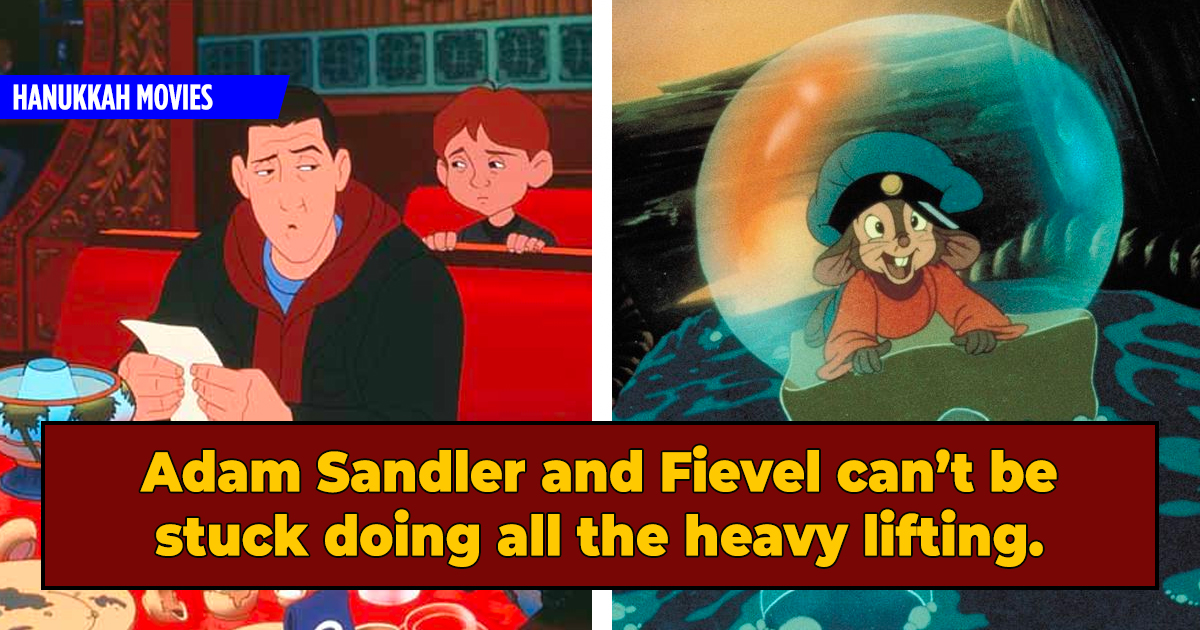
When people talk about mainstream Hanukkah movies, two titles tend to dominate the conversation: Adam Sandler’s animated musical comedy Eight Crazy Nights and the cult comedy The Hebrew Hammer. Both have name recognition. Both are explicitly connected to Hanukkah. Both are also very specific, very chaotic, and not exactly the warm all-ages cultural touchstones many viewers are hoping for.
Eight Crazy Nights: Famous, Messy, and Not Enough
Eight Crazy Nights arrived in 2002 with Adam Sandler at the height of his comedy fame. It is animated, musical, loud, crude, sentimental, and deeply strange. For some viewers, it is a nostalgic oddball. For others, it is proof that representation can technically exist and still make people whisper, “Maybe not like that.”
The movie deserves credit for putting Hanukkah in a mainstream title at all. That matters. But it also became the default answer to “What Hanukkah movies are there?” in a way that no single film should have to be. Christmas viewers are not forced to choose one movie to represent every emotion, age group, tradition, and family dynamic. Jewish viewers should not have to point to one animated Adam Sandler fever dream and say, “Well, that’s the big one.”
The Hebrew Hammer: Cult Comedy With a Sharp Edge
The Hebrew Hammer, released in 2003, is a parody action comedy about a Jewish hero trying to save Hanukkah from a villain who wants Christmas to dominate everything. It is proudly ridiculous, full of satire, and built for an audience that enjoys jokes with elbows. In some ways, it understands the feeling of December cultural overload better than more polished holiday films do.
But again, one cult comedy cannot carry an entire holiday’s cinematic presence. The Hebrew Hammer is funny to some, exhausting to others, and definitely not the kind of family-friendly annual classic that parents casually introduce to young kids between latkes and dreidel games. It is a niche answer to a mainstream absence.
What About An American Tail?
An American Tail is often pulled into the Hanukkah movie conversation, and for good reason. The 1986 animated film opens with a Jewish family of mice celebrating Hanukkah in Russia before violence forces them to immigrate to America. The film is not “about Hanukkah” in the seasonal-movie sense, but its opening matters. It connects the holiday to Jewish memory, displacement, family hope, and the immigrant story.
Still, calling An American Tail a Hanukkah movie shows how hungry audiences are for options. It is a deeply Jewish movie, yes. It includes Hanukkah, yes. But it is not the equivalent of a December comfort classic built around the holiday itself. When viewers have to debate whether a 1980s immigration allegory counts as one of the most important Hanukkah films, that is a sign the shelf needs restocking.
TV Has Started Doing the Work Hollywood Avoided
While major studios have moved slowly, television networks have begun testing the waters. Disney Channel’s Full-Court Miracle gave families a Hanukkah sports story in 2003, connecting basketball, faith, teamwork, and the Maccabee story. Lifetime’s Mistletoe & Menorahs explored interfaith romance and holiday learning. Hallmark has added titles such as Love, Lights, Hanukkah!, Eight Gifts of Hanukkah, Hanukkah on Rye, Round and Round, Hanukkah on the Rocks, and Leah’s Perfect Gift.
This progress matters. Hanukkah on Rye gave audiences competing Jewish deli owners, a matchmaker, family business stakes, and a romance with actual cultural texture. Round and Round used a time-loop premise during Hanukkah, proving that Jewish holiday movies do not have to be limited to “someone explains Judaism to a non-Jewish love interest.” That is a crucial creative leap. Give us magic, sci-fi, sports, mystery, comedy, family drama, workplace chaos, and yes, even a tasteful amount of romantic bickering near a plate of sufganiyot.
But made-for-TV holiday films still often live in a separate category from mainstream theatrical or prestige streaming releases. They are welcome, but they should not be the ceiling. Hanukkah deserves the full range: big studio family movies, sharp adult comedies, animated adventures, teen romances, historical dramas, cozy mysteries, and ensemble films where Jewish life is not treated like a footnote.
Why Hollywood Keeps Getting Hanukkah Wrong
One reason Hanukkah gets mishandled is that Hollywood often approaches it as a diversity checkbox instead of a story engine. A menorah appears in the background. A character says “Happy Hanukkah.” Someone spins a dreidel for seven seconds. Then the plot sprints back to Christmas lights, Santa hats, and emotional closure under mistletoe.
That is not representation; it is decoration.
A real Hanukkah movie would understand the rhythms of the holiday. It would know that the lighting of the menorah can be quiet, funny, chaotic, reverent, or all four depending on who is holding the shamash and whether Uncle David is correcting everyone’s Hebrew again. It would know that food is not just food; latkes carry family recipes, oil stains, and at least one disagreement about applesauce versus sour cream. It would know that Jewish identity can be religious, cultural, secular, interfaith, Ashkenazi, Sephardi, Mizrahi, converts, Jews of color, queer Jews, immigrant families, suburban families, city families, and people who feel connected in complicated ways.
Most importantly, it would know that Jewish joy is not a minor subplot.
Hanukkah Has Built-In Movie Magic
From a screenwriting perspective, Hanukkah is practically gift-wrapped. Eight nights provide a natural structure. Each night can reveal a secret, deepen a relationship, escalate a conflict, or bring a family closer to the truth. The holiday’s themes of light in darkness and perseverance against overwhelming odds are cinematic without needing to be forced.
Imagine a family comedy where three generations gather for Hanukkah and accidentally uncover a long-buried family story. Imagine a teen movie about a Jewish high school student trying to stage a Hanukkah concert in a school obsessed with Christmas pageantry. Imagine an animated adventure where children follow the history of the Maccabees through a magical menorah. Imagine a romantic comedy set in a New York deli, a Chicago synagogue fundraiser, a Los Angeles comedy club, or a Florida retirement community where the gossip is faster than the candle lighting.
Even the simplest Hanukkah setup can work beautifully because the holiday naturally combines intimacy and spectacle. There are candles, songs, games, food, family rituals, community events, and a countdown built into the calendar. If Christmas can support movies about royal twins, time-traveling knights, and sentient snowmen, Hanukkah can support more than two mainstream titles and one annual “Actually, this one has a Jewish character” headline.
Representation Is Not About Replacing Christmas Movies
Asking for more Hanukkah movies is not an attack on Christmas cinema. No one is coming for the cozy cable kingdom. The gingerbread infrastructure is safe. The fake snow machines may continue operating at full power.
The point is expansion, not replacement. A richer holiday movie season benefits everyone. Audiences are not tired of holiday stories because there are too many traditions represented; they are tired of seeing the same template recycled with different scarves. Hanukkah movies could refresh the entire genre by bringing new conflicts, settings, jokes, rituals, family dynamics, and emotional stakes.
Good representation also helps non-Jewish viewers understand Jewish life without turning the story into homework. The best cultural movies do not feel like lectures. They feel like invitations. They let viewers laugh, recognize themselves, and learn through character rather than exposition. A great Hanukkah movie would not need someone to pause the plot and explain every ritual like a museum audio guide. It would simply let the holiday breathe inside the story.
What a Great Mainstream Hanukkah Movie Needs
1. Jewish Characters With Full Lives
Jewish characters should not exist only to teach someone else a lesson about inclusion. They need desires, flaws, careers, crushes, grudges, jokes, bad decisions, and beautiful moments of growth. Let them be messy. Let them be specific. Let them be more than “the Jewish friend.”
2. Cultural Specificity Without Stereotype
Specificity is where comedy and emotion live. A grandmother guarding her brisket recipe, a cousin who brings store-bought rugelach and gets roasted, a family arguing lovingly over candle-lighting timingthese details make a story feel alive. But specificity must come from care, not caricature.
3. A Plot That Could Not Simply Be Christmas With a Menorah
The strongest Hanukkah films will use the holiday’s own themes. The miracle of light, the courage of a small group, the tension between assimilation and identity, the joy of gathering, and the humor of family tradition can all drive a movie in ways that feel distinctly Jewish.
4. Jewish Creative Voices Behind the Camera
Authenticity improves when Jewish writers, directors, consultants, actors, and producers are part of the process. That does not mean every story must be autobiographical. It means the details are more likely to feel lived-in instead of assembled from a quick internet search and a decorative menorah from the prop department.
Audience Experiences: What It Feels Like to Look for a Hanukkah Movie
For many Jewish viewers, the annual search for a Hanukkah movie feels like walking into a giant holiday store where 98 aisles are Christmas and one small shelf near the checkout says “also available: blue napkins.” The feeling is not always anger. Sometimes it is more like comic disbelief. You scroll through streaming platforms and see endless Christmas categories: romantic Christmas, family Christmas, classic Christmas, funny Christmas, royal Christmas, snowy Christmas, country Christmas, Christmas with dogs, Christmas with amnesia, Christmas with a prince who definitely should have checked local labor laws before inheriting that inn. Then you type “Hanukkah” and the platform coughs politely.
That experience matters because holiday movies are not just background noise. They are part of how families create seasonal memory. People rewatch them while cooking, wrapping gifts, cleaning the kitchen, avoiding relatives, or recovering from too many fried foods. A good holiday movie becomes a tradition because it gives people a shared emotional language. Lines become inside jokes. Songs become cues. Scenes become family rituals. When Hanukkah has only a tiny handful of mainstream options, Jewish families have fewer pop-culture traditions to pass around with the same ease.
There is also the experience of always being asked to accept “almost representation.” A Christmas movie includes a Jewish best friend, and that is nice. A sitcom does a Hanukkah episode, and that can be lovely. A romantic comedy lets a Jewish character mention Hanukkah once, and viewers appreciate the nod. But after years of nods, people naturally want the whole story. They want Jewish characters to fall in love during Hanukkah without the movie treating their holiday as a quirky obstacle. They want children to see a menorah on screen and not feel like it is an exotic prop. They want a family argument over latkes to be as cinematically normal as decorating a tree.
Another real experience is the mixed feeling of gratitude and frustration. When a network releases a new Hanukkah movie, Jewish viewers often root for it before they even know whether it is good. That is a heavy burden for any film. Christmas movies are allowed to be mediocre by the dozen. Nobody watches one bland Christmas romance and declares the entire genre a failure. Hanukkah movies, because there are fewer of them, can feel like they have to represent everyone perfectly. That is impossible. The solution is not one flawless Hanukkah movie. The solution is enough Hanukkah movies that some can be silly, some can be moving, some can be weird, some can be romantic, and some can be nobody’s favorite without damaging the whole category.
The best future would be one where choosing a Hanukkah movie is not a symbolic act but a normal one. Maybe one family wants a goofy animated comedy. Another wants a heartfelt drama. Someone else wants a sharp satire, a cozy romance, a musical, or a mystery set during the eighth night. That variety would make Jewish viewers feel seen not as a lesson, but as an audience. And for everyone else, it would make the holiday season more interesting, more human, and much less predictable.
Conclusion: Hollywood, Light the Next Candle
Hollywood does not need to retire Christmas movies. It simply needs to widen the frame. Hanukkah has stories worth telling, characters worth centering, and traditions rich enough to power far more than occasional cameos and cult comedies. The holiday movie season should not feel like one giant Christmas party where Hanukkah is invited only if it brings its own folding chair.
More mainstream Hanukkah movies would not just serve Jewish audiences. They would make American holiday storytelling better. They would add new humor, new family dynamics, new settings, and new emotional textures to a genre that often repeats itself until even the snowflakes seem bored. The candles are already there. The miracle is already there. The audience is already there.
Now Hollywood just needs to stop acting surprised that people want more than two movies.














