There is something wonderfully brave about drawing yourself. Not photographing yourself. Not choosing your best selfie from a suspiciously perfect angle. Drawing yourself. With a pencil, pen, tablet, crayon, eyeliner, coffee stain, or whatever tool happens to be closest when inspiration barges into the room wearing mismatched socks.
The phrase “Hey Pandas, Try To Draw Yourself And Post It Here” sounds like a casual internet challenge, but it taps into something surprisingly meaningful: self-expression, community creativity, artistic courage, and the universal comedy of trying to draw your own nose. Whether you are a trained illustrator or someone whose stick figures appear to be fleeing a crime scene, a self-portrait challenge can be fun, revealing, and oddly addictive.
Online drawing prompts thrive because they lower the pressure. Nobody is asking you to produce a museum masterpiece. The invitation is simple: draw yourself, post it, and let other people see how you interpret your own face, mood, personality, chaos, confidence, coffee dependency, and possibly your legendary bedhead. In a world obsessed with polished images, a handmade self-portrait feels refreshingly human.
Why Self-Portrait Drawing Still Matters Online
Self-portraits have existed for centuries, long before profile pictures, avatars, and “I woke up like this” captions. Artists have used self-portraits to study anatomy, test technique, tell personal stories, document identity, and ask the giant artistic question: “Who am I, and why is one eyebrow always harder to draw?”
Today, the self-portrait has moved from studio walls to social feeds. People draw themselves as cartoons, fantasy heroes, tiny animals, comic characters, pixel avatars, moody pencil sketches, or exaggerated doodles with suspiciously accurate eye bags. That flexibility is what makes a community art challenge so appealing. You are not just drawing a face. You are choosing how to represent yourself.
A self-portrait can be realistic, symbolic, funny, dramatic, or wildly inaccurate in the best possible way. One person might draw themselves surrounded by books and houseplants. Another might draw themselves as a sleepy panda holding iced coffee like it is a sacred artifact. Someone else might draw only their hands, favorite hoodie, or the messy desk that reveals more about them than a perfect face ever could.
The Beauty of the “Hey Pandas” Style Challenge
The phrase “Hey Pandas” has a friendly, community-first energy. It sounds less like an assignment and more like a group of creative strangers yelling across the internet, “Come sit with us. Bring your sketchbook.” That casual tone matters because many people hesitate to share art. They fear being judged, misunderstood, or compared to someone who can casually draw a realistic eye during lunch break.
A good online art challenge removes that fear by making participation the point. The goal is not perfection. The goal is showing up. The best entries often have personality, not technical polish. A wobbly sketch with a hilarious caption can be more memorable than a flawless portrait with no soul. The internet already has enough polished content. What people crave is honesty, humor, and the delightful evidence that a real person made something.
Why People Love Posting Drawings of Themselves
Self-portrait challenges are popular because they combine three things people naturally enjoy: creativity, identity, and connection. You get to make something personal, reveal a little about yourself, and invite others to respond. It is part art exercise, part social experiment, and part public diary entry with better shading.
Posting your drawing also creates a shared vulnerability. When everyone is drawing themselves, nobody gets to hide behind total coolness. The expert artist, the beginner, the doodler, and the “I only draw during phone calls” person are all answering the same prompt. That shared prompt builds a small creative bridge between strangers.
How To Draw Yourself Without Panicking
Before you begin, please release the idea that your drawing must look exactly like you. Cameras already do that job, and even they sometimes make us look like we were assembled during a power outage. A self-portrait drawing can capture likeness, but it can also capture mood, attitude, humor, habits, and personality.
1. Choose Your Version of “You”
Ask yourself what kind of self-portrait you want to make. Do you want it to be realistic, cartoonish, emotional, silly, dramatic, cute, spooky, stylish, or aggressively honest? Maybe today’s version of you is not “elegant Renaissance portrait.” Maybe today’s version is “tired raccoon with deadlines.” Both are valid. One may be more accurate.
Try choosing one theme before you draw. For example:
- The honest portrait: Draw yourself as you look right now, messy hair and all.
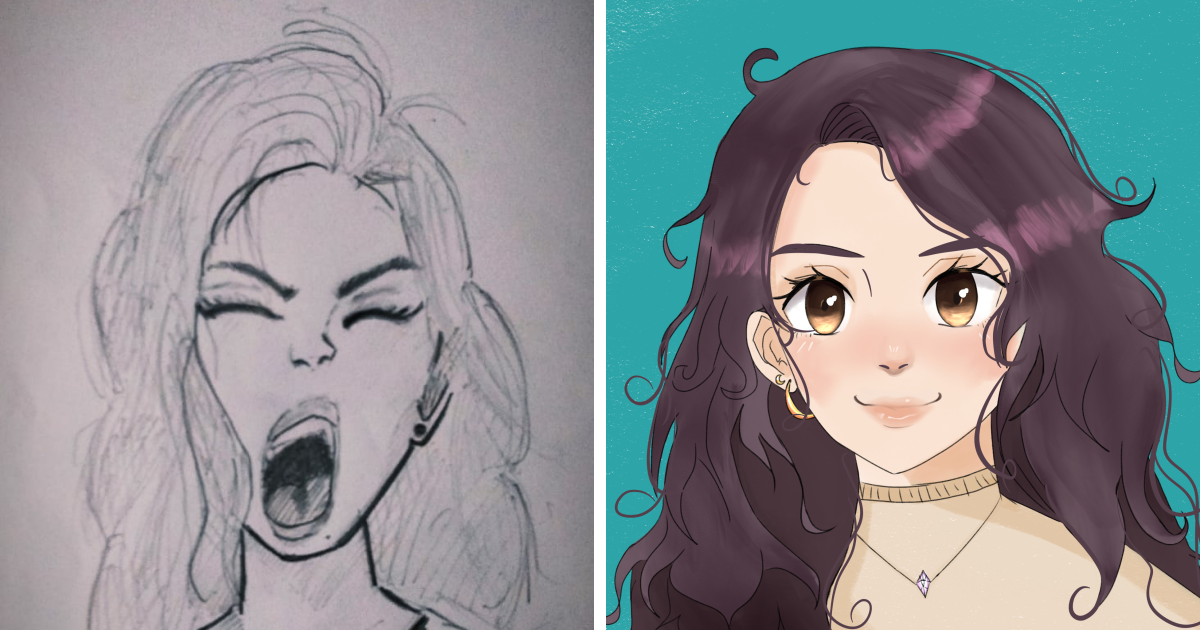
- The cartoon portrait: Exaggerate your favorite features.
- The emotional portrait: Use color, expression, and symbols to show your mood.
- The fantasy portrait: Draw yourself as a wizard, robot, panda, knight, alien, or snack-powered superhero.
- The minimalist portrait: Use only a few lines to suggest who you are.
2. Use a Mirror or Reference Photo
If you want a more accurate self-portrait, use a mirror or a clear reference photo. A mirror gives you direct observation, which is excellent for learning. A photo is easier because it does not move, blink, change expression, or suddenly make you question your haircut.
Place your reference close to your drawing surface. Start with big shapes instead of tiny details. Sketch the head shape, neck, shoulders, and general angle first. Then lightly mark where the eyes, nose, mouth, ears, and hairline will go. This helps you avoid the classic beginner problem of drawing one excellent eye and then realizing there is no room for the rest of the face.
3. Start With Simple Shapes
Most faces can be broken into basic forms: oval, circle, rectangle, triangle, curve. Hair can be treated as a large shape before you draw individual strands. Glasses are shapes. Hoodies are shapes. Even dramatic cheekbones are shapes, though they behave like they know they are famous.
Do not begin with eyelashes, freckles, or tiny wrinkles. Those details are dessert. The structure is dinner. If the basic placement works, the final drawing will feel more convincing even if your lines are loose.
4. Capture Expression, Not Just Proportion
A self-portrait becomes more interesting when it shows expression. Are you smiling, suspicious, sleepy, focused, confused, proud, or emotionally attached to your favorite pen? The tilt of eyebrows, curve of the mouth, and angle of the head can say a lot.
If realism feels intimidating, exaggerate. Make your tired eyes bigger. Turn your smile into a comic grin. Draw your hair as a weather event. The exaggeration may actually communicate your personality better than strict accuracy.
5. Add Personal Clues
Your face is only part of your story. Add details that reveal who you are: headphones, pets, plants, books, snacks, sports gear, gaming controllers, paintbrushes, musical instruments, favorite clothes, or the mysterious water bottle that follows you everywhere but is never quite full.
Background objects can transform a simple drawing into a mini autobiography. A self-portrait with a cat sitting on your keyboard tells a different story than a self-portrait with hiking boots, a camera, and a mountain behind you.
Creative Ideas for the Challenge
If you want to participate but do not know where to begin, try one of these self-portrait ideas. They are beginner-friendly, shareable, and flexible enough for any skill level.
Draw Yourself as a Panda
Since the prompt says “Pandas,” why not fully commit? Draw yourself as a panda version of your personality. Are you a sleepy panda, fancy panda, gamer panda, bookworm panda, chef panda, office panda, or dramatic panda staring out a rainy window? This version is fun because it removes pressure from realistic facial features while still letting you express identity.
Draw Yourself in Three Moods
Create three small portraits: morning you, social you, and deadline you. This format is funny because most of us are not one consistent character. We are a rotating cast of emotional weather systems. A three-mood self-portrait makes that visible.
Draw Yourself as a Cartoon Character
Cartoon self-portraits are perfect for online sharing. You can simplify the face, exaggerate the hairstyle, choose bold colors, and focus on personality. Give yourself a signature outfit or prop. A hoodie, glasses, hat, backpack, or coffee cup can become part of your visual identity.
Draw Yourself Without Drawing Your Face
This is a great option for people who value privacy or want a more symbolic approach. Draw your desk, shoes, hands, bag, bookshelf, favorite meal, or the contents of your pockets. A portrait does not always need a face. Sometimes a charging cable, three pens, and a half-finished notebook say everything.
Draw Yourself as You Feel Today
Instead of focusing on appearance, focus on emotion. Use color and shape to show your current state. Bright yellow scribbles might show excitement. Blue shadows might show exhaustion. Red lines might show stress. A tiny figure under a giant blanket might show Monday.
Why Beginners Should Join Anyway
Many people avoid drawing challenges because they think they are “not good enough.” That belief is the dusty little goblin sitting on top of every blank page. Ignore it. Drawing is not a talent-only club guarded by people in berets. It is a skill, a habit, and a form of expression.
Beginners often create the most charming challenge entries because they are not trapped by perfection. Their drawings can be direct, funny, and emotionally clear. A crooked portrait with personality is better than a technically correct drawing that says nothing.
Also, improvement only happens when you make things. If you draw yourself today and then try again six months from now, you may be shocked by how much changes. Your proportions improve. Your lines become more confident. You notice shadows differently. You learn that ears are not just decorative question marks attached to the head.
How To Post Your Self-Portrait Online
Once your drawing is finished, take a clear photo or export the file if it is digital. Natural light helps. Avoid harsh shadows unless your goal is “mysterious basement artist,” which is also a valid aesthetic. Crop the image neatly and make sure the drawing is easy to see.
Then write a caption. A good caption can make your post more engaging. You might explain your idea, share what was difficult, mention your tools, or add a joke. For example:
- “I tried to draw myself and accidentally created my sleep paralysis intern.”
- “Self-portrait as a panda because I, too, enjoy snacks and emotional sitting.”
- “First attempt at drawing myself. The left eye has filed a complaint.”
- “I used pencil, markers, and three moments of artistic panic.”
Captions invite comments and make your artwork feel approachable. They also remind viewers that the challenge is about participation, not perfection.
Kind Feedback Makes the Challenge Better
Any community art challenge depends on the tone of the comments. If someone posts a beginner drawing, kindness matters. Helpful feedback should be specific, gentle, and invited. Instead of saying, “The proportions are wrong,” try, “I love the expressionif you want to develop it further, you could try lightly mapping the eye line before adding details.”
Better yet, celebrate what works. Notice the humor, color, effort, originality, or courage. Art communities grow when people feel safe enough to try again. A kind comment can turn one nervous post into a lifelong drawing habit.
Digital vs. Traditional Self-Portraits
You can draw yourself with pencil and paper, digital software, markers, watercolor, charcoal, ballpoint pen, collage, or mixed media. Traditional tools offer texture and unpredictability. Digital tools make editing, layering, coloring, and undoing easier. Both are real art. The pencil does not become more noble just because it cannot update its software.
For traditional drawing, keep your materials simple: paper, pencil, eraser, and maybe a pen for final lines. For digital drawing, start with a rough sketch layer, lower the opacity, then draw clean lines on a new layer. Add color after the main shapes are working. Do not spend forty minutes shading the lips if the head is still floating like a potato moon.
Common Self-Portrait Mistakes and How To Fix Them
The Eyes Are Too High
Many beginners place eyes near the top of the head, but eyes usually sit around the middle of the head. Hair creates the illusion that the face starts higher. Lightly sketch guidelines before adding features.
The Face Looks Flat
Add shadows. Even simple shading under the nose, lower lip, chin, hair, and neck can create depth. Look for where light hits your face and where shadows gather.
The Drawing Does Not Look Like You
Focus on distinctive features: face shape, hairstyle, glasses, eyebrows, smile, posture, or favorite accessories. Likeness often comes from a combination of clues, not one perfectly drawn nose.
You Overworked It
Sometimes the drawing was better ten minutes ago. This is normal. Artists often pass through a danger zone where “just one more adjustment” becomes “I have invented a new species.” Take breaks. Step back. Let the drawing breathe.
Experience Section: What It Feels Like To Draw Yourself and Share It
The first experience most people have with a self-portrait challenge is hesitation. You sit down with your paper or tablet, look at your own face, and suddenly become aware of every detail you usually ignore. One eyebrow is more dramatic than the other. Your nose has architecture. Your mouth refuses to be a simple line. Your hair is less “style” and more “weather report.” This moment can feel awkward, but it is also the beginning of real observation.
When I imagine joining a prompt like “Hey Pandas, Try To Draw Yourself And Post It Here,” the best approach is to treat it like a playful experiment rather than a final exam. I would start with a quick sketch, maybe five minutes, just to catch the big shapes. No pressure. No tiny details. Just the head, shoulders, expression, and one honest attempt at the hair. The first sketch would probably look like a cousin of mine from an alternate universe, but that is fine. Warm-up drawings are allowed to be weird. In fact, they usually insist on it.
The second attempt would be more personal. Instead of chasing perfect realism, I would ask, “What makes this feel like me?” Maybe it is tired eyes from late-night writing, a coffee cup nearby, a hoodie, a laptop, or a facial expression that says, “I have seventeen tabs open and one of them is playing music.” Those details matter because a self-portrait is not only a record of facial measurements. It is a snapshot of a life, a mood, and a moment.
Posting the drawing would bring another wave of nerves. Sharing art online can feel like placing a tiny piece of yourself on a table and waiting to see whether strangers clap, shrug, or ask why your ears are trying to escape. But that vulnerability is also what makes the challenge memorable. Once people begin posting their own versions, the page becomes less like a contest and more like a gallery of personalities. Some drawings are polished. Some are chaotic. Some are funny. Some are surprisingly emotional. Together, they create a community portrait.
One of the nicest experiences in this kind of challenge is seeing how differently people interpret the same instruction. “Draw yourself” sounds simple, but one person creates a realistic pencil portrait, another posts a cartoon panda in pajamas, another draws themselves as a superhero powered by anxiety and snacks, and another shares a symbolic portrait made of flowers, books, and storm clouds. The variety proves that identity is not one fixed image. It is a collection of choices.
The challenge can also change how you see other people’s art. After struggling to draw your own face, you become more generous toward every posted sketch. You understand the courage behind uneven lines. You notice effort. You appreciate humor. You stop asking, “Is this perfect?” and start asking, “What is this person trying to show?” That shift is valuable far beyond drawing.
Finally, the experience leaves you with a record of yourself at one point in time. Months later, you can look back and remember not only what you drew, but how you felt while making it. Maybe you will laugh. Maybe you will see improvement. Maybe you will want to redraw it. That is the quiet magic of a self-portrait challenge: it gives you permission to observe yourself, represent yourself, and share yourself without needing to be flawless first.
Conclusion
“Hey Pandas, Try To Draw Yourself And Post It Here” is more than a fun internet prompt. It is an invitation to be creative, honest, silly, brave, and connected. You do not need expensive supplies. You do not need perfect technique. You do not even need both eyes to match, although congratulations if they do. All you need is a willingness to look, draw, and share.
Self-portrait drawing helps people explore identity, practice observation, build confidence, and join a larger creative conversation. Whether your final image is realistic, cartoonish, symbolic, or completely panda-based, it has value because it shows how you see yourself. And sometimes, that is more interesting than any polished selfie could ever be.
So grab a pencil, open a drawing app, find a mirror, or summon your inner snack-loving panda. Draw yourself and post it. The world does not need another perfect picture. It needs your wonderfully imperfect one.