An astrology chart can look like someone spilled a box of geometry homework across the zodiac. There are circles, triangles, mysterious symbols, colored lines, tiny numbers, and enough abbreviations to make a beginner quietly close the browser tab.
Fortunately, learning how to read an astrology chart does not require memorizing the entire universe before lunch. A natal chart becomes much easier to understand when you read it in layers. You begin with accurate birth information, identify the most important placements, and then combine planets, signs, houses, and aspects into a coherent interpretation.
This 10-step guide focuses on a modern Western astrology birth chart. It explains the chart wheel, the Big Three, planetary meanings, zodiac signs, astrological houses, chart rulers, aspects, and repeating patterns. By the end, that intimidating cosmic diagram should resemble a map rather than an exploded plate of celestial spaghetti.
What Is an Astrology Birth Chart?
A birth chart, also called a natal chart, is an astrological diagram representing the positions of the Sun, Moon, planets, and calculated points at a particular time and location. For a personal natal chart, that moment is usually the time of birth.
The wheel contains four main ingredients:
- Planets describe the functions or drives involved.
- Zodiac signs describe how those functions tend to operate.
- Houses identify the areas of life in which they operate.
- Aspects describe the relationships between planets.
A useful beginner formula is: planet equals what, sign equals how, house equals where, and aspect equals how the different parts interact. Keep that formula nearby. It will rescue you whenever the chart starts looking like decorative pasta.
How to Read an Astrology Chart in 10 Steps
Step 1: Collect Accurate Birth Information
Before interpreting a chart, make sure it was calculated with the correct birth date, birthplace, and birth time. The date establishes the general planetary positions, while the location and exact time are used to calculate the Ascendant and house cusps.
An incorrect birth time can produce a different rising sign or move planets into neighboring houses. Even a modest time difference may affect placements near a house cusp. Whenever possible, check a birth certificate, hospital record, baby book, or another reliable family document rather than relying on “sometime after dinner.” The planets appreciate specificity.
Choose a reputable chart calculator and note which zodiac and house systems it uses. Most mainstream Western charts use the tropical zodiac. Placidus and Whole Sign are two common house systems. Neither should be mixed randomly during one interpretation. Select a system, learn its logic, and remain consistent while practicing.
If the birth time is unknown, you can still study many planetary sign placements and aspects. However, treat the rising sign, house positions, Midheaven, and other angles as uncertain.
Step 2: Learn the Layout of the Chart Wheel
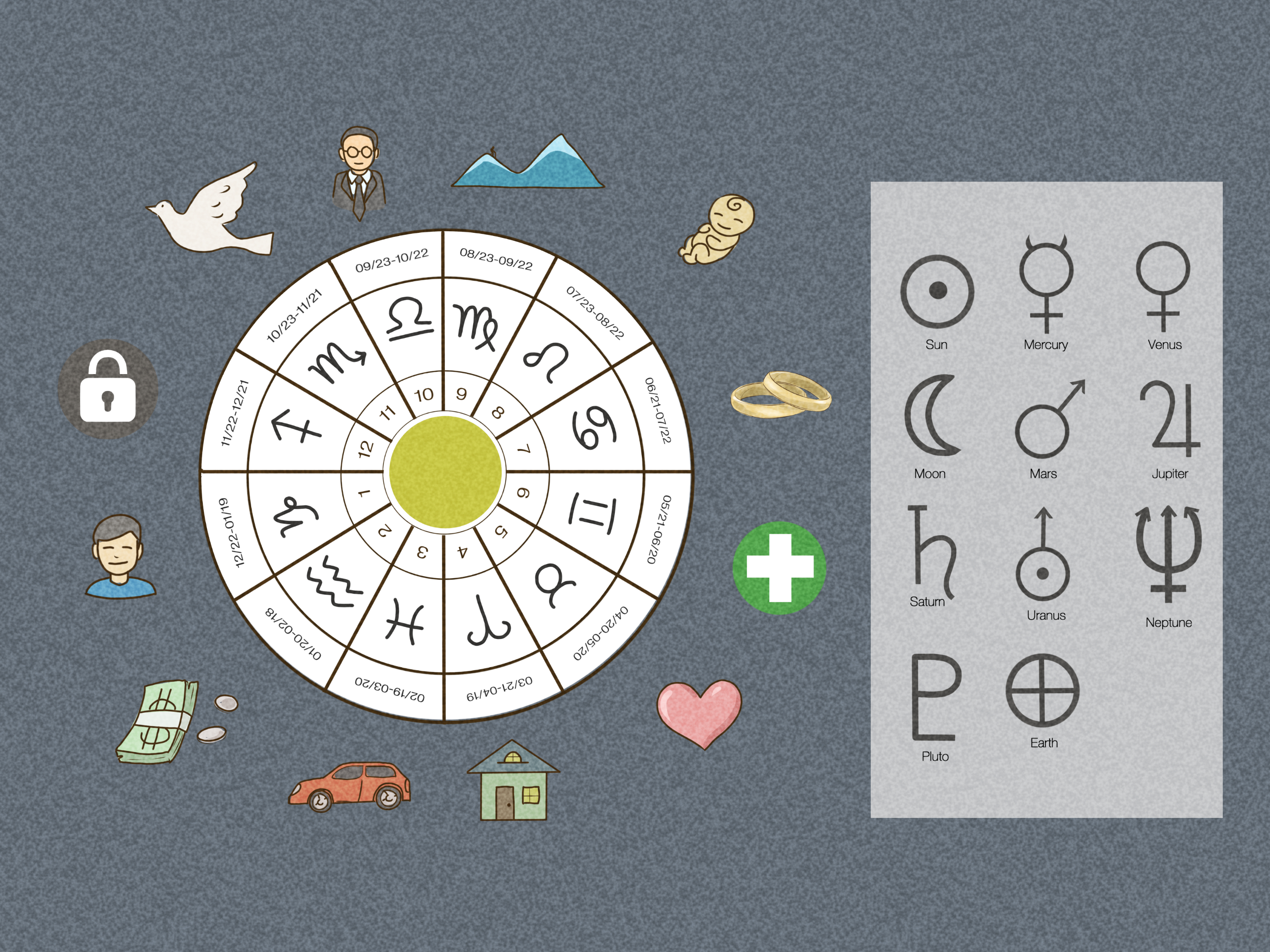
A natal chart is a 360-degree circle divided into 12 zodiac signs and 12 astrological houses. The signs always follow the same order: Aries, Taurus, Gemini, Cancer, Leo, Virgo, Libra, Scorpio, Sagittarius, Capricorn, Aquarius, and Pisces.
The houses are numbered counterclockwise. In many chart styles, the Ascendant appears on the left side of the wheel and begins the first house. The Midheaven is usually located near the top, although its exact position depends on the house system and birthplace.
Locate the chart’s legend before attempting an interpretation. It should identify the symbols for planets, signs, aspects, retrograde motion, and calculated points. Do not guess that a strange glyph is Neptune when it is actually an asteroid, a node, or an accidental coffee stain on your screen.
Notice the difference between signs and houses. Zodiac signs are equal 30-degree sections of the zodiac. Houses represent areas of life and may appear equal or unequal depending on the selected house system.
Step 3: Find the Big Three
The Sun, Moon, and Ascendant are commonly called the Big Three because they provide a practical foundation for reading a natal chart.
- The Sun is associated with identity, vitality, purpose, confidence, and the qualities a person is learning to express consciously.
- The Moon is associated with emotional needs, instincts, habits, memory, comfort, and private reactions.
- The Ascendant or rising sign describes the approach to new experiences, outward manner, first impressions, and the perspective through which the rest of the chart is expressed.
Read the sign and house of both the Sun and Moon. Then identify the zodiac sign rising at the first-house cusp. For example, a Leo Sun may seek confident self-expression, while a Capricorn Moon may prefer emotional control and practical security. If Gemini is rising, that person might approach new situations with curiosity, conversation, and rapid observation.
The result is not a contradiction. People are layered. Someone can crave recognition, process emotions cautiously, and still appear lighthearted in a new social setting. Astrology charts are designed to describe combinations, not reduce everyone to one zodiac-flavored adjective.
Step 4: Identify What Each Planet Represents
Once you understand the Big Three, locate the remaining planets. Each planet symbolizes a particular psychological function or category of experience within astrology.
- Mercury: thinking, communication, learning, perception, and information exchange.
- Venus: attraction, relationships, pleasure, values, aesthetics, and the way affection is expressed.
- Mars: action, desire, initiative, conflict, courage, anger, and physical drive.
- Jupiter: expansion, opportunity, belief, generosity, education, and meaning.
- Saturn: structure, responsibility, limits, discipline, fear, maturity, and long-term effort.
- Uranus: independence, disruption, innovation, rebellion, and sudden change.
- Neptune: imagination, ideals, spirituality, compassion, confusion, and blurred boundaries.
- Pluto: power, intensity, elimination, renewal, and deep transformation.
The Sun and Moon are traditionally called luminaries, but chart interpretations often group them with the planets for convenience. Begin with the personal planetsthe Sun, Moon, Mercury, Venus, and Marsbecause they move relatively quickly and tend to distinguish one personal chart from another more clearly.
The slower-moving outer planets can remain in one sign for years. Their sign placements therefore describe broader generational themes. Their house positions and close aspects to personal planets usually make them more personally significant.
Step 5: Read the Zodiac Sign as the Planet’s Style
The zodiac sign shows how a planet expresses its function. Mercury describes communication, but Mercury in Aries may communicate quickly and directly, while Mercury in Taurus may prefer deliberate, practical, and carefully considered language.
To understand the signs efficiently, study their elements and modalities.
The four elements are:
- Fire: Aries, Leo, and Sagittariusexpressive, enthusiastic, active, and inspiration-driven.
- Earth: Taurus, Virgo, and Capricornpractical, tangible, stable, and results-oriented.
- Air: Gemini, Libra, and Aquariusmental, social, communicative, and idea-oriented.
- Water: Cancer, Scorpio, and Piscesemotional, intuitive, receptive, and relationship-sensitive.
The three modalities are:
- Cardinal: Aries, Cancer, Libra, and Capricorn initiate action.
- Fixed: Taurus, Leo, Scorpio, and Aquarius sustain, stabilize, and resist disruption.
- Mutable: Gemini, Virgo, Sagittarius, and Pisces adapt, revise, and transition.
Combine the planet with the sign rather than memorizing placements as unrelated definitions. Venus in a fixed earth sign, for example, might approach affection and personal values with consistency, patience, loyalty, and a strong preference for reliability.
Step 6: Use the Houses to Find the Area of Life
The 12 houses describe where a planet’s themes are most likely to become noticeable. A planet does not change its basic function when it enters a house; the house provides the setting.
- First house: identity, appearance, approach, embodiment, and new beginnings.
- Second house: money, possessions, personal resources, skills, and self-worth.
- Third house: communication, learning, siblings, local travel, and everyday information.
- Fourth house: home, family, ancestry, privacy, foundations, and emotional roots.
- Fifth house: creativity, romance, play, pleasure, children, and self-expression.
- Sixth house: work routines, service, habits, maintenance, health practices, and daily responsibilities.
- Seventh house: partnership, contracts, close relationships, negotiation, and visible opponents.
- Eighth house: shared resources, debt, inheritance, intimacy, vulnerability, loss, and transformation.
- Ninth house: higher education, travel, publishing, religion, philosophy, and worldview.
- Tenth house: career, public reputation, authority, ambition, and social contribution.
- Eleventh house: friendships, groups, networks, causes, audiences, and long-range hopes.
- Twelfth house: retreat, solitude, hidden patterns, spirituality, closure, and the unconscious.
Suppose Mars is in the tenth house. Mars represents initiative and competition, while the tenth house concerns career and public direction. The combination may suggest strong professional drive, willingness to lead, or recurring conflict with authority. The sign of Mars explains the style in which that ambition operates.
Step 7: Examine the Angles and Chart Ruler
The four angles are highly sensitive points in a natal chart:
- Ascendant: the beginning of the first house and the approach to life.
- Descendant: the beginning of the seventh house and the approach to partnership.
- Midheaven: the point associated with public life, direction, achievement, and reputation.
- Imum Coeli: the point associated with home, ancestry, privacy, and personal foundations.
Planets located close to these angles are often emphasized in an interpretation. Venus near the Ascendant, for example, may make Venusian themes such as harmony, attractiveness, diplomacy, or aesthetics especially visible.
Next, identify the chart ruler. This is the planet traditionally associated with the rising sign. Aries rising is ruled by Mars, Taurus and Libra by Venus, Gemini and Virgo by Mercury, Cancer by the Moon, Leo by the Sun, Scorpio by Mars, Sagittarius by Jupiter, Capricorn by Saturn, Aquarius by Saturn, and Pisces by Jupiter.
Many modern astrologers also use Pluto for Scorpio, Uranus for Aquarius, and Neptune for Pisces. Either approach can work as an interpretive system, but beginners should label which rulership method they are using instead of switching halfway through whenever a different answer sounds more exciting.
The sign, house, and aspects of the chart ruler can reveal major themes that appear throughout the chart.
Step 8: Read the Major Aspects
Aspects are angular relationships between planets. On many chart wheels, they appear as lines crossing the center. These lines show how different planetary functions cooperate, merge, challenge, or balance one another.
- Conjunction, approximately 0 degrees: two planetary energies merge and act together.
- Sextile, approximately 60 degrees: the planets have a cooperative connection that may develop through active use.
- Square, approximately 90 degrees: the planets create friction, urgency, and pressure for adjustment.
- Trine, approximately 120 degrees: the energies flow naturally and may represent an accessible ability.
- Opposition, approximately 180 degrees: the planets pull in complementary directions and require balance or integration.
An aspect does not need to be mathematically exact. Astrologers allow an orb, meaning a limited number of degrees on either side of the exact angle. Tighter aspects are generally given greater importance, although permitted orbs vary by planet, aspect, and astrological school.
Avoid labeling trines as automatically good and squares as automatically bad. Ease can become complacency, while tension can produce motivation and skill. A Mercury-Saturn square may correspond with self-doubt in communication, but it may also support disciplined research and precise writing after sustained practice.
Step 9: Look for Repeating Patterns
A strong chart reading depends on repetition. One isolated placement rarely tells the entire story. Look for themes that appear through several different chart factors.
Start by counting the elements and modalities of the major planets. A strong fire emphasis may suggest action and enthusiasm, while a strong earth emphasis may favor planning and practical results. A predominance of fixed signs can indicate determination and consistency, along with a possible reluctance to change direction.
Next, look for a stellium, commonly defined as three or more planets concentrated in one sign or house. A stellium gives extra weight to that sign’s style or that house’s life topics.
Notice angular planets, close aspects, repeated sign rulers, and concentrations in particular sections of the chart. You can also examine the lunar nodes, retrograde planets, chart shape, and hemisphere emphasis, but these are best added after the basic structure is clear.
Do not force significance into every empty house. An empty seventh house does not mean a life without relationships, just as an empty second house does not condemn someone to a wallet containing one expired coupon. Examine the sign on the house cusp and the location of that sign’s ruling planet.
Step 10: Synthesize the Chart Into a Clear Story
The final step is integration. Stop reading placements as separate fortune-cookie messages and connect them into themes.
Use this sequence for each important placement:
Planet + sign + house + major aspects = a complete interpretive sentence.
Consider Mercury in Virgo in the sixth house, square Saturn in the ninth house. Mercury represents thought and communication. Virgo adds analysis, detail, and refinement. The sixth house places these qualities in daily work, systems, and practical problem-solving. Saturn’s square may introduce pressure, seriousness, fear of being incorrect, or demanding educational standards.
A balanced interpretation might be: “This person may communicate carefully and notice practical details that others overlook. They could become highly skilled at editing, analysis, or technical work, although fear of making mistakes may sometimes slow their decisions.”
Prioritize the following factors:
- The Sun, Moon, and Ascendant.
- The chart ruler and its condition.
- Planets close to the four angles.
- Personal planets in signs and houses.
- Tight major aspects.
- Stelliums, element balance, and repeated themes.
Use possibility-based language such as “may,” “can,” or “tends to.” A natal chart is interpreted as a collection of potentials, not an unchangeable verdict. Context, culture, choices, environment, and lived experience matter far more than any single symbol on a wheel.
Common Mistakes When Reading a Natal Chart
One common mistake is trying to interpret every asteroid, midpoint, minor aspect, and hypothetical point immediately. Start with the planets, signs, houses, angles, and five major aspects. Advanced details are seasoning, not the meal.
Another mistake is reading placements in isolation. “Moon in Scorpio” does not produce one universal personality. Its house, aspects, chart ruler, and surrounding patterns all affect the interpretation.
Beginners may also search for dramatic predictions rather than observable themes. A chart is more useful as a structured reflection tool when you connect symbols to habits, choices, motivations, and recurring experiences. Avoid declaring that one placement guarantees divorce, wealth, illness, fame, or a suspiciously specific encounter with a tall stranger on Thursday.
Finally, do not keep changing house systems simply to obtain a preferred answer. Compare systems only after you understand the basic principles of each one.
A Practical Chart-Reading Experience: What Beginners Usually Discover
The following example is a composite learning experience based on common problems beginners encounter rather than a claim about one specific person.
The first time many people open a complete birth chart, they immediately click every available interpretation. Ten minutes later, they have 34 browser tabs, four contradictory descriptions of Venus, and a growing suspicion that Mercury retrograde has personally attacked their Wi-Fi.
A better experience begins by limiting the first session to the Big Three. Imagine a sample chart with a Gemini Sun, Taurus Moon, and Virgo rising. Rather than copying generic descriptions, write one plain sentence for each placement. The Gemini Sun seeks variety, information, and mental stimulation. The Taurus Moon needs consistency, physical comfort, and emotional reliability. Virgo rising approaches unfamiliar situations by observing details and identifying what needs improvement.
Even this basic combination creates a useful theme: the person may be mentally curious but emotionally cautious. They might enjoy change when they have a stable base and enough time to organize the details. That interpretation is more meaningful than calling them “talkative, stubborn, and picky” and then congratulating the zodiac on a job well done.
During the next practice session, add Mercury, Venus, and Mars. Suppose Mercury is in Cancer, Venus is in Leo, and Mars is in Capricorn. Communication may be influenced by memory and emotional context. Affection may be warm, expressive, and appreciative of visible effort. Action may be strategic, controlled, and focused on long-term results.
The challenge is resisting the urge to treat these descriptions as separate people sharing one apartment. Instead, ask how they collaborate. A person with emotionally sensitive communication, dramatic affection, and disciplined action might speak carefully, love generously, and pursue serious goals without making a motivational speech about every spreadsheet.
Aspects usually create the first major breakthrough. A beginner may see a square and assume disaster. With experience, it becomes clear that challenging aspects often describe skills developed through repetition. Someone with Mercury square Saturn might fear sounding uninformed, revise messages excessively, or hesitate before speaking. The same pattern can support research, structured thinking, and unusually careful communication.
House systems can cause another moment of panic. A planet may appear in the fifth house in one system and the sixth in another. Rather than deciding that astrology has collapsed before breakfast, keep the stable informationthe planet’s sign and aspectsand compare the two house interpretations over time. Does the theme appear more clearly through creativity and recreation, or through work and daily routines? Record observations instead of selecting whichever description delivers the best compliment.
Keeping a chart journal makes the learning process more honest. Write down interpretations before deciding whether they fit. Include examples that support the reading and examples that do not. This reduces the temptation to remember every apparent match while quietly escorting the misses out the back door.
After several practice charts, most beginners discover that interpretation is less about memorizing hundreds of definitions and more about identifying repeated ideas. If the chart ruler is in the tenth house, the Sun aspects Saturn, and several planets occupy Capricorn, themes of ambition, responsibility, structure, or public achievement deserve attention. When three independent clues point in the same direction, the interpretation becomes stronger.
The most respectful chart-reading experience also leaves room for the person being described. Ask whether a theme resonates rather than announcing what someone secretly thinks, whom they should marry, or why their childhood was difficult. Obtain permission before reading another person’s chart, particularly when discussing relationships, sexuality, family, health, or trauma.
Progress comes from reading slowly. Begin with the chart’s strongest placements, translate symbols into ordinary language, and test the interpretation against real behavior. Eventually, the wheel stops looking like a cosmic wiring diagram and begins to function as a structured storytelling tool.
Conclusion
Learning how to read an astrology chart is a process of organized interpretation. Start with reliable birth information and understand the chart wheel. Find the Sun, Moon, and Ascendant before moving to the remaining planets. Read each planet through its zodiac sign, house position, and major aspects. Then look for chart rulers, angular planets, stelliums, elemental balance, and themes that repeat.
The goal is not to memorize thousands of disconnected meanings. It is to combine a small number of astrological building blocks into clear, nuanced sentences. Work in layers, keep notes, question overly dramatic conclusions, and allow real experience to remain more important than a symbolic diagram.
With patience, a natal chart becomes less intimidating. You may still encounter enough lines to resemble a subway map designed by a wizard, but at least you will know which train to take.