
Yeezy Slides look almost comically simple: one color, one molded piece of foam, no laces, and barely enough branding to fill a postage stamp. Unfortunately, that minimalist design does not make authentication simple. It makes the smallest differences matter.
Modern replicas can copy the overall silhouette, packaging, barcodes, and even molded logos surprisingly well. A convincing fake may pass a casual glance while failing several closer comparisons involving shape, foam texture, typography, outsole geometry, and production details.
This guide focuses on adidas Yeezy Slides produced during the adidas-Yeezy collaboration. It does not cover newer independent YZY slides that may resemble the adidas version but use different branding and specifications. Sneaker News has noted that newer YZY-branded slides are separate from the adidas collaboration, so identifying the exact product generation is the first stepnot a boring technicality.
Why Yeezy Slide Authentication Is Complicated
Authentic adidas Yeezy Slides were produced across multiple years, factories, colorways, and restocks. Those production differences can change the finish, sizing, foam firmness, packaging, and small molding details.
For example, earlier releases were commonly smoother, firmer, slightly shorter, and narrower around the strap. Later releases often used softer EVA foam with a more textured surface. Sole Retriever specifically notes that pre-Ochre releases used a smoother finish and stiffer foam, while older pairs could fit differently from later versions.
That means advice such as “real Yeezy Slides are always textured” or “authentic pairs never have a circular molding mark” is unreliable. The correct question is not whether your pair matches every Yeezy Slide ever produced. The correct question is whether it matches a confirmed authentic pair with the same style code, colorway, size, release period, and country label.
How to Tell Whether Yeezy Slides Are Real or Fake
1. Start With the Exact Model, Colorway, and Style Code
Before studying the foam with the intensity of a crime-lab technician, identify the exact pair you are checking. Find the style code on the box label, hangtag, receipt, or interior markings and compare it with a trusted product database.
For example, the adidas Yeezy Slide Onyx is associated with style code HQ6448. A box labeled Onyx but displaying a code belonging to another colorway is an immediate problem. LegitApp’s model-specific authentication guide treats the inner stamp, heel mark, sizing information, hangtag, and box label as connected pieces of evidence rather than isolated details.
Check that the model name, color description, size conversion, product code, barcode, and manufacturing information make sense together. Counterfeiters sometimes build a convincing label by combining accurate information from several different releases. Each line may look legitimate by itself while the complete label tells a confused little story.
A working barcode or QR code is not proof of authenticity. Replicas can copy valid codes from genuine boxes. The code must correspond to the exact item in front of you.
2. Examine the Overall Silhouette From the Side
Place the slides on a flat surface and inspect them at eye level. Authentic Yeezy Slides have a sculpted, slightly futuristic profile rather than the flat shape of an ordinary pool sandal.
Look at the angle of the strap, the height of the toe area, the depth of the heel cup, and the curve running from the forefoot to the heel. The transitions should appear intentional and smooth. A fake pair may have a strap that sits too upright, an opening that looks too square, a heel that is unusually tall, or a toe platform that resembles a foam brick wearing a belt.
Compare both slides as well. Their curves, strap height, heel shape, and overall length should be symmetrical. Minor manufacturing variation is possible, but noticeable left-to-right differences can indicate poor replica molds.
Shape is one of the strongest checks because a counterfeit factory may reproduce printed information more easily than the exact three-dimensional geometry of the original mold.
3. Check the One-Piece EVA Foam Construction
Authentic adidas Yeezy Slides use a molded, one-piece EVA foam construction. The upper, footbed, sidewall, and outsole should look like parts of one continuous form rather than separate components glued together. StockX and Sole Retriever both describe the slide as an EVA foam design built around a single molded silhouette.
Run your fingers around the sidewalls and underneath the strap. Watch for glue residue, separated layers, patched areas, or abrupt changes in texture. These are suspicious on a product designed to appear seamless.
The foam should feel flexible but structurally stable. It should compress under pressure and recover without feeling hollow, brittle, or excessively rubbery. Some replicas are unusually hard, while others feel so soft that the sidewalls collapse when lightly squeezed.
Do not use softness as a pass-or-fail test, however. Older authentic releases may feel firmer than later restocks, and storage temperature can temporarily affect foam flexibility.
4. Compare the Surface Texture With the Correct Release
Surface texture is useful only when you compare matching releases. Newer authentic pairs often have a fine, grainy, or lightly pebbled finish. Earlier releases can appear smoother.
Under bright, indirect light, inspect the strap, sidewall, and footbed. Authentic texture should look naturally integrated into the molded foam. On lower-quality fakes, the grain may be too deep, too glossy, completely uniform, or visibly printed onto the surface rather than formed within it.
Look for strange shiny patches, rough scratches beneath the surface, clusters of dents, and heavy wrinkles around the strap. Dype’s comparisons highlight unnatural creases, nicked areas, and molding damage as recurring warning signs on counterfeit pairs.
Color and texture should also be consistent between the left and right slides. One slide should not look matte while the other seems freshly buttered.
5. Inspect the Strap Opening and Interior Curve
The strap is one of the hardest areas for counterfeiters to reproduce accurately. Compare the width of the opening, the thickness of the strap, and the way the interior curve follows the top of the foot.
Authentic pairs generally have a clean, rounded transition where the strap meets the footbed. The opening should not have sharp corners, flattened interior sections, or noticeably different curves on each side.
View the pair from above. A fake may have an opening that is too narrow at the toes, too wide near the ankle, or positioned too far forward. These differences may also create an unusual fit, such as excessive pressure across the top of the foot or too much empty space around the heel.
Remember that fit varies by production period. Older releases were often narrower and shorter, so a snug fit alone does not prove that a pair is counterfeit. StockX’s size chart also shows that Yeezy Slide conversions differ from many standard adidas shoe conversions.
6. Study the Footbed, Heel Cup, and Toe Lip
The footbed should have a controlled contour that rises toward the sides and supports the heel. Check the depth and roundness of the heel cup, the slope beneath the arch, and the raised edge around the toe.
Replica footbeds are sometimes too flat, too deeply scooped, or uneven from one side to the other. The toe lip may appear thick and blunt instead of smoothly sculpted. Other fakes exaggerate the heel cup until it looks ready to store loose change.
Inspect the small adidas mark typically molded near the heel area on adidas-era pairs. It should be cleanly formed, properly positioned, and appropriate for that release. Blurry edges, shallow lines, poor spacing, or an oversized logo are warning signs.
Do not authenticate the pair from the logo alone. A counterfeit mold can reproduce branding while getting the surrounding footbed shape wrong. Always evaluate the logo together with its placement, depth, scale, and neighboring contours.
7. Inspect the Interior Embossing and Typography
Turn the slide over and look inside the strap. Depending on the release, you may find molded information such as the YEEZY name, country of manufacture, sizing, and other production details.
Authentic lettering should look deliberate and evenly formed. Compare the depth of each character, spacing between letters, alignment, capitalization, and the shapes of numbers. Counterfeit text may be too thin, too thick, shallow in some areas, or crowded together.
LegitGrails points to interior lettering, sizing information, and font execution as important comparison areas. Its examples show how replicas can use text that looks acceptable from a distance but differs in thickness, spacing, and edge definition.
Use macro photographs if possible. Phone cameras reveal uneven letter depth and crooked alignment more effectively than squinting into a dark strap while questioning every purchase decision you have ever made.
8. Analyze the Serrated Outsole Grooves
The aggressive, sawtooth-like outsole is one of the Yeezy Slide’s most recognizable features. Inspect the depth, angle, spacing, and shape of each groove.
On an authentic pair, the ridges should form a consistent pattern across the sole. The peaks and valleys should have clean transitions without random flattening. Counterfeit soles may have grooves that are too shallow, too narrow, incorrectly angled, or inconsistent near the heel and toe.
Set the pair side by side and count or compare the major ridges. Do not assume that every size uses identical proportions, because the outsole geometry can scale with size. Compare your pair with verified photographs of the same size whenever possible.
On used slides, account for wear. Genuine outsole ridges can become rounded after months of pavement, pool decks, grocery runs, and heroic trips to retrieve food deliveries. Focus on protected sections where the original molding remains visible.
9. Look for Sloppy Mold Seams, Nubs, and Trim Marks
Molded foam footwear may retain tiny production marks, including a small circular spot or trimmed injection point. The existence of that mark does not automatically make a pair real or fake.
Production timing matters. Dype notes that some older authentic releases did not have the same visible sole nub seen on later retail production. It also warns that a poorly trimmed nub leaving a crater, ragged edge, or messy imprint is suspiciousbut a clean trim does not guarantee authenticity.
Inspect the full perimeter for rough mold seams, hanging foam, deep dents, or areas that appear manually shaved. Authentic mass-produced footwear is not handcrafted sculpture, so microscopic imperfections can occur. What you are looking for is a pattern of careless finishing combined with other mismatches.
One tiny mark is evidence. Five messy marks are a conversation.
10. Verify the Box, Label, Sticker, and Packaging
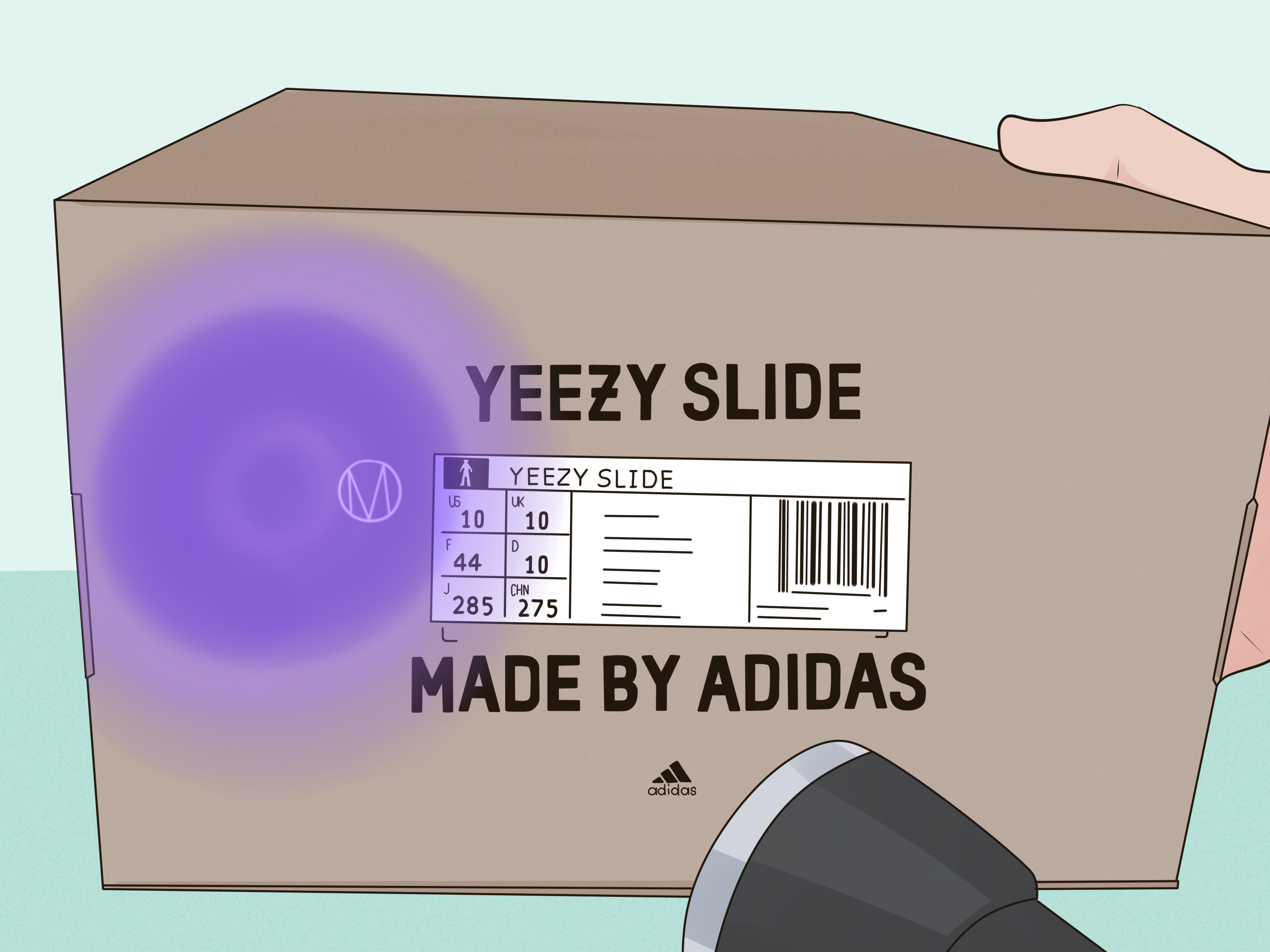
A correct box should have sturdy construction, clean printing, and a label matching the exact pair. Compare font weight, letter spacing, barcode placement, label dimensions, and the alignment of every printed field.
Common counterfeit errors include labels placed too high or low, incorrect size conversions, unusually bold barcodes, pale adidas text, spelling inconsistencies, and printing that appears fuzzy around the edges.
Check whether the box size is appropriate for the slides. A genuine label attached to the wrong box is not enough. Also compare tissue paper, hangtags, and retailer stickers with verified examples from the same release and sales region.
Packaging can be replaced, damaged, or mixed up by a previous owner, so a questionable box does not automatically prove the slides are fake. Conversely, authentic packaging can be paired with counterfeit footwear. Professional marketplaces therefore inspect the product and packaging together. eBay describes its process as a multi-point physical inspection that also checks whether the item and accessories match the listing, while GOAT says its specialists evaluate details including labels, texture, and color.
11. Investigate the Seller, Price, Photos, and Purchase History
The easiest fake to avoid is the one you never buy. Examine the transaction before examining the footwear.
Be cautious when a new seller offers a complete size run of supposedly rare slides at dramatically below-market prices. Other warning signs include stolen stock photos, refusal to provide timestamped images, pressure to pay outside the marketplace, vague receipts, and stories involving a mysterious cousin who somehow owns a warehouse full of deadstock Yeezys.
Ask for clear photographs of the side profile, outsole, heel mark, interior stamp, box label, and both slides together. Request proof of purchase when available, but remember that receipts can also be fabricated.
The Federal Trade Commission advises consumers to comparison-shop, research sellers, study the complete product description, and treat suspiciously cheap brand-name products as potentially counterfeit or stolen. The Better Business Bureau similarly recommends checking seller history, complaint records, contact information, return terms, and secure payment options.
When the value is significant, use a marketplace or service offering physical authentication and buyer protection. StockX says eligible orders are inspected through its verification process or supplied by vetted verified sellers, while GOAT routes many resale items through review before delivery.
Common Yeezy Slide Authentication Mistakes
Relying on Only One Detail
A correct logo cannot rescue an incorrect shape. A legitimate style code cannot rescue low-quality foam. A perfect box cannot rescue a pair with crooked outsole grooves. Strong authentication comes from several independent details pointing toward the same conclusion.
Comparing Different Releases
Comparing an early Resin release with a later Onyx restock can create false alarms because the foam, texture, finish, and fit may differ. Match the colorway, style code, size, manufacturing period, and sales region as closely as possible.
Using Smell as Definitive Proof
A harsh chemical odor can be suspicious, particularly on a supposedly new pair, but smell changes with storage, cleaning products, packaging, and temperature. Use it as supporting evidencenot the judge, jury, and foam executioner.
Assuming a Cheap Pair Must Be Fake
Prices fluctuate according to colorway, size, condition, supply, and market demand. A low price is a reason to investigate, not automatic proof. The same applies in reverse: counterfeit sellers can raise prices to appear trustworthy.
A Practical Authentication Routine
For a fast but thorough inspection, follow the same order every time:
- Confirm the model name, style code, colorway, and size.
- Compare the box label with a verified example.
- Photograph both slides from above, from the side, and from behind.
- Compare the overall silhouette and strap opening.
- Inspect the foam texture and flexibility.
- Check interior stamps and heel branding with a macro camera.
- Compare outsole groove depth, spacing, and direction.
- Review mold seams and trim points.
- Investigate the seller and purchase history.
- Use professional authentication when uncertainty remains.
This process is more reliable than jumping randomly between social-media comments, especially when one person declares the pair fake because “the vibes are off” and another replies with three fire emojis.
Conclusion
Spotting fake versus real Yeezy Slides requires patience and comparison, not a single magical trick. Begin with the exact style code and release, then examine the silhouette, foam, texture, strap, footbed, interior typography, outsole, molding, packaging, and seller history.
The more details that agree with a confirmed authentic reference, the stronger your conclusion becomes. When several areas conflictor when the seller prevents you from examining themwalk away or obtain a professional opinion. Missing a bargain is mildly annoying. Paying premium money for suspicious foam is considerably more annoying.
Experience Notes: What Real-World Yeezy Slide Checks Teach You
The biggest lesson from comparing Yeezy Slides is that authenticity becomes easier to judge when you stop hunting for a dramatic “gotcha” flaw. Many buyers expect a fake pair to arrive with a misspelled logo, a wildly incorrect color, or an outsole attached backward. Those obvious replicas exist, but better counterfeits usually fail through a collection of subtle inconsistencies.
A useful first habit is to photograph the slides instead of relying only on what your eyes see. A straight side-profile image makes incorrect heel height and strap angle much easier to notice. A top-down photograph reveals asymmetry between the left and right slides. Macro shots expose weak lettering, rounded barcode printing, rough mold seams, and uneven logo depth. The camera is not merely documenting the inspection; it often becomes the inspection tool.
Lighting matters just as much. Warm indoor bulbs can make tan, gray, and brown colorways appear completely different. Direct flash can exaggerate texture and turn matte foam glossy. The most helpful setup is indirect daylight with the slides placed beside a verified reference image on a neutral background.
Another practical lesson is that used pairs require a different approach from deadstock pairs. Outsole wear can soften the serrated grooves. Repeated cleaning can alter the surface finish. Heat exposure may deform the strap or shrink the slide. Foot pressure can deepen the heel cup. Those changes should not be confused with factory differences. On a worn pair, protected areas beneath the strap and inside deeper outsole channels usually preserve the most useful original details.
Packaging also deserves realistic expectations. Collectors love pristine boxes, but boxes travel through warehouses, delivery trucks, closets, resale stores, and occasionally households where cats regard cardboard as a personal challenge. A crushed corner or replacement tissue paper is not proof of counterfeiting. A mismatched style code, impossible size conversion, or clearly incorrect label layout is far more meaningful.
Fit comparisons can help, but only when handled carefully. An older authentic pair may feel tighter than a later release in the same marked size. A counterfeit may also fit comfortably. Comfort is subjective, and human feet are inconveniently unwilling to follow standardized engineering diagrams. Measure outsole length, opening width, heel depth, and strap height instead of relying only on how the slides feel.
The most valuable real-world habit is keeping the seller involved in the inspection. A legitimate seller should generally be willing to provide detailed, current photographs. Ask for a handwritten date or username beside the slides to reduce the chance of receiving copied images. Request pictures that show the pair and box in the same frame. When answers become evasive, rushed, or oddly theatrical, treat the behavior as part of the evidence.
Finally, know when to stop. Home authentication is excellent for identifying obvious and moderate-quality fakes, but highly accurate replicas may require access to authenticated reference pairs, factory-specific data, and experienced physical inspection. Paying for a reputable authentication service can be sensible when the purchase price is high or the evidence remains evenly divided.
The goal is not to become emotionally attached to proving a pair authentic. The goal is to make a careful buying decision. Compare methodically, document every detail, consider production variation, and remain willing to walk away. There will always be another pair of slides. Your money, after it has sprinted into a scammer’s account, is less enthusiastic about returning.













