Once upon a time, a car was a simple creature. It had four wheels, a steering wheel, a trunk full of grocery bags, and the occasional mysterious rattle that only appeared when the mechanic was not listening. Then Hyundai looked at the future of mobility and asked a wonderfully strange question: what if cars could walk?
That question led to some of the most eye-catching images in modern transportation: vehicles with robotic legs, wheels at the end of their limbs, and the confidence of a mountain goat wearing an electric skateboard. Add Hyundai’s acquisition of Boston Dynamics into the story, and suddenly the idea of a walking car no longer feels like a comic-book doodle. It feels like a serious preview of where robotics, electric vehicles, artificial intelligence, disaster response, logistics, and smart factories may be heading.
The Hyundai-Boston Dynamics deal was not just about buying viral robots that dance, jump, and occasionally make the internet nervous. It was a strategic move into advanced robotics, physical AI, automated logistics, and next-generation mobility. Hyundai’s walking car concepts, including Elevate and TIGER, show one side of that vision. Boston Dynamics’ robots, such as Spot, Stretch, and Atlas, show another. Together, they point toward a future where mobility is not limited to paved roads, warehouse floors, or neat little parking spaces.
Why Hyundai Bought Boston Dynamics
Hyundai Motor Group completed its acquisition of a controlling interest in Boston Dynamics from SoftBank in June 2021. The transaction valued Boston Dynamics at about $1.1 billion, with Hyundai taking an 80 percent stake and SoftBank retaining 20 percent. On paper, that sounds like a corporate finance headline. In practice, it was a giant neon sign flashing: “Cars are not the end of mobility.”
Boston Dynamics had already become famous for agile robots that looked less like factory equipment and more like mechanical athletes. Spot, the four-legged robot, could walk across industrial sites, climb stairs, inspect facilities, and carry sensors. Atlas, the humanoid robot, had been seen running, jumping, balancing, and moving in ways that made ordinary gym memberships feel personally insulting. Stretch, meanwhile, targeted warehouse automation by moving boxes in logistics environments.
Hyundai saw value beyond the spectacle. The company’s long-term mobility strategy includes electric vehicles, autonomous driving, smart factories, urban air mobility, logistics automation, and robotics. Boston Dynamics brought deep expertise in perception, balance, legged locomotion, manipulation, and mobile robot control. In plain English: Hyundai bought one of the world’s best teams at making machines move through the physical world without looking like a shopping cart with commitment issues.
The Walking Car Idea: Meet Hyundai Elevate
Before the Boston Dynamics deal closed, Hyundai had already begun exploring vehicles that could go beyond conventional roads. The most memorable example was Hyundai Elevate, a walking car concept revealed at CES 2019. Elevate was described as an Ultimate Mobility Vehicle, or UMV, and it blended an electric vehicle platform with robotic legs.
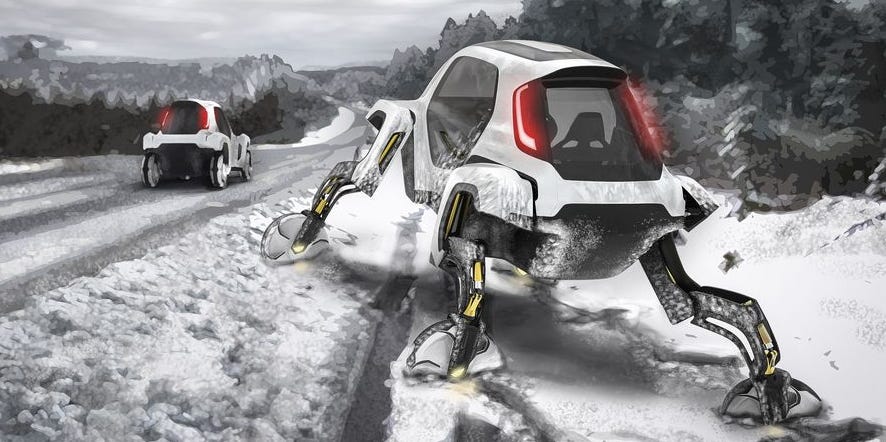
Images of Hyundai Elevate are dramatic for a reason. The vehicle looks like a compact rescue pod mounted on four articulated legs, each ending in a wheel. On smooth roads, the legs can fold into a driving mode, allowing the vehicle to behave more like a normal electric car. When the road disappears, the vehicle can stand up and walk over rough terrain, debris, snow, broken concrete, or obstacles that would stop traditional off-road vehicles.
The concept was especially focused on emergency response. After earthquakes, floods, landslides, or tsunamis, conventional rescue vehicles may only get close to the disaster zone. First responders often have to continue on foot through unstable debris. Elevate imagined a different scenario: a vehicle that could drive to the edge of the damage, rise up on its robotic legs, and step closer to injured or stranded people.
What the Images of Elevate Show
The most striking images of Hyundai Elevate usually show three things: legs, clearance, and adaptability. The robotic legs give the vehicle an animal-like stance. The high body position suggests it could keep passengers level while crossing uneven ground. The wheels at the feet show that Hyundai was not trying to replace the wheel; it was trying to give the wheel a promotion.
Elevate’s design also hints at accessibility use cases. Hyundai described a future where a walking vehicle could approach a building without an ADA ramp, level itself, and allow a wheelchair user to roll directly inside. That is a powerful idea because it reframes mobility as access, not just speed. A walking car is not merely a toy for engineers with too much coffee. It could be a tool for people who live in places where infrastructure is damaged, missing, or simply not designed for them.
TIGER: Hyundai’s Smaller, Uncrewed Walking Machine
In 2021, Hyundai revealed TIGER, short for Transforming Intelligent Ground Excursion Robot. If Elevate was the dramatic rescue vehicle with a passenger cabin, TIGER was the compact, uncrewed cousin built for cargo, research, and remote missions. It was developed by Hyundai Motor Group’s New Horizons Studio, the team created to explore Ultimate Mobility Vehicles.
TIGER is designed to operate either as a four-wheel-drive vehicle or as a four-legged walking machine. On smoother surfaces, it rolls efficiently. When terrain becomes too rough, it can stand up and walk. Hyundai described it as a platform for carrying payloads across remote or inaccessible terrain, with potential uses in scientific exploration, emergency supply delivery, surveillance, and even extraterrestrial environments. Yes, that means Hyundai’s walking car family has “maybe useful on the moon” energy, which is not something you can say about most sedans.
Images of TIGER often show a compact robot with a central cargo body and four leg-wheel modules. It looks less like a passenger car and more like a robotic field assistant. The concept included 360-degree directional control, sensors for remote observation, and the possibility of connecting with unmanned aerial vehicles. In one imagined mission, a drone could deliver TIGER to a difficult location, charge it, and let it continue across terrain that wheels alone could not handle.
How Boston Dynamics Changes the Story
Hyundai’s Elevate and TIGER concepts were already bold. Boston Dynamics adds credibility in the hardest part of the problem: making legged machines move reliably in the real world. Computer renderings are easy. Walking across rocks, stairs, wet floors, ramps, and industrial spaces without falling over like a dramatic toddler is much harder.
Boston Dynamics has spent decades solving problems related to balance, perception, locomotion, and machine control. Spot can walk through facilities and outdoor environments. Atlas has pushed humanoid mobility into public demonstrations that show increasingly fluid movement. Stretch has brought mobile manipulation into warehouse logistics. These are not walking cars, exactly, but they are part of the same technological family tree.
The Hyundai-Boston Dynamics deal therefore connects two worlds. Hyundai brings global manufacturing scale, automotive engineering, electric vehicle platforms, supply chains, and industrial deployment opportunities. Boston Dynamics brings robotics software, mechanical design, legged movement, manipulation, and field-tested robot systems. The result is not just “cars plus robots.” It is a broader platform for physical AI: intelligent machines that can sense the world, decide what to do, and act in physical space.
Atlas and the Factory Future
The latest chapter in the Hyundai-Boston Dynamics relationship is Atlas, Boston Dynamics’ humanoid robot. Hyundai and Boston Dynamics have positioned Atlas for industrial work, especially material handling and manufacturing environments. Hyundai has announced plans to deploy humanoid robots at its U.S. manufacturing plant in Georgia starting in 2028, beginning with tasks such as parts sequencing and potentially expanding toward more complex assembly work by 2030.
This matters because Hyundai’s robotics strategy is not limited to futuristic concept vehicles. The company wants robots to work inside real factories. Atlas is being developed for enterprise applications, including material handling, workflow integration, autonomous navigation, and smart industrial operations. The robot has been described with features such as human-scale hands with tactile sensing, the ability to lift up to 110 pounds, and suitability for industrial environments.
That does not mean humanoid robots will instantly replace human workers. In fact, Hyundai has acknowledged concerns about job displacement while emphasizing that people will still be needed to maintain, train, supervise, and integrate robots. The more realistic near-term picture is collaboration: robots taking on repetitive, risky, or physically demanding jobs while humans manage judgment, quality, troubleshooting, and higher-level work.
Why Walking Cars Matter for Disaster Response
The most compelling use case for Hyundai’s walking cars remains disaster response. Ordinary vehicles are optimized for roads. Off-road vehicles can handle mud, rocks, slopes, and uneven ground, but even they have limits. A collapsed bridge, a field of rubble, a flooded street, or a broken staircase can turn wheels into decorative circles.
A walking vehicle could theoretically step over gaps, climb obstacles, and keep its cabin level. For emergency teams, that could reduce the time needed to reach victims. For medical transport, it could allow injured people to be moved with less disturbance. For supply delivery, a compact UMV like TIGER could carry food, medicine, batteries, radios, or sensors into places too dangerous for humans to enter immediately.
There are also military, mining, construction, energy, and space exploration possibilities, though each comes with its own technical, ethical, and economic questions. Walking machines are expensive, complex, and difficult to maintain. They need reliable batteries, durable actuators, robust sensors, weather protection, and safety systems. But when the terrain is ugly enough, complexity may be worth it.
Why the Images Went Viral
Images of Hyundai’s walking cars went viral because they hit the sweet spot between ridiculous and logical. At first glance, a car with legs looks like something built by a child who had toy cars, action figures, and no adult supervision. But after thirty seconds of thought, the idea starts making sense. Roads do not cover the whole planet. Disasters do not respect traffic lanes. Accessibility ramps are not everywhere. Delivery routes do not always end at a clean curb.
The design language also helps. Elevate looks heroic, almost like a rescue vehicle from a science-fiction film. TIGER looks practical and compact, like a robot that would quietly carry lab samples across Mars and never complain about the weather. Boston Dynamics’ robots add another layer of public fascination because people have already seen Spot dance, Atlas jump, and robots perform physical tasks once thought nearly impossible.
In SEO terms, the phrase “Hyundai walking car” works because it is instantly understandable. People do not need a robotics degree to know why a walking car is interesting. The image explains the concept before the headline finishes loading.
The Reality Check: Are Hyundai Walking Cars Coming Soon?
As exciting as these concepts are, it is important to separate images from production reality. Elevate and TIGER are concept vehicles, not mass-market products sitting at a dealership next to the Tucson and Santa Fe. Walking vehicles face major barriers: cost, durability, regulation, insurance, safety, weight, battery life, repairability, and public acceptance.
For passenger use, safety standards would be especially demanding. A vehicle that walks must control balance, passenger comfort, obstacle detection, emergency stops, and stability in unpredictable environments. For cargo or industrial use, the path may be easier because the vehicle can operate in controlled conditions or remote areas with fewer passengers and lower public-road complications.
This is why the Hyundai-Boston Dynamics deal is so important. The near-term future may not be a family SUV that walks to soccer practice. It is more likely to be robots in factories, inspection robots in industrial sites, warehouse automation, and specialized mobility platforms for extreme environments. Over time, lessons from those deployments could influence future UMVs.
Experience: What It Feels Like to Imagine Hyundai’s Walking Cars in Real Life
Looking at images of Hyundai’s walking cars creates a strange mental shift. At first, the brain wants to laugh. A vehicle standing on four mechanical legs looks almost too theatrical, like it wandered out of a movie studio and forgot to remove its costume. But the longer you study the design, the more practical it becomes. The wheels are still there for efficiency. The legs are there for the moments when efficiency alone fails. It is not a rejection of the car; it is an upgrade for the places cars fear to tread.
Imagine a mountain town after a landslide. The road is blocked, the shoulder has collapsed, and rescue teams are trying to reach people on the other side. A normal ambulance cannot pass. A helicopter may not be able to land. A walking emergency vehicle, if engineered safely, could approach the broken section, stabilize itself, and move carefully across rough ground. That image changes the conversation from “cool robot car” to “useful emergency tool.”
Now imagine TIGER in a forest fire zone after the flames have passed but the ground is still unstable. Instead of sending people into a risky area immediately, an uncrewed walking robot could carry sensors, map hazards, deliver communication gear, or bring water and medical supplies to a stranded crew. It might not look glamorous. It might look like a lunchbox with legs. But in that moment, a lunchbox with legs could be the most beautiful machine in the world.
There is also an emotional side to accessibility. The idea of a vehicle walking up to a doorway and leveling itself for a wheelchair user sounds futuristic, but the need is very real. Cities are full of small barriers that become huge barriers for people with mobility challenges: steps, curbs, damaged sidewalks, steep driveways, gravel paths, and missing ramps. A walking car concept asks designers to think beyond smooth roads and perfect infrastructure. That is valuable even if the final product looks different from the concept art.
For everyday drivers, Hyundai’s walking cars may never become the next commuter trend. Nobody needs a car to climb a five-foot wall just to reach a coffee shop, unless the parking lot is truly having a bad morning. But the concept expands what people expect from mobility. It suggests that future vehicles may be more modular, more robotic, more electric, and more aware of the world around them.
The most realistic experience connected to the Hyundai-Boston Dynamics deal may happen inside factories first. Workers may see robots carrying parts, inspecting equipment, or handling repetitive movement. That may feel less dramatic than a walking rescue car, but it is where the technology can mature. Robots learn reliability in boring places before they earn the right to work in dangerous ones. The future often arrives first as a tool, not a spectacle.
Conclusion: Hyundai’s Walking Cars Are a Preview, Not a Gimmick
The Hyundai-Boston Dynamics deal gives Hyundai more than a famous robotics brand. It gives the company a serious foothold in the future of physical AI, smart mobility, and machines that can move through the world with greater flexibility. Elevate and TIGER show how Hyundai imagines vehicles that can drive, walk, carry, climb, and adapt. Boston Dynamics shows how difficult movement problems can be solved with advanced robotics.
Images of Hyundai’s walking cars are fun, weird, and memorable. They are also meaningful. They challenge the assumption that mobility must begin and end with roads. Whether the first real-world successes come from factories, warehouses, disaster zones, remote research sites, or future rescue vehicles, the direction is clear: Hyundai is no longer thinking only about cars. It is thinking about movement itself.
And if one day a Hyundai vehicle politely walks over a pile of rubble to rescue someone, we may look back at those strange concept images and realize they were not science fiction. They were early sketches of a world where transportation finally learned to use its legs.