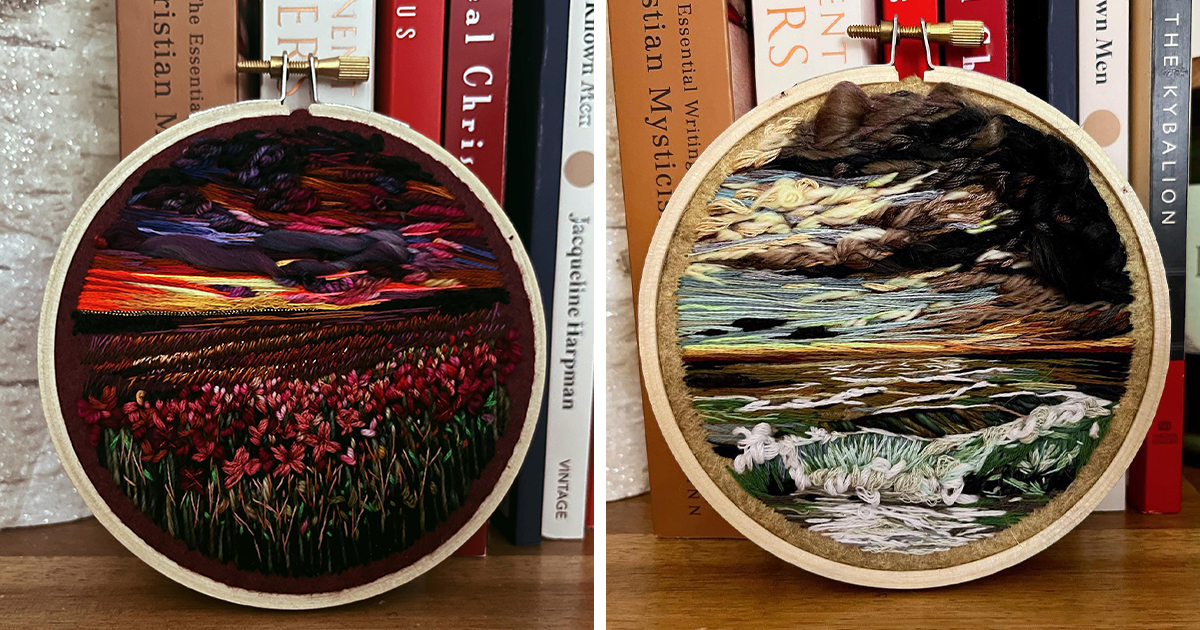
Some artists paint with oils. Some work in watercolor. And then there are the brave souls who look at a perfectly innocent spool of thread and think, “Yes, this will become a glowing landscape with atmosphere, drama, and suspiciously cinematic clouds.” That is the magic behind tonal impressionism embroidery, a style that blends the mood of tonal art with the light-chasing spirit of Impressionism, all through needle, thread, wool, and patient hands.
In the case of textile artist Jessa Spencer, that magic feels especially vivid. Her embroidered landscapes have drawn attention because they do something that sounds almost impossible at first: they make thread behave like paint. The result is neither old-fashioned sampler work nor polished decorative stitching. It is fiber art with weather, feeling, and a pulse. The scenes shimmer, blur, glow, and gather darkness in ways that feel painterly, even though every mark is stitched by hand.
This is what makes the series behind I Am A Textile Artist And I Create Tonal Impressionism Embroideries (14 Pics) so compelling. It is not just a gallery of pretty hoop art. It is a lesson in how contemporary embroidery can hold light, atmosphere, and emotion without losing the intimacy of handmade work. These pieces invite viewers to lean in close for texture and then step back for mood. Up close, they are thread. From a few feet away, they become weather systems, memory fragments, and tiny stitched landscapes that feel bigger than their frames.
Who Is Behind These Tonal Impressionism Embroideries?
Jessa Spencer has publicly described herself as a textile artist who creates tonal impressionism embroideries with a needle, thread, wool, and whatever else helps the image come alive. She has also spoken about being drawn to the tension between slow stitching and the fast, spontaneous look of Impressionist painting. That contrast is the heartbeat of the work. Embroidery is deliberate. Impressionism looks immediate. Put them together, and you get art that seems to flicker even though it probably took many patient hours and at least one dramatic sigh over tangled floss.
Her embroidered landscapes often center on atmosphere rather than literal description. Instead of outlining every leaf, blade of grass, or cloud edge, the work focuses on tonal relationships: deep shadow against luminous sky, muted ground against a glowing horizon, soft reflections against dark water. That emphasis on light emerging from mood gives the pieces their emotional pull. They are not trying to behave like photographs. They are trying to capture the feeling of a place as it changes in front of your eyes.
What Does “Tonal Impressionism” Mean in Embroidery?
The phrase “tonal impressionism” is part description, part invitation. It suggests a meeting point between two visual instincts. The tonal side is about mood, value, atmosphere, and subtle shifts between dark and light. The Impressionist side is about visible mark-making, fleeting light, broken color, and an image that often resolves only after you step back. In embroidery, that combination becomes especially rich because thread already has physical dimension. Light does not just sit on the image; it catches on the fibers themselves.
Light Matters More Than Detail
One reason these embroideries feel fresh is that they do not worship detail for detail’s sake. They understand a classic painterly secret: viewers remember light before they remember perfect edges. A stitched sky that glows through layered blues, grays, creams, and smoky violets can feel more alive than a technically precise but emotionally flat scene. The image breathes because the values are doing the heavy lifting.
Thread Becomes Brushstroke
Impressionist painting is famous for broken brushwork and visible marks. In embroidery, thread can serve a similar role. Long stitches can drag like brush marks across a sky. Dense short stitches can mimic dabs of reflected light on water. Uneven directional stitching can suggest wind, motion, fog, grass, or the soft collapse of a horizon at dusk. This is where embroidery stops acting like decoration and starts acting like image-making.
Texture Does Half the Storytelling
Paint can imply texture. Stitching actually has it. Wool, floss, layered fibers, and varied stitch lengths build a surface that changes depending on distance and lighting. A cloud can look soft in one angle and stormy in another. Water can appear calm until the thread catches the light and suddenly looks restless. That physicality gives tonal impressionism embroidery an almost theatrical quality. The work is never entirely still.
Why These Embroidered Landscapes Feel So Modern
Fiber art has long been underestimated, usually by people who imagine thread belongs only in heirloom drawers, craft stores, or the terrifying sewing kit your grandmother could weaponize with one look. But contemporary museums and institutions have increasingly recognized textiles and embroidery as serious artistic media. That matters here, because work like Spencer’s sits comfortably in that larger conversation. It borrows from painting, but it does not apologize for being textile-based. It uses handwork as a strength, not a limitation.
That confidence is part of why these pieces resonate online and off. Viewers respond to the tension between softness and intensity. The format may look intimate, but the visual ambition is not small. These embroideries are interested in atmosphere, scale, memory, and painterly illusion. They ask the same questions painters ask: How do you show fading light? How do you suggest depth without over-explaining it? How do you make an image feel fleeting and grounded at the same time?
The answer, in these works, is not through slick perfection. It is through restraint, tonal control, and a willingness to let the medium remain visible. You can still tell it is thread. That is the point. The image never fully disguises its making. The stitches remain present, and that honesty makes the final effect more convincing, not less.
What the 14-Piece Gallery Reveals
A multi-image presentation like this one works because it shows consistency without repetition. Across a gallery of embroidered landscapes, certain themes rise to the surface: cloud-heavy skies, dusky fields, moody shorelines, soft tree lines, luminous breaks in the dark, and reflections that feel more sensed than mapped. Even when the palette is restrained, the emotional range is not. One piece may feel quiet and meditative, while another seems to hint at a storm rolling in with a little stitched attitude.
There is also something important about scale. Many embroidery works are viewed at close range, which makes the experience intimate by default. That intimacy suits landscape surprisingly well. Instead of treating nature as grand and distant, these embroideries make it personal. A horizon becomes something held in the hand. A sky becomes something stitched line by line. The effect is deeply human. It is not about conquering the landscape. It is about translating a passing visual impression into something tactile and lasting.
That translation gives the work a poetic quality. The stitched marks do not merely describe what a place looked like. They suggest what it felt like to be there, or perhaps what it felt like to remember being there later. That distinction matters. Good tonal work is often less about geography than atmosphere. The scene becomes emotional weather.
Why Impressionism and Embroidery Belong Together
At first glance, Impressionism and embroidery may seem like artistic opposites. Impressionism is associated with speed, spontaneity, and the sensation of a moment. Embroidery is associated with slowness, repetition, and control. Put those together, though, and something wonderfully strange happens. The slowness of stitching does not kill the spontaneity. It distills it.
In fact, embroidery may be uniquely suited to reinterpreting Impressionist ideas. Impressionist painters relied on visible marks and optical effects, letting color and gesture carry more information than line. Embroiderers can do something similar with thread direction, stitch density, fiber sheen, and layered tones. Where a brush leaves paint ridges, a needle leaves topography. Where a painter uses broken color, a textile artist can use neighboring strands that visually mix from a distance. The medium changes, but the visual logic survives.
This is also why these embroidered landscapes feel so satisfying. They are not trying to imitate painting in a timid way. They are translating painterly ideas into textile language. That is a much stronger move. The best fiber art does not ask permission from painting. It borrows what is useful, then makes its own rules.
How Tonal Embroidery Builds Mood
Mood in embroidery does not come from color alone. It comes from pacing. It comes from where the eye is allowed to rest and where it is interrupted. Dark thread creates weight. Lighter thread creates release. Matte fibers can absorb visual energy, while shinier strands can suddenly behave like reflected light. When arranged carefully, these elements create a stitched atmosphere that feels almost cinematic.
That is why a piece with only a few dominant tones can still feel rich. Tonal embroidery is not trying to overwhelm the viewer with every color in the crayon box and its dramatic cousin in the glitter aisle. It is about subtle shifts. A gray-green field next to a blue-black treeline next to a pale band of sky can generate more emotional complexity than a louder palette ever could.
In many of these works, the bright areas matter because the dark areas are doing their job. Light does not simply appear. It emerges. It pushes through. It surprises. That is part of the appeal of Spencer’s landscapes in particular. They often seem to locate a moment when the world is between states: before rain, after sunset, under cloud cover, or just as illumination slips across a surface for a second and then disappears.
Why Viewers Connect With Textile Art Like This
Part of the appeal is technical admiration. People naturally respond to handmade skill, especially when the process is visible but the effect still feels miraculous. Another part is emotional accessibility. Fiber art carries a sense of familiarity because thread is humble. It belongs to clothing, repair, home life, memory, and touch. When that same material is used to create moody, painterly landscapes, the result feels both surprising and intimate.
There is also a broader cultural shift at work. Contemporary audiences are increasingly open to art forms that blur craft and fine art, process and image, domestic material and public expression. Embroidery no longer needs to sit quietly in the corner pretending to be decorative while painting hogs the spotlight like a diva in a beret. Textile art is fully capable of complexity, innovation, and conceptual depth. Work like this proves it without needing to shout.
Studio Experiences Behind Tonal Impressionism Embroideries
Creating tonal impressionism embroidery feels a little like trying to catch weather with a needle. The first challenge is never the stitching itself. It is deciding what kind of light the piece is going to hold. Is it the dim silver of an overcast afternoon? The bruised purple of evening? The sudden pale gold that slips through clouds and makes even a muddy field look briefly holy? Once that choice is made, the rest of the work becomes a conversation with tone.
In this kind of process, color behaves differently than people expect. A thread that looks bluish-gray in the skein might suddenly read as mist when stitched next to charcoal. A brown that seems ordinary on its own may become the exact right note for distant ground once surrounded by muted greens. Tonal embroidery teaches patience because you cannot bully harmony into place. You test, adjust, pull out stitches, try again, and occasionally stare at the hoop as if it personally betrayed you.
There is also a strange and beautiful contradiction in making this kind of work: the hand moves slowly, but the image aims to feel immediate. Every stitch takes time, yet the final scene should suggest a passing moment, almost like a glance out the window. That tension is one of the most addictive parts of the medium. The slowness does not cancel the spontaneity; it sharpens your attention to it. You start noticing how a horizon softens, how reflections blur, how clouds are never really one color, and how darkness can make a tiny patch of light feel enormous.
Another experience that shapes this work is distance. Up close, the embroidery can look messy, raw, and wonderfully unresolved. Individual strands wander. Textures collide. Certain areas feel too rough. Then you step back, and suddenly the image clicks. The sky opens. The water settles. The composition starts breathing. It is a good reminder that art is not always meant to be judged from six inches away while you squint like a suspicious detective.
Materials also have their own personalities. Cotton thread can behave politely for a while and then knot itself into a small act of rebellion. Wool brings softness and body, but it also changes the surface in ways that can either save the piece or completely hijack it. Sometimes the most useful material is not the fanciest one, but the odd scrap or imperfect strand that adds just enough grit, haze, or unevenness to make the scene feel alive. That willingness to improvise is part of what gives tonal textile work its character.
Emotionally, these embroidered landscapes often become records of attention. You are not just making a picture of a place. You are recording the act of looking, remembering, and translating. A stitched field may hold a mood from a real drive at dusk. A cloudy shoreline may begin from a memory, then drift into invention. The work lives somewhere between observation and feeling. That is why tonal impressionism embroidery can be so affecting. It does not merely show scenery; it shows how scenery lingers in the mind.
And perhaps that is the deepest experience of all: learning that softness can still be powerful. Thread is flexible, quiet, and familiar. Yet in the right hands, it can hold shadow, movement, melancholy, wonder, and light. It can build a landscape that feels both fragile and permanent. It can turn a hoop into a horizon. Honestly, that is not just craft. That is alchemy with floss.
Final Thoughts
I Am A Textile Artist And I Create Tonal Impressionism Embroideries (14 Pics) works as a title because it is direct, but the art behind it is anything but simple. These embroidered landscapes succeed not just because they are skillful, but because they understand what makes viewers feel something. They use thread to hold atmosphere. They let texture stand in for brushwork. They rely on tonal subtlety instead of visual noise. And they prove, one stitched horizon at a time, that fiber art can be as emotionally layered and visually ambitious as any painted canvas.
In an era that rewards speed, this kind of handmade work feels especially refreshing. It slows the eye down. It rewards close looking. It asks viewers to notice how light behaves, how memory edits a scene, and how a soft material can still deliver a dramatic punch. If that is not impressive, the thread may need a better publicist.