
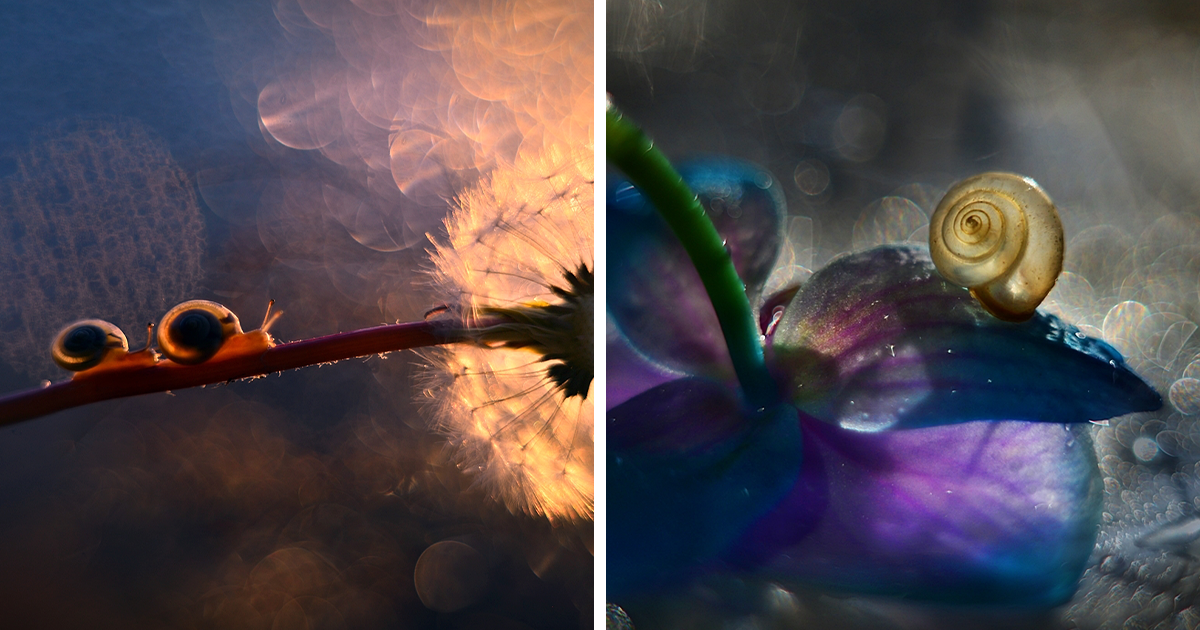
Snails do not exactly market themselves as the rock stars of the backyard. They do not roar, sprint, or leap dramatically through the air like they are auditioning for a nature documentary trailer. They glide. They blink on impossible little stalks. They carry their homes like seasoned minimalists. And yet, when I started observing snails in the sun, I realized I had stumbled into one of the most mesmerizing forms of slow cinema the garden has to offer.
What began as casual curiosity quickly turned into a full-on fascination with sunlit snails, macro nature photography, and the quiet intelligence of these tiny gastropods. The more I watched, the more I saw: glowing shells, shimmering trails, delicate tentacles testing the world, and the kind of patience that makes human schedules look like a bad joke. These 25 snail photos are not just pictures of small creatures. They are portraits of texture, resilience, biology, and a very underrated sense of style.
This article explores what makes snails so visually compelling, why sunlight changes everything, and what these tiny beings can teach us if we are willing to pause for five minutes and stop behaving like over-caffeinated squirrels.
Why Snails In The Sun Are So Fascinating To Photograph
There is a reason snail photography feels more magical in sunlight. A snail’s shell catches light in ways that make it look sculpted rather than merely grown. The curves become more dramatic. The ridges stand out. Moisture on the body reflects brightness like polished glass. Even the humble slime trail, which most people notice only when it appears mysteriously across a flowerpot, suddenly becomes a glittering signature.
Sunlight also creates contrast. Against leaves, bark, stones, garden soil, or a fence post, a snail becomes a tiny moving artwork. You see the spiral shell more clearly. You notice the translucent quality of the soft body. You catch the tension between fragility and toughness: a soft animal protected by a hard shell, inching forward through a bright, drying world that it must constantly negotiate.
That tension is part of the appeal. Land snails generally prefer moisture, shade, and gentle conditions. They are most active when the air is damp, after rain, or in the cooler parts of the day. On hot, bright days, many retreat from the sun, tuck themselves away, or seal themselves against dry conditions. So when you spot one out in morning light or briefly crossing a sunny patch, it feels like you have witnessed a small, rare performance.
The Science Behind The Beauty
Snails Are Built For Slow, Smart Movement
Snails move on a muscular foot and glide over mucus, which is one of those facts that sounds simple until you really look at it. That glossy trail is not just slime for slime’s sake. It helps reduce friction, supports movement, and protects the animal’s soft body from rough surfaces and moisture loss. In photographs, this movement appears elegant. In reality, it is also a clever feat of engineering.
When I watched snails travel across leaves and stone, what impressed me most was not their speed, because, well, let’s not get fictional here. It was their steadiness. They do not flail. They do not panic. They advance with a kind of absolute commitment, like they have already accepted that the universe is large, the lettuce is far away, and hurrying will not help.
Those Tentacles Are Doing More Than Looking Cute
The classic snail silhouette includes two longer upper tentacles and a lower pair beneath them. The upper ones usually carry the eyes, while the lower ones help with sensing the immediate environment. When a snail moves through sunlight, these tentacles become expressive. They extend, retract, sway, and test the air in a way that makes the animal seem both cautious and curious.
For a photographer, that matters. The difference between a decent snail picture and a truly captivating one often comes down to posture. When the tentacles are fully extended, the snail looks alert and engaged. It stops being a shell with a body attached and becomes a character.
A Shell Is Not Just Decoration
A snail’s shell is doing serious work. It protects the animal from predators, helps reduce drying, and grows as the snail grows, adding coils over time. That spiral structure is one reason macro wildlife photography of snails can feel unexpectedly luxurious. Even common garden snails look ornate when viewed up close.
Sunlight makes the shell’s architecture pop. Grooves, bands, scuffs, mottling, and subtle color changes suddenly read like design choices rather than random details. In some shots, the shell looks ancient. In others, it looks polished and almost ceramic. It is a portable shelter, yes, but it is also the reason a snail can look like a museum artifact and a living creature at the same time.
What My 25 Snail Photos Revealed
I did not set out to create a grand philosophical series. I just kept finding snails that looked oddly majestic in the light. But across 25 photos, a few themes kept returning, and together they turned a simple photo project into a richer study of snail behavior, garden wildlife, and small-scale beauty.
- Photo 1: A snail emerging from shade onto a warm stone, with the shell glowing amber at the edges like stained glass.
- Photo 2: A close-up of eye stalks fully extended, giving the tiny explorer the expression of a very cautious astronaut.
- Photo 3: A silver slime trail catching the light behind a snail on a clay pot, like calligraphy written by patience itself.
- Photo 4: A snail halfway up a stem, backlit by early sun, looking like it had scheduled a serious meeting with a flower.
- Photo 5: A shell patterned with earthy browns and creams, proving that nature understands neutral tones better than most furniture catalogs.
- Photo 6: A snail pausing under a leaf edge, where light and shadow split the frame into drama and safety.
- Photo 7: The body stretched long across a rough surface, showing just how much grace exists in slow locomotion.
- Photo 8: A profile shot where the shell dominated the composition, making the snail look like a tiny traveling cathedral.
- Photo 9: Morning dew clinging to the body, turning a common garden visitor into a jewel-toned marvel.
- Photo 10: A snail on bark, where texture met texture and the shell’s spiral echoed the grooves of the tree.
- Photo 11: A shot from above that revealed the mathematical neatness of the shell coil.
- Photo 12: A snail lifting its head toward light, creating a pose that felt weirdly noble for an animal the size of a thumb.
- Photo 13: A half-hidden snail peeking from leaf litter, as if it knew exactly how to work the camera.
- Photo 14: A sunbeam highlighting the shell while the body remained in shadow, creating the effect of a spotlighted sculpture.
- Photo 15: A snail crossing a garden wall, proving that yes, vertical ambition exists, even in creatures famous for not rushing.
- Photo 16: A side view that made the rippling movement of the foot feel almost liquid.
- Photo 17: A tiny snail on a broad leaf, making scale the entire story.
- Photo 18: Two snails near each other in soft light, turning the frame into something between wildlife photography and a romantic comedy.
- Photo 19: A shell marked by weather and wear, reminding me that even slow lives leave visible history.
- Photo 20: A shot where the background dissolved into blur, making the snail appear to float through a green dream.
- Photo 21: A pause at the edge of a leaf, with the whole scene suggesting decision, hesitation, and maybe a fear of heights.
- Photo 22: Sun reflecting off mucus on the body, revealing motion as shine.
- Photo 23: A shell against terracotta tones, a color pairing so perfect it felt curated.
- Photo 24: A snail retreating slightly after a disturbance, a reminder that the soft body inside the beauty is always alert.
- Photo 25: One final image in late light, where the snail looked less like a backyard creature and more like a symbol of calm persistence.
Lessons From Observing Snails Up Close
They Reward Patience
Snails are not ideal subjects for people who want instant gratification. They do not pose on command. They do not care about your timeline, your battery life, or the fact that you crouched awkwardly for ten minutes and now your legs are making dangerous complaints. But they reward patience beautifully. The longer you watch, the more behavior you notice.
That is especially true in sunlight. A quick glance shows “small snail on leaf.” A slower look reveals moisture patterns, feeding posture, shell markings, the direction of travel, and how the animal responds to heat, brightness, texture, and open exposure.
They Make You Notice Micro-Habitats
One of the best things about observing snails is that they teach you to read a garden differently. You start noticing damp corners, shaded bark, undersides of leaves, cracks in pots, edges of stones, and places where humidity lingers a little longer. You stop thinking of the garden as one large space and start seeing it as a collection of tiny neighborhoods.
That shift matters for both photography and appreciation. Snails are not randomly placed decorations. They are selecting surfaces, shelter, and routes with surprising precision. The sun, in that sense, is part of the story. It does not just light the snail; it shapes where the snail can safely be.
They Are More Vulnerable Than They Look
It is easy to see a shell and assume toughness. But many land snails are highly sensitive to environmental changes, especially shifts in moisture, habitat quality, and the availability of calcium needed to maintain shells. Some species thrive in gardens and human-made spaces, but others are far more vulnerable. That is part of what makes photographing them feel meaningful. You are not just documenting a curious creature. You are noticing a form of life that often goes overlooked.
Why These Captivating Beings Deserve More Attention
There is something refreshingly honest about snails. They do not pretend to be more than they are. They carry their shelter, move with intention, and operate according to weather, texture, and survival. In bright sun, they are especially compelling because they seem slightly out of place, exposed yet beautiful, delicate yet determined.
That contrast makes them unforgettable subjects. A sunlit snail is not flashy in the usual sense. It does not rely on speed, size, or spectacle. It wins your attention through detail. Through stillness. Through the sheer elegance of being built for a different pace of life.
And frankly, in a world that treats rushing like a personality trait, that feels pretty revolutionary.
Extended Experience: What It Felt Like To Spend More Time With Sunlit Snails
The longer I worked on this series, the more it stopped feeling like a simple photo exercise and started feeling like a practice in attention. At first, I was only interested in getting sharp, attractive images. I wanted good light, a clean background, and enough detail in the shell to make each shot worth keeping. But after several mornings and late afternoons of following snails across leaves, bricks, wood, and garden paths, the experience changed. I stopped chasing only the best-looking frame and started paying attention to the personality of each encounter.
There is a peculiar intimacy in watching a snail move. Because the animal is slow, your own speed changes too. You crouch lower. You wait longer. You begin to notice tiny decisions: when the snail stretches farther, when it retracts slightly, when it tests an edge, when it pauses as if calculating whether a surface is worth crossing. Those decisions may be basic survival responses, but from behind a camera lens they feel almost narrative. Every snail appears to be on a mission, even if that mission is simply “continue toward questionable lettuce.”
Sunlight made those experiences richer and trickier at the same time. It gave me glowing shells, bright highlights, and magical backlighting, but it also reminded me that snails are creatures of moisture and caution. If the light became too harsh or the surface too hot, the mood of the scene changed. What had looked serene suddenly felt precarious. That tension made me more respectful as an observer. I was not there to stage nature or force a dramatic shot. I was there to notice a living being navigating conditions that mattered to it far more than they mattered to me.
Some of my favorite moments happened when nothing dramatic occurred at all. A snail crossing the rim of a pot. Another inching along bark in a thin ribbon of morning sun. One pausing beneath a leaf while the shell glowed at the edges. These scenes were quiet, but they never felt empty. They felt full of texture and timing. The more I looked, the more I realized that snails are not boring subjects waiting to be improved by human imagination. They are already remarkable. We are usually just too distracted to notice.
That may be the biggest gift of photographing snails in the sun. It sharpens your sense of scale and significance. You start to understand that fascination does not always arrive with a roar. Sometimes it arrives carrying a spiral shell, leaving a silver trail, and asking you to slow down enough to see it properly.
Conclusion
These 25 photos reminded me that extraordinary subjects do not always live in extraordinary places. Sometimes they live in gardens, on walls, beneath leaves, and beside flowerpots, moving through brightness with all the caution and grace their soft bodies require. Snails in the sun are captivating not because they perform for us, but because they reveal so much when we finally choose to look closely.
From shell texture and slime trails to light, posture, and behavior, every image became a small lesson in patience and observation. That is why this project stayed with me. It was never just about photographing snails. It was about recognizing beauty in quiet life, science in tiny details, and wonder in beings most people walk past without a second thought.













