
Note: This article is written as original, publication-ready HTML content based on real craft, glue-art, process-art, and mixed-media information, with no source links inserted for cleaner web publishing.
Some artists need marble, bronze, gold leaf, imported pigment, and a studio that looks like it was designed by a minimalist millionaire. Others look at a bottle of Elmer’s glue, a few drops of food coloring, and say, “Yes, this is my Renaissance.” That second group is where things get interesting.
Elmer’s glue art sounds like something you might do at a kitchen table while trying not to glue your sleeve to the newspaper. But in the hands of a patient, experimental artist, it becomes something surprisingly elegant: translucent sheets, layered patterns, glossy color fields, raised textures, and compositions that catch light like candy-colored stained glass. The project behind “I Use Elmer’s Glue And Food Coloring To Make Works Of Art (22 Pics)” proves that ordinary materials can stop being ordinary the second someone treats them seriously.
The idea is simple enough to explain in one sentence: dye glue with food coloring, pour it, let it dry, stretch or layer it, and build small mixed-media works from the results. The magic is in everything that happens between those steps. Glue shrinks, pools, wrinkles, tears, gleams, clouds, and reflects. Food coloring blooms through it like watercolor trapped under ice. A piece that begins as a puddle can dry into something that looks like a map, a membrane, a mineral slice, or a tiny alien window. In other words, school supplies are out here auditioning for a gallery wall, and frankly, they are overqualified.
Why Elmer’s Glue And Food Coloring Make Such Strange, Beautiful Art
Elmer’s glue is familiar because most of us met it early in life: on construction paper, in classrooms, in slime recipes, and occasionally on fingers we swore we were not peeling like fake skin. Its appeal as an art material comes from its texture and chemistry. White school glue is water-based and typically associated with polyvinyl acetate, a flexible polymer that forms a film as it dries. When mixed with food coloring, the glue becomes a tinted liquid medium that can be poured, spread, dripped, or shaped before it sets.
That film quality is the secret. Unlike paint, which is usually meant to sit on a surface, dried glue can become a surface. It can be peeled, cut, stretched, suspended, layered, or attached to a panel. Clear or translucent glue allows light to pass through; white glue often dries clearer than it appears in the bottle. Add color, and suddenly you are working with a material that behaves somewhere between paint, plastic, resin, and very dramatic fruit snack.
Food coloring adds another layer of unpredictability. It disperses through the wet glue, sometimes evenly and sometimes in streaks, veins, dots, or smoky gradients. Because glue is thicker than water, the color does not always behave like watercolor. It may hold its place, feather slowly, or create concentrated bursts. This makes the process feel part art, part science experiment, and part “please do not touch that, it is still drying.”
The Artist’s Approach: Turning Everyday Materials Into Gallery Pieces
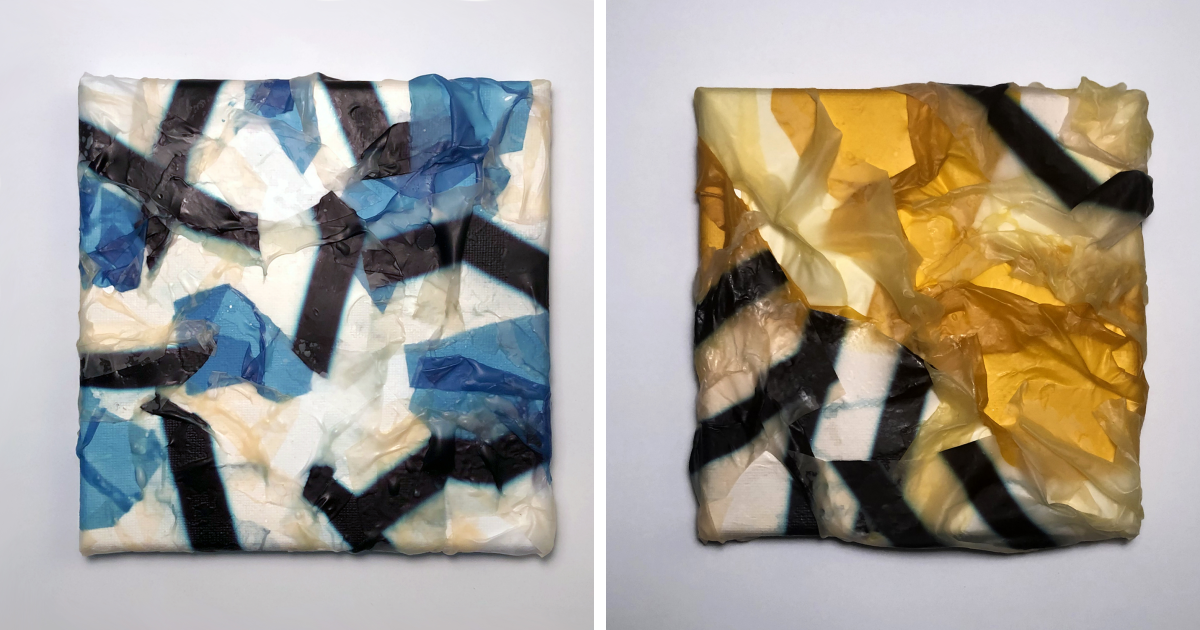
The project connected to this title centers on artist Evan Stoler, who is known for exploring non-traditional materials, texture, pattern, light, and the tension between the ordinary and the mystical. In the original series, glue was dyed, poured into sheets, then stretched or layered onto canvas or wood frames. Each work was smallabout 6 inches by 6 inchesbut the scale did not make the pieces feel minor. If anything, the small format invited closer looking.
That matters because glue art rewards attention. From across the room, a piece might read as a compact abstract composition. Up close, it becomes a miniature landscape of wrinkles, bubbles, transparent edges, color shifts, and glossy ridges. The material still carries traces of its former life as school glue, yet it no longer behaves like something meant only to paste macaroni to paper. It becomes sculptural. It becomes painterly. It becomes weirdly luxurious, which is quite an achievement for something that may have once lived beside a pencil sharpener.
The 30 x 30 x 30 Challenge
The works were part of a 30 x 30 x 30 exhibition format at Var Gallery in Milwaukee, where selected artists create 30 pieces in 30 days. That structure is important because it encourages momentum. Instead of waiting for one grand, perfect masterpiece to descend from the heavens wearing a velvet cape, the artist must return to the studio every day and keep making. The repetition becomes a laboratory.
With a material like glue, daily practice is especially useful. One day’s pour may dry too thin. Another may become too cloudy. One color combination may look like a sunset; another may look like a melted snow cone having an identity crisis. But each attempt teaches something about drying time, viscosity, layering, surface tension, and how much control the artist really has. Spoiler: not as much as the artist wants, but more than the glue would like to admit.
How Glue Becomes Texture, Pattern, And Light
What makes these 22 pictures compelling is not just that they are made from unusual materials. “Unusual” can be a gimmick if the work stops there. The stronger idea is transformation. Glue begins as a utility product; its job is to make two things stick together and then politely disappear. In this art process, glue refuses to disappear. It becomes the star.
Texture is one of the biggest reasons the work holds attention. As glue dries, it can form ripples, skins, ridges, folds, and edges. If poured thickly, it may dry with a raised, rubbery look. If spread thinly, it can become delicate and translucent. If layered, it can create depth similar to looking through colored glass or stacked film. This allows the artist to build compositions that are not only seen but almost felt by the eye.
Pattern emerges through repetition and arrangement. A small square frame can hold loops, strips, blobs, waves, grids, or organic shapes. Because the pieces are 6 by 6 inches, every decision feels concentrated. There is no giant canvas where a weak corner can run away and hide. Each mark matters. Each layer has to earn its spot.
Light is the third ingredient, even though it is not squeezed from a bottle. Translucent glue catches and reflects light differently depending on thickness, color, and surface. A glossy fold may shine; a cloudy area may soften; a clear edge may glow. The result is art that can change as the viewer moves. That makes the material feel alive, or at least alive enough to make traditional paint a little nervous.
Why This Kind Of Process Art Feels So Fresh
Process art puts emphasis on how something is made, not only what it looks like at the end. That does not mean the final object is unimportant. It means the final object carries the evidence of pouring, drying, stretching, tearing, layering, and experimenting. In glue-and-food-coloring art, the process is visible because the material records its own behavior.
This is why the work feels fresh. Many people have used Elmer’s glue, but fewer have slowed down enough to ask what glue can do when it is not being bossed around as an adhesive. Can it be a skin? Can it be a lens? Can it become a painting without behaving like paint? Can a cheap, everyday supply hold the same visual seriousness as expensive art materials?
The answer, demonstrated across these 22 works, is yes. The art does not apologize for the humble materials. It celebrates them. That is part of the charm. The viewer recognizes the ingredients, then has to reconsider them. It is a small but satisfying artistic magic trick: the familiar becomes unfamiliar, and the ordinary gets caught wearing a gallery outfit.
Can You Make Elmer’s Glue And Food Coloring Art At Home?
Yes, with a few important expectations. You can make beautiful glue art at home, but you should not expect your first attempt to behave like a perfectly edited craft video. Glue has a personality. It spreads when you want it to stay. It clumps when you want it smooth. It dries slower than your patience. It also has the comedic timing of a raccoon: the moment you look away, something weird happens.
For a basic experiment, you can mix small amounts of washable school glue with food coloring in separate cups. Add a little water if you want a thinner pour, but do so carefully because too much water can weaken the dried film. Pour the tinted glue onto a nonstick surface such as a plastic sheet, silicone mat, wax paper, or a prepared transparency surface. Use a toothpick, craft stick, dropper, or skewer to move the color. Then let it dry completely.
Drying may take hours or even a full day depending on thickness, humidity, and airflow. Thin layers dry faster and peel more easily; thick layers create richer dimension but may stay cloudy or tacky longer. Once dry, the glue film can sometimes be peeled, trimmed, layered, or attached to another surface. This is where the project moves from “fun craft” to “composition.”
Basic Supplies
- Elmer’s white or clear school glue
- Liquid food coloring
- Small cups or disposable palettes
- Craft sticks, toothpicks, droppers, or skewers
- Wax paper, silicone mat, plastic sheet, or another peel-friendly surface
- Canvas board, wood panel, cardstock, or picture frame backing
- Paper towels, because optimism is not a cleanup strategy
Helpful Tips For Better Results
Start small. A 4-inch or 6-inch square is easier to control than a large surface. Work in thin layers if you want translucent effects. Use clear glue when you want jewel-like color and white glue when you want a milkier, softer finish. Try placing drops of food coloring into wet glue instead of fully mixing them; this can create blooming patterns and marbled movement. Leave some areas clear so light can pass through.
Also, resist the urge to poke the glue every twelve minutes to see if it is dry. This is difficult, because wet glue practically whispers, “Touch me, I dare you.” Do not listen. Let the material cure fully. Half-dry glue stretches, wrinkles, and fingerprints easily. Fully dry glue gives you more control when peeling or layering.
What The 22 Pictures Teach About Creative Experimentation
A 22-picture series is powerful because it shows variation. One image may emphasize color. Another may focus on folds. Another may highlight the reflective quality of glue. Seen together, the works show how one simple material can produce a surprising range of results. This is a valuable lesson for artists, crafters, teachers, and anyone who has ever said, “I can’t make art because I don’t have fancy supplies.”
Fancy supplies are wonderful, but they are not the beginning of creativity. Curiosity is. The artist’s decision to use Elmer’s glue and food coloring is a reminder that materials do not have to be prestigious to be expressive. A bottle of glue can become a drawing tool, a casting medium, a sculptural skin, a color field, or a reflective surface. Food coloring can become more than a baking ingredient. A wood frame can become a stage for something fragile, glossy, and strange.
The series also shows the value of constraints. Working with one material combination forces deeper exploration. Instead of asking, “What else can I buy?” the artist asks, “What else can this do?” That question leads to discovery. It is also much cheaper, which your wallet will appreciate with the quiet dignity of a person who has seen the price of professional art resin.
Glue Art In The Bigger World Of Mixed Media
Mixed-media art has long welcomed unconventional materials: fabric, paper scraps, tape, resin, found objects, plastic, metal, thread, packaging, and household products. Glue-and-food-coloring art belongs naturally in that world because it challenges the boundary between support material and visible material. Usually glue is backstage. Here, it takes the spotlight and sings the eleven o’clock number.
This approach also connects to contemporary interest in process, material honesty, and the reimagining of everyday objects. Artists often choose humble materials not because they are cheaper, though that helps, but because those materials carry cultural memory. Everyone knows glue. Many people associate it with childhood, school, mess, repair, and play. When glue becomes fine art, those associations come along for the ride.
That emotional familiarity gives the work warmth. Viewers do not need an art history degree to enter the piece. They can begin with recognition: “I know that material.” Then the artwork leads them somewhere less expected: “I did not know it could do that.” That moment of surprise is one of the great pleasures of mixed media.
Safety, Durability, And Display Considerations
Because Elmer’s school glue is commonly marketed for washable, nontoxic craft use, it is approachable for home experiments and classroom-style projects. Still, good habits matter. Work on a covered surface, keep food coloring away from clothing and unfinished wood, and supervise children. Food coloring stains with the confidence of a tiny villain, so treat it accordingly.
Durability is another consideration. Glue art is not the same as archival oil painting or kiln-fired glass. Dried glue films may remain flexible, attract dust, soften with moisture, or change over time depending on thickness, environment, and display conditions. For decorative projects, that is usually fine. For serious artwork, the artist must think about support, sealing, humidity, sunlight, and how the material ages.
Displaying glue art near a window can enhance translucency, but direct sunlight may affect color over time. A shadow box, sealed frame, or protected panel can help preserve delicate surfaces. If the glue is layered on wood or canvas, the support should be clean and dry. If pieces are suspended or stretched, tension should be gentle; dried glue can be flexible, but it is not invincible. It is art, not a trampoline.
Why Viewers Love These 22 Glue-And-Food-Coloring Pieces
The appeal of the series comes from a rare combination: accessibility and mystery. People understand the ingredients immediately, but the finished works do not look obvious. They look like fragments of stained glass, microscopic slides, translucent fabric, candy wrappers, geological samples, or abstract maps from a planet with excellent lighting.
That blend makes the art easy to enjoy and surprisingly deep. The pieces invite viewers to think about material transformation, patience, repetition, and the beauty of surfaces. They also make people want to try the process themselves, which is one of the best compliments an artwork can receive. When a piece makes someone say, “Wait, could I make something with glue tonight?” it has successfully opened a door.
And yes, there is humor in the whole thing. Elmer’s glue has spent decades helping paper turkeys survive Thanksgiving bulletin boards. Now it is making abstract art. That is a glow-up worthy of applause.
Experience Notes: What Making Glue-And-Food-Coloring Art Taught Me
The first lesson of making art with Elmer’s glue and food coloring is that the material is both forgiving and stubborn. It forgives messy hands, uneven pours, and strange color choices. It does not forgive impatience. If you try to peel a sheet before it is ready, the glue will stretch into a sad, rubbery noodle and remind you that time is not optional. Waiting is part of the craft.
One of the most enjoyable parts of the process is mixing color. Food coloring looks intense in the bottle, but once it enters glue, it can become soft, cloudy, bright, or jewel-like depending on the amount used and the type of glue. Clear glue gives a sharper stained-glass effect, while white glue creates a misty, pastel quality. Red may turn rosy; blue can become aquatic; yellow can glow like sunlight caught in plastic. Mixing colors directly in the glue creates even tones, but dropping color into the glue and dragging it with a toothpick creates veins and marbling. That second method feels less controlled, but the results often look more alive.
Surface choice matters more than beginners expect. Wax paper works for quick experiments, but it can wrinkle. Silicone mats are easier for peeling. Plastic sheet protectors can be useful for window-cling-style tests. Wood panels and canvas boards are better for finished compositions, especially when dried glue pieces are layered onto them. The best approach is to make several glue “skins” first, then treat them like collage material. Cut them, overlap them, rotate them, and hold them up to the light before committing.
The process also teaches composition in a sneaky way. Because glue pieces can look beautiful on their own, it is tempting to use everything. But a strong artwork often needs restraint. A single translucent strip across a plain panel may be more powerful than fifteen colorful blobs fighting for custody of the viewer’s eyeballs. Negative space helps the glossy material breathe. It also makes the colors feel more intentional.
Another useful discovery is that imperfections are not always problems. Bubbles can look like cells. Wrinkles can look like fabric. Thin edges can create delicate shadows. A tear can become a design feature if placed thoughtfully. Glue art rewards artists who can adapt instead of panic. When something dries differently than expected, the better question is not “How do I fix it?” but “What does this want to become?” That question turns accidents into decisions.
Cleanup is simple compared with many art processes, but it should happen early. Wet glue wipes away with water more easily than dried glue. Food coloring should be handled carefully because it can stain fingers, counters, and anything white within a three-foot radius. Wearing an apron is wise. Wearing your favorite shirt is an act of reckless optimism.
The biggest experience-based takeaway is that glue-and-food-coloring art encourages play without becoming childish. It uses childhood materials, but the results can be sophisticated. The process is approachable enough for beginners and flexible enough for serious experimentation. It asks for curiosity, patience, and a willingness to let cheap supplies behave beautifully. That is the real charm of the 22 pictures: they show that art does not always begin with rare materials. Sometimes it begins with a bottle of glue, a drop of color, and the courage to make a controlled mess.
Conclusion
“I Use Elmer’s Glue And Food Coloring To Make Works Of Art (22 Pics)” is more than a quirky title. It is a reminder that creativity often begins when we stop using materials only for their expected purpose. Elmer’s glue is supposed to stick things together. Food coloring is supposed to tint frosting, batter, and the occasional science-fair volcano. But together, they can become translucent sheets, glowing layers, textured surfaces, and small abstract works that make viewers look twice.
The beauty of this kind of art lies in transformation. A familiar school supply becomes a medium. A simple pour becomes a composition. A drying accident becomes texture. A small 6-by-6-inch panel becomes a world of color, light, and pattern. Whether you are an artist, a teacher, a parent, a crafter, or just someone with a suspiciously full junk drawer, glue art offers a refreshing message: you do not need fancy tools to begin. You need attention, experimentation, and maybe a few paper towels standing by like emergency responders.
In a world where art supplies can be expensive and intimidating, this project feels wonderfully democratic. It says: start where you are, use what you have, and look closer at the ordinary. There may be a masterpiece hiding in the craft aisle, quietly wearing an orange cap.














