
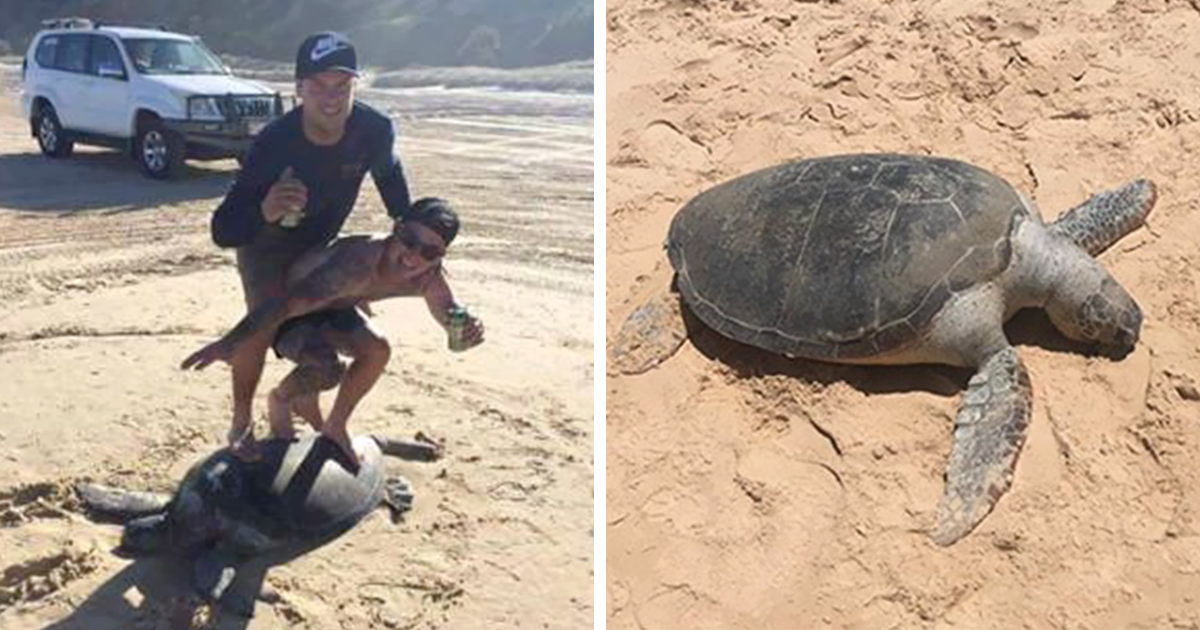
Some people go to the beach to swim, relax, take sunset photos, or pretend they are the main character in a sunscreen commercial. Others, apparently, see a turtle and think, “Excellent, nature has provided me with a surfboard.” That is roughly the level of decision-making behind the viral incident in which two men were photographed standing on a turtle on Fraser Island, Queensland, then watched the internet transform their “joke” into a full-blown wildlife controversy.
The photo, reportedly posted online with a caption joking about “surfing” a tortoise, spread quickly after being reshared by outraged wildlife supporters. Authorities investigated whether the men had interfered with a protected natural resource, and reports at the time said they could face fines of nearly $20,000 each. Even if the turtle was already dead, as some reporting suggested officials were examining, the public reaction was clear: using a protected animal as a prop is not edgy, funny, or cool. It is the kind of stunt that makes the entire internet collectively put down its coffee and say, “Really?”
This story is more than another example of social media stupidity wearing flip-flops. It is a reminder that turtles, especially sea turtles, are protected for serious reasons. They are ancient, vulnerable, slow to mature, and already threatened by habitat loss, fishing gear, plastic pollution, artificial lighting, predators, climate change, and human disturbance. In other words, they have enough problems without becoming accessories in someone’s beach-bro photo shoot.
What Happened in the Turtle “Surfing” Incident?
The incident took place on Fraser Island, now officially known as K’gari, a World Heritage-listed island famous for its beaches, dunes, rainforests, freshwater lakes, and wildlife. A photo circulated online showing two men standing on the back of a turtle on the beach. The image was reportedly captioned in a joking way, describing the act as “surfing” a tortoise. For the record, sea turtles are not tortoises, and they are also not surfboards, ottomans, stage props, beer tables, or anything else found in the “Things You Should Stand On” category.
After the photo spread, Queensland Parks and Wildlife Service looked into the matter. Reports said the maximum penalty for interfering with a natural resource such as a green turtle was $19,965, commonly rounded in headlines to $20,000. The investigation also considered whether the turtle had already died before the photo was taken. But that detail did not soften the public backlash much. Many people saw the image as disrespectful, irresponsible, and harmful to the broader culture of wildlife protection.
The most important lesson is simple: when you encounter wildlife, leave it alone. If an animal is alive, disturbance can injure or stress it. If an animal is dead, it still may be protected, may be part of an ecological process, or may need to be reported to authorities. Either way, climbing on it for internet points is a spectacularly bad audition for the role of “responsible adult.”
Why Sea Turtles Are Protected
Sea turtles have survived for millions of years, which is impressive considering they now have to share beaches with plastic bottles, careless tourists, bright resort lights, beach traffic, and people who think a viral post is a personality. In U.S. waters, six sea turtle species are listed and protected under the Endangered Species Act. These protections exist because sea turtles are biologically vulnerable and face threats throughout their life cycle.
Adult females return to land to nest, often crawling slowly up beaches at night to lay eggs. Hatchlings must then make the dangerous trip from nest to ocean, a journey that can be disrupted by lights, footprints, vehicles, pets, predators, and human handling. In the water, turtles can be struck by boats, trapped in fishing gear, entangled in debris, or harmed by pollution. A single careless human encounter may seem small, but conservation is built on thousands of small choices. Some help. Some hurt. Standing on a turtle is not exactly in the “help” column.
Why “It Was Already Dead” Is Not a Great Defense
One argument that often appears in cases like this is: “But what if the turtle was already dead?” Legally, that can matter depending on the exact law, species, jurisdiction, and evidence. Morally and socially, however, it does not magically turn the stunt into a TED Talk on marine conservation.
Dead wildlife should still be treated with respect. A dead turtle may provide useful information to researchers, especially if reported properly. It may help authorities understand disease, boat strikes, plastic ingestion, fishing impacts, or environmental problems. Moving, climbing on, damaging, or posing with the animal can interfere with documentation and response. It can also normalize the idea that wild animals are props. That is the bigger problem: once the internet rewards disrespectful behavior with attention, someone else may try to copy it with a living animal.
Social media does not always distinguish between “dead animal,” “injured animal,” and “protected animal being harassed.” It mostly sees a shocking image, generates outrage, and spreads it like sunscreen on a toddler: unevenly, aggressively, and everywhere. That is why people who post wildlife stunts often regret it after the applause they expected turns into a digital thunderstorm.
The Real Cost of Wildlife Stunts
A potential $20,000 fine sounds dramatic, but the real cost of behavior like this is bigger than money. Wildlife harassment teaches the wrong lesson. It tells viewers that animals exist for entertainment. It encourages people to get closer, touch more, chase longer, film harder, and think later. That mindset is dangerous for animals and sometimes dangerous for people too.
Sea turtles are not aggressive animals, but many wild animals can bite, scratch, carry bacteria, or react unpredictably when stressed. Even with turtles, touching or handling can cause harm. Human contact can disturb nesting, interrupt movement, damage sensitive tissue, or create stress. Around nests, careless steps can crush eggs or compact sand. Around hatchlings, bright lights and handling can reduce their chance of reaching the ocean.
There is also a legal reality. In many places, protected wildlife laws prohibit harassment, harm, capture, possession, disturbance, or interference. In the United States, the Endangered Species Act can bring civil and criminal penalties for violations involving protected species. State laws, such as those in Florida, also restrict the disturbance and harassment of marine turtles, nests, eggs, and hatchlings. So the practical rule is beautifully uncomplicated: admire from a distance, take photos without disturbing the animal, and do not touch.
How Social Media Turns Bad Choices Into Evidence
Before social media, a foolish wildlife stunt might have been witnessed by a few people and then retold as a cautionary tale at a barbecue. Now, the person doing the foolish thing often uploads the evidence voluntarily, adds a caption, tags the location, and waits for likes. This is not criminal-mastermind behavior. This is leaving breadcrumbs, a map, and a tiny flag that says “Fine me here.”
Wildlife officers, conservation groups, journalists, and the public can all see viral posts. Screenshots travel fast. Deleted accounts do not always erase the evidence. In the turtle “surfing” case, the post reportedly spread after being reshared by someone condemning the behavior. That pattern is common: the original poster may expect laughs, but the larger public may see cruelty, disrespect, or illegal conduct.
There is a useful warning here for travelers: the internet is not a private scrapbook. If you would be embarrassed explaining your photo to a ranger, judge, employer, grandmother, or a classroom of disappointed third graders, maybe do not post it. Better yet, do not do the thing in the first place.
What Responsible Wildlife Viewing Looks Like
Responsible wildlife viewing is not complicated. It starts with distance. If you see a sea turtle on the beach, stay back and stay quiet. Do not block its path. Do not shine bright lights in its face. Do not use flash photography near nesting turtles or hatchlings. Do not touch, lift, ride, chase, feed, or crowd the animal. If you see a turtle nesting, injured, stranded, dead, or in danger, contact local wildlife authorities or a rescue organization.
On nesting beaches, small actions matter. Fill holes in the sand before leaving because hatchlings and adult turtles can become trapped. Remove beach furniture at night. Keep dogs leashed where required. Turn off beachfront lights or close curtains during nesting season. Dispose of fishing line properly. Pick up plastic waste. These are not glamorous actions. Nobody goes viral for responsibly closing the blinds. But these quiet habits save more wildlife than any dramatic selfie ever will.
Why Public Outrage Can Help, But Also Needs Direction
The public reaction to the turtle photo was intense. People called the men reckless, cruel, and foolish. Outrage can be useful when it pressures authorities to investigate and educates others about protected species. But outrage works best when it points people toward better behavior, not just a comment-section bonfire.
Instead of only saying, “These people are idiots,” the better message is: “Here is what you should do when you see a turtle.” Stay away. Report concerns. Respect nesting areas. Teach kids that wild animals are neighbors, not toys. Support conservation groups. Reduce plastic. Follow posted beach rules. If the story ends only with mockery, it becomes entertainment. If it ends with education, it becomes useful.
Specific Examples of Turtle Disturbance People Should Avoid
Taking selfies too close
A close selfie with a turtle may look harmless, but crowding can alter an animal’s natural behavior. If your photo requires the animal to notice you, move away from you, or stop what it is doing, you are too close.
Using flashlights or flash photography
Bright lights can disturb nesting females and confuse hatchlings. Baby turtles rely on natural light cues to find the ocean. Artificial lights can send them inland, where they may die from exhaustion, predators, or vehicles.
Touching hatchlings
It is tempting to “help” a hatchling by picking it up and carrying it to the water, but this can interfere with natural processes and may be illegal. The better move is to keep the path clear and call trained responders if something seems wrong.
Driving carelessly on beaches
Vehicles can crush nests, hit turtles, create deep ruts that trap hatchlings, and damage fragile beach habitat. Where beach driving is allowed, slow down and follow local rules.
Turning wildlife into a joke
Humor is wonderful. Wildlife harassment is not. The turtle “surfing” photo failed because the joke required disrespecting an animal. A good rule: if the punchline needs a protected species to suffer indignity, write a better joke.
What This Story Teaches Travelers
Travel comes with responsibility. Beautiful places remain beautiful because people choose restraint. K’gari, Hawaii, Florida, Texas, and other coastal destinations draw visitors because wildlife still exists there. But every careless interaction chips away at that privilege.
Before visiting beaches known for turtles, learn the local rules. Many destinations post signs explaining nesting season restrictions, lighting requirements, pet rules, and reporting numbers. Read them. They are not decorative beach poetry. They are there because rangers, scientists, and volunteers have seen exactly how quickly one bad choice can harm wildlife.
Also remember that “I didn’t know” is not always a shield. Tourists are expected to follow local laws. If a beach sign says keep away from turtles, keep away. If a ranger tells you to move back, move back. If common sense whispers, “Maybe don’t climb on the endangered-looking creature,” give common sense a microphone.
The Bigger Conservation Picture
The turtle “surfing” story may sound absurd, but sea turtle conservation is serious work. Across turtle habitats, trained teams monitor nests, protect eggs from predators, rescue stranded animals, reduce artificial lighting, clean beaches, and educate visitors. In Queensland, nest-protection programs focus on threats such as feral pigs and foxes. In the United States, agencies and conservation groups monitor nesting beaches, respond to strandings, and enforce rules designed to keep turtles alive.
Sea turtles mature slowly, and many species take decades to reach breeding age. That means today’s harm can echo far into the future. A disturbed nesting female may abandon a nesting attempt. A disoriented hatchling may never reach the water. An adult turtle killed by a boat strike may represent decades of lost survival and reproductive potential. Conservation is not just about saving cute hatchlings; it is about protecting a long, fragile chain of life.
Experience-Based Reflection: What This Incident Feels Like on the Ground
Anyone who has spent time around protected beaches knows the strange mix of awe and nervousness that comes with seeing a turtle in the wild. The moment feels ancient. A turtle on sand does not move like an animal in a hurry. It moves like a creature that has been following the same moonlit instructions since long before humans invented beach towels, hashtags, or the terrible phrase “doing it for content.” You instinctively lower your voice. You step back. You suddenly understand why signs, ropes, volunteers, and rangers exist.
I have seen how quickly a calm wildlife moment can become chaotic when people forget themselves. One person edges closer for a photo. Another follows because the first person did it. Someone whispers, “Just one picture,” which often means twelve pictures, a video, and a dramatic crouch. A child wants to touch. A parent hesitates. A dog pulls on a leash. Nobody intends to cause harm, but the animal experiences the crowd all at once. That is the problem with wildlife disturbance: it is often made of small selfish choices stacked together.
The turtle “surfing” case feels especially frustrating because it was not a confused attempt to help. It was a pose. A performance. A tiny theater production titled “Bad Judgment at the Beach.” Even if the men later regretted it, and even if the turtle was already dead, the image sent the wrong message. It suggested that a protected animal could become a punchline. That is exactly the kind of attitude conservation educators spend years trying to undo.
A better experience with wildlife is quieter and, honestly, more memorable. Watching from a respectful distance gives you time to notice details: the drag marks in the sand, the slow lift of a flipper, the patience of volunteers, the way people become gentle when they understand they are witnessing something rare. You do not need to touch the animal to feel connected to it. In fact, the restraint is part of the connection. You are choosing to let the wild thing remain wild.
For parents, teachers, travelers, and content creators, this story is a ready-made lesson. Before taking a photo, ask: does this help the animal, harm the animal, or use the animal? Before posting, ask: what behavior am I encouraging? The best wildlife content makes people care without making animals pay the price. The worst wildlife content turns living creatures, or even dead protected creatures, into props for attention.
So yes, the headline is funny in a forehead-slapping way. “Idiots face $20,000 fine after surfing on turtle” sounds like a rejected comedy sketch. But underneath the absurdity is a practical truth: nature does not need us to be perfect. It needs us to be less careless. Stay back. Read the signs. Report injured wildlife. Pick up trash. Keep the flash off. Let turtles be turtles. They have been doing the job beautifully for millions of years, and they do not need two guys on vacation trying to improve the design.
Conclusion
The turtle “surfing” incident became viral because it combined three things the internet cannot resist: wildlife, stupidity, and consequences. But the real takeaway is not just that two men could face a painful fine. It is that protected animals deserve respect whether they are alive, injured, nesting, stranded, or dead. A beach is not a theme park, and a turtle is not a prop.
If you see wildlife, admire it from a distance. If something seems wrong, call trained authorities. If you feel the urge to climb on a protected animal for a photo, consider taking a peaceful picture of the ocean instead. The ocean will not press charges, and honestly, it has better angles.
Note: This article is based on real reporting about the Fraser Island turtle photo and on public wildlife guidance from marine conservation agencies and organizations. It is written as original SEO content for web publication.













