Few kitchen upgrades feel as dramatic as using a genuinely sharp Japanese chef knife for the first time. A ripe tomato suddenly behaves. An onion stops fighting back. Even a sweet potato, normally the vegetable equivalent of a stubborn tree stump, becomes manageable.
Japanese chef knives are admired for their thin blades, precise cutting geometry, hard steels, and remarkable edge retention. However, “Japanese knife” describes a broad family rather than one universal design. Some are stainless and beginner-friendly; others are reactive carbon-steel specialists that demand attentive care. Choosing wisely means matching the blade to your cooking stylenot simply purchasing the fanciest pattern on the internet.
What Makes Japanese Chef Knives Different?
Compared with traditional Western chef knives, Japanese blades are generally thinner, lighter, and made from harder steel. Many fall around 59–65 HRC on the Rockwell hardness scale, although specifications vary. Hard steel can support a fine cutting edge and remain sharp for a long time, producing clean cuts with less pressure.
That performance comes with a trade-off. A thin, hard edge may chip if it is twisted through a squash, dropped into a sink, or used to chop frozen food. A German-style chef knife is often the sturdier choice for rough work, while a Japanese chef knife rewards controlled technique.
Precision Instead of Brute Force
Japanese blades commonly use more acute edge angles than heavy Western knives. Depending on the maker and model, a double-bevel knife might be sharpened around 10–16 degrees per side. The exact number matters less than maintaining the blade’s intended geometry.
The thin profile also reduces resistance as the blade moves through food. Carrots split less dramatically, herbs stay greener because they are not crushed, and raw fish can be sliced without looking as if it survived an argument.
Traditional Craft and Modern Production
Japan has long-established cutlery centers, including Seki, Sakai, Sanjo, and Tsubame. Their knives may involve several specialists responsible for forging, heat treatment, grinding, sharpening, polishing, and handle installation.
Not every excellent Japanese knife is handmade, however. High-quality factory-produced blades from brands such as MAC, Global, Shun, Miyabi, and Tojiro can offer excellent consistency. Craftsmanship matters, but so do heat treatment, grind quality, comfort, and quality control. A romantic hammer mark cannot rescue poor geometry.
Essential Types of Japanese Kitchen Knives
Traditional Japanese cooking uses specialized blades for particular ingredients and techniques. Most American home cooks do not need an entire museum of steel. One versatile knife, supported by a small utility knife and bread knife, can handle nearly every ordinary task.
Gyuto: The All-Purpose Chef Knife
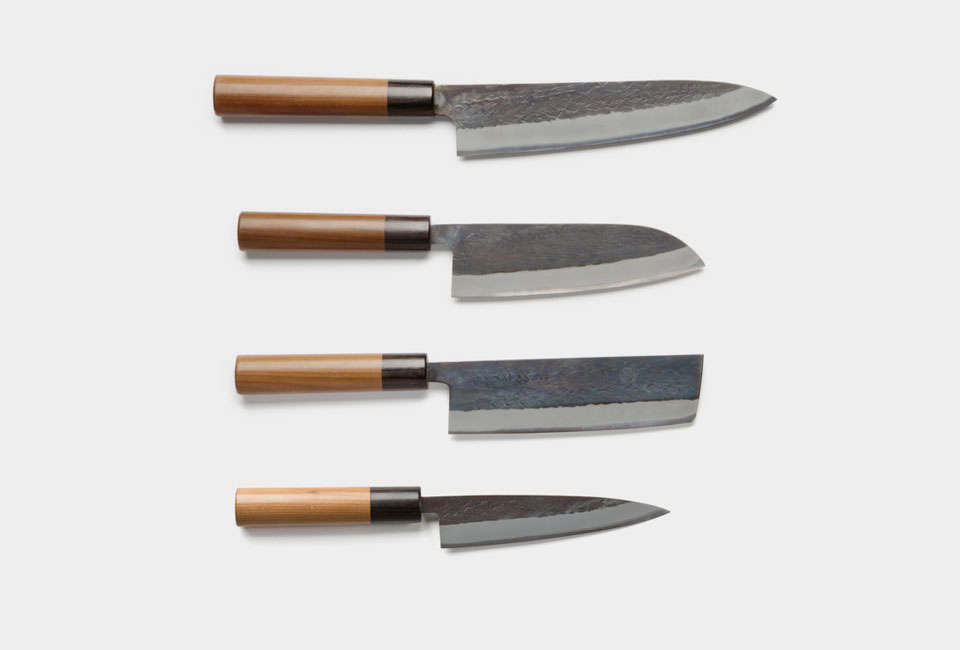
The gyuto, a name often translated as “cow sword,” is Japan’s answer to the Western chef knife. Typical blade lengths range from 180 to 240 millimeters, with 210 millimetersabout 8.3 inchesbeing a comfortable middle ground.
A gyuto can slice meat, dice onions, mince herbs, and prepare vegetables. Its pointed tip supports detailed work, while its longer edge handles large ingredients efficiently. For someone buying one Japanese chef knife, a stainless 210-millimeter gyuto is usually the safest recommendation.
Santoku: Compact and Approachable
The santoku is generally shorter than a gyuto, commonly measuring 165–180 millimeters. Its name is frequently interpreted as “three virtues,” referring either to slicing, dicing, and chopping or to handling meat, fish, and vegetables.
A santoku usually has a broad blade and a spine that curves toward a relatively low tip. It feels nimble in smaller kitchens and suits cooks who prefer push-chopping to dramatic rocking motions. It is particularly comfortable for vegetables, boneless proteins, and everyday meal preparation.
Nakiri and Bunka
A nakiri has a rectangular profile, thin construction, and relatively flat edge designed for vegetables. It excels at straight downward cuts, neat julienne strips, and rapid cabbage preparation. Despite resembling a miniature cleaver, it is not intended for bones.
The bunka is a compact multipurpose knife with an angular, reverse-tanto-style tip. It combines much of a santoku’s versatility with a sharper point for scoring, trimming, and detailed cuts. The tip is useful but delicate, so attempting to open packaging with it is a quick way to turn a beautiful knife into an expensive lesson.
Specialized Blades
- Petty: A small utility knife for fruit, shallots, trimming, and in-hand work.
- Sujihiki: A long, narrow slicer for cooked meat, fish, and roasts.
- Yanagiba: A traditional single-bevel blade used for precise sashimi slicing.
- Deba: A thick, usually single-bevel knife for breaking down and filleting fishnot for hacking through large beef bones.
- Honesuki: A pointed poultry-boning knife designed for working around joints and small bones.
- Usuba: A single-bevel vegetable knife associated with advanced professional techniques.
Understanding Japanese Knife Steel
Stainless Steel
Stainless Japanese chef knives resist corrosion and require less daily maintenance than traditional carbon steel. Popular formulations include VG-10, AUS-10, various molybdenum steels, and powder metallurgy steels such as SG2 or R2. “Stainless” does not mean invincible; water spots and corrosion can still appear when a wet blade is abandoned beside the sink.
For most home cooks, stainless steel provides the best balance of sharpness, edge retention, and convenience.
Carbon Steel
Carbon steels such as White steel and Blue steel can take extremely refined edges and are favored by many professional cooks and sharpening enthusiasts. They are also reactive. Acidic ingredients may discolor the blade, and moisture can create rust.
A gray, blue, or rainbow-colored patina is normal and can help protect the surface. Fuzzy orange rust is not a charming artisanal finish. Carbon steel should be washed and dried immediately after use, especially when cutting citrus, tomatoes, or onions.
Cladding and Damascus Patterns
Many knives place a hard core steel between softer outer layers. Stainless cladding can make a carbon-core knife easier to maintain because only the exposed edge remains highly reactive.
Damascus-style layering creates flowing patterns across the blade. It can be beautiful, but the pattern alone says little about cutting performance. Edge steel, heat treatment, thickness behind the edge, and overall grind have a greater effect. Buy Damascus because you enjoy looking at itnot because decorative waves allegedly give onions a spiritual experience.
How to Choose the Best Japanese Chef Knife
Begin With Your Cutting Style
Choose a gyuto if you want one versatile blade and regularly prepare large vegetables or proteins. Select a santoku or bunka for compact control and vegetable-heavy cooking. Consider a nakiri when produce preparation dominates your routine and you already own a general-purpose knife.
Blade profile is important. A curved edge supports gentle rocking, while a flatter edge works better with push cuts and straight chopping. Neither is inherently superior; the best Japanese chef knife is the one that cooperates with your natural movement.
Check Size, Weight, and Comfort
A 210-millimeter gyuto fits many cooks, but people with limited counter space may prefer 180 millimeters. A 240-millimeter model offers more slicing length and board clearance but can feel unwieldy in a small apartment kitchen.
Handle comfort cannot be judged from steel specifications. Traditional Japanese wa handles are usually light and may be oval, D-shaped, or octagonal. Western-style yo handles often use full-tang construction and feel heavier. Try a pinch grip and notice whether the spine, choil, or handle creates pressure points.
Consider Bevel and Handedness
Most modern gyuto, santoku, bunka, and nakiri knives use double-bevel edges. Some are symmetrical, while others use an asymmetrical grind such as 70/30. Traditional yanagiba, deba, and usuba knives are commonly single-bevel and made specifically for right- or left-handed users.
Left-handed shoppers should confirm the grind before purchasing. A strongly asymmetric or single-bevel right-handed knife may steer during a cut and can require specialized sharpening.
Spend for Performance, Not a Giant Set
A practical collection starts with one dependable chef knife, a serrated bread knife, and a petty or paring knife. Large matching blocks often include blades that spend their lives gathering dust while the gyuto does all the actual work.
Higher prices may bring improved fit and finish, premium steel, hand-forged construction, or an acclaimed craftsperson’s work. They do not automatically provide better comfort. A well-made midrange stainless knife can outperform a costly collector’s blade in the hands of someone who actually cooks dinner instead of photographing the choil.
Using and Caring for Japanese Chef Knives
Use an Edge-Friendly Cutting Board
Wood and quality synthetic rubber boards are gentle on fine edges. Many plastic boards are also acceptable when they are not excessively hard. Avoid glass, stone, ceramic, and metal surfaces. They may look stylish, but they treat a sharp edge like a parking lot treats bare feet.
Cut Without Twisting
Use smooth push cuts, slicing strokes, or controlled chopping. Keep the blade aligned as it moves through dense ingredients. Never force it sideways to free it from a squash, strike frozen food, pry open a jar, or scrape the board with the cutting edge. Turn the knife over and use the spine to move chopped ingredients.
A pinch gripthumb and index finger lightly holding the blade near the handleusually provides more control than gripping only the handle. Keep the fingertips of the guiding hand tucked into a claw shape and work at a pace that feels stable.
Wash and Store It Properly
Hand-wash the knife with mild soap and warm water, then dry it completely. Dishwashers expose blades to heat, harsh detergent, moisture, and collisions with other utensils. Leaving a sharp knife hidden in soapy water is also an excellent method for making the next person at the sink deeply unhappy.
Use a magnetic strip designed not to damage edges, a wooden block, an in-drawer holder, or a protective sheath. Do not let the blade rattle loose in a utensil drawer.
Sharpen According to the Blade
Sharpening removes metal to create a fresh apex. Honing primarily maintains or realigns an existing edge, although abrasive ceramic and diamond rods remove some steel. Hard Japanese blades should not be aggressively slammed against a coarse grooved steel rod.
Water stones offer excellent control and can preserve thin or asymmetrical geometry, but they require practice. A medium stone around 800–1,000 grit is a useful starting point for routine sharpening; finer stones can refine the edge afterward. Follow the knife maker’s guidance because soaking requirements and recommended angles vary.
If freehand sharpening feels intimidating, use a reputable professional who understands Japanese knives. An enthusiastic hardware-store grinder can remove years of steel in the time it takes you to regret the decision.
Practical Experience: What Living With Japanese Chef Knives Teaches You
The first lesson from regular use is that sharpness changes more than cutting speed. With a thin gyuto, an onion can be sliced cleanly without requiring enough downward force to flatten its layers. Herbs come off the board as crisp ribbons rather than bruised green confetti. When carving chicken breast or steak, a long drawing stroke creates a smooth surface instead of the ragged texture produced by sawing with a dull blade.
That precision can improve consistency. Carrot pieces of similar size cook at a similar rate, which means fewer crunchy surprises hiding among soft ones. Thin potato slices become easier to control, and tomato slices keep their juice instead of depositing most of it on the cutting board. The knife does not magically provide professional technique, but it stops getting in the way.
A 210-millimeter stainless gyuto tends to be the easiest transition for someone accustomed to an 8-inch Western chef knife. It has enough length for cabbage, melons, and roasts while remaining manageable for garlic and shallots. The lighter balance may initially feel insubstantial to cooks who associate weight with quality. After preparing a large batch of vegetables, however, that reduced weight often becomes the feature their wrist appreciates most.
A santoku creates a different experience. Its shorter blade feels controlled on a modest cutting board, and its broad face is convenient for transferring chopped food. The flatter profile encourages deliberate push-chopping. Cooks who habitually rock the blade through herbs may need to shorten that motion; lifting the handle too high can cause the tip or heel to lose contact with the board.
Dense produce reveals the importance of geometry. A thin blade may pass through a sweet potato with less wedging than a thick Western knife, but this is not permission to twist it. If the blade becomes stuck, the safest response is to withdraw it carefully and begin another cut. Japanese chef knives are superb slicers, not crowbars wearing attractive wooden handles.
Carbon steel adds a small daily ritual. After slicing tomatoes, the knife should be rinsed and dried promptly. Over time, the exposed steel develops a patina that records what it has cut. Some owners enjoy that evolving finish; others see one gray streak and immediately reach for emotional support. Anyone who wants a spotless, low-maintenance blade will be happier with stainless steel.
Edge maintenance also becomes easier once it is treated as routine rather than an emergency. A few careful passes on an appropriate stone or ceramic rod before the knife becomes truly dull require less work than rebuilding a neglected edge. The noticeable warning sign is often not total bluntness but reduced confidence: tomato skin resists, onions require pressure, and the knife begins sliding before it bites.
The most valuable experience is learning that fit matters more than prestige. A celebrated artisan knife can be wrong for a particular hand, grip, or cutting style. One cook may adore a blade-forward octagonal wa handle; another may prefer the familiar security of a full-tang Western handle. Trying different lengths and profilesideally at a reputable cutlery storeprovides information that steel charts cannot.
Finally, ownership encourages better habits. You clear the cutting board, dry the knife immediately, and stop tossing sharp objects into the sink. The result is not merely a longer-lasting tool. Preparation becomes calmer and more intentional. Dinner may still be late, and someone may still ask whether onions are supposed to be that dark, but at least the knife performed beautifully.
Conclusion
Japanese chef knives combine refined geometry, hard steel, and purposeful design to make food preparation cleaner and more enjoyable. A stainless gyuto or santoku is the strongest starting point for most home cooks, while carbon steel and traditional single-bevel knives suit users ready for additional maintenance and specialized technique.
Choose according to comfort, size, grind, and actual kitchen tasks. Then protect the edge with a suitable board, careful washing, dry storage, and informed sharpening. Treat the knife as a precision tool and it may become the most useful object in your kitchensorry, avocado slicer.