
Note: This article is written for web publication and synthesizes real developments in photonic memory, optical computing, silicon photonics, AI data-center interconnects, and neuromorphic hardware.
Computer memory has always had one job: remember things without making the processor wait around like someone stuck behind a person paying for groceries with pennies. For decades, chips became faster, processors gained more cores, and software learned new tricks. But one stubborn problem kept showing up at the worst possible moment: moving data is slow, expensive, and surprisingly dramatic.
That problem is often called the memory wall. It describes the widening gap between how fast processors can compute and how quickly memory systems can deliver the data those processors need. In modern artificial intelligence, high-performance computing, networking, and data centers, the bottleneck is not always raw computation. Often, the bigger issue is getting the right data to the right place at the right time without turning the server rack into a very expensive toaster.
This is where the idea of memory at the speed of light becomes more than a flashy phrase. It points to a new generation of technologies that use photons, optical signals, photonic chips, and light-sensitive materials to store, move, and process information with far less delay and energy loss than traditional electronic systems. No, your laptop is not about to become a tiny glowing oracle tomorrow morning. But the research is real, the progress is accelerating, and the future of memory may involve much more light than copper.
What Does “Memory At The Speed Of Light” Actually Mean?
The phrase sounds like science fiction, but the core idea is straightforward. Traditional computers use electrons moving through metal wires and semiconductor devices. Photonic systems use photons, the particles of light, to transmit or manipulate information. Optical fiber already carries huge amounts of internet traffic across continents and oceans. The next challenge is bringing similar advantages closer to the processor, inside data centers, on packages, and eventually onto chips themselves.
In the strict physics sense, nothing inside a computer gives you magical instant memory. Light slows down in materials, signals must be generated and detected, and devices still have practical limits. But compared with purely electrical interconnects, optical communication can offer enormous bandwidth, lower signal loss over distance, reduced electromagnetic interference, and better energy efficiency in the right architecture. That combination is exactly why researchers and chip companies are paying attention.
The Memory Wall: Why Fast Processors Still Get Bored
A processor without fast access to memory is like a chef with a rocket-powered stove but a refrigerator located three blocks away. It can cook quickly, but every ingredient run ruins the performance. Modern AI systems face a similar challenge. Large language models, recommendation systems, computer vision tools, and scientific simulations constantly move model weights, activations, embeddings, cached tokens, and training data between memory, processors, accelerators, and storage.
For AI inference, especially long-context language models, memory bandwidth can dominate the user experience. The system may have powerful GPUs, but if the data movement pipeline cannot keep up, the expensive silicon waits. Waiting silicon is bad. Waiting silicon that costs more than a sports car is worse.
That is why the industry is investing heavily in high-bandwidth memory, advanced packaging, chiplets, compute-in-memory, near-memory processing, and optical interconnects. Each approach attacks the same monster from a different angle: reduce the cost of moving data. Photonic memory and optical data movement take that ambition further by asking whether some of the memory system itself can speak the language of light.
Silicon Photonics: The Bridge Between Chips and Light
Silicon photonics is one of the most important technologies behind this shift. It integrates optical components such as waveguides, modulators, detectors, and sometimes lasers with semiconductor manufacturing methods. Instead of treating optics as bulky external hardware, silicon photonics tries to place light-handling structures close to ordinary chips.
Intel, NVIDIA, AMD, GlobalFoundries, startups, and university labs are all exploring ways to use optical links for high-bandwidth, low-latency communication in AI infrastructure. Intel has demonstrated an optical compute interconnect chiplet co-packaged with a CPU, designed for high-speed data transmission in AI and high-performance computing environments. NVIDIA has promoted co-packaged silicon photonics for AI networking, emphasizing massive switching capacity, lower power per port, and improved reliability compared with older pluggable optical architectures. AMD has also moved deeper into co-packaged optics, describing optical interconnects as a path toward higher bandwidth density and better power efficiency for rack-scale AI systems.
The common theme is simple: AI clusters are hungry. They need data moving between accelerators, memory pools, switches, and storage systems at extreme scale. Electrical links remain essential, but they become harder to push over longer distances and higher bandwidths without more power, heat, and complexity. Optical links are attractive because they can carry more data farther while wasting less energy in many large-system designs.
Photonic Memory: Storing Information With Light
Moving data with light is already powerful. But photonic memory asks an even more interesting question: can information be stored in a form that works naturally with optical processing?
In conventional computers, memory is electronic. Data is stored as electrical charge, resistance states, magnetic states, or transistor configurations. Optical systems often still need to convert light into electrical signals for storage and then convert data back into light for processing or communication. Those conversions add latency, complexity, and energy cost. It is like translating every sentence from English to French to Klingon and back before answering a text message. Technically impressive, emotionally unnecessary.
Photonic memory aims to reduce that translation tax. Some designs store optical states directly. Others use materials whose optical properties change when programmed. Still others combine electronic control with optical readout, creating hybrid systems that can be manufactured with today’s chip technologies.
Phase-Change Materials: Tiny Memory With a Personality
One of the most promising paths involves phase-change materials, often called PCMs. These materials can switch between different structural phases, such as amorphous and crystalline states. The important part is that each state interacts with light differently. By changing the material’s phase, engineers can alter refractive index, absorption, or transmission in a photonic circuit.
Materials such as GST, short for germanium-antimony-tellurium, are already known from electronic phase-change memory research. In integrated photonics, PCMs can act as compact, nonvolatile optical memory cells, programmable weights for neural networks, switches, modulators, or tunable optical components. “Nonvolatile” means the material can remember its state without constant power. In plain English: it does not need to keep sipping electricity just to remember what it had for breakfast.
Research from IBM and others has shown all-photonic in-memory computing based on phase-change materials, where storage and processing are colocated on an integrated photonic platform. Springer and Nature-indexed research summaries have also highlighted how phase-change photonics can support multilevel storage, analog tuning, nanosecond switching, and in-memory computing architectures designed to reduce the classic von Neumann bottleneck.
Photonic Latches: Optical Memory Gets a Short-Term Brain
Not all useful memory needs to last forever. Processors rely heavily on volatile memory such as SRAM caches, which temporarily hold data close to the compute units. Optical computing needs a similar short-term memory primitive if it is going to become more complete.
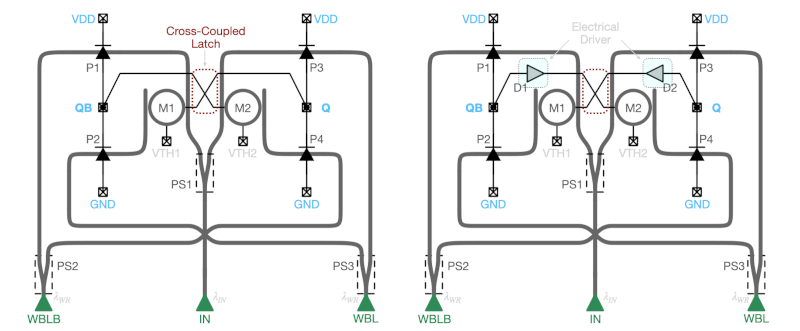
Researchers from USC Information Sciences Institute and the University of Wisconsin–Madison have developed regenerative photonic memory on a commercial foundry platform, an important step toward practical light-based computing. Optica has also described programmable photonic latch research using silicon photonic micro-ring modulators. A latch stores a bit by switching between set and reset states. In optical form, that means temporary data storage can happen inside an optical processing system instead of always falling back to electronic memory.
This matters because photonic processors can perform certain operations extremely quickly, especially matrix operations used in AI. But without memory that can operate in the same optical neighborhood, the system keeps paying conversion costs. A photonic latch is not a full replacement for DRAM or SSD storage. It is more like a missing piece in the optical computing toolkit. Small piece, big attitude.
Optical Computing and AI: Why Light Loves Matrix Math
AI workloads involve huge numbers of multiply-and-add operations, especially in neural networks. Photonic systems can perform some linear algebra operations naturally by using interference, diffraction, wavelength division multiplexing, and optical matrix multiplication. MIT researchers have demonstrated photonic processors that perform deep-learning computations on chips at nanosecond or sub-nanosecond time scales. One MIT optical processor for wireless signal classification was reported to classify signals in nanoseconds and operate about 100 times faster than a strong digital alternative for that task, while maintaining high accuracy.
The reason light is attractive for AI is not that photons are magical. It is that photons can travel through one another without the same resistance and capacitance penalties that haunt electronic wires. Multiple wavelengths can also carry separate data streams through the same optical path, a technique known as wavelength division multiplexing. That makes photonics appealing for high-throughput AI accelerators, edge devices, optical neural networks, signal processing, lidar, and future wireless systems.
Still, optical computing is not a universal replacement for electronics. Some operations are awkward in pure optics. Nonlinear functions, memory management, control logic, error correction, and programmability often require hybrid designs. The likely future is not “light wins, electrons retire to Florida.” It is more likely that photonics and electronics will cooperate, each doing what it does best.
In-Sensor Memory: When the Camera Starts Remembering
Another exciting frontier is in-sensor computing, where sensing, memory, and processing happen in the same device. Oregon State University researchers recently described a light-sensitive phototransistor inspired by the human brain. The device combines light sensing, memory, and signal processing in one structure. Light creates stored electrical charges that act like memory, and a small electrical signal can influence whether those memories persist or fade.
This idea is especially useful for AI vision systems. Today, many cameras and sensors capture huge amounts of raw data, ship that data to memory, move it to a processor, and then discard most of it after deciding what matters. That is wasteful. A sensor with built-in memory and processing could filter information closer to where it is captured. A drone, robot, smart camera, or medical device could react faster while using less energy.
Nature already does something similar. Human vision does not record the world like an unlimited 8K security camera. The brain filters, prioritizes, and forgets. That is not a bug; it is a feature. It is also why you can remember your best friend’s face but forget where you put your keys fourteen seconds ago. Ahem. Hypothetically.
Quantum Memory: Saving Photons for the Future Internet
There is also a more specialized meaning of optical memory in quantum technology. Optical quantum memory stores the quantum state of photons and retrieves it later with high fidelity. This is important for quantum communications, quantum repeaters, secure networking, and potential quantum internet architectures.
NIST and other research organizations study single-photon technologies, detectors, quantum states of light, and optical memory systems because photons are excellent carriers of quantum information. They travel well, but they are also difficult to pause, store, and synchronize. Quantum memory is the traffic light at a very strange intersection where every car is also a probability wave.
Although quantum memory is different from the photonic memory used in AI accelerators, both fields share a deeper goal: controlling light precisely enough to make information systems faster, more scalable, and more efficient.
The Big Advantages of Light-Based Memory Systems
1. Higher Bandwidth
Optical links can carry enormous amounts of data, especially when multiple wavelengths are used at the same time. For data centers and AI clusters, this can help reduce congestion between processors, memory pools, and networking equipment.
2. Lower Energy for Data Movement
Electrical signals lose energy as heat when pushed through wires, especially at high speeds and longer distances. Optical links can reduce that penalty in many high-bandwidth environments. Since data movement is one of the largest energy costs in modern computing, even modest improvements matter.
3. Less Heat and Signal Interference
Photonic signals are less vulnerable to some forms of electromagnetic interference. They can also help reduce heat in parts of the system where electrical I/O is becoming difficult to scale.
4. Better Fit for Certain AI Operations
Optics can perform some matrix and signal-processing operations naturally. Combined with photonic memory or programmable optical weights, this may lead to faster AI inference and specialized accelerators.
5. New Architectures
Photonic memory could support architectures that look very different from today’s CPU-plus-DRAM model. We may see more memory-centric computing, disaggregated memory pools, optical fabrics, in-sensor processors, and hybrid photonic-electronic AI systems.
The Challenges: Light Is Fast, But Engineering Is Petty
For all the promise, photonic memory is still a hard engineering problem. Optical components are often larger than electronic transistors. Dense memory arrays are difficult to build. Phase-change materials must balance switching speed, optical loss, endurance, thermal control, precision, and manufacturability. Optical systems also need lasers, modulators, detectors, packaging, alignment, and control circuits.
Then there is the economics problem. A technology can be brilliant in a lab and still lose in the market if it is too expensive, too fragile, too hard to manufacture, or too weird for existing software stacks. The history of computing is full of ideas that were scientifically beautiful and commercially allergic to reality.
That is why commercial foundry compatibility is such a big deal. If photonic memory devices can be built using existing semiconductor manufacturing platforms, the path to real products becomes more believable. Research that works only in a handcrafted lab sample is exciting. Research that can survive process variation, packaging, testing, and mass production is the kind investors start smiling at.
Where We May See Light-Speed Memory First
The first mainstream uses of photonic memory may not look like a normal RAM stick glowing inside a gaming PC. More likely, early adoption will happen in specialized places where bandwidth, latency, and power are painful enough to justify new hardware.
AI data centers are an obvious candidate. Co-packaged optics and optical interconnects can help move data between accelerators and switches more efficiently. High-performance computing systems could use optical fabrics to connect compute and memory resources at scale. Edge AI devices may benefit from phototransistors and in-sensor memory that reduce data movement. Telecommunications, 6G signal processing, lidar, autonomous systems, and scientific instruments could also use photonic processors with local optical memory elements.
Consumer devices will probably see the benefits indirectly. Faster cloud AI, better real-time translation, smarter cameras, lower-power wearables, improved augmented reality, and more responsive connected systems may all depend on memory and data movement becoming more efficient behind the scenes.
Real-World Experiences Related To “Memory At The Speed Of Light”
The easiest way to understand this topic is to think about everyday waiting. Anyone who has used a computer has experienced the gap between “the machine is powerful” and “why is this still loading?” A laptop may have a fast processor, but opening a giant project, rendering a video, training a model, or searching a huge archive can still feel slow because the system is constantly fetching, copying, decoding, and reorganizing data. The processor is not always the lazy one. Sometimes it is just standing at the counter waiting for memory to bring the ingredients.
In real work, this becomes painfully obvious with large files and AI tools. A photo editor may apply a small adjustment instantly to one image but slow down when handling thousands of high-resolution files. A developer may run code that performs simple calculations but spends most of its time reading from storage or moving arrays between memory and the GPU. A student may think the internet is slow, when the real delay is a chain of servers, caches, routers, and storage systems passing data around like a bucket brigade with caffeine issues.
That is why the phrase “memory at the speed of light” feels so powerful. It captures a dream many users already understand emotionally: information should appear when needed, without delay. We want the photo to open, the search result to load, the AI assistant to respond, the game world to stream, and the medical scan to process now. Not after the spinning wheel performs its tiny hypnotic dance.
In data centers, this experience becomes industrial. A single user waiting two seconds is annoying. Millions of users waiting two seconds becomes a business problem. A GPU cluster waiting for data becomes an energy problem. A medical device waiting to classify a signal becomes a safety problem. A smart vehicle waiting to interpret sensor input becomes a design problem with very real consequences. Faster memory and faster data movement are not just about bragging rights; they are about making systems responsive enough for modern demands.
Photonic memory also changes how people imagine computing. Instead of treating memory as a passive warehouse, future systems may treat it as an active participant. Data may be stored closer to where it is processed. Sensors may remember patterns before sending anything upstream. Optical neural networks may keep weights inside photonic circuits. Data centers may pool memory through optical fabrics so resources can be shared more flexibly. The machine starts to look less like a desk with separate drawers and more like a nervous system where signals move quickly, locally, and intelligently.
There is a human lesson hiding inside the technology. Good memory is not only about storing everything. It is about storing what matters, retrieving it quickly, and forgetting what wastes attention. The best future computers may borrow that idea. They will not merely hoard data; they will move it efficiently, process it near its source, and keep the important parts ready. That is the real promise of memory at the speed of light: not just faster machines, but smarter information flow.
Conclusion: The Future of Memory Is BrightLiterally
Memory At The Speed Of Light is not a single product, chip, or miracle material. It is a direction. It includes silicon photonics, optical interconnects, photonic latches, phase-change memory cells, in-memory optical computing, neuromorphic sensors, and quantum memory research. Together, these fields attack one of computing’s biggest problems: data movement.
The future will not abandon electronics. Electrons are still excellent workers. But photons are becoming valuable coworkers, especially where speed, bandwidth, and energy efficiency matter most. As AI systems grow, data centers expand, and edge devices need faster decisions with less power, light-based memory and optical data movement will become increasingly important.
The dream is simple: processors should spend less time waiting and more time thinking. If photonic memory delivers on its promise, tomorrow’s computers may not just compute faster. They may remember faster, move information smarter, and waste less energy doing it. That is a future worth watchingeven if we need sunglasses.













