
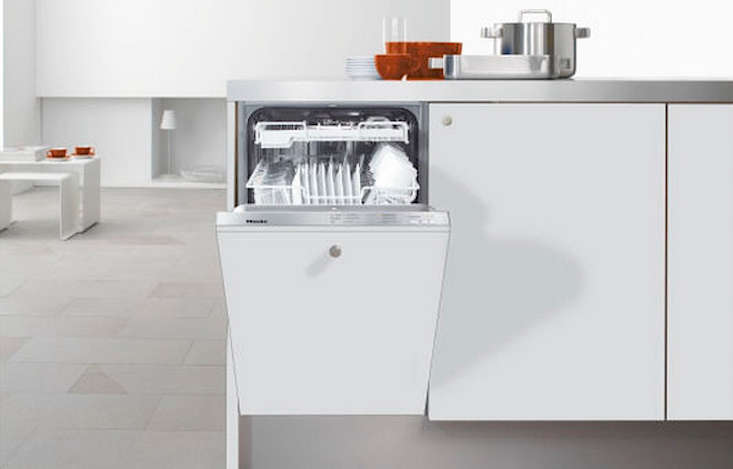
The Miele Futura Dimension Slimline Series G4760SCVI is the kind of dishwasher designed for a kitchen where every inch has already been assigned a job. At roughly 18 inches wide, it fits into spaces that cannot accommodate a standard 24-inch machine, yet it still offers a stainless-steel interior, a dedicated cutlery tray, six wash programs, and room for up to 10 place settings. In other words, it is slim, but it does not arrive with the personality of a dorm-room appliance.
This fully integrated, panel-ready dishwasher was created for homeowners who wanted premium cleaning without interrupting the visual line of custom cabinetry. The controls sit along the top edge of the door, while the exterior accepts a matching cabinet panel. Close it, and the machine effectively disappears. Open it, and there is considerably more engineering inside than the modest footprint suggests.
The G4760SCVI is now a discontinued model, so most people researching it today are likely evaluating an existing appliance, a used unit, a clearance find, or a home that already includes one. That makes an honest review especially useful: the question is no longer simply whether it looked impressive in a showroom, but whether its design still makes sense in daily life.
Miele G4760SCVI Specifications at a Glance
| Configuration | Fully integrated, panel-ready built-in dishwasher |
|---|---|
| Nominal size | 18-inch slimline class |
| Overall width | 17 5/8 inches |
| Overall height | 32 1/16 to approximately 34 2/3 inches |
| Overall depth | 22 7/16 inches |
| Capacity | 10 place settings |
| Noise rating | 46 dBA |
| Wash programs | Six |
| Interior | Stainless steel |
| Cutlery storage | Upper cutlery tray |
| Water treatment | Built-in water softening system |
| Electrical requirement | 110/120 volts, 60 Hz, 15 amps |
| Notable certifications | ENERGY STAR qualified and ADA compliant |
Why the Slimline Design Matters
A Premium Dishwasher for a Narrow Opening
The biggest reason to consider the Miele G4760SCVI is obvious: it provides built-in dishwashing in a cabinet opening only about 17 11/16 inches wide. That can be invaluable in a city apartment, galley kitchen, accessory dwelling unit, historic renovation, or compact vacation home. A standard dishwasher may offer more raw capacity, but raw capacity is not useful when the appliance is several inches wider than the available cabinet.
Miele used the narrow shell efficiently. The published 10-place-setting capacity is respectable for an 18-inch model, and the separate cutlery tray frees the lower rack from the bulky utensil basket found in many compact dishwashers. That extra organization helps the machine feel larger than it looks, although physics remains undefeated: oversized skillets, stockpots, and a full dinner-party load will require more planning than they would in a 24-inch unit.
Fully Integrated Styling
The G4760SCVI is designed to accept a custom front panel, allowing the dishwasher to align with surrounding cabinetry. This is a major aesthetic advantage in small kitchens, where a visible appliance front can dominate the room. The hidden top controls also keep the exterior clean and uninterrupted.
Panel-ready installation is not a casual Saturday project involving optimism and one slightly bent screwdriver. The panel must be correctly sized, weighted, and mounted so the door springs operate properly. Miele’s installation information specifies a panel about 17 1/2 inches wide and 3/4 inch thick, with a maximum weight of approximately 21 pounds. The exact panel height depends on countertop and toe-kick dimensions. Professional measurement is strongly recommended, especially when replacing an older integrated appliance.
Cleaning Performance and Wash Programs
AutoSensor Technology Does the Thinking
The Normal program uses sensor-based adjustment to match water and energy use to the load and soil level. That is useful because most real dishwasher loads are gloriously inconsistent: breakfast bowls, a saucepan with dried oatmeal, coffee mugs, and one plate containing evidence of a lasagna incident. AutoSensor technology allows the machine to respond rather than blindly treating every load the same.
The six-program lineup covers the situations most households actually encounter. Normal handles routine mixed loads. Pots & Pans targets heavily soiled cookware and baked-on residue. China & Crystal lowers the intensity for delicate glassware. SaniWash is intended for items that benefit from a high-temperature cycle, such as cutting boards or food-preparation pieces. Express is for lightly soiled dishes, while Pre-wash rinses a partial load until there is enough to justify a complete cycle.
This is not a dishwasher overloaded with novelty modes that sound as though they were named by a smartphone company. The program list is practical and understandable. The optional Short function can reduce program duration where available, but faster cleaning may increase resource use or alter the drying portion of a cycle. For everyday efficiency, the standard Normal program remains the sensible default.
Three Spray Arms and a Filtered Wash System
The machine uses three spray arms to reach the cutlery tray, upper basket, and lower rack. This matters in a narrow tub because dishes are packed closer together and poorly aimed water can leave frustrating pockets of residue. Proper loading is still essential: tall plates should not block the middle spray arm, and pans should face the water jets rather than forming a stainless-steel umbrella over everything below.
The filter system captures food particles and protects the circulation pump. Unlike a hard-food disposer, it requires periodic inspection and cleaning. That may sound like a chore, but it is a two-minute chore, not an expedition. A neglected filter can contribute to odors, cloudy results, and poor drainage, so this maintenance task is worth putting on the household calendar.
Perfect GlassCare and the Built-In Water Softener
One of the G4760SCVI’s most valuable features is its integrated water softener. Hard water can leave mineral deposits on glassware, dull stainless steel, and create scale inside the dishwasher. Once programmed for the local water hardness, the softening system helps control those problems and supports the Perfect GlassCare approach used by the China & Crystal program.
Owners must set the water-hardness level correctly and use dishwasher salt when required. This is not ordinary table salt, no matter how persuasive the salt shaker looks. The machine calls for coarse dishwasher salt formulated for water-softener regeneration. Rinse aid also matters, particularly for minimizing spots and improving drying. When the softener, detergent dose, and rinse-aid setting are properly balanced, glassware is where this Miele can look especially polished.
The trade-off is that the system demands a little more setup than a basic dishwasher. Buyers who ignore the manual may miss much of the benefit. Those who spend a few minutes learning their water hardness are more likely to see the clear glasses and reduced scale that justified the feature in the first place.
Rack Design and Real-World Capacity
The Cutlery Tray Is the Space-Saving Hero
The upper cutlery tray separates forks, spoons, knives, and small tools so water can reach each item individually. It also removes the need for a basket in the lower rack, preserving valuable room for plates and cookware. Loading each utensil takes slightly longer than tossing everything into a basket, but unloading becomes faster because similar items can be grouped together.
The adjustable upper basket provides flexibility for taller glasses above or larger dishes below. Still, a slimline dishwasher rewards strategic loading. Everyday plates, cereal bowls, mugs, wine glasses, and moderate cookware fit well. Large sheet pans, wide serving platters, and deep stockpots may need to be washed separately.
The stated 10-place-setting capacity is based on standardized tableware, not the aftermath of hosting Thanksgiving for ten people who all brought their own casserole dish. A couple or small family may find the interior perfectly adequate, while enthusiastic home cooks could fill it much more quickly.
Noise Level and Drying Performance
At 46 dBA, the G4760SCVI is quiet enough for most open kitchens and small apartments. It is not literally silent, but the sound is generally closer to a subdued wash of water than a mechanical argument happening under the counter. Because the controls are hidden, the optical operating indicator and end-of-cycle cues help confirm that the machine is working.
Drying relies on the stainless-steel chamber, residual heat, airflow, and a drying fan rather than simply blasting every item with an exposed heating element. Ceramic, glass, and metal usually release heat and dry well. Plastic containers may retain droplets, especially when nested or placed where water can pool. Rinse aid, sensible loading angles, and allowing the cycle to finish fully make a noticeable difference.
The drying fan may continue briefly after the program ends. Unloading the lower rack first, followed by the upper rack and then the cutlery tray, prevents water from dripping from higher levels onto dry dishes below. This is a tiny habit that saves a surprising amount of towel work.
Energy and Water Efficiency
Archived product data lists the G4760SCVI as ENERGY STAR qualified, with annual energy use around 270 kWh and annual water consumption around 645 gallons under standardized testing. Actual consumption depends on program choice, incoming water temperature, soil level, detergent, and household habits. The operating manual lists a cycle range of approximately 1.0 to 3.7 gallons of water.
For best efficiency, fill the baskets without overcrowding, scrape off large food debris instead of pre-rinsing every plate, and choose the program that matches the load. Sensor-equipped dishwashers are designed to deal with normal food soil. Turning every plate into a surgically clean object before loading it simply moves the water use from the dishwasher to the faucet.
Maintenance That Protects Performance
Long-term results depend on basic care. Check and rinse the filter regularly, wipe the door seals, keep the rinse-aid and salt reservoirs properly filled, and inspect the spray arms for blocked jets. Miele recommends inspecting the spray arms periodically and cleaning them when food particles restrict the openings.
Households that mainly use low-temperature programs should occasionally run a hotter cycle to discourage grease, odor, and residue buildup. The cabinet is largely self-cleaning when the correct detergent dosage is used, but accumulated scale or grease may still require an appropriate dishwasher cleaner.
Because the model is discontinued, maintenance has another dimension: parts and qualified service availability. Before purchasing a used G4760SCVI, confirm that the unit completes a full cycle without intake, drain, circulation-pump, or leak-protection errors. Inspect the racks for corrosion, check the door balance with the custom panel attached, and ask for the model and serial information.
A low purchase price becomes less charming when the installation hardware is missing or the nearest compatible replacement part is on an archaeological dig.
Advantages and Drawbacks
Main Advantages
- Compact 18-inch width suits narrow kitchens and renovations.
- Fully integrated, panel-ready design blends into custom cabinetry.
- Ten-place-setting capacity is strong for a slimline machine.
- Upper cutlery tray improves organization and frees lower-rack space.
- Built-in water softener supports clearer glassware in hard-water areas.
- Six practical programs cover routine dishes, cookware, delicate items, and sanitizing needs.
- 46 dBA operation is comfortable for many open-plan homes.
Potential Drawbacks
- The narrow tub cannot match the cookware capacity of a 24-inch dishwasher.
- Custom-panel installation requires precise measurements and proper spring adjustment.
- Plastic drying can be less complete than drying with an aggressive high-heat element.
- The filter, water softener, salt, and rinse-aid systems require owner attention.
- As a discontinued model, parts, warranty coverage, and service history deserve careful review.
Who Is the Miele G4760SCVI Best For?
This dishwasher is best suited to one- or two-person households, small families with disciplined loading habits, apartment owners, and kitchen remodelers who need a premium appliance in an 18-inch opening. It is also appealing to buyers who value custom cabinetry, quiet operation, delicate-glass care, and a dedicated cutlery tray more than smart-home features or maximum interior volume.
It is less suitable for large households that produce several bulky pots and pans every night. A family that routinely fills a standard dishwasher after every meal may find the slimline capacity restrictive. Likewise, renters or budget buyers may prefer a simpler machine that does not require a custom door panel or specialized installation.
Final Verdict
The Miele Futura Dimension Slimline Series G4760SCVI remains an intelligently designed compact dishwasher. Its strengths are not flashy Wi-Fi tricks or an app that sends emotional support during the rinse cycle. They are the fundamentals: good rack organization, a stainless-steel tub, sensor-guided washing, specialized glass care, a water softener, practical programs, and quiet performance in a narrow cabinet opening.
Its limitations are equally clear. Capacity requires planning, panel-ready installation must be accurate, and ownership involves routine filter and water-softener care. Because the model is discontinued, condition and serviceability matter as much as the original feature list. A well-maintained unit can still be an excellent match for a compact kitchen; a neglected bargain may quickly become an expensive cabinet ornament.
Extended Ownership Experience: What Daily Use Feels Like
A realistic day with the G4760SCVI begins with loading decisions that become second nature after a week or two. Breakfast bowls and mugs go into the upper basket, plates line the lower rack, and utensils are arranged across the top tray. At first, placing forks and spoons individually may feel unnecessarily formal, as though the dishwasher has requested assigned seating. Soon, however, the tray proves its value. Utensils do not nest together, small measuring spoons stay visible, and unloading becomes a quick grab-and-sort routine.
The narrow interior encourages better habits. Instead of tossing dishes in at random, owners learn which direction gives each item a clean path to the spray arms. Deep bowls need space between them. Cutting boards belong at the side, not directly in front of a spray path. Tall glasses fit more confidently after adjusting the upper basket.
The machine can hold an impressive everyday load, but it communicates displeasure when treated like a storage locker. Overloading is usually rewarded with one stubbornly dirty bowl in the center, the dishwasher equivalent of a passive-aggressive note.
During operation, the 46 dBA sound level is noticeable mainly in a very quiet room. A soft rush of water may be heard nearby, but normal conversation, television, or kitchen activity easily covers it. In a compact apartment, this matters. The dishwasher can run after dinner without making the living room feel as though it shares a wall with a car wash.
Normal becomes the everyday program because it balances cleaning and efficiency without requiring much thought. Pots & Pans is useful after baked pasta, roasting trays, or cookware with dried sauce. China & Crystal feels reassuring for wine glasses and delicate pieces, especially after the water softener has been correctly programmed.
Express is convenient for lightly soiled party dishes, although crowded or heavily soiled loads still deserve a complete cycle. The lesson is simple: quick cycles are helpful, but they are not time machines.
Drying results are strongest on plates, flatware, glass, and metal. Lightweight plastic lids can emerge with droplets, particularly when they have flipped over and collected a miniature indoor swimming pool. Angling plastics, using rinse aid, and waiting until the drying phase is fully complete improves the outcome.
Opening the dishwasher too early can release steam and interrupt the process, so patience becomes part of the ownership experience. After the cycle, unloading the bottom rack first also prevents droplets from the upper basket from redecorating the plates below.
The built-in water softener is one of those features that seems invisible until it is neglected. With the hardness correctly set and the salt reservoir maintained, glasses look clearer and scale is easier to control. When refill indicators are ignored, spotting and mineral film can gradually return. The machine is sophisticated, but it cannot refill itself; apparently that feature was reserved for the future along with flying cars.
Maintenance is straightforward rather than glamorous. The filter twists out for rinsing, door seals wipe clean with a damp cloth, and spray arms need occasional inspection. Owners who perform these small tasks are more likely to enjoy consistent cleaning and fresh-smelling operation. Owners who never look beneath the lower rack may eventually discover that pasta fragments have formed their own local government.
Overall, living with the G4760SCVI feels premium in a practical way. The custom front keeps the kitchen visually calm, the top tray makes small items manageable, and the slim cabinet width preserves valuable storage or floor space. It does ask the user to load thoughtfully and maintain the water-treatment system, but the reward is a compact dishwasher that behaves like a serious built-in appliance rather than a compromise.
Note: This article evaluates an older, discontinued model. Verify current parts availability, installation dimensions, panel compatibility, and service support before purchasing or replacing the appliance.













