
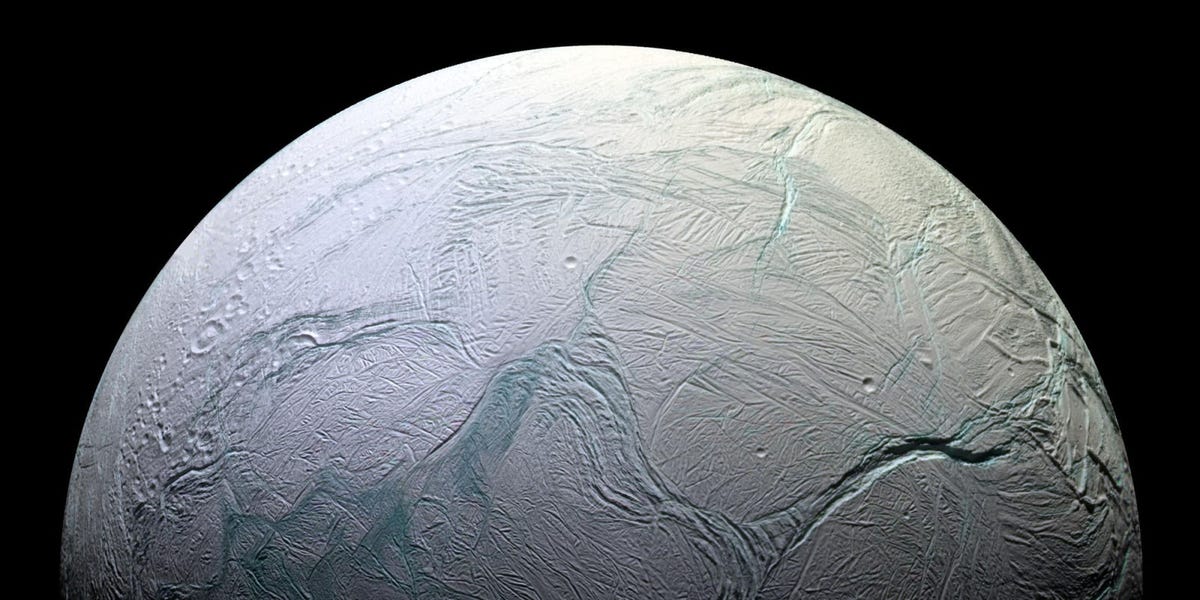
Saturn’s moon Enceladus is tiny, icy, and extremely good at making planetary scientists cancel their weekend plans. For decades, it looked like just another frozen moon in the outer solar system: bright, cold, and not exactly screaming “beach vacation.” Then NASA’s Cassini spacecraft flew past it and discovered something wild: geyser-like plumes spraying water vapor, ice grains, salts, organic compounds, and gases from cracks near the moon’s south pole.
Those plumes turned Enceladus into one of the most exciting places in astrobiology. Why? Because they appear to come from a global subsurface ocean hidden beneath the moon’s icy shell. Even better, Cassini found evidence that water may be interacting with rock at the ocean floor, producing chemical energy in a way that resembles hydrothermal vent systems on Earth. In plain English: Enceladus may have a dark ocean, a rocky seafloor, heat, chemistry, and ingredients that make scientists lean forward in their chairs.
NASA has not found life on Enceladus. Let’s say that loudly before the internet puts a tiny alien in a hoodie on a thumbnail. What NASA and mission scientists have found is evidence that Enceladus could have the right kind of environment for life as we understand it: liquid water, useful chemistry, and a possible energy source. That makes this small Saturnian moon a giant player in the search for life beyond Earth.
Why Enceladus Became an Astrobiology Superstar
Enceladus is only about 310 miles wide, which makes it small enough that it should have frozen solid long ago. Instead, Cassini revealed an active world with fractures, heat, plumes, and a hidden ocean. The moon’s icy surface is especially reflective, which is why Enceladus appears so bright. Fresh ice from its plumes coats the surface and helps feed Saturn’s faint E ring.
The biggest surprise came from the south polar region, where long cracks known as “tiger stripes” release jets of water vapor and ice particles into space. These plumes are like free samples from a cosmic ocean. Scientists do not need to drill through miles of ice to taste the water below. Cassini simply flew through the spray and let its instruments do the sniffing.
That is what makes Enceladus so valuable. Europa, Jupiter’s famous ocean moon, also has strong potential for habitability, but Enceladus is practically handing out ocean material like a generous bakery with a very unusual menu: water ice, salts, silica, hydrogen, carbon compounds, and possibly more chemical clues waiting in old Cassini data.
What Hydrothermal Vents Are and Why They Matter
Hydrothermal vents are openings on the seafloor where heated, mineral-rich water escapes from the crust. On Earth, they occur where seawater seeps into cracks, reacts with hot rock, and returns carrying dissolved chemicals. Around these vents, entire ecosystems can thrive without sunlight. Instead of depending on photosynthesis, many organisms rely on chemosynthesis, using chemical energy from compounds such as hydrogen sulfide or hydrogen.
This matters because Enceladus is far from the Sun. Sunlight at Saturn is weak, and the ocean is buried under an icy crust. If life exists there, it probably would not be lounging under alien palm trees. It would need chemical energy, much like microbes around deep-sea vents on Earth. That is why evidence of hydrothermal activity on Enceladus is so important.
NASA’s Cassini findings suggest that Enceladus may have water-rock reactions occurring at the bottom of its ocean. These reactions could produce molecular hydrogen, a gas that some Earth microbes can use as an energy source. That does not prove microbes exist on Enceladus, but it does suggest the moon may offer a familiar kind of biological opportunity: water plus rock plus heat plus chemistry.
The Cassini Clues: How NASA Built the Case
The evidence for hydrothermal vents on Enceladus did not come from one dramatic “Aha!” moment. It came from multiple Cassini observations that gradually formed a compelling picture.
1. The Plumes Are Connected to an Ocean
Cassini observed jets erupting from the moon’s south pole and analyzed material in those plumes. The particles contained water ice and salts, strongly suggesting that the plumes originate from liquid water rather than from dry surface frost. Later studies of Enceladus’s slight wobble, called libration, supported the idea that the moon has a global ocean beneath its shell rather than a small isolated sea.
That global ocean is essential. A small pocket of water might be interesting, but a long-lived ocean in contact with rock is a much stronger candidate for habitability. It gives chemistry time and space to work.
2. Silica Nanoparticles Point to Hot Water Chemistry
One of the strongest early clues came from tiny silica-rich particles detected in Saturn’s system. Scientists concluded that these grains most likely formed when hot, slightly alkaline, mineral-rich water experienced a rapid temperature drop. On Earth, particles of this size can form in hydrothermal environments. The discovery suggested that Enceladus’s ocean water may circulate through warm rock and then rise upward before being blasted into space.
That is a big deal. Silica grains are not flashy. They do not wave little flags saying, “Hello, we came from alien vents.” But chemically, they are like breadcrumbs leading back to warm water-rock interaction deep inside the moon.
3. Cassini Detected Molecular Hydrogen
In 2015, Cassini made a deep dive through Enceladus’s plume and detected molecular hydrogen. Scientists later reported that the hydrogen was best explained by ongoing hydrothermal reactions between warm water and rock inside the moon. This is one of the most important findings in the Enceladus story.
Hydrogen matters because it can provide chemical energy. On Earth, some microbes combine hydrogen with carbon dioxide to produce methane through a process called methanogenesis. Again, this does not mean Enceladus has microbes. It means that a possible food source for certain kinds of microbes may exist there. For astrobiologists, that is like finding a fully stocked pantry in a house where nobody has checked the basement yet.
4. Organic Molecules Add to the Habitability Case
Cassini also detected organic compounds in material associated with Enceladus. Organic molecules are carbon-based compounds, and carbon chemistry is central to life on Earth. Some later analyses of Cassini data found more complex organic chemistry than scientists had previously identified. These findings do not count as biosignatures, but they strengthen the case that Enceladus’s ocean is chemically active.
The distinction is important. Organic molecules can form without life. Space is full of chemistry that sounds suspiciously biological but is perfectly non-biological. Still, when scientists see organics, liquid water, hydrogen, salts, and possible hydrothermal activity together, Enceladus becomes impossible to ignore.
5. Phosphates Help Complete the Ingredient List
More recent analysis of Cassini’s ice grain data found evidence of phosphates from Enceladus’s ocean. Phosphorus is one of the key elements needed for life as we know it, playing a major role in DNA, RNA, cell membranes, and energy transfer molecules. The detection of phosphate compounds added another major ingredient to the habitability checklist.
For years, scientists wondered whether phosphorus might be too scarce in ocean worlds to support life. Enceladus now appears to have accessible phosphorus in its ocean chemistry. That does not make life inevitable, but it makes the moon’s environment look more complete from an astrobiological perspective.
Does This Mean NASA Found Alien Life?
No. NASA has found evidence of conditions that could support life, not life itself. That difference matters. Saying Enceladus may be habitable is like saying a kitchen has flour, water, yeast, and an oven. It does not mean there is already bread on the counter. It means the basic setup is promising.
To confirm life, scientists would need much stronger evidence, such as clear biosignatures or direct detection of biological patterns that cannot be easily explained by non-living chemistry. Future missions would need instruments designed to search for amino acids, cell-like structures, isotope patterns, complex organic distributions, or other signs that point toward biology rather than chemistry alone.
Still, Enceladus is special because the ocean is accessible. The moon is actively ejecting ocean material into space. A future spacecraft could fly through the plumes, collect fresh samples, and analyze them with far more advanced instruments than Cassini carried. Cassini was not built as a life-detection mission, yet it transformed Enceladus into one of the best targets in the solar system.
How Enceladus Compares With Earth’s Deep-Sea Vents
Earth’s hydrothermal vents are often used as analogs for Enceladus because they show that life does not need sunlight to survive. Around Earth’s vents, microbes form the foundation of ecosystems powered by chemical reactions. Some scientists even think environments like hydrothermal vents may have played a role in the origin of life on Earth.
Enceladus is not Earth, of course. Its ocean is sealed beneath ice. Its gravity is weak. Its seafloor chemistry, pressure, heat flow, and ocean circulation could be very different. But the basic comparison is still powerful: if water interacts with warm rock and produces usable chemical energy, then a dark ocean can become biologically interesting.
The most exciting possibility is not that Enceladus has fish, squid, or anything ready for a science-fiction casting call. If life exists there, it would likely be microbial. Tiny. Simple. Probably not impressed by human social media. But even microbial life on Enceladus would be one of the greatest discoveries in history because it would show that life can emerge independently beyond Earth.
Why Saturn’s Tiny Moon Changed the Search for Life
Before Cassini, the search for life in the solar system focused heavily on Mars. Mars still matters, especially because it once had rivers, lakes, and potentially habitable surface environments. But Enceladus shifted the conversation. It showed that small icy moons far from the Sun can hide liquid oceans and active chemistry.
This broadened the idea of a habitable world. A planet or moon does not need warm beaches, blue skies, or a cozy distance from the Sun. It may only need liquid water, chemical energy, and essential ingredients. That means icy ocean worlds around giant planets could be some of the most promising places to search for life.
Enceladus also changed mission planning. Because its plumes carry ocean material into space, future missions may be able to test habitability without landing or drilling. A plume-sampling spacecraft could fly through the spray repeatedly, analyze fresh ice grains, and search for patterns that Cassini could not detect.
What Future Missions Could Look For
A future Enceladus mission would likely focus on the south polar plumes. Scientists would want to measure organic compounds in greater detail, determine whether amino acids are present, study isotopic ratios, and examine whether chemical patterns suggest biological activity. The mission might also map the ice shell, study plume variability, and determine how directly the plumes connect to the ocean below.
A lander could take the search even further by sampling fresh plume fallout near the tiger stripes. But landing near active fractures on an icy moon is not exactly parallel parking at the grocery store. It would require careful engineering, planetary protection planning, and instruments capable of working in extreme cold.
Even if a future mission finds no life, the result would be valuable. A habitable environment without life would teach scientists something profound about how difficult life is to start. On the other hand, if signs of life were found, it would reshape biology, astronomy, philosophy, and probably every documentary streaming queue on Earth.
Common Misunderstandings About the Enceladus Discovery
“Hydrothermal vents have been photographed on Enceladus.”
No spacecraft has seen Enceladus’s seafloor. The evidence is indirect, based on plume chemistry, silica particles, hydrogen, and models of water-rock reactions.
“NASA found aliens.”
No. NASA found evidence of a potentially habitable environment. That is exciting enough without adding little green neighbors.
“Organic molecules always mean life.”
No. Organic chemistry can occur without biology. The important point is that organics are part of the larger habitability picture.
“Enceladus is warm on the surface.”
No. The surface is extremely cold. The interesting warmth is likely internal, driven by tidal forces and water-rock interactions.
Why This Discovery Feels So Big
The evidence for hydrothermal vents on Enceladus is not just another space headline. It touches one of humanity’s oldest questions: Are we alone? For a long time, that question felt almost impossible to answer. Now, thanks to missions like Cassini, it has become scientific, testable, and surprisingly specific.
Instead of asking vaguely whether life exists “somewhere out there,” scientists can ask sharper questions: Does Enceladus’s ocean contain enough energy? Are its organic compounds arranged in ways that suggest biology? Do its plumes preserve chemical signatures from the ocean? Can a future spacecraft collect samples cleanly enough to tell the difference between living and non-living chemistry?
That is why Enceladus is so thrilling. It turns the search for life into a practical investigation. The moon is not just a distant ice ball. It is an active ocean world throwing clues into space.
Experience Section: What Enceladus Teaches Us About Curiosity, Patience, and Looking Twice
One of the most meaningful experiences related to the Enceladus discovery is the lesson that scientific breakthroughs often come from looking again. Cassini was launched in 1997, arrived at Saturn in 2004, and spent years studying the Saturn system. Enceladus was not originally expected to become the star of the show. It was small, icy, and easy to underestimate. Yet repeated flybys, careful instrument readings, and patient data analysis turned it into one of the most important worlds in planetary science.
That is a useful reminder far beyond astronomy. Sometimes the most interesting discoveries are hidden inside things we think we already understand. Enceladus looked simple from a distance. Up close, it turned out to be complicated, active, and full of surprises. In everyday life, that is a pretty good argument for not dismissing small details too quickly. The tiny clue, the odd pattern, the strange result in the datathose are often where the story begins.
The Cassini mission also shows the value of designing tools that can answer questions nobody has fully imagined yet. Cassini was not sent to Saturn specifically to prove Enceladus had a potentially habitable ocean. But its instruments were good enough, and its mission team was flexible enough, to follow the evidence. When the plumes appeared, scientists adapted. They planned flybys, adjusted priorities, and used the spacecraft like a detective uses a flashlight in a dark room.
There is also something deeply human about the Enceladus story. Imagine trying to understand an ocean you cannot see, on a moon nearly a billion miles away, using ice grains sprayed into space. That sounds absurd until you remember that science is often the art of making the impossible slightly more measurable. Cassini did not need to dive into the ocean. It caught the ocean’s fingerprints in flight.
For students, writers, science fans, and anyone who enjoys a good mystery, Enceladus is a perfect example of curiosity with discipline. The exciting claim is not “aliens are there.” The stronger, better claim is “we have evidence of water, chemistry, energy, and ocean material that deserves a closer look.” That is how responsible science stays exciting without turning into a carnival booth.
In a way, Enceladus gives us a new emotional map of the solar system. Mars may feel familiar because it has deserts, rocks, and sunsets. Europa feels dramatic because it has a hidden ocean beneath cracked ice. But Enceladus feels almost generous. It is actively sending pieces of its ocean into space, as if it wants to be studied. For a world so cold, it has a surprisingly warm invitation: come closer, sample the plume, ask better questions.
The next chapter will depend on future missions, improved instruments, and careful interpretation. Whether Enceladus turns out to be lifeless or living, it has already changed the way we think about habitability. It reminds us that the universe does not always place its most interesting possibilities in obvious places. Sometimes, the best clues come from a small moon, a frozen surface, and a plume of ocean spray glittering in the darkness near Saturn.
Conclusion: Enceladus Is Small, Icy, and Scientifically Huge
NASA’s evidence for hydrothermal activity on Saturn’s moon Enceladus has transformed the moon from a frozen curiosity into one of the top targets in the search for life beyond Earth. Cassini’s discoveries point to a global subsurface ocean, plume material connected to that ocean, silica particles consistent with hot water chemistry, molecular hydrogen that may come from water-rock reactions, organic compounds, salts, and phosphates.
None of this proves life exists on Enceladus. But it does show that the moon may have many of the conditions that make life possible. In the search for habitable worlds, that is a very big deal. Enceladus is no longer just Saturn’s shiny little moon. It is a natural laboratory, a cosmic ocean sampler, and perhaps one of the best places in the solar system to ask whether life can begin in the dark.











