
Nikola Tesla is one of those historical figures who seems to become more futuristic with age. Born in 1856, he helped shape the electrical system that powers modern civilization, experimented with wireless communication before radio became a mass medium, demonstrated remote control when automobiles were still a novelty, and imagined global information networks decades before anyone complained about their Wi-Fi password.
Yet Tesla’s real story is more interesting than the internet mythology surrounding him. He did not invent electricity, he was not the sole inventor of alternating current, and he did not secretly discover a magical source of unlimited energy. What he actually accomplished was impressive enough without the embellishment: Tesla developed crucial technologies for practical polyphase alternating-current power, created a remarkably effective induction motor, advanced high-frequency electrical engineering, pioneered radio-control technology, and pushed wireless research into territory that looked almost like science fiction to his contemporaries.
His life also offers a striking lesson about invention. Brilliant engineering does not automatically produce business success. Tesla could visualize machines with extraordinary clarity, command a lecture hall like a theatrical magician, and think decades beyond existing technology. Managing investors and converting those visions into profitable commercial systems? That part proved considerably less electrifying.
Who Was Nikola Tesla?
Nikola Tesla was born on July 10, 1856, in Smiljan, a village in the Austrian Empire that is now part of Croatia. He came from a Serbian family. His father, Milutin Tesla, was a Serbian Orthodox priest and intellectual, while his mother, Georgina-Djuka Tesla, had a talent for creating practical household devices despite having little formal education.
Tesla later credited his mother as an important source of his inventive ability. As a child, he displayed an intense fascination with machinery, natural forces, mathematics, and mental visualization. His imagination was not merely recreational. Tesla said he could picture mechanical devices internally, operate them in his mind, inspect their components, and revise their designs before building physical versions.
Education and Early Engineering Work
Tesla studied engineering at the Austrian Polytechnic in Graz and later attended lectures at the University of Prague. His formal academic path was less tidy than some biographies suggest, but his interest in electrical machinery became increasingly focused.
One problem fascinated him: conventional direct-current motors relied on brushes and commutators, components that created friction, sparks, maintenance requirements, and efficiency limitations. Tesla became convinced that an electrical motor could be built without those troublesome mechanical switching arrangements.
While working in Budapest in the early 1880s, he developed the conceptual breakthrough that would define his career: a rotating magnetic field created with alternating currents differing in phase. That insight eventually became the foundation of his induction motor and polyphase AC system.
Tesla Comes to America
In 1884, Tesla immigrated to the United States and arrived in New York City. He soon began working for an Edison organization, where his European experience with electrical equipment made him useful almost immediately.
The professional relationship between Nikola Tesla and Thomas Edison has since become one of technology history’s favorite rivalries. It is often portrayed as a superhero movie featuring two men throwing lightning bolts at each other. Reality was more complicated.
Edison was already committed financially and technically to direct-current electrical systems. Tesla believed alternating current provided a better foundation for transmitting power over substantial distances. Their engineering philosophies also differed. Edison was famous for relentless experimentation and commercial development, while Tesla tended to begin with mathematical and conceptual visualization.
Tesla left Edison’s organization after a relatively short period. He eventually found investors interested in developing his own electrical ideas, although his first American business ventures were hardly smooth. At one stage he was forced into manual labor while trying to rebuild his career.
Nikola Tesla and the Alternating-Current Revolution
Tesla’s greatest practical contribution was not the invention of alternating current itself. AC principles and experimental systems existed before him. His importance lies in developing an elegant polyphase system that made alternating-current motors and large-scale power transmission far more practical.
The Rotating Magnetic Field
The key idea was wonderfully clever. Instead of mechanically switching the magnetic forces inside a motor, Tesla used alternating currents with different phases to create a magnetic field that effectively rotated.
Place a suitable rotor inside that rotating magnetic field and electromagnetic induction causes the rotor to turn. The resulting induction motor could operate without the brushes and commutators common in many earlier motors.
In 1888, Tesla presented his work to the American Institute of Electrical Engineers. His patents attracted George Westinghouse, whose company was competing to build an AC electrical system. Westinghouse acquired rights to important Tesla patents and brought Tesla to Pittsburgh to help adapt the technology for commercial use.
The Smithsonian’s National Museum of American History preserves examples of early Westinghouse induction motors based on Tesla’s designs, tangible reminders that the famous rotating magnetic field was not merely a dramatic idea scribbled in a notebook. It became working machinery.
The War of the Currents
The competition between direct current and alternating current became known as the War of the Currents. Edison-associated interests promoted DC, while Westinghouse became the most important American champion of AC.
DC worked well locally, but changing its voltage efficiently was difficult with the technology of the period. AC could be transformed to high voltages for transmission and reduced again near customers. Higher transmission voltages allowed the same amount of power to travel with lower current, dramatically reducing resistive losses in conductors.
That advantage made AC particularly attractive for building regional power systems instead of placing generating stations every short distance.
The contest reached a spectacular public stage at the 1893 World’s Columbian Exposition in Chicago. Westinghouse won the contract to illuminate the fair using alternating current. Millions of visitors saw an enormous landscape glowing with electric lights, while Tesla presented demonstrations of high-frequency electricity and other electrical phenomena.
Electricity had become a show, a business, and infrastructure simultaneously.
Niagara Falls: Tesla’s Ideas Reach Industrial Scale
One of the defining achievements associated with Tesla’s AC technology came at Niagara Falls.
For decades, engineers and industrialists had dreamed of converting the enormous mechanical energy of the falls into useful electricity. The difficult question was how that electricity could be transmitted effectively to customers some distance away.
The Niagara project adopted an AC approach, with Westinghouse building generators and Tesla’s polyphase technology playing an important role in the system. By 1896, electrical power generated at Niagara was being transmitted to Buffalo, New York.
This was considerably more important than making impressive laboratory sparks. It demonstrated that large centralized generating facilities could send useful electrical energy over substantial distances.
The underlying model became fundamental to modern electric grids: generate electricity efficiently, transform its voltage, transmit it, transform it again, and distribute it to consumers.
The Tesla Coil and High-Frequency Electricity
In 1891, Tesla patented the electrical device now known as the Tesla coil. It is a resonant transformer circuit capable of producing extremely high-voltage, high-frequency alternating currents.
Tesla coils became famous for their spectacular electrical discharges. In public demonstrations, Tesla illuminated lamps without conventional wired connections and produced dramatic artificial lightning effects.
His presentations combined real science with first-class theater. Tesla understood something that modern technology companies continue to appreciate: if you are unveiling complicated engineering, a memorable demonstration certainly does not hurt.
His high-frequency research contributed to developments in resonant circuits, electrical lighting experiments, oscillators, radio-frequency systems, and wireless technology. Tesla also investigated phenomena related to X-rays during the period when scientists were rapidly exploring the new radiation discovered by Wilhelm Röntgen.
Tesla, Radio, and Remote Control
Wireless communication is an area where Tesla’s genuine accomplishments are sometimes buried underneath exaggerated claims.
He experimented extensively with high-frequency oscillators, tuned circuits, antennas, transmitting systems, and wireless receivers. He obtained important U.S. patents involving tuned electrical circuits and recognized that electromagnetic signals could be used for communication and control.
The Radio-Controlled Boat
In 1898, Tesla provided one of his most remarkable demonstrations at Madison Square Garden: a radio-controlled boat.
The small vessel could be commanded wirelessly to move and change direction. To a modern observer accustomed to drones and Bluetooth toys, that may sound ordinary. In 1898, it appeared close to sorcery.
Tesla called the broader idea teleautomatics. He understood that wireless signals could control machines without a human operator physically connected to them. The concept pointed toward remote-controlled vehicles, automated systems, robotics, and eventually technologies such as unmanned aircraft.
Did Nikola Tesla Invent Radio?
The most accurate answer is that radio emerged from the work of numerous scientists and engineers, including James Clerk Maxwell, Heinrich Hertz, Oliver Lodge, Guglielmo Marconi, Tesla, John Stone Stone, and others.
A frequently repeated story claims that the U.S. Supreme Court officially declared Tesla the true inventor of radio in 1943. The actual legal history is more nuanced. In Marconi Wireless Telegraph Co. v. United States, the Supreme Court invalidated certain later Marconi patent claims because important elements had been anticipated by earlier work, including work by Stone, Lodge, and Tesla. The decision did not simply issue a historical verdict declaring Tesla the sole inventor of radio.
That distinction matters because Tesla does not need a fictional victory to remain important. His patents and experiments were genuine contributions to the evolution of wireless technology.
Colorado Springs and Artificial Lightning
In 1899, Tesla established an experimental laboratory in Colorado Springs, Colorado, where he had room to investigate extremely high voltages and wireless transmission on a much larger scale.
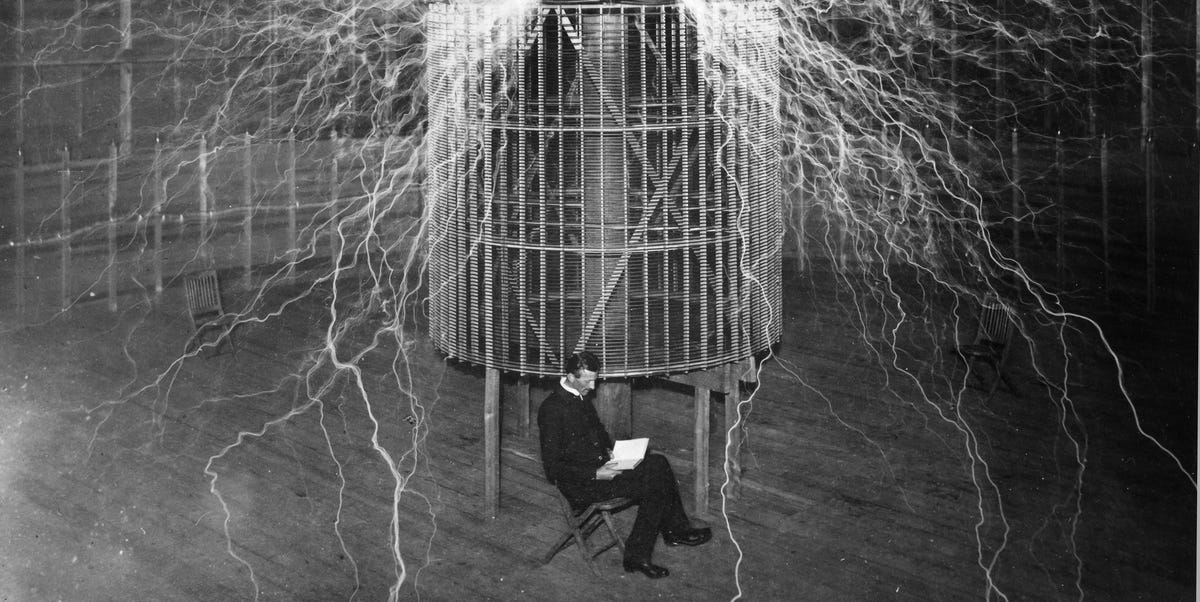
His equipment produced spectacular electrical discharges, and photographs from the period helped create the enduring image of Tesla calmly sitting near enormous bolts of artificial lightning.
Some famous Tesla photographs were produced using photographic techniques that combined separate exposures, so they should not be interpreted as evidence that he casually read books while gigantic arcs fired inches from his head. Tesla was adventurous, not a cartoon character.
The serious objective of the Colorado experiments was to better understand resonance, electrical propagation, atmospheric effects, grounding, and the possibility of transmitting signals or power wirelessly over great distances.
Wardenclyffe: Tesla’s Greatest Dream
After returning to New York, Tesla pursued the most ambitious project of his career: a worldwide wireless system.
With initial financial backing from J.P. Morgan, construction began on a facility at Wardenclyffe in Shoreham, Long Island, in 1901. The site included a laboratory designed by the prestigious architectural firm associated with Stanford White and a wooden transmitting tower approximately 187 feet tall.
Tesla envisioned a system capable of distributing information around the world. He discussed transmitting messages, news, financial information, voice, images, and other forms of communication. He also hoped to demonstrate substantial wireless transmission of electrical power.
Parts of that vision now sound astonishingly modern. The engineering methods Tesla proposed, however, should not be confused with today’s cellular networks or Wi-Fi, and his global wireless-power concept was never completed as a commercially functioning system.
Costs increased, additional investment proved difficult to secure, and competing wireless systems were advancing quickly. Wardenclyffe eventually stalled. The tower was dismantled in 1917.
The brick laboratory survives in Shoreham and is now preserved by the Tesla Science Center at Wardenclyffe, making it the most important surviving physical site associated with Tesla’s American research career.
Other Nikola Tesla Inventions
Tesla’s work extended well beyond induction motors and coils. He explored mechanical oscillators, improved electrical generators, lighting systems, radio-frequency equipment, pumps, turbines, measurement devices, and wireless control.
The Tesla Turbine
One especially interesting later invention was his bladeless turbine. Instead of using conventional turbine blades, Tesla arranged closely spaced smooth disks on a shaft. Fluid moving between the disks transferred energy through boundary-layer effects and viscosity.
The design was mechanically elegant, but commercial efficiency, materials, operating conditions, and competition from established turbine technology prevented it from transforming industry in the way Tesla hoped.
Ideas About Automation
Tesla also thought surprisingly deeply about intelligent machines. His remote-control experiments encouraged him to consider devices capable of responding automatically to environmental information.
Calling Tesla the inventor of modern artificial intelligence would be historical fan fiction. Still, his belief that increasingly autonomous machines would become technologically important was strikingly forward-looking.
Was Tesla Trying to Create Free Energy?
This is another area where terminology creates confusion.
Tesla frequently discussed making electrical energy widely accessible and experimented with wireless power transmission. That does not mean he demonstrated a machine capable of producing energy from nothing.
Wireless transmission still requires an energy source. Modern wireless charging proves the basic point beautifully: energy can move without a conventional conductive connection across the entire path, but somebody still has to generate and pay for the electricity.
Claims that Tesla possessed a suppressed perpetual-motion generator or a proven machine producing unlimited energy without fuel are not supported by established physics or reliable historical evidence.
Nikola Tesla’s Personality and Final Years
Tesla became famous not only for inventions but also for an unusual personality. Contemporary accounts describe him as elegant, extremely disciplined, highly particular about cleanliness and routines, and intensely devoted to his work.
He never married. As he grew older, he became increasingly isolated and developed a famous attachment to pigeons, feeding them regularly around New York City.
It is tempting to diagnose historical figures using modern psychological labels, but doing so confidently from anecdotes more than a century old is poor history. Tesla’s unusual routines are better treated as documented personal characteristics rather than retroactive internet diagnoses.
His financial circumstances deteriorated, even as his earlier contributions gained greater recognition. Tesla spent his final years living at the New Yorker Hotel and died there on January 7, 1943, at age 86.
His papers were temporarily taken into government custody by the Office of Alien Property Custodian because officials were interested in claims concerning advanced weapons. Contrary to a persistent conspiracy theory, the FBI has stated that it did not seize Tesla’s belongings, and Tesla was already a U.S. citizen.
Nikola Tesla’s Legacy
Tesla’s reputation has traveled through several unusual phases. He was internationally famous during parts of his lifetime, became less prominent in popular memory after his death, and then experienced an enormous cultural revival.
His most important technical legacy remains the rotating magnetic field, induction motor, and polyphase alternating-current power system. Induction motors became workhorses of industrial civilization, operating pumps, fans, compressors, conveyors, manufacturing equipment, and countless other machines.
His high-frequency experiments helped advance resonant electrical systems. His radio-controlled boat demonstrated wireless machine control decades before remote control became ordinary. His wireless research anticipated an increasingly connected world, even when specific engineering schemes failed to achieve his goals.
In 1960, the scientific community adopted tesla, symbol T, as the SI unit of magnetic flux density. Few memorials could be more appropriate. Every time an engineer specifies the magnetic field of an MRI machine, motor, magnet, or scientific instrument in teslas, Nikola Tesla’s surname quietly returns to work.
Myths Versus Reality: Why the Real Tesla Is Better
The internet occasionally turns Nikola Tesla into a wizard who invented everything from smartphones to earthquake machines while corporations supposedly hid the evidence in a secret basement. That version may generate excellent thumbnails, but it makes Tesla’s actual achievements harder to appreciate.
Real innovation normally develops through networks of scientists, engineers, manufacturers, investors, and earlier discoveries. Tesla built on electromagnetic science established before him. Westinghouse engineers helped commercialize his AC technologies. Wireless communication emerged through contributions from many inventors.
Recognizing those connections does not diminish Tesla. It reveals why his genuine contributions matter.
His induction-motor work solved a major engineering problem. His polyphase patents were commercially valuable. His high-frequency demonstrations were technically significant. His radio-controlled boat actually worked. His Wardenclyffe laboratory actually existed. His patents are available for anyone to examine.
Reality, in other words, gives us plenty of lightning without needing to manufacture extra thunder.
Experiencing Nikola Tesla Today: Beyond the Biography
Reading about Nikola Tesla is useful, but experiencing the places, machines, and documents connected with him provides a completely different perspective. Tesla can easily become an abstract collection of dramatic photographs. Seeing the physical scale of his work turns him back into an engineer.
Experience Niagara Falls as an Engineering Story
Start with Niagara Falls. Most visitors naturally look at the enormous volume of water and think, “That is spectacular.” After learning Tesla’s story, a second thought tends to arrive: “Someone looked at all of that moving water and decided to connect it to an electrical grid.”
The Niagara power project makes the importance of AC easier to understand than a textbook diagram does. Electricity generation is only half the challenge. Useful power must reach factories, streets, businesses, and homes. Tesla’s polyphase system and Westinghouse’s engineering helped make that practical on a major scale.
Standing near Niagara also provides a useful cure for the mythology surrounding Tesla. His most consequential accomplishments were not mysterious secret machines. They were engineering systems built to solve enormous practical problems.
Visit Wardenclyffe With the Right Expectations
Another valuable Tesla experience is Wardenclyffe in Shoreham, New York. The site preserves Tesla’s last remaining laboratory building and the base area associated with his famous transmitting tower. The Tesla Science Center has been developing the property as a science and education destination, with access and programming evolving as restoration continues, so visitors should check current arrangements before making a trip.
Wardenclyffe is especially interesting because it represents both brilliance and failure. Tesla correctly anticipated a future hungry for rapid global communication. Yet his proposed business and engineering system could not compete successfully with cheaper, more immediately practical wireless approaches.
That makes Wardenclyffe an unusually valuable place for entrepreneurs as well as engineers. Being early is not enough. A technology must also be financeable, manufacturable, competitive, understandable, and useful at the right moment.
Look at a Real Induction Motor
Museum collections containing early Tesla-Westinghouse motors provide another revealing experience. Compared with a gigantic Tesla coil, an induction motor may look disappointingly ordinary. There are no ten-foot sparks. Nobody’s hair stands up. The machine just rotates.
That ordinariness is precisely the point.
Technologies often become historically important when they stop looking miraculous. The induction motor became useful enough to disappear into machinery. Millions of people benefit from its underlying principle without thinking about Tesla while a pump, compressor, elevator, or factory machine operates nearby.
Read Tesla’s Patents Instead of Tesla Memes
Anyone interested in Tesla can also experience his thinking directly through historical U.S. patents. Patent drawings reveal a very different character from the mystical Tesla often presented online. They show circuits, coils, motors, mechanical arrangements, operating principles, and carefully defined claims.
This is one of the quickest ways to separate history from mythology. When somebody announces that Tesla secretly invented a miraculous technology, looking for contemporary technical documentation is a remarkably effective filter.
See a Tesla Coil Demonstration Safely
A professionally operated Tesla coil remains one of the most memorable demonstrations in electrical science. The sound, light, and visible discharges make electromagnetic phenomena feel wonderfully physical.
High-voltage equipment can also cause severe injury, burns, fires, electromagnetic interference, and damage to electronics. Tesla performed dangerous experiments in an era with very different safety standards. The modern way to appreciate his high-voltage work is through a science museum, university demonstration, or trained operatornot by improvising a lightning machine in the garage after watching three videos.
The Most Useful Tesla Experience
Perhaps the best way to experience Nikola Tesla is to study one successful idea and one failed idea side by side.
Compare the induction motor with Wardenclyffe. The first joined strong physical principles to a clear industrial need and became enormously influential. The second contained breathtaking ambition but ran into technical, financial, and competitive realities.
Together they reveal a more valuable version of Tesla than the flawless genius of popular mythology. He was capable of extraordinary insight and spectacular miscalculationsometimes within the same decade.
That is not a weakness in his story. It is what makes the story useful to inventors today.
Conclusion
Nikola Tesla helped transform electricity from an exciting nineteenth-century novelty into infrastructure capable of powering an industrial society. His rotating magnetic field and induction motor strengthened the case for polyphase AC systems. His work with Westinghouse contributed to the expansion of alternating-current power. His Tesla coil opened new possibilities for high-frequency experimentation, while his wireless and remote-control research anticipated technological fields that would grow dramatically in the twentieth century.
He also reminds us that technological vision and commercial success are different skills. Tesla could see possibilities that other people struggled even to imagine, yet some of his largest projects collapsed because resources, markets, engineering realities, and timing refused to cooperate.
More than eight decades after his death, his name remains attached to an SI unit, electrical devices, museums, popular culture, and endless arguments about who really invented what. Strip away the mythology, however, and the central fact becomes clearer: Nikola Tesla was an exceptionally original electrical engineer whose best ideas became part of the machinery of everyday life.
Research note: Historical and technical details in this article were cross-checked against material from the U.S. Department of Energy, Smithsonian Institution and National Museum of American History, Smithsonian Magazine, National Park Service, U.S. Patent and Trademark Office, Library of Congress, PBS American Experience, National Inventors Hall of Fame, Lemelson-MIT, Franklin Institute, Tesla Science Center at Wardenclyffe, FBI historical archives, NIST, and the U.S. Supreme Court record.
SEO Tags
Note: This article distinguishes well-documented Tesla achievements from popular myths and uses cautious wording where historical claims remain disputed or are frequently exaggerated.












