
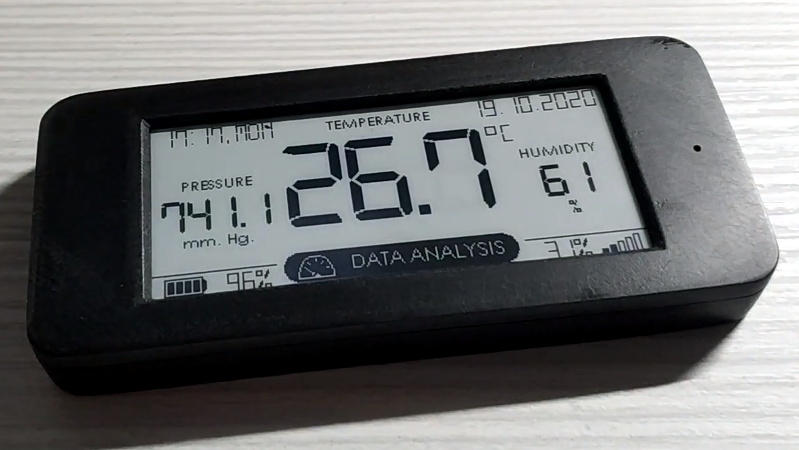
A weather station does not have to look like a laboratory instrument that escaped from a government basement. The best maker projects combine useful data, thoughtful hardware, and a little bit of design swagger. That is exactly why the NRF52 Weather Station Gives Forecast With Style concept stands out: it turns temperature, humidity, pressure, and local forecasting into something compact, battery-friendly, and good-looking enough to live on a kitchen wall instead of hiding in a plastic project box behind the router.
At its heart, this project is a miniature, nRF52-based weather station built around a low-power wireless microcontroller, an e-paper display, and environmental sensors such as the Bosch BME280. The result is not just another blinking breadboard demo. It is a polished smart home sensor that measures indoor climate, watches barometric pressure trends, displays a simple forecast, and can send data into a home automation setup. In other words, it is the kind of gadget that tells you whether to grab an umbrella while quietly reminding you that your thermostat may be lying.
What Makes This NRF52 Weather Station Special?
The charm of this weather station begins with restraint. Many DIY IoT projects try to do everything: Wi-Fi, cloud dashboards, rainbow LEDs, five phone apps, and possibly a toaster integration nobody asked for. This design takes a calmer route. It focuses on the essential information people actually glance at during the day: temperature, humidity, atmospheric pressure, battery level, signal strength, and a forecast icon or status.
The visual centerpiece is the e-paper display. Unlike a bright LCD that begs for power and attention, e-paper behaves more like printed paper. It remains readable in ambient light, does not need a backlight, and only requires power when the image refreshes. That makes it a natural fit for a battery-powered weather station. A device that spends most of its life showing slow-changing data should not burn energy like it is streaming a movie.
The enclosure is another reason this build feels different. A 3D-printed case can look rough if it goes straight from printer bed to wall, but sanding, finishing, and careful front-panel design can turn printed plastic into something that looks surprisingly commercial. The finished effect is closer to a boutique smart home accessory than a weekend science fair project, which is a big win for anyone who wants home automation without making the living room look like a server closet.
The nRF52: A Smart Choice for Low-Power Weather Monitoring
The nRF52 family from Nordic Semiconductor is popular in wireless embedded projects because it balances processing power, Bluetooth Low Energy, and low energy consumption. A weather station does not need a desktop-class processor. It needs to wake up, read sensors, update the display when necessary, send a short wireless packet, and go back to sleep like a responsible little silicon creature.
The nRF52832 and nRF52840 are especially relevant to projects like this. They support Bluetooth Low Energy, include Arm Cortex-M processors, and provide enough memory and peripherals for sensor reading, display control, and communication. That combination makes them a practical alternative to Wi-Fi-first boards when battery life matters more than constant internet access.
Why BLE Works Well Here
Bluetooth Low Energy is designed for short bursts of data rather than continuous high-bandwidth communication. That is ideal for environmental sensing. Temperature, humidity, and pressure readings do not need to be streamed every millisecond. A weather station can measure conditions at intervals, advertise or transmit the results, and return to a sleep state. The user still gets useful updates, and the battery does not need a motivational speech every morning.
In smart home scenarios, BLE data can be collected by a hub, gateway, or compatible framework and then passed along to dashboards, automations, or logging systems. For example, a home automation setup could use humidity data to trigger a bathroom fan, pressure trends to display storm alerts, or temperature changes to compare comfort across rooms.
The Sensor Stack: BME280 and Friends
A stylish weather station still needs accurate sensing. The BME280 is a common choice because it combines temperature, humidity, and barometric pressure in one tiny package. That reduces board complexity and helps keep the overall device compact. The project also allows for similar humidity and temperature sensors such as SI7021 or HTU21D, but the BME280 has one key advantage: pressure measurement.
Pressure is what lets the station do more than report the present moment. A thermometer tells you what is happening now. A barometer gives clues about what may happen next. Falling pressure often suggests unsettled weather, while rising pressure is commonly associated with improving conditions. A small indoor sensor will never replace a professional weather model, but pressure trends are enough to create a basic local forecast that feels delightfully old-school and surprisingly useful.
Why Barometric Pressure Matters
Weather is driven by changes in air pressure, temperature, moisture, and wind. Professional weather services use vast observing networks, radar, satellites, balloons, aircraft reports, and numerical models. A DIY station cannot compete with that, and it should not pretend to. What it can do is observe the air in your immediate environment and display trends that help you understand local conditions.
For example, if pressure has been slowly falling for several hours while humidity is climbing, the station can reasonably suggest that weather may become cloudy or wet. If pressure is steady or rising and humidity is moderate, it may show a calmer forecast. This is not magic. It is simple environmental pattern recognition, packaged in a way that makes your wall look smarter.
E-Paper Gives the Forecast Its Style
The display choice is what gives the project its personality. E-paper is not flashy, and that is the point. It has a quiet, printed look that fits into a room rather than shouting from it. A weather station that sits in a hallway, kitchen, workshop, or office should be glanceable. You should be able to read it while holding a coffee mug, half-awake, and emotionally unprepared for Monday.
A 2.9-inch e-paper panel offers enough space for large numbers, icons, labels, and status indicators without making the enclosure bulky. The screen can show temperature prominently, place humidity and pressure below it, and reserve a smaller region for forecast symbols, battery status, signal level, and update time. Good interface design matters here. A tiny display becomes useful when it has hierarchy: big data for quick reading, smaller data for curious users, and no clutter trying to audition for a spreadsheet.
Low Power, High Readability
E-paper displays are well suited to slow-changing data because they hold their image without continuous power. That makes them excellent for battery-powered devices that do not need animation. Weather data usually changes gradually, so refreshing every few minutesor even less oftenis enough for many indoor use cases.
The tradeoff is refresh speed. E-paper is slower than LCD or OLED, and partial refreshes can sometimes leave ghosting if used too aggressively. But for a weather station, that limitation is easy to accept. Nobody needs a cinematic transition when the humidity rises from 42% to 43%. If your humidity reading needs motion blur, something has gone terribly wrong.
Smart Home Integration Without the Drama
The project’s ability to transmit data makes it more than a decorative desktop gadget. By sending readings through BLE and working with frameworks such as MySensors, the station can become part of a larger smart home ecosystem. That means the data is not trapped on the display. It can be logged, charted, compared, and used in automations.
Imagine placing one station in a bedroom, another in a basement, and another near a window. Over time, you could learn which rooms are too humid, which areas heat up fastest, and whether your HVAC system is distributing air evenly. That kind of insight is much more practical than simply asking a smart speaker for the outdoor forecast and receiving a robotic lecture about drizzle.
Offline Use Is a Real Advantage
One of the best parts of a sensor-based weather station is that it can still provide value without depending completely on the internet. A cloud weather app may offer a richer forecast, but it cannot tell you the exact humidity in your hallway or the pressure trend inside your home. Local sensing gives the device independence. Even if your network is down, the screen can still show the latest measured conditions.
This matters for privacy and reliability, too. Not every home device needs an account, a subscription, and a 17-page privacy policy written in legal fog. A low-power sensor that measures local conditions and talks to your own home automation system is refreshingly straightforward.
Design Lessons From the NRF52 Weather Station
The biggest lesson from this project is that polish changes everything. A PCB, sensor, battery, and display can be technically impressive, but the final object is what people interact with. The enclosure, screen layout, mounting method, and update behavior all shape the user experience.
For makers, the project is a reminder to think beyond “Does it work?” and ask “Would I actually want this in my home?” A weather station should be readable from a few feet away. It should not require constant charging. It should be easy to mount or place on a shelf. It should recover gracefully after a battery change. And, ideally, it should look like it belongs next to a coffee maker instead of inside a robotics lab.
Good Hardware Feels Calm
The best home sensors do not demand attention. They sit quietly, collect data, and present information when needed. This weather station follows that philosophy. E-paper avoids screen glow. BLE avoids power-hungry networking. The nRF52 handles the embedded workload efficiently. The BME280 gathers the environmental data. The enclosure gives it a finished look. Each design choice supports the same goal: useful information without noise.
Potential Improvements and Variations
A project like this naturally invites customization. Makers could add an outdoor sensor node, use a larger e-paper screen, include CO2 or VOC sensing, or build a dashboard that compares multiple rooms. A light sensor could help explain why one room warms during the afternoon. A motion sensor could trigger more frequent updates only when someone is nearby. A capacitive button could switch between current readings, pressure graphs, and historical highs and lows.
Another useful enhancement would be better forecasting logic. Basic pressure-based forecasts are charming, but combining local pressure trends with internet forecast data could produce a richer display. The station could show indoor conditions from its own sensors and outdoor forecast data from a trusted weather API. That hybrid approach would give users the best of both worlds: hyperlocal indoor monitoring and broader regional prediction.
Who Should Build or Buy Something Like This?
This kind of device is ideal for makers who enjoy embedded systems, smart home automation, low-power electronics, and practical design. It is also a great learning project because it touches several important areas: sensor communication, power management, PCB design, wireless data, display rendering, enclosure design, and user interface planning.
Homeowners and renters can benefit from the same ideas even if they do not build the exact project. Indoor humidity affects comfort, mold risk, static electricity, and even how warm or cool a room feels. Temperature readings help reveal uneven heating and cooling. Pressure trends provide a simple window into changing weather. A local display makes that information visible without forcing you to open an app.
Experience Notes: Living With a Stylish NRF52 Weather Station
Using a small e-paper weather station changes the way you notice your home. At first, you glance at it for the obvious reasons: Is it warm? Is it humid? Should I open a window? After a few days, though, the display becomes part of the room’s rhythm. You start recognizing patterns. The kitchen humidity jumps after cooking pasta. The bedroom cools faster than the hallway. The pressure drops before a rainy afternoon, and suddenly that little forecast icon feels less like decoration and more like a tiny meteorologist with excellent posture.
The best experience comes when the station is placed somewhere visible but not intrusive. A refrigerator door, entryway shelf, home office wall, or workshop pegboard all make sense. E-paper helps because it does not glow at night or distract during the day. It simply sits there, readable and calm. Compared with checking a phone, the experience feels slower in a good way. There are no notifications, no ads, no accidental detour into emailjust the weather and the room conditions.
Battery life also changes expectations. A well-designed nRF52 weather station can feel more like a wall clock than a gadget. You do not want to think about charging it every few days. The whole point is quiet usefulness. When the microcontroller sleeps properly, the sensor runs in efficient modes, and the e-paper only refreshes when needed, the device becomes low-maintenance. That is where the nRF52 platform shines: it encourages a design style where every milliamp matters.
There is also something satisfying about local data. A phone weather app may tell you the official temperature for your city, but your home has its own microclimates. A sunny window, a damp basement, a closed bedroom, or a busy kitchen can all feel different from the forecast. The NRF52 weather station gives those spaces a voice. Sometimes that voice says, “Open a window.” Sometimes it says, “Your plants are judging you.” Either way, it is useful.
For DIY builders, the most rewarding part is the moment the project stops feeling like a project. The wires are hidden, the enclosure is finished, the screen layout looks intentional, and the device earns its place in the room. That is the real meaning of “forecast with style.” It is not just about predicting weather. It is about making data feel natural, readable, and attractive enough that people actually use it.
Conclusion
The NRF52 Weather Station Gives Forecast With Style idea proves that a practical sensor can also be a design object. By combining an nRF52 microcontroller, BLE connectivity, a BME280 environmental sensor, an e-paper display, and a polished enclosure, the project delivers useful local weather information without wasting power or visual space.
Its greatest strength is balance. It is technical without being messy, connected without being cloud-dependent, and stylish without becoming decorative fluff. For makers, it is a blueprint for building better smart home devices. For everyday users, it is a reminder that useful technology does not have to blink, buzz, or beg for attention. Sometimes the smartest gadget in the room is the quiet one telling you the pressure is falling and you should probably bring a jacket.











