
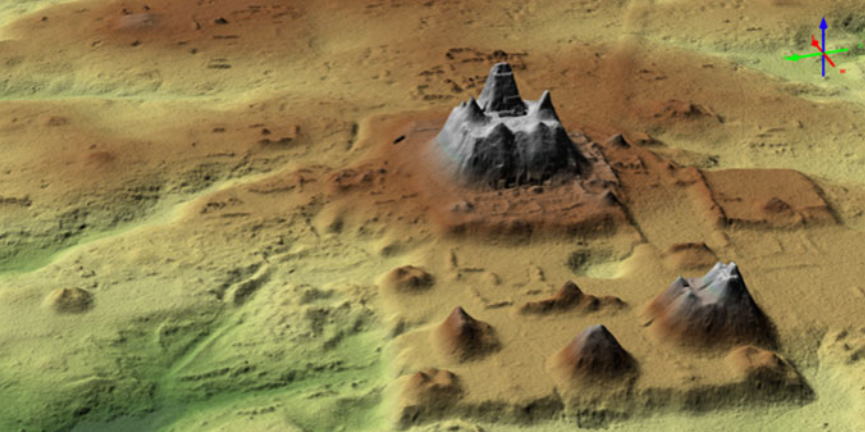
Every so often, archaeology delivers a headline that sounds like it was written by an overcaffeinated movie trailer narrator: Scientists find Mayan civilization underground! Cue the jungle mist, dramatic drums, and somebody whispering, “This changes everything.”
In fairness, this discovery really is a big deal. But the truth is a little more interesting and a lot more precise than the headline. Scientists did not uncover an entire civilization stuffed under one convenient trapdoor. What they found was a major ancient Maya urban center, now called Valeriana, hidden beneath dense forest cover in southern Mexico. It had likely been sitting there in plain sight for centuries while roads, farms, and modern communities existed nearby. Archaeology can be humbling like that.
So where is it, exactly? Why are people calling it “underground”? And why does this Maya city matter so much to our understanding of the ancient world? Let’s get into it without turning the story into a jungle-themed guessing game.
Where Is the Newly Found Maya Site?
The newly identified site is in the Mexican state of Campeche, in the southern part of the Yucatán Peninsula. More specifically, it sits in a forested zone in eastern Campeche, near the town of Xpujil and not far from the border of Quintana Roo. Researchers analyzed lidar data from a roughly 47-square-mile area and identified Valeriana as the standout urban center inside that landscape.
That location matters because Campeche is already famous among archaeologists for its Maya history. The region is home to major ruins, thick tropical forest, and an astonishing amount of ancient settlement that remains hard to spot from the ground. The new finding suggests that the land between well-known sites was not empty wilderness at all. It was, in many places, heavily occupied, engineered, and organized.
In other words, this was not some mythical city at the end of the Earth. It was in a region scholars already knew was important, but one that still had major blind spots. Valeriana appears to have been hiding in one of those blind spots, which is both thrilling and a little embarrassing for everyone who assumed the map was mostly done. Spoiler: the map was not done.
What Did Scientists Actually Find?
Researchers identified more than 6,500 structures across the broader surveyed landscape, including monumental architecture and dense settlement associated with Valeriana. The site includes the kinds of features archaeologists expect from a significant Maya urban center: pyramids, enclosed plazas, a ballcourt, causeways, residential platforms, agricultural modifications, and a reservoir created by damming a seasonal watercourse.
That is not the profile of a tiny outpost or a lonely ceremonial stop. That is the profile of a place where people lived, built, farmed, gathered, governed, and likely competed for status. Researchers have described the city as showing the hallmarks of a Classic Maya political capital, and its layout suggests that it may have been founded before A.D. 150, with occupation extending through the Classic period.
One striking detail is that Valeriana appears to contain two major monumental precincts about two kilometers apart, linked by dense settlement and landscape engineering. That is the sort of thing archaeologists love because it tells a story bigger than a handful of fancy buildings. It points to an organized urban landscape with connected neighborhoods and infrastructure, not just a few dramatic ruins trying to win an architecture contest.
Why Are Headlines Calling It “Underground”?
Here is where the clicky language needs a gentle archaeological timeout.
The city was not underground in the way a subway station is underground. It was hidden beneath forest canopy and subtle topographic cover. Over time, vegetation and the natural shape of the terrain made the architecture difficult to see from the ground. To hikers or drivers nearby, the area could look like ordinary jungle, low rises, or vaguely suspicious hills that do not immediately scream, “Excuse me, I am an ancient plaza.”
So yes, the structures were concealed. But the better description is that the city was buried in landscape and obscured by vegetation, not swallowed by a dramatic geological event. “Underground” makes for a spicy headline. “Hidden in lidar-resistant jungle topography” does not exactly trend on social media.
Still, the headline gets at a real truth: a major Maya city remained effectively invisible to modern eyes until scientists used better tools to read the land.
How Did Scientists Find It?
The discovery came through lidar, short for Light Detection and Ranging. This technology uses laser pulses, often fired from aircraft, to measure the shape of the ground below. The clever part is that lidar can filter through vegetation and reveal topographic patterns hidden beneath trees. What looks like endless green from above can become a map of terraces, mounds, roads, platforms, canals, and structures once the data is processed.
In this case, researchers were not starting from scratch with a custom treasure map. They reanalyzed a 2013 environmental lidar survey that had originally been collected for forest monitoring, not archaeology. That twist is part of what makes the story so irresistible. The ancient city was not discovered because someone hacked dramatically through vines while thunder rolled in the distance. It was found because researchers took another look at existing data and realized it contained archaeological gold.
That might sound less cinematic, but honestly, it is a perfect 21st-century discovery story. Ancient ruins meet digital detective work. Indiana Jones would probably complain about the lack of booby traps, but the rest of us can appreciate the efficiency.
Why This Discovery Matters for Maya History
The biggest takeaway is not simply that Valeriana exists. It is that dense Maya settlement may have been far more widespread than older maps suggested. For years, scholars have used lidar to show that the Maya world was not made up of isolated temple cities floating in empty forest. Instead, many areas were part of extensive, interconnected human landscapes filled with homes, roads, terraces, water systems, and civic architecture.
Valeriana strengthens that picture. It suggests that what looked like empty space between known centers may actually have been packed with communities of different sizes, from rural settlements to dense cities. That matters because it changes how we think about Maya population, land use, trade, political organization, and environmental management.
It also helps retire a stubborn old misconception: the idea that tropical forest regions could not support large, complex societies. The Maya were master builders and landscape managers. They engineered water storage, modified terrain, connected places with causeways, and created cities that worked with the environment rather than pretending the jungle did not exist.
So when people ask whether scientists found a “Mayan civilization underground,” the smartest answer is this: they found one more piece of evidence that the Maya world was larger, denser, and more sophisticated than many people once believed.
What Was Valeriana Like in Its Prime?
No one can reconstruct daily life there with total certainty yet, but the architecture gives us plenty to work with. A city with monumental plazas, temples, a ballcourt, and water infrastructure was not just surviving. It was functioning as a social and ceremonial hub. People likely came together there for governance, trade, ritual, and public life. Families lived in surrounding residential zones, farmers worked nearby land, and elites probably used the monumental spaces to display authority and legitimacy.
Its urban form also hints at a layered society. Not everyone would have lived near the biggest ceremonial spaces. Like other Maya centers, Valeriana likely included a mix of elite precincts, common households, work areas, and agricultural zones. This was a living city, not a stone postcard.
And that is part of the wonder here. The discovery invites us to stop imagining the Maya only as pyramid-builders frozen in museum time. These were communities of planners, artists, farmers, engineers, rulers, and ordinary residents trying to make daily life work in a demanding landscape. Ancient cities were full of politics, noise, labor, ambition, ritual, logistics, and probably at least one person every day asking why the road project was behind schedule.
Can You Visit the Site?
Not in the simple, tourism-brochure sense. Valeriana is not currently one of the polished headline ruins where visitors buy tickets, follow numbered signs, and pose beside a gift shop refrigerator magnet. The site remains primarily an archaeological discovery rather than a mainstream travel destination.
That said, the broader region of Campeche is rich in Maya heritage. Travelers interested in Maya archaeology already look to places such as Calakmul, Becán, and sites around Xpujil. The Valeriana discovery adds even more significance to that corridor by showing that the visible ruins are only part of the story. Beneath and beyond the famous monuments lies a much wider human landscape.
So the answer to “Where is it?” is both simple and humbling: it is in southern Mexico, in Campeche, near communities and roads people already know. The real surprise is not that it was on another planet. The surprise is that it was so close to modern life and still remained scientifically unrecognized for so long.
The Experience of Imagining a Hidden Maya City
There is something uniquely thrilling about discoveries like Valeriana because they make the modern landscape feel layered rather than finished. A forest stops being just a forest. A low rise stops being just a hill. A road stop near Xpujil stops being just a place to pass through. Suddenly, the whole region feels like a conversation between time periods, with the ancient world speaking softly under the sound of engines, birds, and wind in the trees.
Imagine standing in that part of Campeche with no lidar map in your hand. The air is warm, heavy, and alive. The jungle does what jungles do best: it hides things with complete confidence. Leaves crowd the view. Roots pull at the ground. Insects perform a full percussion concert with no intermission. Nothing about the scene politely announces, “You are beside a major ancient city.” And that is exactly what makes the discovery so powerful.
The emotional experience tied to this story is not just awe. It is also perspective. Modern people are used to thinking that satellites, roads, databases, and search engines have already tamed geography. We assume the major things are known. Then archaeology strolls in, brushes dirt off its sleeves, and says, “Actually, there was a city here the whole time.” It is a healthy reminder that the world still contains mystery, even in places touched by modern infrastructure.
There is also a deeper human feeling at work: connection. The Maya are not some vanished fantasy species from a forgotten universe. Millions of Maya descendants live today, and the landscapes of southern Mexico and Central America are still culturally alive. Discoveries like Valeriana are not just about dead stones in the jungle. They are about recovering pieces of an enduring human story that colonial narratives, dense vegetation, and incomplete scholarship often obscured.
That changes the emotional temperature of the story. The discovery becomes less about “lost civilization” drama and more about recognition. It is about seeing a place more clearly. It is about understanding that the land has memory, and that memory can survive under trees, under soil, and under assumptions. The lidar data did not invent Valeriana. It simply gave modern researchers a better way to listen.
There is a sensory side to that, too. Readers are drawn to these stories because hidden cities stir the imagination. You can almost picture the broad plazas when they were busy, the raised platforms when they held homes, the causeways carrying movement between precincts, the reservoir storing precious water, and the ballcourt pulsing with public life. The jungle of today feels quiet in comparison, but not empty. It feels like a curtain, not a void.
And maybe that is the most memorable experience attached to this discovery: the realization that history is often not gone at all. Sometimes it is just waiting for the right light, the right tool, and the right question. In this case, that tool was lidar, the question was asked by careful researchers, and the answer was a Maya city hidden in Campeche, quietly refusing to be ordinary.
Final Thoughts
If the headline made you picture an entire Mayan civilization tucked inside a secret underground chamber, reality may sound less theatrical at first. But only at first. Because the real story is better. Scientists identified a major Maya city in Campeche, Mexico, near Xpujil, using lidar data that revealed monumental architecture and dense settlement hidden beneath forest cover. The find does not just put a new dot on the map. It reshapes the map itself.
Valeriana reminds us that the Maya world was vast, complex, and deeply urban in ways that scholars are still uncovering. It also reminds us that some of history’s biggest surprises are not buried at the edge of the Earth. Sometimes they are sitting beside a modern road, under trees, waiting for science to notice what the landscape has been holding all along.
Note: Body-only HTML for web publishing; source links intentionally omitted.














