
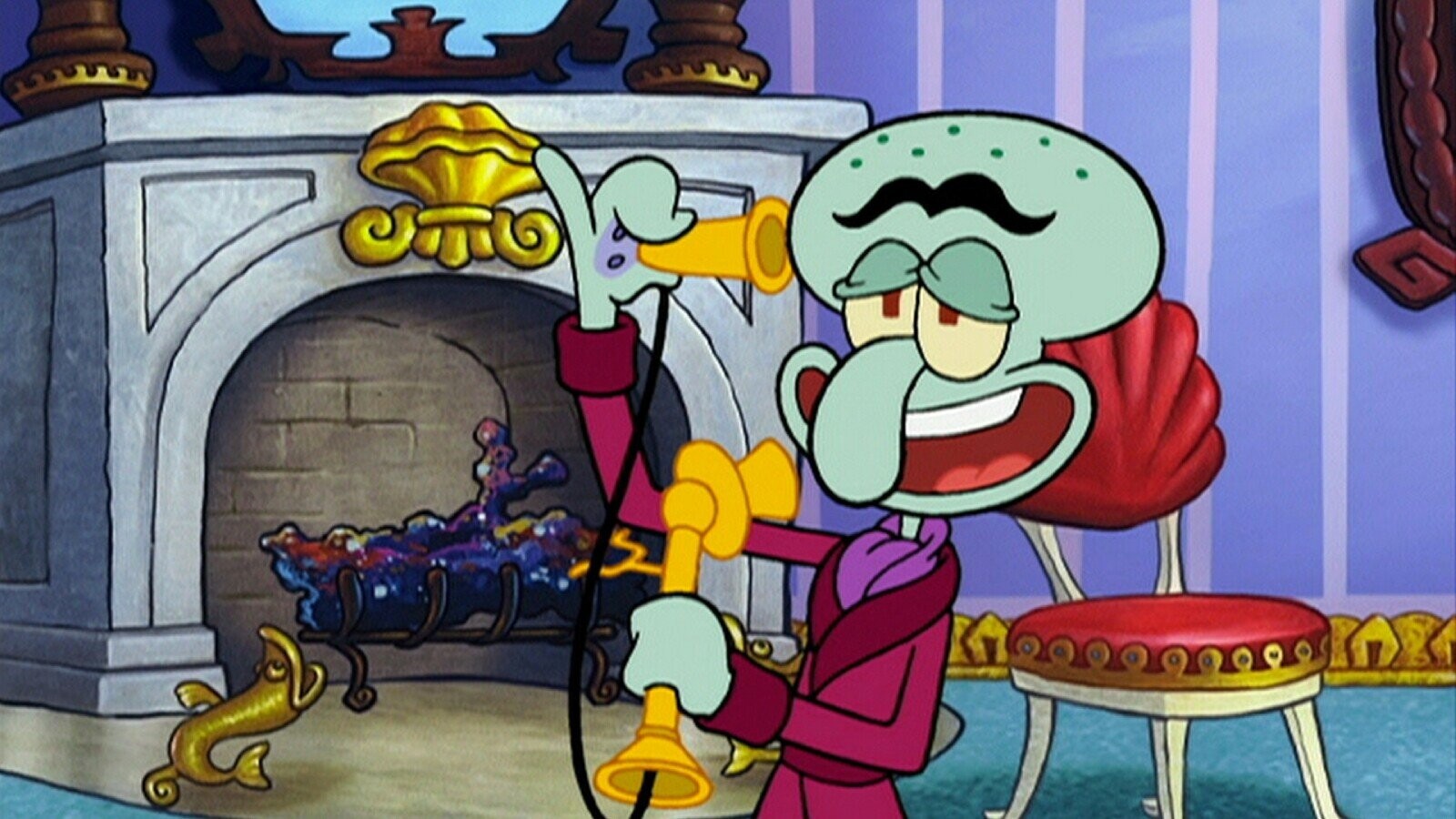
Some cartoons hide adult jokes in the shadows. SpongeBob SquarePants hid an art-history lecture in plain sight, slapped a rim shot on it, and trusted that somebody’s parent, art professor, or future college freshman would eventually catch up.
For a show about a cheerful sea sponge who works the grill at an underwater fast-food restaurant, SpongeBob SquarePants has always had suspiciously sophisticated taste. Yes, it gave children jellyfishing, bubble-blowing technique, and the eternal wisdom that mayonnaise is not an instrument. But it also casually tossed out references to silent German horror, classic literature, Broadway-style theatricality, and, in one especially glorious moment, 19th-century French Post-Impressionist printmaking.
The joke in question appears in the Season 1 episode “Squidward the Unfriendly Ghost.” SpongeBob and Patrick, believing Squidward has died and returned as a ghost, carry him around Bikini Bottom while trying to serve his every dramatic command. Squidward complains that one location is “too hot,” another is “too wet,” and then, when they stop in front of a fishy parody of a famous Henri de Toulouse-Lautrec poster, he lands the punchline: “Too loose, Lautrec.”
That is not a typo. That is not random nonsense from a clarinet-loving octopus with a superiority complex. It is a pun on Henri de Toulouse-Lautrec, the French artist associated with Montmartre nightlife, cabaret posters, and lithographs that helped turn commercial poster art into high culture. In other words, Nickelodeon put a museum joke in a kids’ cartoon and trusted the room to keep up. Bold? Yes. Brash? Also yes. Belonging in the trash? Absolutely not.
The Joke, Explained Without Requiring an Art History Minor
The scene works on three levels, which is why it has aged so beautifully. On the surface, children hear Squidward being picky. “Too hot” and “too wet” are simple complaints, the kind any kid understands after five minutes in summer weather or one tragic encounter with a puddle.
Then comes the third beat: “Too loose, Lautrec.” The rhythm sounds like the previous complaints, so even if viewers do not understand the reference, they can sense that a joke has happened. The rim shot confirms it. SpongeBob does not stop to explain. Patrick does not turn to the camera with a chalkboard. The show simply moves on, leaving a tiny French art-history bomb behind.
The deeper layer is visual. Behind the characters is an aquatic parody of La Troupe de Mademoiselle Églantine, a famous Toulouse-Lautrec lithograph from the 1890s. The original image shows dancers in a cabaret-style composition. SpongeBob’s version swaps the human performers for fish-headed figures and renames the whole thing into a sea-themed gag. It is a joke that requires writing, voice acting, background design, and enough confidence to spend actual animation labor on a punchline many viewers would not decode for decades.
Why Toulouse-Lautrec Was the Perfect Artist for SpongeBob
Henri de Toulouse-Lautrec was not the kind of artist who painted polite bowls of fruit and then went home early to floss. He was fascinated by performance, nightlife, celebrity, movement, and the strange theatricality of public life. His posters turned dancers, singers, and cabaret performers into icons of late-19th-century Paris. His work was lively, graphic, funny, stylish, and slightly scandalousin short, not entirely unlike Bikini Bottom after closing time at the Krusty Krab.
The original La Troupe de Mademoiselle Églantine is a lithograph, a printmaking form that became central to poster culture in Toulouse-Lautrec’s era. These images were not just “fine art” locked away for people in silent rooms with uncomfortable shoes. They were public-facing, commercial, theatrical, and designed to grab attention quickly. SpongeBob’s parody understands that spirit. It takes something associated with art museums and gives it the underwater vaudeville treatment.
That is what makes the joke so high-brow and so SpongeBob at the same time. It does not merely name-drop a famous artist. It recreates the visual language of the work, translates it into the show’s aquatic universe, and then turns the artist’s name into a groan-worthy pun. A lesser cartoon might have stopped at “look, a fancy painting.” SpongeBob went full “graduate seminar with bubbles.”
Why This Is Peak Nickelodeon Weirdness
Nickelodeon in the 1990s and early 2000s built its identity on kid-first chaos. The network loved slime, rebellion, gross-out humor, oddball characters, and a general sense that adults were not always in control. SpongeBob SquarePants fit perfectly into that tradition, but it also brought something extra: a writerly, artsy, deeply specific absurdity that made the show feel smarter than it ever needed to be.
That intelligence came partly from creator Stephen Hillenburg, a marine science educator and animator whose background gave the series its unusual blend of ocean knowledge and cartoon surrealism. Bikini Bottom is silly, but it is not empty. It is built from tide-pool curiosity, old animation timing, vaudeville rhythms, workplace comedy, visual art, and a surprisingly tender belief in optimism.
In the early seasons especially, the show never seemed desperate to prove it was clever. It simply was. It could deliver a joke about ripped pants, then pivot to a background gag that would make sense only to someone who had once wandered through a museum gift shop and thought, “Nice poster, but needs more fish.”
The Genius of a Joke Kids Don’t Need to Understand
One reason the “Too loose, Lautrec” gag works so well is that it does not punish children for missing it. A bad adult joke in a kids’ show can feel like a locked door. SpongeBob’s best layered jokes feel more like secret rooms. Kids laugh at the sound, the timing, and Squidward’s irritation. Adults laugh because they recognize the reference. Former kids laugh years later when the meaning suddenly clicks during an art-history class, a museum visit, or a late-night internet rabbit hole.
This is the mark of durable children’s entertainment. It does not talk down to its audience. It plants jokes at different heights, like shelves in a very strange library. Some are easy to reach immediately. Others require growing a little taller. The Toulouse-Lautrec gag is sitting on the top shelf wearing a beret.
That also explains why the joke keeps resurfacing online. SpongeBob fans love realizing that a scene they watched at age seven contained a reference to French Post-Impressionism. It creates the delightful feeling that the show was bigger than we knew. Bikini Bottom, apparently, had a better arts curriculum than many high schools.
Squidward: The Only Character Who Could Deliver It
The joke belongs to Squidward because Squidward is SpongeBob’s resident frustrated aesthete. He wants to be a musician, a painter, a performer, a person of refined taste. Unfortunately, he lives between SpongeBob and Patrick, works under Mr. Krabs, and plays the clarinet like a goose arguing with a screen door.
That tension is central to the character. Squidward believes he belongs in a world of galleries, recitals, velvet ropes, and polite applause. Instead, he is trapped in a universe where his neighbors turn daily life into a circus and the circus somehow has better ratings than his one-man show.
So when Squidward makes a Toulouse-Lautrec pun, it feels perfectly in character. Of course he knows the name. Of course he would weaponize it while being carried around like royalty. Of course he would use a cultural reference as a complaint. Squidward does not merely dislike things; he dislikes them with vocabulary.
SpongeBob’s Other High-Brow Breadcrumbs
The Toulouse-Lautrec gag is probably the show’s most elegant art-history joke, but it is not the only example of SpongeBob’s cultural range. The series famously introduced many young viewers to Nosferatu in the episode “Graveyard Shift,” where the silent-film vampire appears as the punchline to a spooky Krusty Krab mystery. That single gag gave generations of kids their first glimpse of Count Orlok, long before many knew anything about German Expressionism or F.W. Murnau’s 1922 horror classic.
The show also had a knack for theatrical references, literary textures, and old-school comedy rhythms. SpongeBob’s universe borrows from silent film, slapstick, nautical folklore, workplace sitcoms, monster movies, educational programming, and surrealist cartoon logic. It is a sponge, naturally, so it absorbs everything.
This is why the show’s humor travels so well across ages. A six-year-old can enjoy Patrick saying something gloriously dumb. A teenager can quote it as a meme. An adult can notice the structure of the joke, the visual design, or the weirdly precise cultural reference hiding in the background. SpongeBob is not one joke machine; it is several joke machines stacked inside a pineapple.
Why the Joke Became More Famous Later
When “Squidward the Unfriendly Ghost” first aired, most viewers probably did not pause the TV, pull out an art-history textbook, and whisper, “Ah, yes, Montmartre.” The gag passed by quickly. That was part of its charm.
But the internet changed how we watch old cartoons. Fans can now freeze frames, compare references, share clips, and collectively solve jokes that once slipped past everyone. A two-second gag can become a full cultural investigation. The Toulouse-Lautrec moment benefits from exactly that kind of rewatch culture. It rewards the obsessives, the meme historians, the art nerds, and the people who simply like discovering that their childhood cartoons were secretly brilliant.
It also fits the larger SpongeBob renaissance online. The show’s early episodes have become a shared language of reaction images, quotes, and emotional shorthand. Mocking SpongeBob, Caveman SpongeBob, Tired SpongeBob, Handsome Squidward, “No, this is Patrick”these are not just memes. They are modern hieroglyphics, except the ancient Egyptians probably had fewer Krabby Patties.
What This Joke Says About Great Writing
The best joke writing often depends on confidence. You cannot over-explain. You cannot panic because part of the audience may miss it. You have to trust that the joke has enough surface-level energy to work immediately and enough depth to reward anyone who digs deeper.
“Too loose, Lautrec” is a masterclass in that confidence. The line is short. The setup is clean. The visual reference is specific. The pun is terrible in exactly the right way. It is the sort of joke that makes you imagine a writer quietly waiting years to use the phrase and then finally seeing the perfect opening in a scene about an octopus pretending to be a ghost. Art is mysterious like that.
There is also a lesson here for modern animation and family entertainment. Children do not need every reference simplified. They can enjoy rhythm, tone, character, and visual comedy even when a joke’s full meaning is out of reach. In fact, those out-of-reach jokes can become part of the magic. They give viewers a reason to come back.
Experiences and Reflections: Rewatching SpongeBob as an Adult
Rewatching early SpongeBob SquarePants as an adult is a little like opening a lunchbox and finding a tiny opera inside. You remember the big flavors: SpongeBob’s laugh, Patrick’s confusion, Mr. Krabs’ money panic, Squidward’s exhausted sigh. But then you notice the craftsmanship tucked between the obvious jokes. The timing is sharper. The backgrounds are stranger. The references are more deliberate. The show you thought was just loud and yellow turns out to have been quietly elegant under all that nautical nonsense.
The Toulouse-Lautrec joke is a perfect example of that adult rewatch experience. As a kid, you probably understood only that Squidward said something fancy and a drum reacted. That was enough. The joke had a funny sound, and Squidward’s annoyance carried the scene. Years later, after encountering Toulouse-Lautrec in a museum, textbook, documentary, or online article, the old SpongeBob clip suddenly transforms. The punchline unlocks. The background becomes recognizable. You realize the cartoon did not simply make a random French-sounding noise; it built a complete visual pun around a real work of art.
That delayed understanding is surprisingly satisfying. It feels like the show left a message in a bottle and trusted future-you to find it. In a media world where so much content explains itself into oatmeal, SpongeBob’s refusal to pause is refreshing. It lets the joke breathe. Or, since this is underwater, bubble.
There is also something oddly comforting about discovering high culture inside a children’s cartoon. Museums can intimidate people. Art history can feel like a club where everyone else knows which fork to use for lithographs. SpongeBob lowers the barrier by being ridiculous. It says, in effect, “Here is a French artist, but also here are fish heads and a cranky octopus.” That combination makes the reference less precious and more alive.
For writers, the moment is a reminder that specificity is funny. “Fancy painting” would be forgettable. “Toulouse-Lautrec” is specific enough to be surprising, musical enough to be silly, and obscure enough to feel like buried treasure. For viewers, it is a reminder that childhood favorites often contain more intelligence than adults give them credit for. And for anyone who has ever felt bad about not understanding a joke until years later, relax. SpongeBob was playing the long game.
The best part is that the gag does not make the show feel elitist. It does the opposite. It invites everyone in. A child can laugh at Squidward. An adult can laugh at the reference. An art historian can laugh at the parody. A tired parent can laugh because, for two seconds, Nickelodeon acknowledged that they, too, were in the room. That is generous comedy. That is smart comedy. That is comedy wearing square pants and somehow pulling it off.
Conclusion: Bikini Bottom Belongs in the Museum
The “Too loose, Lautrec” joke remains one of the sharpest and most high-brow moments in Nickelodeon history because it combines everything SpongeBob SquarePants does best: absurdity, speed, visual invention, character-based humor, and a fearless willingness to be smarter than necessary. It is a tiny gag with a huge afterlife, a two-second proof that children’s television can be silly without being shallow.
More than 25 years after SpongeBob first moved into his pineapple under the sea, the show continues to reward rewatching because its humor was never built for one age group alone. It was built like Bikini Bottom itself: colorful on the surface, bizarre underneath, and full of strange little treasures if you know where to look.
So yes, SpongeBob may be a fry cook. Patrick may still be confused. Squidward may never become the artistic genius he believes himself to be. But for one glorious moment in Season 1, Nickelodeon gave viewers a French lithograph pun inside a ghost episode about a melted wax sculpture. That is not just a joke. That is culture with bubbles on it.
Note: This article is written as original, publication-ready content based on verified information from entertainment reporting, official franchise materials, and museum references, with no source links embedded in the article body for cleaner web publishing.













