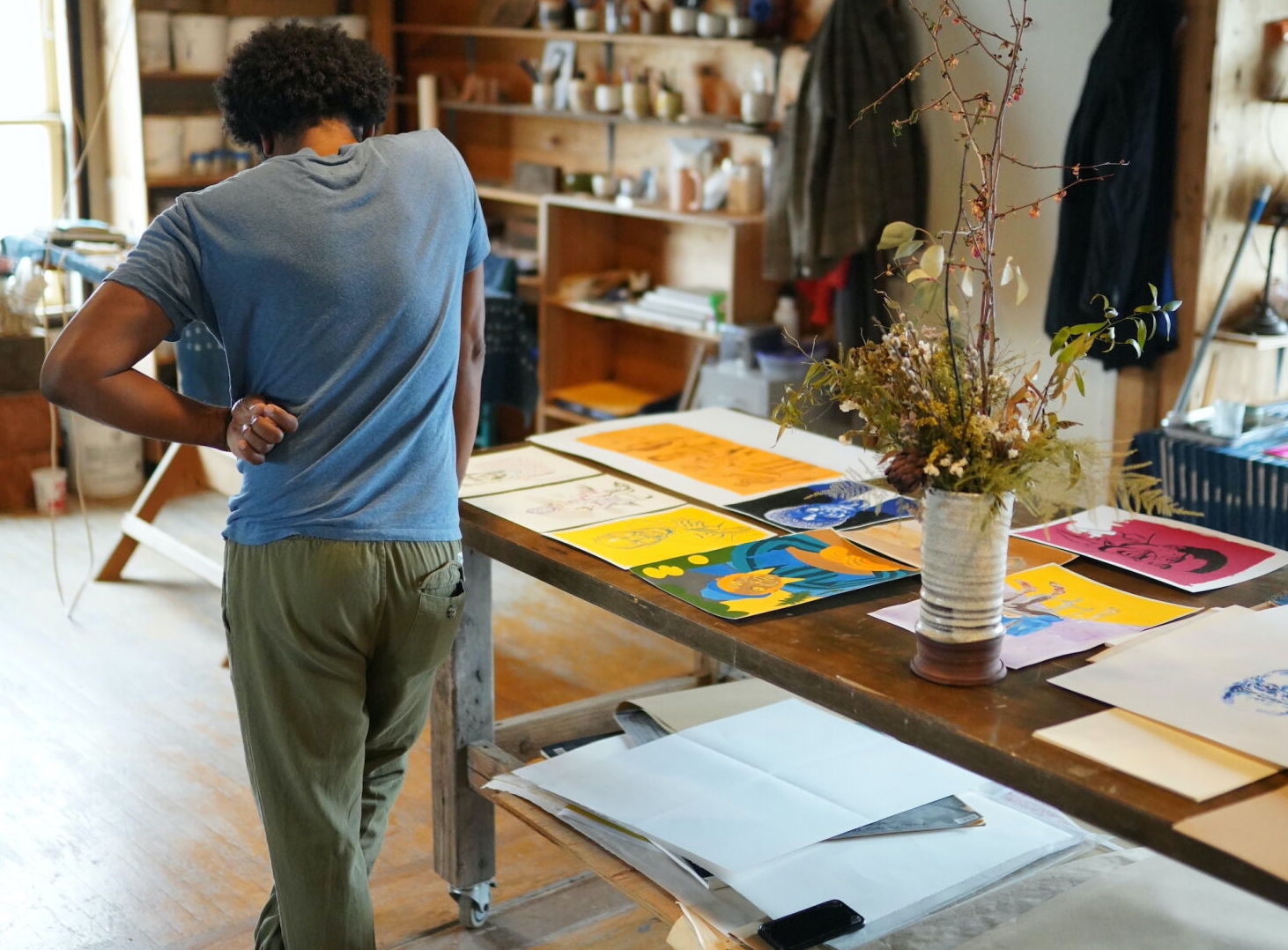
Five blocks from Ocean Beach, where San Francisco’s fog softens the edges of houses and salt air gives nearly everything an accidental patina, George McCalman works in a studio that refuses to behave like a conventional office. It is raw, sunlit, imperfect, and deeply personala creative sanctuary where finished paintings coexist with half-formed ideas, well-used brushes, books, ceramics, scraps of paper, and the productive clutter of an artist in motion.
McCalman is difficult to squeeze into a tidy professional label. He is an artist, illustrator, writer, creative director, cultural critic, and founder of the branding studio McCalman.Co. His Outer Sunset studio reflects that same refusal to choose only one identity. It functions as a painting room, research library, workshop, gathering place, archive, and occasionally something closer to a chapel.
This is not a pristine studio staged to resemble creativity. It is a place where creativity has actually happenedrepeatedly, messily, and with paint under its fingernails.
A Creative Refuge Near Ocean Beach
McCalman shares the upper-floor studio with ceramicist Georgia Hodges. The building itself has the weathered character common to the western edge of San Francisco, where homes endure damp mornings, strong coastal winds, and air seasoned with a little Pacific salt. Inside, however, the atmosphere feels warm and protective.
Windows on three sides allow daylight to move through the room from different directions. In the morning, the light can feel pale and contemplative. Later, it becomes warmer, illuminating rough walls, work surfaces, pottery, drawings, and the irregular textures that make the studio distinctive. Instead of flattening the room with uniform artificial lighting, the shifting sun continually redraws it.
That changing light matters to a painter. It reveals color differently from hour to hour and gives the space its own rhythm. McCalman has spoken about slowing down when he works in the Sunset, and the setting makes that easy to understand. Downtown urgency feels far away. The beach, fog, and long residential blocks seem to lower the volume of the city.
A Studio That Felt Sacred From the Beginning
McCalman has described his immediate connection to the studio as spiritual. He felt drawn to the room even before it became his workplace, sensing an energy that was nurturing, welcoming, and unusually suited to creative concentration.
That feeling is central to understanding the space. Its appeal does not come from luxury finishes or expensive furniture. The sanctuary is created by proportion, light, history, texture, and permissionthe permission to experiment without making every moment presentable.
Many workplaces ask creative people to clean up their thoughts before those thoughts have learned to walk. This studio does the opposite. It gives ideas room to crawl, wobble, fall over, and try again.
The Beauty of an Unfinished Interior
The Outer Sunset art studio has what might politely be called an unfinished veneer. Walls and surfaces retain evidence of construction, age, repair, and use. Materials are not disguised simply because interior-design convention says they should be. The room’s roughness becomes part of its character.
Hodges and her contractor husband were influenced by conceptual artist and architect David Ireland, whose work challenged the distinction between renovation and artistic process. Ireland often treated cracks, exposed materials, repaired surfaces, and architectural history as meaningful rather than embarrassing. In that spirit, McCalman’s studio does not pretend that process is merely an inconvenient bridge to a polished result. Process is visible everywhere.
This philosophy suits McCalman’s multidisciplinary practice. Graphic design often demands precision, schedules, specifications, and final files that behave themselves. Painting is less obedient. A mark may drip. A portrait may resist its original plan. A color may look brilliant at noon and deeply suspicious by four o’clock.
The raw interior allows those two worldsstructure and intuitionto meet without one conquering the other.
The Worktable as the Center of Gravity
A large handmade worktable anchors the room. It offers enough surface area for drawings, paints, tools, books, laptops, reference images, and whatever else a project collects while expanding beyond its original boundaries.
A generous table changes how an artist works. A small desk encourages containment; a large work surface invites comparison and connection. Several portraits can be viewed together. Materials can remain accessible instead of being packed away after every session. Research can spread out until unexpected relationships become visible.
The table is not merely furniture. It is an instrument for thinking horizontally.
Where George McCalman Became an Artist Again
Before establishing himself as a fine artist, McCalman spent years in editorial design. His career included work with major magazines, where he developed the visual storytelling instincts, compositional discipline, and deadline-tested stamina of an experienced art director. In 2011, he founded McCalman.Co, applying that editorial intelligence to branding, books, food, culture, and community-centered projects.
For years, however, painting remained secondary. McCalman had trained in the fine arts but placed practical professional concerns first, a decision shaped partly by his experience as a Grenada-born, Brooklyn-raised immigrant building a viable creative career in industries where few decision-makers looked like him.
Around 2016, drawing returned with urgency. Initially, he worked wherever space was available: cafés, dining tables, and other temporary surfaces. A partner encouraged him to find somewhere he could work freelya place where spilled ink would be an event, not a household emergency.
When Hodges invited him to share the Outer Sunset studio, the answer was simple. The room provided physical space, but more importantly, it gave his artistic identity somewhere to become real through daily practice.
Why Dedicated Space Can Change a Practice
A studio does not magically produce good art. Sadly, landlords have yet to offer that amenity. What it can provide is continuity.
When materials remain visible, returning to work requires less preparation. A painting can stay on the wall long enough for its problems to reveal themselves. Sketches can remain in conversation with one another. An artist can pause without completely dismantling the conditions that made concentration possible.
McCalman’s studio also created psychological separation between commercial assignments and exploratory work. Crossing into the room became a transition from one mode of attention to another. He could stretch out, make a mess, pursue an image without immediately knowing its destination, and allow intuition to compete with professional efficiency.
The Birthplace of Illustrated Black History
The studio became especially important during the creation of Illustrated Black History: Honoring the Iconic and the Unseen. Published in 2022, the book features 145 Black pioneers in activism, science, politics, medicine, business, literature, food, technology, music, and the arts. Its subjects include internationally recognized figures and people whose achievements have received far less public attention.
The project grew from a daily portrait exercise. McCalman began painting Black historical figures he wanted to understand more deeply. What started as an artistic challenge expanded into four years of research, writing, design, and portrait making.
Hundreds of paintings and illustrations emerged from that process. Their visual approaches vary because McCalman did not force every subject into one predetermined house style. Some portraits are delicate and restrained; others are graphic, expressive, or saturated with color. The medium follows the personality and emotional weight of the person depicted.
In the studio, these portraits accumulated on walls and work surfaces, turning the room into a visual assembly of Black achievement. The space became part archive, part conversation, and part historical witness.
Designing History Without Making It Feel Like Homework
McCalman’s background in magazines helped him make the book visually inviting without reducing its seriousness. Editorial design taught him how images, pacing, typography, and text can guide readers through complex material. The result is substantial enough for study yet approachable enough to leave on a coffee table without frightening the coffee.
The book’s larger argument is that Black history is not a detached category brought out for one month of the year. It is American history. By pairing portraits with biographical reflections, McCalman restores individuality to people who are often summarized in textbooksor omitted altogether.
The Outer Sunset studio offered an appropriate setting for that work. It was private enough for deep concentration but spacious enough to hold a growing community of faces, stories, and ideas.
A Space Shared by Different Creative Practices
Sharing the studio with a ceramicist adds another layer to its character. Painting and ceramics have distinct demands, but both are tactile practices shaped by patience, material behavior, and the occasional intervention of physics.
Clay brings volume and weight to a room. Paint brings image and gesture. Shelves lined with vessels, tools, pigments, brushes, and found objects create a conversation between flat and three-dimensional forms. Even when McCalman and Hodges are working independently, their materials share the same visual environment.
A shared studio can also temper the isolation of creative work. Another person’s activity provides gentle momentum without reproducing the constant interruptions of a conventional office. The presence of a fellow maker says, quietly, that work is happening here. It is a form of accountability with fewer spreadsheets.
Caribbean Memory, Bay Area Light, and Cultural Storytelling
McCalman’s visual language is informed by several places at once. He was born in Grenada, grew up in Brooklyn, trained and worked in New York’s editorial world, and later built his practice in San Francisco. Each environment contributed a different vocabulary.
Grenada offered hand-painted signs, vivid color, lettering with personality, and a cultural environment in which visual communication frequently carried the trace of the individual maker. Brooklyn provided density, cultural contrast, and the complicated education of an immigrant childhood in the United States. Magazine work sharpened his ability to organize stories. San Francisco gave him room to combine design, journalism, illustration, and fine art.
The Outer Sunset studio gathers these influences without turning them into décor. Its significance lies in what happens there: observation, research, cultural interpretation, experimentation, and the translation of identity into images.
The Studio as a Self-Portrait
Creative studios often become unintentional portraits of their occupants. The objects artists keep nearby reveal their habits, friendships, influences, and private systems of meaning.
McCalman has described his home as an altar containing art made by friends, including reminders of people both living and departed. A similar emotional logic can be sensed in his studio. Objects are not present solely because they coordinate with the walls. They carry relationships.
This makes the room feel collected rather than decorated. Nothing appears to have been ordered as a complete “artist studio look,” which is fortunate because such a catalog would probably include a decorative paint-splattered stool that nobody is allowed to paint on.
Design Lessons From George McCalman’s Outer Sunset Studio
Let Natural Light Participate
Light should not merely make a room visible. It can influence schedule, mood, color decisions, and the placement of work. Windows on several sides create changing conditions that keep the interior alive throughout the day.
Choose Surfaces That Can Survive Real Work
A creative workspace should not make its occupant afraid of scratching the table. Durable, imperfect, or repairable materials encourage use. Patina becomes evidence that the room is fulfilling its purpose.
Keep Process Visible
Open shelves, pinned sketches, unfinished paintings, and accessible tools can reduce the friction of restarting. Visibility also allows one project to influence another. The goal is not random clutter but meaningful readiness.
Make Room for More Than Production
A good studio needs places to stand back, sit quietly, read, talk, and reconsider. Creative work is not only the moment when hand meets material. Looking, waiting, and changing one’s mind are part of the job description.
Build Around Personal Rituals
McCalman begins his varied workdays by making lists, a centering practice for managing overlapping design, illustration, and production responsibilities. Every creative person has rituals that help attention arrive. A studio should support those behaviors rather than impose somebody else’s fantasy of productivity.
What It Feels Like to Visit a Studio Like This
Imagine approaching the Outer Sunset on a gray San Francisco morning. The city begins to loosen as you travel west. Commercial towers disappear behind you, streets grow quieter, and the air becomes cooler. Near the ocean, the light seems to come from everywhere at once, filtered through fog rather than delivered by a single obvious sun.
From the outside, the studio building may not announce itself as a major creative destination. That discretion is part of the appeal. The most meaningful workspaces rarely need a neon sign reading “AUTHENTICITY HAPPENS UPSTAIRS.”
Inside, the climb to the upper floor creates a natural threshold. Everyday concerns remain below while the room gradually opens around you. The first impression is likely scale, followed by texture and then light. Windows pull the surrounding weather into the studio, while raw walls preserve the marks of previous use.
Your eye moves from the broad architecture to smaller evidence of work: brushes gathered in containers, books opened or stacked for later reference, drawings pinned where they can be studied, paintings facing inward like silent participants in a meeting. Ceramic forms bring shadows and irregular silhouettes to the shelves. Nothing is perfectly aligned, yet the space has an internal order built from habit.
The large worktable invites you closer. It is easy to imagine portraits spread across it during the making of Illustrated Black History, each face asking for a different visual response. One subject might suggest a spare line drawing; another might call for dense color or a more physical application of paint. Research materials would gather nearby until biography and image began to overlap.
A studio visit also changes how finished work is understood. In a gallery or book, the audience encounters a resolved object. Here, you sense the decisions that preceded itthe rejected versions, the materials tested, the moments of doubt, and the long stretches when progress probably looked suspiciously like staring.
There is humor in that contrast. Creative careers are often presented through awards, launches, exhibitions, and elegant photographs. The studio reveals the less photogenic truth: great work may require twenty brushes, three abandoned sketches, a cup of tea gone cold, and an afternoon spent discovering that yesterday’s brilliant idea has developed structural problems overnight.
Yet the room does not feel burdened by effort. Its unfinished surfaces make experimentation seem normal rather than risky. A mistake can join the existing texture instead of becoming a catastrophe. That freedom is one reason the studio feels restorative. It does not demand perfection before participation.
As the day advances, the light shifts across portraits, vessels, walls, and wooden surfaces. The same arrangement appears newly composed. Beyond the windows, the Outer Sunset continues its quiet routine while Ocean Beach provides a nearly invisible horizon. The studio remains connected to San Francisco but protected from its faster tempo.
Leaving such a place, the strongest impression would not be a particular chair, paint color, or storage trick. It would be the relationship between space and becoming. McCalman did not simply place his artwork in this studio. He used the room to reclaim an identity that had waited behind decades of professional design experience.
That is the real lesson of this sanctuary. A creative space matters not because it proves that someone is already an artist, but because it gives that person somewhere to keep becoming one.
Conclusion: A Sanctuary Built for Process
George McCalman’s Outer Sunset studio demonstrates that an inspiring workspace does not require flawless renovation or decorative excess. Its power comes from natural light, weathered materials, generous work surfaces, creative companionship, and a willingness to let process remain visible.
Within this soulful room near Ocean Beach, McCalman connected his editorial expertise with a renewed fine-art practice. He created portraits, explored personal and collective identity, and developed a landmark illustrated history honoring Black figures whose contributions deserve a larger place in American memory.
The studio is therefore more than a photogenic interior. It is an active partner in the worka place that slows time, welcomes uncertainty, and makes enough room for multiple identities to coexist. Designer, painter, writer, art director, historian, and cultural observer can all enter without taking turns.
Editorial note: This independent article synthesizes publicly documented information about George McCalman’s career, artistic practice, published work, and shared Outer Sunset studio. Descriptive passages about the experience of visiting the space are interpretive and are intended to illuminate its documented atmosphere and design principles.