
Note: This article is based on publicly available information from U.S. Air Force, 315th Airlift Wing, Boeing, DVIDS, aerospace news, military aviation, and defense-focused sources. No source links are included in the body for clean web publishing.
Meet the Mini C-17, the World’s Most Serious Tiny Cargo Plane
The U.S. Air Force is famous for aircraft that look like they were designed by engineers who drink black coffee, speak in acronyms, and believe “large” is merely a starting suggestion. The C-17 Globemaster III is one of those machines: a massive four-engine military transport aircraft built to carry troops, tanks, helicopters, relief supplies, and almost anything else that can be convinced to fit through its enormous rear cargo ramp.
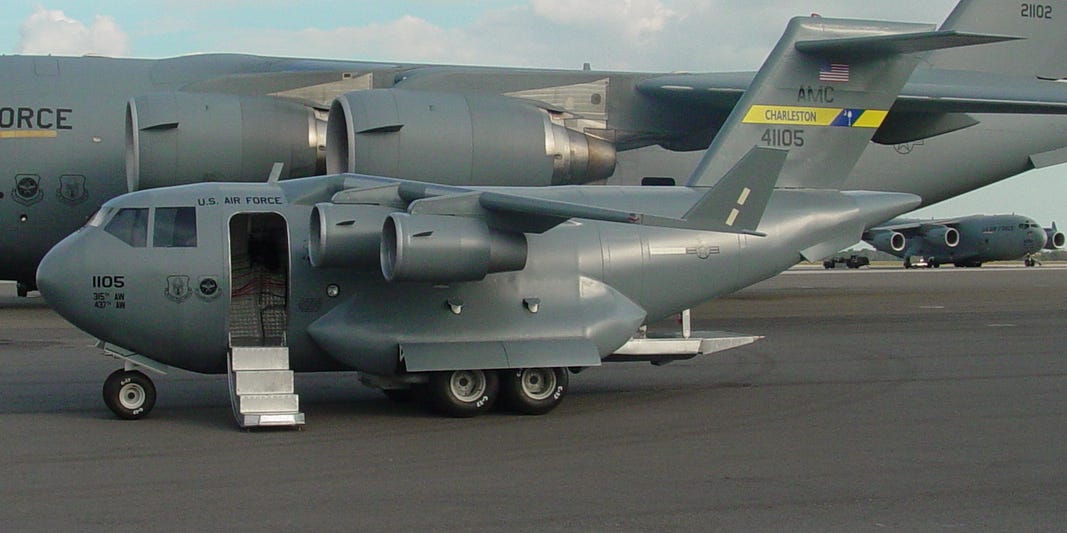
But hidden inside the serious world of strategic airlift is one of the most delightful oddities in American military aviation: a little baby C-17. Officially, it is the Mini C-17 replica known as the “Spirit of Hope, Liberty & Freedom.” Unofficially, it is the aircraft equivalent of seeing a Great Dane puppy wearing aviator sunglasses. It has the shape, markings, tail, engines, ramp, and attitude of a real C-17 Globemaster III, but it is only about 32 feet long and is built around a John Deere Gator utility vehicle.
No, it does not fly. Yes, people ask anyway. And honestly, who could blame them?
The Mini C-17 was created by volunteers from the 315th Airlift Wing and the 437th Airlift Wing at Charleston Air Force Base, South Carolina. It was designed as a community outreach and recruiting tool, but it became something more memorable: a rolling ambassador for the Air Force Reserve, aviation maintenance, and the big-hearted creativity of military people who looked at a utility vehicle and said, “You know what this needs? A cargo plane body.”
What Is the “Little Baby C-17”?
The Mini C-17 is a driveable, ground-based replica of the Boeing C-17 Globemaster III. It is not a remote-controlled model, not a flight simulator, and not a toy you can order with two-day shipping. It is a custom-built, street-parade-ready mini airlifter with a body constructed around a John Deere Gator. Its purpose is to appear at parades, air shows, career days, military displays, and recruiting events where it can do one job better than almost any brochure: make people stop, smile, and ask questions.
The replica measures approximately 32 feet long, 13.4 feet tall, and has a wingspan of about 28.5 feet. It weighs around 3,500 pounds, which makes it small compared with the full-size C-17 but still large enough that moving it around requires planning, manpower, a trailer, and probably at least one person saying, “Watch the wingtip!” every 14 seconds.
Despite its small size, the Mini C-17 includes several surprisingly realistic details. It has flight station panels, engine sounds, authentic-looking markings, an operational cargo ramp, and a cargo door. It was built in modules so it could be transported more easily. That modular design matters because this is not a hangar queen. The Mini C-17 was made to travel.
How the Air Force Built a Baby Globemaster
The story began when members of the 315th Airlift Wing learned about a miniature C-130 replica at Keesler Air Force Base in Mississippi. The idea was simple but brilliant: if a small version of a well-known military aircraft could attract attention and start conversations, why not build a miniature version of Charleston’s signature aircraft, the C-17 Globemaster III?
In December 2000, members of the 315th Aircraft Maintenance Squadron visited Keesler to study the mini C-130. After returning to Charleston, volunteers began turning the concept into a real project. A John Deere Gator, donated through recruiting channels, became the base vehicle. From there, aircraft maintainers and volunteer craftsmen used donated materials, shop skills, and plenty of patience to create a replica that looked unmistakably like the real thing.
This is the kind of project that sounds easy only if you have never tried to build anything more complicated than a bookshelf. Creating a miniature aircraft body that fits over a utility vehicle, looks proportionally accurate, can survive transport, and can safely appear around crowds is not a weekend craft project. It required fabrication, maintenance know-how, teamwork, and a willingness to solve problems that do not appear in standard aircraft manuals.
In February 2004, the replica received its official name after a base-wide naming contest: “Spirit of Hope, Liberty & Freedom.” That name may sound grand for a little vehicle with tiny jet engines that do not actually produce thrust, but it fits. The Mini C-17 is not just a cute replica; it represents the larger mission of air mobility, public service, and the connection between military aviation and local communities.
Why the C-17 Globemaster III Matters
To understand why the baby C-17 is such a crowd favorite, it helps to appreciate the full-size aircraft it imitates. The Boeing C-17 Globemaster III is one of the most flexible cargo aircraft in the U.S. Air Force inventory. It can carry troops, vehicles, pallets, medical evacuation teams, and oversized military equipment. It can operate from major bases, but it can also land on short and austere airfields where larger aircraft might hesitate like a nervous driver trying to parallel park downtown.
The real C-17 is about 174 feet long, with a wingspan of nearly 170 feet and a height of more than 55 feet. It is powered by four Pratt & Whitney F117-PW-100 turbofan engines, each producing more than 40,000 pounds of thrust. Its maximum payload is about 170,900 pounds, and it can carry 102 troops or paratroopers, 36 litter patients plus ambulatory patients and attendants, or heavy cargo such as armored vehicles.
One of the C-17’s signature strengths is its short-field capability. It can take off and land on runways as short as 3,500 feet and as narrow as 90 feet. It can also reverse on the ground using its thrust reversers, which is extremely useful when operating in tight spaces. In other words, the real C-17 is not just big; it is big and weirdly nimble. Imagine a moving truck that can dance.
From Heavy Airlift to Heavy Smiles
The full-size C-17 has supported combat operations, humanitarian relief, aeromedical evacuation, disaster response, and global military logistics. It has carried supplies after natural disasters, moved patients out of dangerous areas, supported remote missions, and helped deliver people and equipment wherever they were needed. The Mini C-17 obviously cannot do those things. It cannot haul an M1 Abrams tank, land in a dusty forward operating base, or perform aerial refueling. But it can help tell the story of the people and aircraft that do.
That is the genius of the Mini C-17. It lowers the intimidation factor. A real C-17 parked on a flight line is impressive, but it can feel untouchable to someone unfamiliar with military aviation. The Mini C-17, by contrast, invites curiosity. Children point at it. Parents take photos. Veterans grin. Aviation fans immediately start comparing proportions. Someone inevitably asks whether it flies, and the answer opens the door to a conversation about the real aircraft, the Air Force Reserve, maintenance careers, loadmasters, pilots, and the enormous logistics network behind global air mobility.
In marketing terms, the Mini C-17 is a perfect brand ambassador. In human terms, it is just plain charming.
Where the Mini C-17 Has Appeared
Since its dedication, the Mini C-17 has appeared at air shows, ballparks, parades, military displays, career events, and community gatherings. It has traveled across the United States and even made a trip overseas to the United Kingdom for Yeovilton Air Day in 2016. At that event, the miniature C-17 appeared alongside a full-size Charleston C-17 Globemaster III, creating the aviation equivalent of a family photo: proud parent, tiny offspring, both wearing the same uniform.
The Mini C-17 helped the 315th Airlift Wing earn attention at public events because it gave visitors something unusual to gather around. At Yeovilton, crowds surrounded the replica, and the display helped support a winning static display presentation. That is not surprising. Air shows are full of sleek fighters, roaring engines, and elegant aerobatics, but a baby cargo plane with a working ramp has a strange gravitational pull. It is difficult to walk past without smiling.
The replica has also appeared at major public events such as Veterans Day parades and sporting events. At the 2010 New York City Veterans Day Parade, members of the 315th Airlift Wing used the Mini C-17 to educate the public about the C-17 mission and the Air Force Reserve. At the 2011 Military Bowl in Washington, D.C., it was displayed as part of outreach connected to a national audience. For a small aircraft that cannot leave the ground, it has collected a surprisingly impressive travel resume.
Why a Mini Aircraft Works So Well for Recruiting
Recruiting is not just about handing someone a flyer and hoping they read past the first bullet point. Good recruiting creates a moment. It gives people a reason to stop. The Mini C-17 does that instantly because it is visually funny, technically interesting, and clearly built with care. It is a conversation starter with wings.
For young people, especially those who may not know much about military aviation, the replica makes the Air Force feel accessible. It shows that aviation is not only about pilots. It involves maintainers, fabricators, loadmasters, public affairs specialists, logisticians, recruiters, and volunteers. The Mini C-17 itself is proof of that. It was not created by one person with a magic wrench. It was built by a team using different skills toward one shared goal.
That message is powerful. A visitor might arrive thinking, “Cute plane.” They might leave thinking, “Maybe there is a place for me in aviation.” That is the kind of recruiting success you cannot measure only with a clipboard.
Engineering Lessons from the Baby C-17
1. Good Design Can Be Playful
The Mini C-17 proves that military engineering culture is not always cold, gray, and humorless. The replica is useful because it is playful. Its charm is part of its function. A serious mission can have a fun delivery method, and sometimes fun is what makes the serious message memorable.
2. Scale Models Teach Big Ideas
A miniature aircraft makes design features easier to notice. The high wing, T-tail, rear ramp, engine placement, and cargo shape of the C-17 all become more approachable when scaled down. Visitors can understand the aircraft’s basic mission just by looking at it: cargo goes in the back, power comes from the engines, and the high-mounted wing keeps the fuselage clear for loading.
3. Community Outreach Needs Objects, Not Just Words
People remember things they can see, hear, and photograph. The Mini C-17 has engine sounds and a working ramp because sensory details matter. It gives the public a hands-on connection to a mission that is usually far away, whether in a desert airfield, a disaster zone, or a distant base.
The Internet Fell in Love with the Mini C-17
Years after it was built, the Mini C-17 found a second life online. Aviation fans rediscovered photos of the replica and began sharing them across social media, forums, and military interest sites. The reaction was predictable: delight, jokes, questions, and a lot of affectionate nicknames. The phrase “baby C-17” stuck because it describes the aircraft perfectly. It looks like someone used a shrink ray on a Globemaster III and then told it to behave at public events.
Part of the appeal is contrast. The real C-17 is associated with immense weight, long-range missions, global logistics, and national defense. The Mini C-17 is associated with smiles, photos, and children asking whether it can fly. Put those ideas together, and you get an irresistible story. It is both impressive and adorable, which is not a combination the defense world produces every day.
Experiences Related to the Little Baby C-17
Seeing the Mini C-17 at an event is the kind of aviation experience that sneaks up on you. At first, you notice the shape. It has the chunky confidence of the real Globemaster III, with that broad nose, high wing, four engine pods, and familiar T-tail. Then your brain catches the scale. Something is delightfully off. The aircraft is too small, too close to the ground, and somehow too cheerful. It is like meeting a bulldog wearing a flight suit.
The best part is watching how different people react to it. Children usually get it immediately. They do not need a technical briefing. They see a tiny cargo plane and understand that it is wonderful. They point, laugh, ask questions, and often head straight for the rear ramp because ramps are universally interesting. Parents pull out phones. Veterans slow down and smile with that look that says they have seen plenty of military equipment in their lives, but not quite like this.
For aviation enthusiasts, the experience is more detailed. They notice the proportions, the markings, the cargo door, the attempt to preserve the C-17’s distinctive silhouette, and the odd brilliance of building the whole thing around a utility vehicle. It feels like a tribute made by people who truly know the original aircraft. The replica does not mock the C-17; it honors it by exaggerating its most recognizable features in a friendly, public-facing way.
At an air show, the Mini C-17 also provides a useful pause between loud demonstrations. Fighter jets are thrilling, but they can be overwhelming. The baby C-17 gives visitors something slower and more approachable. You can stand beside it, study it, talk to the crew, and learn about the real C-17 without needing ear protection or a deep background in military aircraft. It turns global airlift into a sidewalk conversation.
There is also something inspiring about the way it was built. The Mini C-17 is a reminder that creativity is not limited to design studios or corporate innovation labs. Sometimes it happens in maintenance shops, volunteer teams, and military units where people already spend their days solving practical problems. The same mindset that keeps aircraft mission-ready can also turn a John Deere Gator into a rolling mini Globemaster. That is wonderfully American: practical, slightly ridiculous, and deeply effective.
The experience leaves a lasting impression because it connects emotion with education. You may arrive because the aircraft is cute, but you leave knowing more about the Air Force Reserve, the C-17 mission, aircraft maintenance, and the people behind military airlift. That is why the Mini C-17 works. It is not just a small plane. It is a small doorway into a very large story.
Conclusion: Small Plane, Big Mission
The Air Force built a little baby C-17, and somehow that sentence is both funny and completely accurate. The Mini C-17 “Spirit of Hope, Liberty & Freedom” is a 32-foot-long driveable replica built from a John Deere Gator, donated materials, and the skill of Air Force volunteers. It cannot fly, but it has done something almost as valuable for public outreach: it has carried the story of the C-17 Globemaster III directly to communities, students, families, veterans, and future airmen.
The real C-17 is a giant of global mobility. The Mini C-17 is its tiny public-relations cousin with a working ramp and unstoppable charm. Together, they show two sides of the same mission: one delivers cargo across the world; the other delivers curiosity, smiles, and inspiration right where people can see it.














