
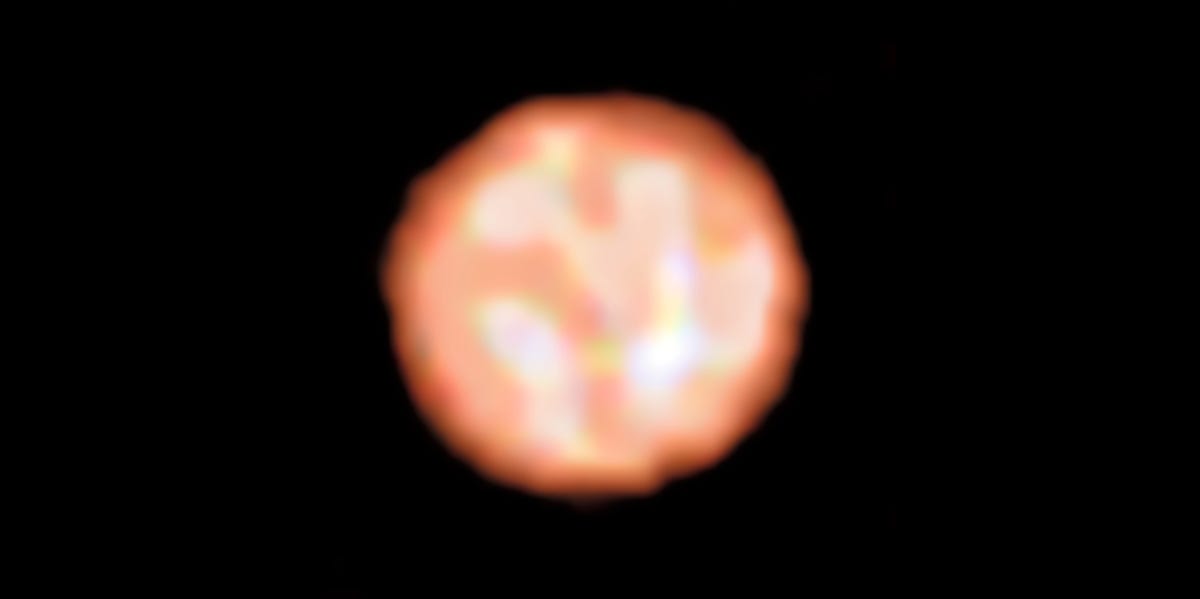
Some astronomy stories arrive with explosions, black holes, or headlines that sound like a metal band’s second album. This one arrives as a portrait: a detailed image of another star’s surface, showing enormous bubbling cells of hot plasma on a red giant called π1 Gruis. At first glance, it looks like a scientific close-up from very far awaywhich it is. But look a little longer, and it becomes something stranger and more personal: a preview of what our own Sun may become billions of years from now.
π1 Gruis sits roughly 530 light-years from Earth in the constellation Grus, the Crane. It is not a second Sun in the “same size, same mood, same coffee order” sense. It is a cool red giant, vastly swollen, late in life, and around 350 times wider than the Sun. Yet it matters to us because its mass is broadly comparable to our star’s. That makes it a valuable cosmic stand-in for studying the future behavior of Sun-like stars as they age, puff up, shed mass, and eventually leave behind a white dwarf.
The headline discovery was not merely that astronomers took a pretty space picture. The real breakthrough was that they directly observed granulation patternshuge convective cellson the surface of a star outside our Solar System. In human terms, that is like seeing weather on a glowing ball hundreds of light-years away. In astronomy terms, it is the kind of achievement that makes telescope engineers deserve cake.
What Exactly Did Astronomers Image?
The star in question, π1 Gruis, is an evolved red giant. It has already moved far beyond the calm middle-aged stage that our Sun currently enjoys. Our Sun is still a main sequence star, steadily converting hydrogen into helium in its core. π1 Gruis has gone through that main hydrogen-burning phase and expanded dramatically as its inner structure changed.
Using the PIONIER instrument on the Very Large Telescope Interferometer in Chile, astronomers combined light from multiple telescopes to achieve the resolving power of a much larger instrument. This technique, called interferometry, is the observational equivalent of getting several telescopes to stop working as solo artists and form a very precise boy band.
The result was one of the clearest direct views ever obtained of the surface of a giant star beyond the Sun. Instead of a smooth, featureless disk, π1 Gruis revealed a surface divided into a small number of gigantic bright and dark regions. These are convection cells, sometimes called granules, where hot plasma rises, cools, and sinks again.
The Giant Bubbles on π1 Gruis
On the Sun, convection is familiar to solar physicists. The solar photosphere is covered with roughly two million granules, each typically around 1,500 to 2,000 kilometers across. Through a solar telescope, they look like a restless pattern of bright kernels and darker lanes. The process is similar to boiling water, except the “water” is electrically charged plasma and the pot is a nuclear furnace the size of a star. Small difference. No need to call the kitchen inspector.
π1 Gruis plays the same game on a ridiculous scale. Its surface appears to contain only a few convective cells, but each one is enormousabout 120 million kilometers across, or roughly a quarter of the star’s diameter. One of these cells could stretch from the Sun to beyond the orbit of Venus. A single stellar “bubble” on π1 Gruis is large enough to make our entire inner Solar System feel like a studio apartment.
This difference comes largely from surface gravity. The Sun has much stronger surface gravity than a bloated red giant. On π1 Gruis, the star’s outer layers are spread across a huge volume, so gravity at the surface is weaker. With less gravity tightly controlling the motion of plasma, convection cells can grow to monstrous sizes. The result is not a tidy orange ball but a slowly shifting, uneven surface with bright hot regions and cooler darker areas.
Why This Image Matters
The importance of the π1 Gruis image is not simply visual. It gives scientists a rare test of stellar convection models. Convection affects how stars transport energy from their interiors to their surfaces. It also influences pulsation, stellar winds, mass loss, dust formation, and the way aging stars return material to space.
Before images like this, astronomers had to infer much of this behavior indirectly. They could measure brightness changes, spectra, temperatures, and motions, but directly mapping the surface of a distant giant star was extremely difficult. Many evolved stars are surrounded by dust and gas that hide their photospheres. π1 Gruis is helpful because its dust is not thick enough to block the infrared observations used in this study.
That makes the star a rare laboratory. By comparing the observed granules with computer models, researchers can check whether their theories of convection in giant stars actually match reality. In this case, the measured granule sizes aligned well with predictions, which is always comforting. Scientists love when the universe agrees with their math. It does not happen every Tuesday.
π1 Gruis and the Future of the Sun
The biggest reason this image captures the public imagination is its connection to our Sun’s future. Today, the Sun is about 4.6 billion years old and still has roughly another 5 billion years of main sequence life ahead. Eventually, however, it will run low on hydrogen fuel in its core. When that happens, the balance between gravity and fusion will change, the core will contract, and the outer layers will expand.
The Sun will become a red giant. It will grow dramatically larger, brighter, and cooler at the surface. Mercury and Venus are expected to be swallowed. Earth’s fate is less certain in the fine details, but “pleasant afternoon picnic” is not on the menu. Even if Earth avoids direct engulfment, it will be roasted long before then as the Sun’s luminosity increases.
π1 Gruis is not an exact snapshot of the future Sun. It is an S-type giant and has its own chemistry, environment, and likely companion-related history. Still, it gives astronomers a concrete example of the kinds of surface behavior that can occur when a star similar in broad mass range to the Sun reaches an advanced stage of evolution. It is not a crystal ball, but it is a very large, very hot hint.
How a Sun-Like Star Dies
Mass determines a star’s ending. Very massive stars can explode as supernovae, leaving behind neutron stars or black holes. Stars like the Sun are less theatrical. They do not go out by detonating the neighborhood. Instead, they swell into red giants, shed their outer layers, create planetary nebulae, and leave behind dense white dwarfs.
After the red giant phase, the Sun’s outer layers will drift into space. The exposed core will become a white dwarf: a hot, compact stellar remnant roughly Earth-sized but with a large fraction of the Sun’s mass packed inside. At first, it will shine from leftover heat. Over immense stretches of time, it will cool and fade.
That process may sound like an ending, but in astronomy, endings are suspiciously good at becoming beginnings. The material shed by aging stars contains elements forged inside them, including carbon and oxygen. Those elements enrich interstellar space and may become part of future stars, planets, and living things. In other words, red giants are messy recyclers. They toss cosmic ingredients back into the galaxy like someone cleaning a garage with a leaf blower.
What Granulation Tells Us About Stellar Aging
Granulation is not just surface decoration. It is evidence of energy transport. Deep inside a star, nuclear reactions produce energy. That energy must move outward. In some layers it travels as radiation; in others, it is carried by moving plasma. Convection cells are the visible signature of that motion.
On a red giant, convection can become especially important because the star’s outer envelope is enormous and unstable compared with a smaller main sequence star. The huge cells on π1 Gruis suggest that giant-star atmospheres can be dominated by only a handful of massive convective structures. These structures may help drive pulsations and winds, both of which contribute to mass loss.
Mass loss is one of the big questions in late-stage stellar evolution. How exactly does a star remove its outer layers? How smooth or clumpy is that process? How do companion stars shape the escaping gas? By studying objects like π1 Gruis, astronomers can connect surface activity to the larger story of how red giants become planetary nebulae and white dwarfs.
The Role of Interferometry
The image of π1 Gruis was possible because of interferometry. A single telescope, no matter how fancy, has a limit to the detail it can resolve. To see fine structures on distant stars, astronomers combine light from separated telescopes. This allows the instruments to work together like a telescope with an effective size equal to the distance between them.
That is crucial because stars are incredibly far away. Even a giant like π1 Gruis appears tiny from Earth. Without interferometry, its surface would remain a point of light or, at best, a blurry disk. With interferometry, researchers can reconstruct an image detailed enough to identify surface patterns.
This matters for the future of astronomy. We are entering an era when stars are not just dots with names. More and more, they are becoming places with surfaces, weather-like activity, winds, magnetic behavior, and evolving structures. The more detail we can capture, the better we can understand the life cycles of starsand, by extension, the history and future of planets orbiting them.
Why This Is Also a Story About Earth
It is tempting to treat the Sun’s death as a remote event with no practical meaning. Five billion years is not exactly next weekend. Your calendar app will not survive that software update. Still, studying the Sun’s distant future helps us understand Earth’s place in time.
Earth is habitable because the Sun is stable enough right now. But that stability is temporary on cosmic scales. As the Sun ages, it will slowly brighten. Long before it becomes a red giant, Earth’s climate will be pushed beyond what complex life can tolerate. The red giant stage is the dramatic finale, but the habitability clock starts changing much earlier.
Images of aging stars remind us that planets are not permanent stage sets. They are part of evolving stellar systems. A planet’s fate depends not only on its own geology and atmosphere but also on the life cycle of its star. That is why red giants, white dwarfs, and planetary nebulae are relevant to exoplanet science. They show what happens to worlds when their suns grow old.
Why π1 Gruis Looks Like a Preview, Not a Perfect Prediction
Calling π1 Gruis a preview of the Sun’s dying days is useful, but it should be understood carefully. The Sun will not become π1 Gruis in every detail. π1 Gruis belongs to a rare S class of stars, with unusual chemical signatures shaped by slow neutron-capture processes. It also exists in a system where companion stars and surrounding material may influence its environment.
Still, the broad comparison is scientifically meaningful. Both π1 Gruis and the Sun belong to the category of stars that do not have enough mass to end as supernovae. Both illustrate the quieter, slower path of stellar death: expansion, mass loss, exposed core, white dwarf. The image of π1 Gruis gives us a physical example of what an evolved stellar surface can look like when a Sun-like star family member grows old.
That is the power of the image. It turns future theory into something visible. Instead of saying, “The Sun will become a red giant,” we can look at a real red giant’s surface and see the enormous convection cells that may dominate such stars. The future becomes less abstract and more like a photograph from a very distant family album.
Experience Notes: Looking at a Star and Seeing Time
There is a special kind of mental whiplash that comes from reading about π1 Gruis. At first, the story feels technical: telescope arrays, interferometry, convective cells, stellar evolution models. Then the scale lands. This is not just a dot in a catalog. It is an enormous aging star, hundreds of times wider than the Sun, with surface cells so large they could swallow the inner Solar System’s architecture in one glowing gulp.
For many readers, the most powerful experience is the shift from “that star” to “our Sun.” Astronomy often works like that. It starts far away, then quietly walks back into the room and sits down next to you. π1 Gruis is distant enough to feel safely unreal, but familiar enough in stellar evolution terms to become unsettling. It shows that the Sun, the dependable lamp of everyday life, is also a star with a life cycle. It had a beginning. It has a middle. It will have an end.
That realization can be surprisingly emotional. The Sun feels permanent because human history is short. Every empire, invention, vacation, traffic jam, and bad haircut has happened under more or less the same Sun. But astronomy stretches the timeline until even the Sun becomes temporary. This does not make life smaller. If anything, it makes the present more astonishing. We exist during the Sun’s long stable chapter, the one part of the story when oceans can stay liquid, plants can photosynthesize, and humans can build telescopes powerful enough to watch other stars grow old.
There is also a practical wonder in the technology. The image of π1 Gruis is not like a snapshot taken by a normal camera. It is reconstructed from light gathered by multiple telescopes working together across distance. That means the picture is both an observation and an achievement of patience, mathematics, optics, and teamwork. The universe did not hand over this image politely. Astronomers had to pry it loose with engineering.
For anyone who has ever looked up at the night sky and seen only points of light, this discovery changes the mood. A star is not merely a sparkle. It is a physical object with a surface, structure, motion, weather-like plasma behavior, and history. Somewhere in Grus, π1 Gruis is boiling on a scale that makes human imagination wheeze. Its surface is alive with movement, not biological life, but stellar activity: hot material rising, cooling, sinking, repeating.
The experience of thinking about this image is a bit like standing in a museum where the exhibit is labeled “Future Sun.” You know the event is billions of years away. You know humanity has more immediate concerns than solar expansion. Still, the image lingers because it connects science with destiny. It says: stars age, systems change, and even the most familiar light in the sky is part of a much larger transformation.
That is why π1 Gruis matters beyond its technical achievement. It is not only one of the most detailed views of another star’s surface. It is a reminder that the universe is not frozen scenery. It is a process. The Sun is in that process. Earth is in that process. And somehow, briefly and wonderfully, so are we.
Conclusion
The detailed image of π1 Gruis is more than a milestone in stellar photography. It is a scientific window into how aging stars behave and a poetic preview of the Sun’s far future. By revealing huge convection cells on a red giant’s surface, astronomers confirmed key ideas about stellar granulation, surface gravity, and energy transport in evolved stars.
For SEO-friendly astronomy content, the story works because it blends hard science with cosmic perspective. It explains interferometry, red giant evolution, solar destiny, and the life cycle of Sun-like stars without turning the reader into a pile of confused space dust. Most importantly, it makes the Sun’s distant future visible. π1 Gruis is not our Sun, but it is close enough in the great family tree of stars to feel like a warning, a lesson, and a strangely beautiful postcard from deep time.
Note: This article is written from synthesized, publicly available astronomy information from reputable scientific and educational sources, including observatory releases, NASA science materials, university research summaries, peer-reviewed study information, and major science publications. Source links are intentionally omitted to keep the publishing copy clean.











