
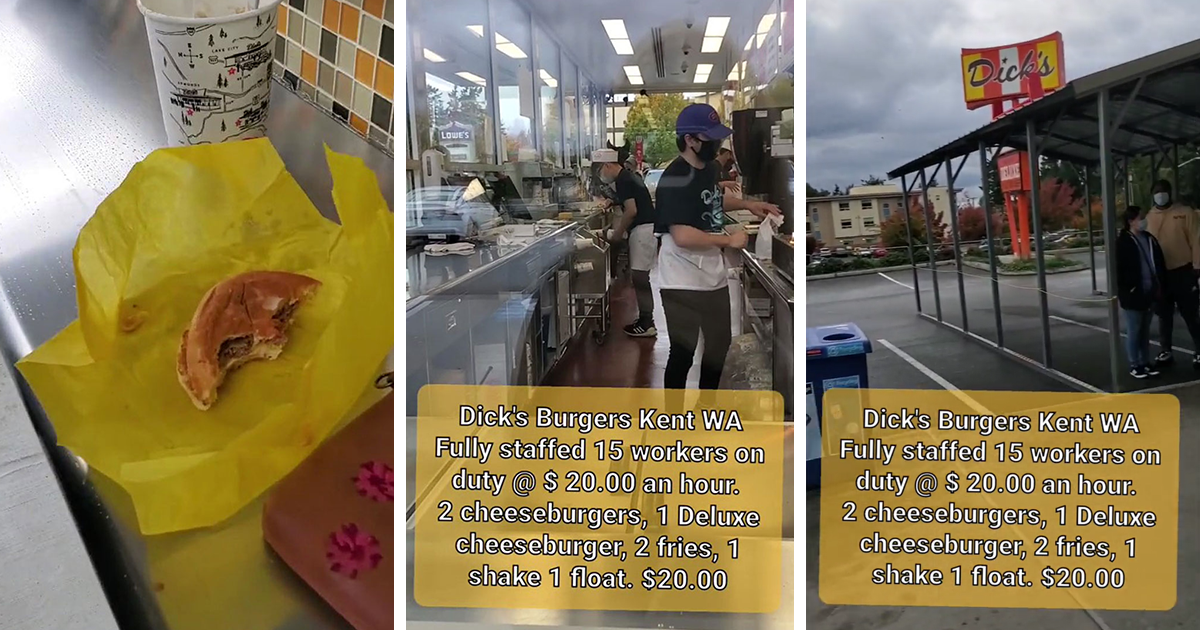
Fast food is supposed to be quick. The food arrives quickly, the line moves quickly, and if you are brave enough to open a ketchup packet in the car, your shirt is ruined quickly. But one fast-food restaurant recently made the internet stop scrolling for a moment after a woman revealed that workers there were being paid around $20 per hour.
The restaurant at the center of the conversation is Dick’s Drive-In, a beloved Seattle-area burger chain known for classic burgers, fries, shakes, late-night crowds, and a labor policy that suddenly made many people ask, “Wait, if they can do it, why can’t everyone?” The viral discussion began when a TikTok user highlighted the restaurant’s pay and benefits, sparking a familiar but still fiery American debate: Are fast-food workers being paid fairly, or are employers simply discovering that low wages no longer attract enough people?
The answer, as usual, is more layered than a double cheeseburger. A $20 hourly wage sounds generous compared with the federal minimum wage and many restaurant job postings across the United States. But in high-cost regions, especially places like Seattle, California, and major metro areas, $20 per hour can feel less like luxury and more like oxygen. The debate is not just about burgers. It is about rent, inflation, staffing shortages, customer prices, business survival, and whether the phrase “entry-level job” should be used as a magic spell to justify poverty wages.
Why This $20 Fast-Food Wage Went Viral
The internet loves a simple visual, and few things are simpler than a hiring sign. When people saw that Dick’s Drive-In was offering workers roughly $20 per hour, plus benefits, the reaction split into two loud camps. One side celebrated the restaurant as proof that better pay is possible. The other side worried that higher wages would raise menu prices, reduce hiring, or make small operators struggle to survive.
What made the story more interesting is that Dick’s Drive-In is not a flashy Silicon Valley experiment or a luxury restaurant charging $31 for “deconstructed fries.” It is a fast-food chain selling everyday comfort food. That is why the wage number hit such a nerve. If a burger stand can pay workers like valuable employees, the public naturally wonders whether low wages are truly unavoidable or simply traditional.
Dick’s Drive-In and the Business Case for Better Pay
Dick’s Drive-In has long positioned itself as a company that invests in workers. Its current employment information lists crew member pay starting at $22 per hour, with fully trained workers earning up to $26 per hour. The company also promotes employer-paid health insurance, dental benefits, scholarship support, childcare assistance, retirement perks, and promotion opportunities.
That matters because the viral debate often focuses only on the hourly rate. But pay is only one part of the employment package. A worker deciding whether to take a restaurant job may also ask: Will I get enough hours? Can I afford medical care? Is there a path to move up? Will management treat me like a person or like a disposable napkin?
Dick’s Drive-In appears to understand a basic hiring truth: workers compare jobs. If one employer offers low pay, unpredictable hours, no benefits, and a manager who treats scheduling like a game of emotional dodgeball, employees may walk across the street to a better option. In a tight labor market, “we are hiring” is not enough. The real question is, “Why should anyone want to work here?”
The Bigger Fast-Food Hiring Debate
The United States has millions of food service workers, and many of them work in physically demanding, customer-facing roles. Fast-food and counter workers take orders, prepare food, clean stations, handle payment, restock supplies, and keep smiling even when someone asks whether the fries are “fresh fresh.” It is not brain surgery, but it is real work. It requires stamina, speed, patience, communication, and the rare emotional strength to survive a lunch rush with a broken soda machine.
According to federal labor data, food and beverage serving jobs remain a huge part of the American workforce, and fast-food and counter workers make up a major share of that category. Median wages in food preparation and serving occupations have historically trailed the median wage for all U.S. occupations. That gap is one reason stories about $20 fast-food jobs become viral lightning rods.
Why Some People Support $20 Per Hour
Supporters of higher fast-food wages argue that these jobs are essential, difficult, and often performed by adults with bills, children, transportation costs, and rent. They reject the old stereotype that fast food is only for teenagers earning pocket money. Many workers are primary earners or important contributors to household income.
Higher pay can also reduce turnover. Restaurants often lose money when employees quit because managers must recruit, interview, train, and schedule replacements. A better wage can make workers stay longer, learn faster, and provide more consistent service. Customers may not notice the economics behind the counter, but they do notice when the restaurant is understaffed, chaotic, or run by a brand-new crew every week.
Why Some Business Owners Push Back
Opponents are not always cartoon villains twirling mustaches over a cash register. Many franchisees and small restaurant operators face tight margins, rising food costs, rent hikes, insurance expenses, delivery app fees, maintenance bills, and customers who are already tired of inflation. When labor costs jump quickly, owners may raise prices, cut hours, delay hiring, introduce kiosks, simplify menus, or reduce operating hours.
That is the heart of the debate. Workers say they need enough money to live. Employers say they need enough money to operate. Customers say they want fair wages but also do not want to pay the GDP of a small island for a combo meal. Everyone has a point, which is deeply inconvenient for anyone hoping for an easy answer.
California Turned the Debate Into State Policy
The $20 fast-food wage debate grew even louder after California implemented a sector-specific minimum wage for many fast-food workers. Beginning April 1, 2024, covered fast-food employees in California had to be paid at least $20 per hour. The law applied to many large fast-food chains and made California a national testing ground for the question that Dick’s Drive-In had already raised: What happens when fast-food workers receive a significantly higher wage floor?
The results are still debated. Some research from UC Berkeley found that the California wage increase raised worker pay without producing clear negative effects on fast-food employment, while estimating modest price increases. Other research, including a Cato summary of work by economists Jeffrey Clemens, Olivia Edwards, and Jonathan Meer, argued that California’s policy reduced fast-food employment by thousands of jobs compared with what might have happened otherwise.
In other words, even the economists are still fighting over the receipt. That does not mean the policy failed or succeeded in a simple way. It means labor markets are complicated. Regional cost of living, local demand, chain size, franchise debt, automation, menu pricing, and customer behavior all shape the outcome.
Does Higher Pay Mean Higher Prices?
Usually, yes, at least somewhat. Labor is a major restaurant cost, so higher wages can push operators to raise menu prices. The real question is how much. A small increase may be accepted by customers, especially if service improves and workers stay longer. A large increase may push budget-conscious diners away, particularly families already watching grocery and gas prices.
For a chain like Dick’s Drive-In, the model depends on volume, efficiency, and a simple menu. That can make higher wages easier to manage than in a slower restaurant with complicated service. A streamlined menu means faster training, fewer mistakes, quicker throughput, and better labor productivity. Put plainly: if your restaurant can sell a lot of burgers quickly, you may have more room to pay workers well than a business where five employees spend ten minutes arguing with a printer that refuses to print table seven’s order.
The “No One Wants to Work” Argument Needs an Update
During the pandemic recovery, many employers complained that “no one wants to work.” The phrase became so common it practically deserved its own uniform. But the Dick’s Drive-In story offered a counterpoint: maybe people do want to work, but they are more selective about jobs that do not pay enough, offer unstable hours, or treat employees poorly.
A hiring shortage is not always a worker shortage. Sometimes it is a wage shortage, a benefits shortage, a respect shortage, or a scheduling shortage. When a company improves the job, more applicants may appear. That does not mean every restaurant can instantly pay $25 per hour and hand out scholarships like fries. But it does mean businesses must compete for labor the same way workers compete for jobs.
What Fast-Food Workers Actually Do
One reason the debate gets heated is that many people underestimate the work. Fast-food employees stand for hours, handle repetitive tasks, manage food safety, deal with impatient customers, clean messes they did not create, and keep operations moving during rushes. They often work nights, weekends, holidays, and unpredictable shifts.
The job may not require a college degree, but that does not make it easy. Skill is not always measured by diplomas. Sometimes skill is remembering six customized orders, keeping fries from burning, calming down an angry customer, and doing it all while someone in the drive-thru has changed their mind for the fourth time.
Why Benefits Matter as Much as the Hourly Wage
The viral $20 wage was attention-grabbing, but Dick’s Drive-In’s broader benefits package may be even more important. Health insurance, scholarships, childcare assistance, retirement support, and promotion paths can change how workers see a job. Instead of a temporary stop, the job becomes a platform.
This is especially relevant in fast food, where turnover can be high. If employees see no future, they leave. If they see training, raises, benefits, and advancement, they may stay. That stability helps the employer too. Experienced workers are faster, safer, and better at handling the tiny emergencies that define restaurant life: spilled milkshakes, missing buns, late deliveries, register problems, and the mysterious disappearance of every clean towel in the building.
Is $20 Per Hour a Living Wage?
It depends where the worker lives. In some parts of the United States, $20 per hour can be solid starting pay. In expensive cities, it may still be barely enough. A full-time worker earning $20 per hour makes about $41,600 per year before taxes. That sounds decent until rent, transportation, food, healthcare, childcare, student loans, and emergency expenses show up at the door like a very rude marching band.
This is why the phrase “living wage” is so controversial. A national number cannot capture every local cost. Seattle is not rural Alabama. San Francisco is not small-town Kansas. A fair wage discussion must consider geography, housing costs, household size, and whether workers receive benefits.
What Other Restaurants Can Learn
Not every restaurant can copy Dick’s Drive-In exactly. But many can learn from the strategy. A strong hiring offer is not only about generosity; it is about reducing churn, improving operations, and becoming known as a good employer. In a competitive labor market, reputation matters.
Restaurants that cannot raise pay dramatically may still improve scheduling, training, management culture, advancement paths, meal policies, and communication. Workers notice when a business is organized. They notice when managers respect availability. They notice when raises are clear instead of hidden behind vague promises like “we’ll see after things settle down,” which in restaurant language can mean “somewhere between next Tuesday and the heat death of the universe.”
The Real Lesson Behind the Viral Moment
The viral Dick’s Drive-In story is not just about one woman, one TikTok, or one hiring sign. It is about a national shift in how Americans value service work. For decades, fast-food labor was often described as low-skill, temporary, and replaceable. But recent labor shortages, inflation, and public debates about essential work have challenged that idea.
Consumers want fast, friendly, affordable food. Businesses want stable profits. Workers want wages that match the cost of living. The hard part is balancing all three. The $20 wage debate forces everyone to look directly at the real cost of convenience. Cheap food is not magic. Someone cooks it, packages it, cleans up after it, and absorbs the pressure when the line gets long.
Experience-Based Reflections: What This Debate Feels Like on the Ground
Anyone who has worked in food service, managed hourly employees, or simply watched a lunch rush from the customer side knows the restaurant world runs on pressure. The work looks simple from across the counter because good workers make it look simple. That is the trick. A smooth fast-food shift is like a stage performance where the actors are also cleaning the stage, fixing the lights, counting money, and occasionally getting yelled at because the ice cream machine is down.
From a worker’s perspective, the difference between a low-wage job and a better-paid job is not just extra spending money. It can mean being able to repair a car before it breaks completely, buy groceries without mental math in every aisle, or say yes to a doctor’s appointment instead of hoping the problem disappears. A few more dollars per hour can reduce stress in ways customers never see.
From a manager’s perspective, higher wages can create both relief and anxiety. Relief comes when more applicants respond, employees stay longer, and training finally sticks. Anxiety comes when payroll rises faster than sales, especially in locations with thin margins. A responsible manager has to care about both the people and the numbers. Ignore the people, and the restaurant becomes a revolving door. Ignore the numbers, and there may be no restaurant left.
From a customer’s perspective, the debate often arrives through prices. A burger that used to feel cheap now feels like a small financial decision. Customers may support higher wages in theory, but they still compare prices in practice. That tension is real. People want workers treated fairly, but they also want dinner to remain affordable. The most successful restaurants will be the ones that explain value clearly, operate efficiently, and make customers feel that the extra cost supports better service rather than disappearing into corporate fog.
The Dick’s Drive-In example stands out because it reframes fast-food work as something worth investing in. It suggests that when employees are paid better and supported with benefits, the job can become more stable, more respected, and more attractive. That does not solve every problem in the restaurant industry, but it changes the conversation. Instead of asking, “How little can we pay and still keep the doors open?” more businesses may need to ask, “What kind of job would make good people want to stay?”
That question is bigger than burgers. It applies to retail, caregiving, hospitality, delivery, warehouses, and every job where workers were once called “essential” but often paid as if they were optional. The $20 fast-food wage debate keeps resurfacing because it touches a nerve in American life: people want work to pay enough to live, and businesses want costs they can survive. Somewhere between those two truths is the future of hiring.
Conclusion
The fast-food restaurant wage debate reignited by Dick’s Drive-In shows that $20 per hour is more than a number. It is a symbol of changing expectations. Workers are asking for pay that reflects modern living costs. Employers are trying to balance wages, prices, staffing, and survival. Customers are deciding what they are willing to pay for convenience and fairness.
The most honest answer is that higher wages are neither a miracle cure nor an automatic disaster. They are a business choice, a policy tool, and a social statement all at once. When handled thoughtfully, better pay can attract workers, reduce turnover, and improve service. When implemented suddenly or without operational planning, it can strain some businesses and push prices upward.
Dick’s Drive-In became part of the national conversation because it showed that fast-food jobs do not have to be treated as disposable. Whether every restaurant can match its model is debatable. But the question it raised is here to stay: in a country that depends on service workers every day, what should their work be worth?
Note: This article is written for web publishing in standard American English, based on real wage reporting and labor information, and intentionally excludes source-link placeholders or citation artifacts.











