A secondhand chair may bring character to a room. An antique mirror may make a hallway look larger. A vintage doll may add nostalgic charmright up until someone claims it changes expressions, moves after midnight, or causes visitors to apologize by mail.
Stories about cursed and haunted household items transform familiar belongings into supernatural suspects. Beds become portals, paintings survive fires, and cabinets arrive with more emotional baggage than the average family reunion. Yet these legends are not all alike. Some are rooted in documented objects and identifiable owners. Others grew through tabloid reporting, online auctions, tourism, movies, or stories repeated so often that folklore eventually put on a name tag and introduced itself as history.
This ranking considers cultural influence, the quality of the available historical record, and one essential question: How uncomfortable would this object make a houseguest feel at 2 a.m.? Paranormal activity has not been scientifically verified in any of these cases, so the alleged curses should be understood as legends, personal testimony, or entertainmentnot established fact.
Why Do Ordinary Household Objects Become “Haunted”?
Household belongings are ideal containers for ghost stories because they feel personal. A chair remembers the shape of its owner. A mirror appears to preserve every face that passes before it. Dolls resemble people but remain unnervingly stillusually. When such an item survives a death, changes owners, or arrives without a clear history, imagination supplies the missing chapters.
Expectation also matters. Psychology research suggests that people who enter a place believing it is haunted are more likely to report strange sensations. Darkness, drafts, old plumbing, unfamiliar smells, fatigue, and suggestions from other people can turn ordinary events into an apparently connected pattern. In other words, once an object earns a sinister reputation, every creak becomes a witness.
10. The “Haunted” Mirror Linked to Bela Lugosi
Mirrors already have an unfair advantage in the horror business. They reverse familiar spaces, create movement in peripheral vision, and are exceptionally talented at making bathrobes resemble intruders.
A mirror displayed by paranormal entertainer Zak Bagans has been promoted as an object once connected to Bela Lugosi, the actor famous for portraying Dracula. Stories surrounding it include emotional distress, shadowy figures, and unusual experiences reported by later owners. However, investigations into its provenance have challenged the claimed Lugosi connection, finding gaps between the dramatic story and the available documentation. The mirror remains an effective haunted attraction, but its Hollywood history is considerably foggier than its glass.
9. The Hands Resist Him Painting
Painted by Bill Stoneham in 1972, The Hands Resist Him depicts a boy standing beside a doll-like girl in front of a glass-paneled door. Numerous small hands press against the glass behind them. It is not exactly the sort of artwork that whispers, “Relax, everything is fine.”
The painting became an early internet legend after appearing on eBay in 2000. Its sellers claimed the figures moved at night and included photographs that supposedly showed changes in the scene. The listing attracted enormous online attention, and some viewers reported headaches, uneasiness, or nightmares after seeing the images. Stoneham explained that the boy was based on a childhood photograph of himself, while the doorway represented the boundary between ordinary reality and imagination. The supernatural reputation came later, assisted by one very memorable auction description.
8. The Crying Boy Print
During the 1980s, British tabloids began connecting mass-produced prints of a tearful child with a series of house fires. Reports claimed that copies of the Crying Boy image had been discovered largely undamaged among burned furniture and ruined rooms. Soon, an affordable piece of sentimental wall art had become the decorative equivalent of a smoke alarm with malevolent intentions.
The legend gained national attention in 1985, but investigators proposed a practical explanation. Many prints were produced on dense board with a protective coating. When the hanging cord burned, the picture could fall facedown, shielding its surface while more combustible materials continued burning around it. The fires were real; the alleged supernatural connection was not demonstrated. Still, “fire-resistant manufacturing materials” never had the same headline potential as “cursed crying child.”
7. The Myrtles Plantation Mirror
A large mirror at Louisiana’s Myrtles Plantation is said to contain the spirits of Sara Woodruff and two of her children. According to the familiar version of the story, the family members were poisoned, and the mirror was accidentally left uncovered after their deaths. Their spirits supposedly became trapped inside, later appearing as handprints or shadowy shapes.
Historical research creates serious problems for that version. Records indicate that Sara Woodruff and her children were not murdered by poisoning, and researchers have reported that the mirror entered the house much later than the supposed tragedy. Marks appearing in photographs may also come from the backing, lighting, reflections, or the aging materials behind the glass. The legend remains popular because a cloudy antique mirror in a historic plantation needs very little help looking suspicious.
6. The Tallman Family’s Bunk Bed
In the late 1980s, the Tallman family of Horicon, Wisconsin, reportedly began experiencing disturbing activity after purchasing a secondhand bunk bed. Family members described strange voices, apparitions, unexplained movement, and the frightening sense that something hostile had entered their home.
The story later appeared on Unsolved Mysteries, turning a used children’s bed into one of America’s best-known pieces of allegedly haunted furniture. According to retellings of the case, the experiences stopped after the family left the house and the bed was removed or destroyed. There is no independent evidence showing that the furniture caused paranormal activity, but the case established an enduring rule for thrift-store shopping: Inspect the joints, check for insects, and perhaps avoid anything with its own television episode.
5. The Conjure Chest
The Kentucky Historical Society preserves a mahogany-veneered chest of drawers surrounded by a multigenerational curse legend. The story begins around 1830 and alleges that an enslaved craftsperson created the chest for a man who had treated him brutally. A curse was supposedly placed on the furniture, after which numerous illnesses, deaths, and family tragedies became associated with people who used it.
The chest passed through generations before Virginia Cary Hudson Mayne donated it to the Kentucky Historical Society in 1976. Researchers have continued examining family records and oral traditions to distinguish documented events from later additions. Whatever conclusion one reaches, the chest illustrates how heirlooms can preserve more than clothing. They also hold memories, trauma, family storytelling, and unresolved history.
4. Busby’s Stoop Chair
Busby’s Stoop Chair, also called the Dead Man’s Chair, is associated with Thomas Busby, an English criminal executed in 1702. Legend says Busby cursed his favorite chair before his death, declaring that anyone who sat in it would meet a terrible fate.
Over time, stories linked the chair to fatal accidents involving soldiers, workers, and curious pub customers. It was eventually donated to the Thirsk Museum in 1978 and suspended from the ceiling so nobody could sit in it. There is, however, a major historical wobble in the story: the surviving chair appears to have been manufactured after Busby’s lifetime. That does not prove chairs cannot be cursed, but it suggests this particular chair may have arrived late to its own origin story.
3. The Dybbuk Box
The Dybbuk Box entered popular culture as a small wine cabinet allegedly containing a malicious spirit from Jewish folklore. Its modern story began with an online auction in the early 2000s. Seller Kevin Mannis described nightmares, strange odors, illness, and misfortune connected to the cabinet and its previous owner.
Subsequent owners expanded the narrative, and the object eventually inspired books, television episodes, and the movie The Possession. Detailed investigations, however, found that key parts of its history could not be verified. Mannis also publicly acknowledged fabricating the original narrative, making the Dybbuk Box an extraordinary example of internet folklore growing from a sales listing into a global supernatural franchise. The story may not prove that spirits live in cabinets, but it certainly proves that good product descriptions can be dangerously effective.
2. Annabelle
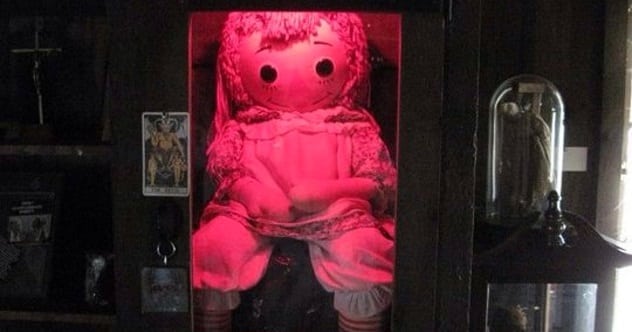
The real Annabelle looks nothing like the sharp-featured porcelain doll shown in the movies. She is a large Raggedy Ann doll, which somehow makes the story both less cinematic and more unsettling.
According to accounts promoted by paranormal investigators Ed and Lorraine Warren, a nurse named Donna received the doll from her mother in 1970. Donna and her roommate reportedly noticed that it changed positions and appeared in different rooms. They also claimed to find handwritten messages asking for help. The Warrens later took possession of the doll and described the activity as demonic rather than the work of a human spirit.
Annabelle became internationally famous through The Conjuring film universe. The documented facts establish the doll’s identity, its connection to the Warrens, and its enormous cultural influence. Claims that it moves, attacks people, or causes fatal accidents remain unverified paranormal testimony.
1. Robert the Doll
Robert the Doll has the ideal résumé for this list: an unsettling face, a sailor suit, more than a century of stories, and a museum display that receives apology letters.
Robert belonged to Key West artist Robert Eugene “Gene” Otto. Stories from Otto’s childhood claimed that the doll changed expressions, moved around the house, and received blame whenever something went wrong. After Otto’s death, later residents reported additional strange incidents. In 1994, Robert was donated to the Fort East Martello Museum, where he remains on permanent display.
Visitors are commonly advised to ask permission before photographing him. According to the museum’s tradition, people who behave disrespectfully sometimes blame subsequent bad luck on Robert and send letters requesting forgiveness. Are these misfortunes supernatural, coincidental, or examples of people connecting unrelated events after hearing the legend? No controlled test has answered that question. Nevertheless, Robert has achieved something most household objects can only dream of: permanent accommodations, climate control, and worldwide celebrity status.
Experiences People Commonly Associate With Haunted Household Items
Bringing home an object with a frightening reputation can create a surprisingly intense experience even when nothing unusual occurs. The first evening is often the most dramatic. A new antique changes the outline of a room, reflects unfamiliar patches of light, or produces noises as its materials adjust to temperature and humidity. A wooden cabinet may crack as it cools. A mirror may catch headlights from the street. A doll’s glass eyes may appear to follow someone because their concave or reflective surfaces create the illusion of a shifting gaze.
The Expectation Effect
Imagine that one person buys an old portrait without knowing its history. It hangs quietly for months. Then a visitor says, “That painting looks haunted.” Suddenly, the owner notices every sound near it. A loose frame tapping against the wall becomes a deliberate knock. A headache becomes evidence of an unseen presence. A nightmare that would normally be forgotten becomes part of the object’s growing case file.
This does not mean the person is lying. Experiences can feel completely genuine while their interpretation remains uncertain. Controlled experiments have shown that people who are told a location is haunted tend to report more unusual sensations than people given a neutral explanation for the same surroundings. Fear is also socially contagious. When one family member becomes alarmed, others may watch more closely, sleep less comfortably, and interpret ambiguous events as threatening.
Nighttime Encounters and Sleep Paralysis
Some of the most frightening reports involve waking to see a figure near a bed, feeling pressure on the chest, hearing a voice, or being unable to move. These symptoms closely resemble sleep paralysis, a state in which awareness returns while the temporary muscle paralysis of REM sleep continues. Research has found that a sensed presence and vivid visual or auditory hallucinations are common during such episodes. When a supposedly haunted doll or painting is already in the room, it can become the obvious target of blame.
When a “Haunting” Requires a Safety Inspection
Repeated headaches, nausea, dizziness, confusion, weakness, or unusual behavior inside a home should never be treated as entertaining paranormal evidence. Carbon monoxide exposure can cause these symptoms, including altered mental status and, in serious cases, hallucinations. Residents should leave the area, seek medical assistance when appropriate, and have fuel-burning appliances, ventilation systems, detectors, and electrical equipment inspected.
Old objects can also bring non-supernatural hazards into a home. Antique paint may contain lead. Upholstered furniture can harbor insects or mold. Damaged wiring in lamps can cause shocks or fires. Unstable wardrobes and chests can tip over. Before investigating spirits, inspect the screws.
A Sensible Response to an Allegedly Haunted Object
Start by documenting events without embellishment. Write down the date, time, weather, witnesses, and exactly what happened. Check windows, pipes, heating systems, pets, pests, floor movement, reflective surfaces, and nearby electronics. Record ordinary explanations with the same enthusiasm given to spooky ones.
If the object causes continuing anxiety, there is no rule requiring it to remain in the house. Return it, donate it with an honest description, place it in storage, or ask a trusted person to remove it. Respect religious or cultural practices when they provide comfort, but avoid anyone demanding large payments, encouraging dangerous rituals, or telling frightened people to stop taking prescribed medication.
The best haunted-object experiences leave behind a good story rather than an injury, financial scam, or untreated safety problem. Enjoy the folklore, preserve genuine history, and remember that a mysterious thump at midnight is statistically more likely to be plumbing than a Victorian child demanding possession of the guest room.
Conclusion
Cursed and haunted household items endure because they make the supernatural feel portable. A ghost in a distant castle is interesting; a ghost included free with a used bunk bed is a personal scheduling problem.
Robert, Annabelle, the Dybbuk Box, and the other objects on this list occupy the shadowy boundary between history, folklore, psychology, entertainment, and commercial storytelling. Their physical existence can often be confirmed, but their supernatural reputations depend on anecdotes, disputed histories, coincidence, and belief. That uncertainty is not a weakness. It is exactly what keeps people debating, investigating, and carefully saying “excuse me” after bumping into an antique chair.
Note: The paranormal claims described in this article are presented as folklore and reported experiences. They should not be interpreted as scientifically proven events. Health concerns, suspected gas exposure, electrical problems, structural noises, or other household hazards should be evaluated by qualified professionals.