Note: This article is written as high-level news analysis for public reading. It focuses on strategic context, verified reporting, and the broader impact of naval drones, without providing operational instructions.
Ukraine’s war at sea has become one of the most unexpected stories of the Russia-Ukraine conflict. For a country that began the full-scale invasion with a tiny conventional navy, Ukraine has repeatedly found ways to make Russia’s Black Sea Fleet look less like an untouchable armada and more like a very expensive collection of floating targets. The latest headline-grabbing example: Ukrainian kamikaze drone boats reportedly sank another Russian ship, the patrol vessel Sergey Kotov, near the Kerch Strait.
The attack, reported in March 2024, was claimed by Ukraine’s military intelligence agency, which said its Group 13 special unit used Magura V5 uncrewed surface vessels to hit the Russian Black Sea Fleet ship. Russia did not confirm the loss, and independent verification in wartime conditions is never simple. Still, the incident fit a pattern that had already become hard to ignore: Ukrainian naval drones were no longer experimental curiosities. They had become a serious threat to Russian ships operating near Crimea and beyond.
And that is the part that matters most. This was not just one ship going down in dramatic nighttime footage. It was another signal that the rules of naval warfare are changing quickly, especially in tight coastal waters like the Black Sea. Large ships still matter, but small uncrewed boats have earned a seat at the strategic table. Someone should probably give them a name tag.
What Happened to the Russian Ship Sergey Kotov?
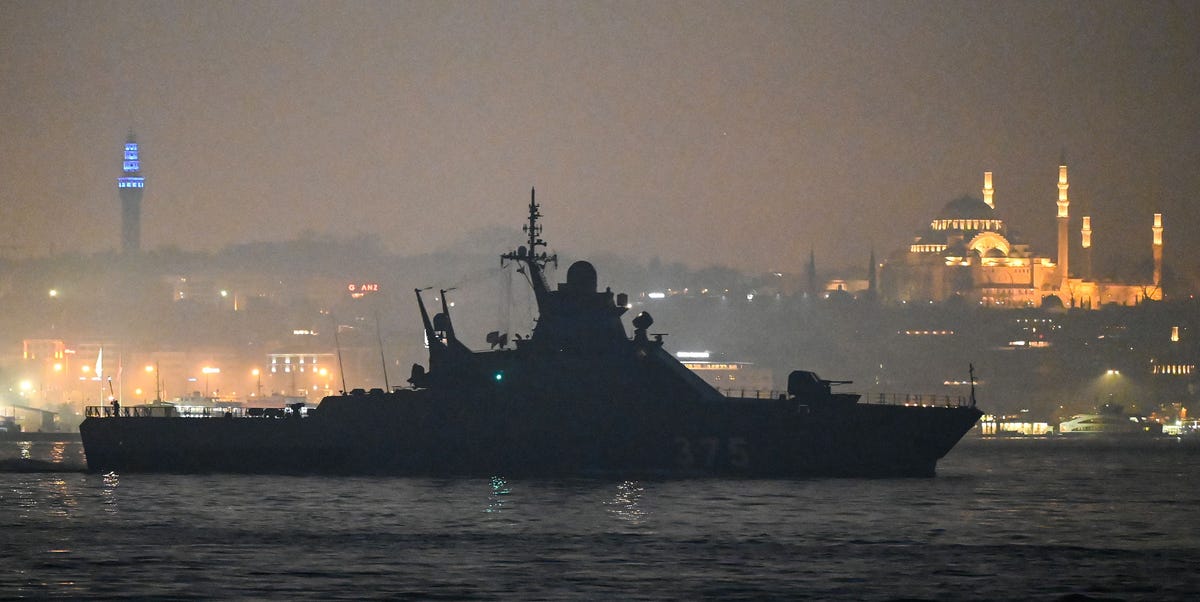
The Sergey Kotov was a modern Russian Project 22160 patrol ship, part of the Black Sea Fleet. Ukrainian officials said the vessel was attacked near the Kerch Strait, the narrow waterway connecting the Black Sea and the Sea of Azov. According to Ukraine’s account, multiple naval drones struck the ship, damaging it severely enough that it later sank.
Ukrainian officials described the strike as another successful operation by Group 13, a special unit associated with Ukraine’s military intelligence service. The same broad family of naval drones had previously been linked to attacks on other Russian vessels. The Sergey Kotov was not a symbolic old tub kept around for parades and patriotic speeches. It was a relatively new patrol ship with military utility, reportedly worth tens of millions of dollars.
Reports at the time said the ship may have had a helicopter on board and could support missile-related operations. That made the loss more painful for Moscow than the sinking of a minor auxiliary craft. In plain English: Ukraine did not just swat a mosquito; it appears to have hit something Russia actually cared about.
Why Ukrainian Drone Boats Are So Disruptive
Ukraine’s naval drones are often described as kamikaze drone boats, sea drones, or uncrewed surface vessels. The basic idea is simple from a reader’s point of view: small remotely controlled or semi-autonomous craft can approach a target at sea and detonate on contact. The strategic consequences, however, are anything but simple.
Traditional naval thinking often favors big platforms: cruisers, destroyers, frigates, submarines, and aircraft carriers. These are powerful, expensive, and politically impressive. They are also difficult to replace quickly once damaged or destroyed. A naval drone, by contrast, is far cheaper than a warship. Even when several are lost in a single operation, the economic trade-off can still favor the attacker.
That cost imbalance is one reason Ukraine’s campaign has attracted attention far beyond the Black Sea. Military planners in the United States, Europe, and Asia are watching closely because the lesson is uncomfortable: the future navy may not simply be a bigger navy. It may be a smarter, more distributed, more robotic navy.
The Black Sea Has Become a Testing Ground
The Black Sea is not the open Pacific. It is geographically constrained, crowded with ports, coastlines, surveillance opportunities, and political choke points. That makes it especially vulnerable to sea-denial tactics. Ukraine does not need to defeat the entire Russian Navy globally. It only needs to make certain areas too dangerous, too costly, or too unpredictable for Russian ships to operate freely.
This is where Ukraine’s drone boats have been most effective. They have contributed to a layered maritime campaign that also includes missiles, intelligence, coastal defenses, and strikes against infrastructure in occupied Crimea. The result has been a major shift in Russia’s naval behavior. Ships that once operated confidently from Sevastopol have been pushed toward safer ports farther from Ukraine’s reach.
That does not mean Russia’s Black Sea Fleet is finished. It still has submarines, missile platforms, aircraft support, and land-based systems. But the fleet’s freedom of movement has been reduced. For a navy, freedom of movement is not a luxury feature, like heated seats in a car. It is the whole point.
From Moskva to Sergey Kotov: A Pattern of Naval Pressure
Ukraine’s success at sea did not begin with drone boats. In April 2022, the sinking of the Russian cruiser Moskva became a defining moment of the war. The loss of the Black Sea Fleet’s flagship was a major symbolic and operational blow. It told the world that Ukraine could hurt Russia at sea, even without matching Russia ship for ship.
After that, Ukraine continued to develop a mixed approach. Missiles threatened larger targets. Aerial drones and sabotage complicated Russian defenses. Naval drones added a new layer of pressure, especially against ships near ports, anchorages, and coastal routes.
By early 2024, several Russian vessels had been damaged or destroyed in Black Sea operations. The Ivanovets, the landing ship Caesar Kunikov, and then the Sergey Kotov became part of a growing list of losses or serious hits. Each individual incident had its own details, but together they told a bigger story: Russia’s fleet was being forced to defend itself against a country with few traditional warships left.
Why the Sergey Kotov Sinking Matters
The reported sinking of the Sergey Kotov matters for three main reasons. First, it showed that Russia’s newer patrol ships were not immune to the drone threat. Modern does not automatically mean safe. In naval warfare, confidence can become a liability when the threat environment changes faster than defensive habits.
Second, the attack happened in a strategically important area. The Kerch Strait is tied to Crimea, Russian logistics, and maritime access between the Black Sea and the Sea of Azov. Any successful strike near that zone sends a message: Ukrainian reach is not limited to the front line on land.
Third, the loss reinforced Ukraine’s information advantage. Naval drone attacks often produce dramatic footage, and in modern war, video matters. It shapes public perception, boosts morale, and pressures political leaders. A burning ship in the dark is not just a military image; it is a communication event.
Russia’s Problem: Defense Is Getting Harder
Defending a warship against small, fast, hard-to-detect threats is difficult, especially at night or near cluttered coastlines. Ships can use guns, sensors, electronic warfare, barriers, helicopters, patrol boats, and other protective measures. But no defense is perfect, and the attacker only needs a few drones to get through.
Russia has adapted. It has moved vessels, added defenses, changed operating patterns, and tried to intercept drones earlier. But adaptation is a race, not a finish line. Ukraine changes its systems. Russia changes its defenses. Ukraine studies those defenses and adjusts again. It is a cycle of wartime innovation, and it moves much faster than traditional defense procurement. Somewhere, a committee is probably still designing the committee that will study it.
The result is a constant pressure campaign. Even when Ukrainian drones do not sink a ship, they can force Russia to spend time, money, attention, and defensive resources. That is sea denial in action: not always destroying the enemy fleet, but making it harder for that fleet to do its job.
Ukraine’s Maritime Strategy: Small Tools, Big Effects
Ukraine’s naval drone campaign is often described as asymmetric warfare. That term can sound fancy, but the idea is straightforward: when you cannot match an enemy’s strength directly, you attack where the enemy is vulnerable. Ukraine cannot build a Russian-style Black Sea Fleet overnight. So it has focused on tools that can impose costs, disrupt operations, and create uncertainty.
Drone boats fit that strategy perfectly. They are not magic weapons. They can fail, be intercepted, malfunction, or miss their targets. But they give Ukraine a way to threaten high-value ships without risking crews at sea. They also allow repeated pressure across a wide maritime battlespace.
This approach has helped Ukraine challenge Russia’s naval blockade, protect export routes, and reduce the psychological dominance Russia once held in the Black Sea. For Ukraine’s economy, that matters. Maritime trade is not an abstract issue; it affects grain exports, revenue, jobs, insurance, shipping confidence, and international support.
What This Means for Modern Naval Warfare
The Ukrainian drone boat campaign has become a case study for navies around the world. The lesson is not that big ships are obsolete. That claim is too easy, too dramatic, and too likely to age badly. Big ships still provide air defense, command capability, long-range strike, logistics, and presence. But the lesson is that big ships now operate in a world where smaller, cheaper, networked systems can threaten them in new ways.
Future navies will need better drone detection, layered close-range defenses, electronic protection, rapid repair methods, and their own uncrewed systems. They will also need commanders who understand that a threat does not have to look impressive to be dangerous. A small boat on a dark sea can be just as strategically annoying as a missile battery with a press release.
Ukraine has shown that naval power can come from land, from software, from improvisation, and from relentless learning. That combination is difficult for traditional fleets to handle because it does not wait politely for a 20-year procurement cycle.
The Information War Around Each Sinking
Every reported sinking in the Russia-Ukraine war comes with uncertainty. Ukraine announces success. Russia often stays silent, denies the claim, or provides limited information. Open-source analysts examine video, satellite imagery, ship-tracking data, and local reports. Journalists try to verify what they can. Readers are left sorting through a fog bank of war claims, propaganda, and partial evidence.
That is why careful language matters. Saying “Ukraine claimed” is not weakness; it is accuracy. Saying “reported sinking” is not hedging for fun; it reflects the reality that wartime verification is hard. Still, when multiple indicators point in the same direction and a ship disappears from active service, the strategic effect can be discussed even while some details remain uncertain.
In the case of the Sergey Kotov, the attack became widely reported because it matched Ukraine’s established pattern of naval drone operations and because the available footage and official statements supported the core claim. The broader takeaway does not depend on one perfect piece of evidence: Russia’s Black Sea operations have become more dangerous, and Ukraine’s sea drones are a major reason.
Experience-Based Takeaways: What This Story Teaches Readers
For anyone following the war from the outside, the first experience-related lesson is humility. Many early assumptions about the naval balance in the Black Sea turned out to be too simple. Russia had the bigger fleet, the established bases, the larger missile inventory, and the stronger traditional naval position. Ukraine had fewer ships and fewer classic naval options. On paper, that looked decisive. In practice, Ukraine found ways to change the math.
The second lesson is that innovation often comes from necessity. Ukraine did not develop naval drones because they were trendy defense expo gadgets. It developed and refined them because it needed practical ways to survive, strike back, and keep maritime routes alive. That kind of pressure can produce fast learning. It can also produce unusual solutions that formal institutions might dismiss until they start sinking expensive things.
The third lesson is about morale. A successful strike on a Russian ship does more than remove a platform from the battlefield. It gives Ukrainian citizens and soldiers a visible reminder that Russia can be hurt. In a long war, visible successes matter. They do not erase losses on land or solve ammunition shortages, but they help sustain national confidence. War is fought with steel and electronics, yes, but also with belief.
The fourth lesson is economic. A naval drone campaign changes the cost equation. If a relatively inexpensive uncrewed system can threaten a vessel worth tens of millions of dollars, the defender must spend heavily on protection, relocation, repair, and caution. Even unsuccessful attacks can raise insurance costs, delay operations, and force commanders to behave more carefully. In business terms, Ukraine has found a way to make Russia’s maritime balance sheet extremely irritating.
The fifth lesson is that geography still matters. The Black Sea’s confined nature helps Ukraine. Ships have predictable routes, ports have fixed locations, and coastal surveillance can be leveraged. This does not mean the same tactics would work the same way in every ocean. A method that succeeds near Crimea may not translate perfectly to the open Atlantic or Pacific. Context is king, and in the Black Sea, the context has favored clever sea-denial tactics.
The sixth lesson is about adaptation. Russia is not standing still. It has adjusted defenses and moved assets. Ukraine is also adapting, improving its systems and broadening its maritime pressure campaign. This back-and-forth is the real story of modern warfare. The side that learns faster often gains temporary advantage. Then the other side responds. Then the cycle begins again. It is less like chess and more like chess played during a software update.
Finally, the Sergey Kotov story reminds readers that the future of war will not always arrive wearing a futuristic helmet and glowing blue lights. Sometimes it arrives as a small, hard-to-see vessel on a dark sea, forcing admirals, analysts, and politicians to rethink assumptions that had seemed solid for decades. Ukraine’s kamikaze drone boats have not made navies obsolete, but they have made complacency expensive. In military history, that is already a big deal.
Conclusion
The reported sinking of the Russian patrol ship Sergey Kotov by Ukrainian kamikaze drone boats was more than another dramatic episode in the Black Sea. It was another chapter in a larger transformation of naval warfare. Ukraine has shown that a country with limited traditional naval power can still challenge a stronger fleet through innovation, persistence, and smart use of uncrewed systems.
The Black Sea campaign has damaged Russian confidence, disrupted fleet operations, and offered the world a preview of future maritime conflict. Big warships are not disappearing, but they are entering an era where small autonomous or remotely operated threats can impose very large costs. That reality will shape naval planning for years to come.
For readers, the main takeaway is simple: Ukraine’s drone boats are not just weapons in a single war. They are symbols of a wider shift. The sea is getting more crowded, more robotic, and more dangerous for anyone who assumes yesterday’s defenses are enough for tomorrow’s fight.