
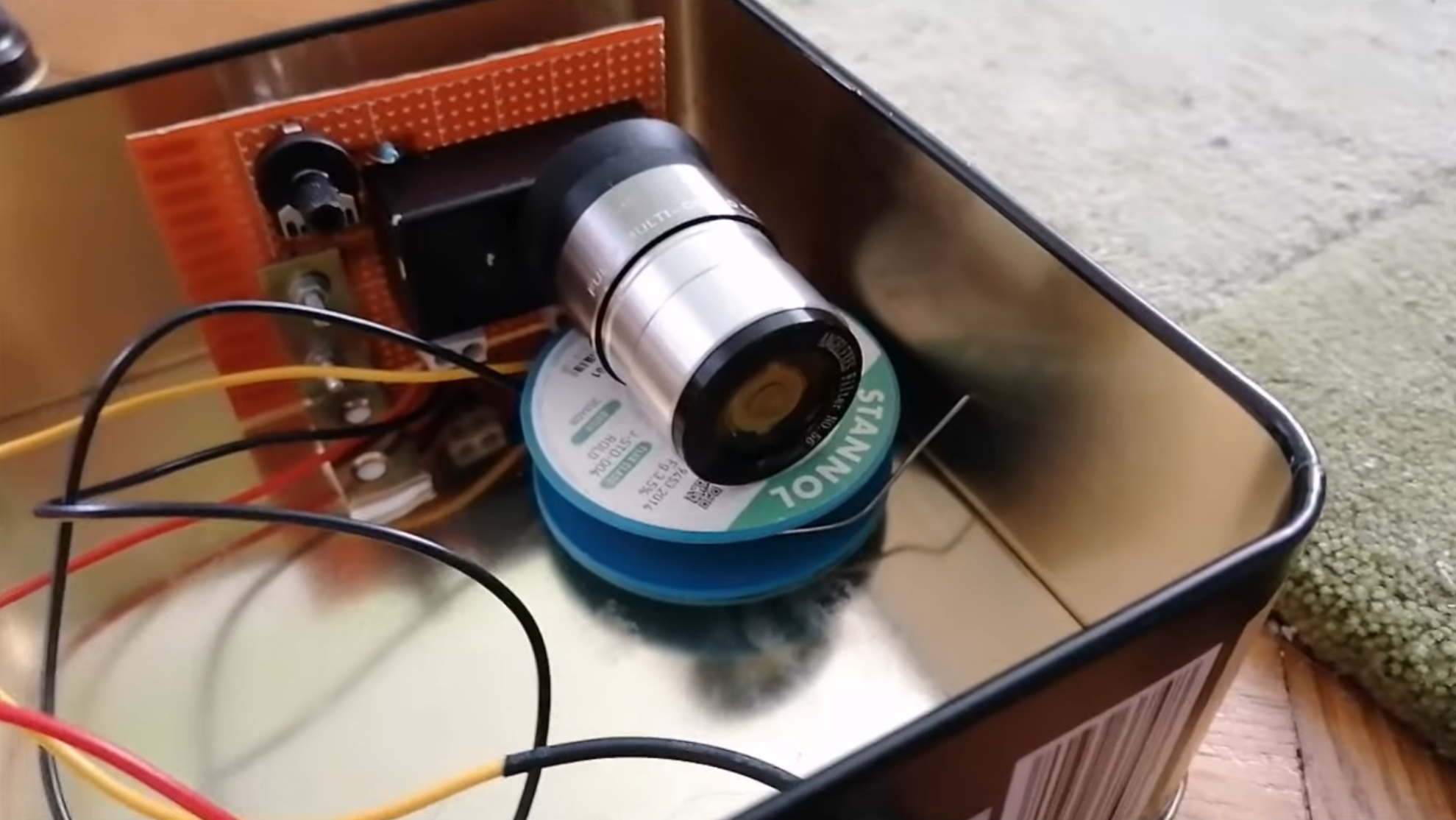
Most science projects politely stay on the table. A homemade spinthariscope, however, asks you to turn off the lights, let your eyes adjust, and watch tiny flashes that come from atoms doing their private fireworks show. No batteries. No screen. No dramatic countdown. Just a dark room, a scintillating surface, a safe sealed radiation source, and the strange pleasure of seeing radioactive decay as a field of blinking sparks.
A spinthariscope is one of the simplest radiation viewers ever invented. It does not measure radiation the way a Geiger counter does. It does not beep like a movie prop in a submarine. Instead, it lets you see individual scintillations: tiny flashes of light made when alpha particles strike a fluorescent material such as zinc sulfide. Each speck of light is a clue that an unstable atomic nucleus has changed into something else. That is the magic. The atom changes; the screen twinkles; the human brain says, “Wait, did I just see nuclear physics?”
Before we go further, one safety point deserves the front row seat: a responsible homemade spinthariscope is not a project about collecting loose radioactive material. It should be built only around a sealed, legal, educational source or a pre-sealed demonstration cell. Do not open smoke detectors, scrape old radium dials, crush minerals, handle unknown radioactive antiques, or turn your workbench into a suspicious episode of “What Could Possibly Go Wrong?” The goal is to observe a phenomenon safely, not to audition for a radiation safety training video.
What Is a Spinthariscope?
A spinthariscope is a small optical instrument used to view scintillations produced by ionizing radiation. In plain English, it is a peephole into atomic randomness. The classic design uses three basic parts: a radioactive source that emits alpha particles, a zinc sulfide screen that glows when struck, and a magnifying lens or eyepiece that lets the observer see the flashes.
The device dates back to 1903, when Sir William Crookes noticed flashes on a zinc sulfide screen while working with radium. The original spinthariscope was not just a party trick for Victorian science fans with excellent waistcoats. It became one of the earliest tools for observing individual nuclear events. Later, related scintillation methods played a role in famous experiments that helped scientists understand alpha particles and the structure of the atom.
Modern spinthariscopes are usually educational devices. They may use a tiny sealed source positioned close to a scintillating screen. When alpha particles travel the short distance to the screen, they deposit energy in the zinc sulfide. That energy is released as little flashes of visible light. To your eyes, it looks like a silent meteor shower trapped inside a tube.
How Radioactive Decay Becomes Visible
Radioactive decay happens when an unstable atomic nucleus releases energy to become more stable. That energy may appear as alpha particles, beta particles, gamma rays, or other forms depending on the isotope. A spinthariscope is most closely associated with alpha radiation because alpha particles are heavy, energetic, and excellent at making zinc sulfide sparkle when the geometry is right.
Alpha Particles: Tiny but Dramatic
An alpha particle is made of two protons and two neutrons. It is essentially the nucleus of a helium atom, minus the electrons. Alpha particles do not travel far in air and can be stopped by something as humble as paper or the outer layer of dead skin. That limited range is one reason a spinthariscope places the source very close to the scintillating screen. Move the source too far away, and the show fades faster than a phone battery at 2%.
Alpha particles are not a serious external hazard when properly sealed and handled at a distance, but they can be dangerous if radioactive material is inhaled, swallowed, or introduced into the body. That is why sealed sources matter. The safest homemade spinthariscope concept is really a homemade viewing body surrounding a sealed source, not a homemade radioactive source.
The Zinc Sulfide Screen
Zinc sulfide, often activated with silver or another dopant, is a scintillator. A scintillator converts energy from ionizing radiation into visible light. In a spinthariscope, the zinc sulfide screen acts like a tiny stage. Alpha particles arrive, collide with the material, and produce pinprick flashes. The screen does not glow like a flashlight. Instead, it flickers with individual events, which is far more interesting and far less useful for finding your keys.
Why the Flashes Look Random
The most fascinating part of watching radioactive decay is the randomness. You cannot predict exactly when a particular unstable atom will decay. You can only describe the probability over time. That is why the flashes look scattered and unpredictable. One moment the screen is calm; the next moment several tiny sparks appear. It feels like the universe is tapping Morse code, but refusing to share the dictionary.
Can You Really Make a Homemade Spinthariscope?
Yes, but the word “homemade” needs a grown-up definition. A safe homemade spinthariscope should focus on the housing, lens alignment, darkness control, and viewing comfort. It should not involve opening consumer devices, extracting radioactive components, or experimenting with mystery minerals. The safest route is to use a sealed educational spinthariscope source or a commercially sealed demonstration unit designed for observation.
A responsible project might involve making a better viewing tube, adding a comfortable eyepiece, improving light blocking, or designing a stable mount so the scintillation screen can be observed without shaky hands. Think of it as building the theater, not manufacturing the fireworks.
What a Safe Design Needs
A safe observation setup needs a light-tight body, an eyepiece or magnifier, a scintillating screen, and a sealed source that cannot be removed or touched. The inside should be dark enough for the faint flashes to stand out. The eyepiece should focus on the screen clearly. The device should be sturdy enough that it does not rattle apart like a bargain-bin flashlight after one enthusiastic twist.
Good viewing also depends on patience. Your eyes need time to adapt to the dark. If you check your phone every 20 seconds, the spinthariscope will punish you by showing approximately nothing. Give your eyes several minutes. Look slightly off-center. Relax. The flashes are faint, and your retina is doing delicate work.
What Not to Do
Do not harvest americium from smoke detectors. Do not dismantle smoke detectors for a science project. Ionization smoke detectors are safe when intact and properly handled because the radioactive material is shielded and contained. Taking them apart changes the risk. Also avoid old radium watch hands, aircraft dials, antique luminous paint, unknown ore samples, and any “my uncle found this in a box” radioactive object. Vintage radium items can shed contamination, and unknown sources are not educational materials; they are problems wearing nostalgia as a hat.
Do not sand, grind, crush, heat, dissolve, or scrape anything suspected of being radioactive. Do not store radioactive material casually. Do not mail it, loan it, or bring it to school without proper authorization. If you want a classroom demonstration, work through a teacher, radiation safety officer, university lab, museum, or licensed supplier. The best science projects end with notes and curiosity, not paperwork and a stern conversation.
How to Watch the Flashes
Watching a spinthariscope is surprisingly personal. Unlike a Geiger counter, which announces radiation with clicks, the spinthariscope asks you to meet it halfway. You need darkness, patience, and a willingness to stare at what first looks like a tiny greenish-gray nothing.
Start in a darkened room. Let your eyes adjust for several minutes. Bring the eyepiece close and focus gently. Do not expect a bright neon sparkle storm at first. The flashes are small and subtle. Once your vision settles, you may begin to notice tiny pinpricks appearing and vanishing across the screen. Some flashes may seem brighter than others. Some may appear in clusters. The pattern is not a hidden message. It is statistical behavior made visible.
Why It Feels So Different From Other Science Demonstrations
Many demonstrations are big on drama. Vinegar and baking soda foam up like a kitchen volcano with self-esteem issues. Magnets snap together. Dry ice fog rolls across the table. A spinthariscope is quieter. It is a whisper from the atomic world. That quietness is its charm.
When you see a scintillation, you are not watching an animation of radioactive decay. You are watching light caused by an actual particle interaction. The event is small, but the concept is enormous. It connects your eye to nuclear physics, early twentieth-century experimentation, radiation detection, and the probabilistic nature of matter. Not bad for something that looks like a tiny telescope for a very serious ant.
What a Spinthariscope Teaches About Radiation
A homemade spinthariscope is a strong teaching tool because it corrects several common myths at once. Radiation is not always green, glowing goo. Radioactivity is not automatically a death ray. And nuclear science is not only found in reactors, weapons, or dramatic movie plots. It is also a measurable natural process that can be observed with simple optics and the right safety controls.
Radioactive Decay Is Random, But Not Lawless
The flashes appear random because individual atoms decay unpredictably. However, a large population of atoms follows statistical rules. This is where half-life comes in. A half-life is the time it takes for half of the radioactive atoms in a sample to decay. You cannot point at one atom and schedule its big moment, but you can predict how a group behaves over time. It is like trying to predict which popcorn kernel will pop next: impossible for one kernel, very predictable for the bag.
Radiation Detection Is About Interaction
The spinthariscope does not “see radiation” directly. It sees the result of radiation interacting with matter. That distinction matters. A zinc sulfide screen flashes because energy is deposited in the material. A Geiger tube clicks because ionizing radiation triggers an electrical pulse in a gas-filled detector. A cloud chamber reveals tracks because particles disturb supersaturated vapor. Different detectors translate invisible events into signals humans can notice.
Alpha Radiation Has a Short Range
One lesson becomes obvious if the device allows safe variation in source-to-screen distance: alpha particles do not travel very far. Increase the distance and the number of visible scintillations drops. This makes the spinthariscope a simple way to understand range, shielding, and geometry. It also explains why sealed design matters. The source must be close enough to work while remaining safely contained.
Safety Rules for Curious People
Radiation safety often comes down to three principles: time, distance, and shielding. Minimize unnecessary time near a source, maximize distance when practical, and use appropriate shielding or containment. With a properly sealed educational spinthariscope, the exposure is typically very low, but the mindset still matters. Good habits are part of good science.
- Use only sealed, legal, educational sources designed for demonstration.
- Do not open, modify, scrape, grind, heat, or remove radioactive material.
- Keep the device intact and store it according to supplier instructions.
- Wash hands after handling demonstration equipment, especially in classroom settings.
- Do not allow children to use the device without knowledgeable adult supervision.
- Follow local rules, school policies, and radiation safety guidance.
The safest science is not the science with zero risk. That does not exist. Even making toast has a nonzero risk if you are sufficiently determined to be ridiculous. Safe science means understanding the risk, controlling it, and choosing methods that preserve both curiosity and common sense.
Spinthariscope vs. Geiger Counter vs. Cloud Chamber
A spinthariscope is often compared with other radiation detectors, but each tool tells a different story. A Geiger counter is excellent for detecting radiation and giving count rates. It is practical, portable, and satisfyingly clicky. A cloud chamber shows particle tracks as wispy lines, making invisible radiation look like tiny skywriting. A spinthariscope sits somewhere else: it shows individual flashes from particle impacts on a scintillator.
If the Geiger counter is a smoke alarm for radiation, the cloud chamber is a particle art gallery, and the spinthariscope is a peephole into atomic sparkle. For education, that makes it memorable. It turns an abstract word, “decay,” into a visible event.
Why the Homemade Version Still Matters
In a world full of digital sensors and instant graphs, the spinthariscope feels wonderfully analog. You do not need software updates. You do not need Bluetooth. You do not need to agree to a privacy policy before looking at alpha particles. The device works because physics works.
A homemade viewing body can make the experience more comfortable and more engaging. Better light sealing makes the flashes easier to see. A stable eyepiece reduces eye strain. A mount helps multiple observers use the same device without accidentally changing the focus every three seconds. Small improvements can turn a frustrating “I think I saw something” moment into a reliable demonstration.
For students, makers, and science communicators, that matters. The spinthariscope is not just an object. It is a teaching bridge between history and hands-on observation. It shows that early nuclear science was not built only with giant laboratories. It was also built with clever instruments, dark rooms, patient eyes, and researchers willing to count faint flashes until their eyeballs filed formal complaints.
Experience Notes: What It Feels Like to Watch Radioactive Decay
The first experience with a spinthariscope is often underwhelming for the first minute, and that is part of the charm. You look through the eyepiece and see darkness. Maybe a soft texture. Maybe nothing. Your brain, trained by glowing screens and impatient apps, immediately wants a progress bar. There is no progress bar. The spinthariscope is old-school. It makes you wait.
After a few minutes in the dark, the first tiny flashes begin to appear. They are not fireworks in the usual sense. They are more like distant sparks seen through fog, or glitter that exists for only a fraction of a second. Once you notice one, you start noticing more. The screen seems to wake up. Your eye learns the rhythm, except there is no rhythm. That is the point. Radioactive decay is not a metronome. It is probability wearing a sparkly jacket.
One of the best parts of the experience is how quiet it is. A Geiger counter gives you clicks, which are useful and dramatic. A spinthariscope gives you silence. The silence makes the flashes feel more intimate. You are not being told that decay is happening. You are watching evidence of it with your own eyes. It feels less like operating an instrument and more like eavesdropping on matter.
The second thing you notice is how much your own body affects the experiment. If your eyes are not dark-adapted, the flashes disappear. If you move too quickly, the focus shifts. If you keep glancing toward a lamp or phone, your night vision resets and the screen becomes stubborn again. The spinthariscope teaches patience in a way modern gadgets rarely do. It says, “Slow down, human. The atoms are already working.”
For a classroom or maker-space demonstration, the social experience can be funny. One person looks and says, “I don’t see anything.” Another person says, “Wait, I saw one!” Then everyone argues politely about whether “one” counts as proof. Eventually, after enough dark adaptation, most observers begin to see the flickers. The room gets quieter. People lean in. The mood changes from skepticism to fascination. It is a rare project where the big reveal is almost microscopic, but the reaction can be huge.
There is also a strong historical feeling to the experience. Watching the flashes helps you imagine why early researchers were so captivated by radioactivity. Today, nuclear physics can feel buried under equations, regulations, detectors, and industrial infrastructure. The spinthariscope strips the idea down to something direct. A particle hits a screen. A flash appears. A person sees it. That simple chain is powerful.
The final impression is humility. Each flash is small, but it represents a real atomic event. The material is changing one nucleus at a time, whether anyone watches or not. The spinthariscope does not make decay happen; it merely lets you witness a few visible consequences. That is the best kind of science demonstration: one that does not pretend nature is performing for us, but instead gives us a better seat.
Conclusion
Watching radioactive decay with a homemade spinthariscope is one of the most elegant ways to connect curiosity, history, optics, and nuclear science. It turns alpha particles into visible scintillations and makes radioactive decay feel less like an abstract textbook term and more like a real physical process. The best version of the project is careful, legal, and safety-minded: build or improve the viewer, use only sealed educational sources, and never tamper with radioactive materials.
A spinthariscope may be simple, but it is not simplistic. It teaches randomness, half-life, scintillation, radiation detection, and the importance of safe handling. It also reminds us that science does not always need a giant screen or a dramatic soundtrack. Sometimes, all it needs is a dark room, a patient observer, and a few tiny flashes from the heart of the atom.
Note: This article is for educational publishing purposes only. It does not provide instructions for extracting, modifying, or handling radioactive materials. Any real demonstration should use sealed, compliant educational equipment and follow applicable safety rules.














