Turkeys are easy to underestimate. Their wobbling walk, dangling facial accessories, and starring role beside mashed potatoes have given them a slightly comedic public image. Yet the wild turkey is a sharp-eyed, fast-flying, socially complicated survivor with an ancient American history.
These birds can sprint through forests, rocket into the air, sleep in treetops, swim across water, and communicate with an impressive assortment of calls. Their heads even change appearance with their mood. In other words, the turkey is less like a clumsy farmyard prop and more like a feathered woodland athlete wearing an unusually elaborate hat.
Here are 10 engrossing facts about turkeys that reveal what these remarkable birds are really like.
1. Turkeys Are Ancient Natives of the Americas
Wild turkeys did not arrive in North America with European settlers. They were already hereand their family history goes back an astonishingly long way. Turkey fossils discovered in the southern United States and Mexico include specimens more than five million years old.
Only two living turkey species exist today. The familiar Wild Turkey, scientifically known as Meleagris gallopavo, occurs across much of North America. Its spectacular relative, the Ocellated Turkey, lives mainly in Mexico’s Yucatán Peninsula and parts of Belize and Guatemala. The latter looks as though a peacock, a turkey, and a box of metallic crayons collaborated on a design project.
The North American Wild Turkey is divided into five recognized subspecies: Eastern, Osceola, Rio Grande, Merriam’s, and Gould’s. Each is adapted to a different combination of forests, grasslands, deserts, and climate conditions.
2. Domestic Turkeys Took a Remarkable Round-Trip Journey
Indigenous peoples in Mexico domesticated turkeys roughly 2,000 years ago, long before Thanksgiving menus or supermarket freezer aisles existed. Turkeys supplied food, feathers, and other useful materials, and they held cultural importance in numerous communities.
Spanish explorers encountered domesticated turkeys during the 1500s and carried them to Europe. The birds became popular farm animals there. Later, European colonists sailed to North America with domesticated turkey breeds descended from birds originally taken from Mexico. The turkey had traveled from America to Europe and back againa transatlantic tour completed without a passport, luggage, or even a decent travel pillow.
Did Benjamin Franklin Want the Turkey as the National Bird?
Not exactly. Franklin did criticize the bald eagle in a private letter and praised the turkey as a courageous bird native to America. However, there is no solid evidence that he formally proposed replacing the eagle with a turkey as the national symbol. The popular version of the story is entertaining, but history is slightly less dramatic.
3. Wild Turkeys Can Fly at Highway Speeds
One of the most persistent turkey myths is that these birds cannot fly. Heavy commercial domestic breeds usually have limited flying ability because selective breeding has produced exceptionally large bodies and breast muscles. Wild turkeys are another matter entirely.
When danger appears, a wild turkey can launch itself into the air and reach approximately 55 to 60 miles per hour during a short burst. The flight may not last long, but it can be startlingly powerful. A bird weighing more than 20 pounds suddenly crossing the forest at traffic speed is not a gentle, floating experience. It is closer to witnessing a feathered bowling ball discover aviation.
Wild turkeys normally walk or run while feeding. Flight is primarily used to escape predators, cross obstacles, or reach nighttime roosts. Their broad, rounded wings provide rapid acceleration, although they are not built for long-distance migration.
4. Turkeys Sleep in Treesand They Can Swim
Wild turkeys spend most daylight hours on the ground, but sleeping there would leave them vulnerable to coyotes, foxes, bobcats, and other predators. Near sunset, they fly into trees and settle on sturdy branches, often roosting together as a flock.
A turkey may first land on a lower branch and then hop or fly upward until it reaches a secure position. At dawn, the birds glide or flap back to the ground and resume feeding. Seeing several large turkeys arranged across bare winter branches can be wonderfully confusing, like discovering that someone decorated a tree with living feather dusters.
Turkeys also have an emergency swimming technique. When necessary, they can tuck their wings close to the body, spread the tail, and kick through the water. Swimming is not their preferred weekend hobby, but it gives them another way to escape trouble or cross a narrow waterway.
5. Their Eyesight Is Exceptionally Sharp
Trying to sneak up on a wild turkey is an excellent way to learn humility. Turkeys have extremely sharp vision, can see in color, and possess a field of view covering roughly 270 degrees. Because their eyes sit on opposite sides of the head, they can monitor an enormous portion of their surroundings without turning around.
This visual system is ideal for a ground-feeding bird surrounded by potential predators. A turkey scratching through leaves may appear absorbed in its meal, but it is constantly checking for suspicious shapes and movement. Even a small motion can trigger an alarm response.
Turkeys often tilt or rotate their heads while examining an object. This behavior allows them to view it from different angles and compensate for the limited overlap between the visual fields of their two eyes. To a person, the head movement can look comical. To the turkey, it is advanced security surveillance.
6. A Turkey’s Head Works Like a Mood Display
The strange-looking skin on a male turkey’s head is not merely decorative. Its colors and shapes communicate information about excitement, confidence, submission, and reproductive condition.
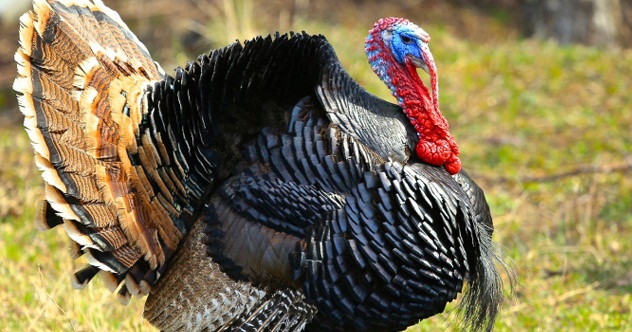
The fleshy flap beneath the throat is called the wattle. The soft projection extending over the bill is the snood. During courtship or confrontation, a male’s bare head and neck may display vivid combinations of red, white, and blue. A confident gobbler may show more white, while stronger red coloring can accompany fear or submission in certain situations.
The snood changes as well. It can become longer and hang over the bill when a male is displaying confidently, then retract when the bird becomes alarmed. Together with feather position, posture, wing placement, and tail fanning, these features create a surprisingly detailed system of turkey body language.
7. Gobbling Is Only One Part of the Turkey Vocabulary
The classic gobble may be the most famous turkey sound, but it is only one item on a varied vocal menu. Adult males gobble primarily to attract hens and announce their presence to rival males. The call usually lasts about a second, yet it can carry particularly well when delivered from a treetop roost.
Turkeys also yelp, cluck, purr, cackle, and make sharp alarm calls often described as putts. A scattered flock uses yelps to regroup. Turkeys may purr softly while walking or feeding, and birds leaving a roost can produce excited cackling sounds. Lost young turkeys whistle to contact their flockmates.
Displaying males add low-frequency noises to the performance, including soft chumps and humming or drumming sounds. Much of the conversation is subtle, meaning a quiet flock may still be exchanging information that a nearby human completely misses.
8. Turkey Beards Are Feathers, and Some Hens Have Them
The dark strand hanging from a turkey’s chest is called a beard, but it is not made of mammalian hair. It consists of specialized, stiff, hair-like feathers. Most adult male turkeys grow a beard, and it generally becomes longer as the bird ages, although wear, ice, rocky terrain, and nutritional problems can break or shorten it.
Beards are not exclusive to males. Approximately 10 percent of hens may develop them, although a hen’s beard is usually shorter and thinner. This means that identifying a turkey’s sex by the beard alone can occasionally produce an embarrassing ornithological misunderstanding.
Males also commonly have spurs on the backs of their legs. These pointed structures are used during fights with competing males. Combined with a long beard, large body, bright head, and bold strutting display, the spurs help make a mature gobbler one of the most unmistakable birds in an American woodland.
9. Turkeys Eat Almost Anything Their Habitat Offers
Wild turkeys are opportunistic omnivores. Their seasonal diet may include acorns, hickory nuts, seeds, grasses, berries, fruits, buds, insects, snails, and even small salamanders. They spend much of the day walking through suitable habitat and scratching leaf litter aside with their feet.
Young poults depend heavily on insects during their first weeks because rapidly growing bodies require protein and energy. Beetles, grasshoppers, and other small invertebrates are especially important. As the birds mature, plant foods make up a larger share of the menu.
Because turkeys do not have teeth, they swallow small stones and grit. These materials collect in the muscular gizzard, where they help grind hard seeds and nuts. It is essentially a built-in food processor, though significantly noisier and unlikely to come with a warranty.
This flexible diet helps explain why wild turkeys can survive in habitats ranging from oak forests and pine woodlands to farms, grasslands, and suburban neighborhoods.
10. Turkey Chicks Begin Exploring Almost Immediately
A female wild turkey, called a hen, creates a shallow nest on the ground, often hidden among dead leaves, shrubs, brush, or tall vegetation. A typical clutch may contain around 10 to 14 eggs, although recorded clutches range from four to 17.
The hen incubates the eggs for approximately 25 to 31 days. After hatching, the down-covered poults are already relatively well developed. They can walk and leave the nest within about a day, following their mother as she searches for insects and safer cover.
The early weeks are dangerous. Ground nests can be discovered by raccoons, skunks, snakes, foxes, rodents, and other predators. Once hatched, poults face hawks, owls, bobcats, coyotes, bad weather, and habitat conditions that may limit food or concealment.
Hens protect and guide their young without help from males. Family groups sometimes join together, allowing multiple hens and their poults to travel in larger flocks. Within a few weeks, the youngsters develop enough flight ability to follow their mothers into trees at night.
A Wildlife Comeback Worth Remembering
Wild turkeys were once eliminated from large portions of their historical range. Extensive forest clearing, unregulated hunting, and habitat loss caused severe declines during the 1800s and early 1900s.
Early restoration attempts using farm-raised turkeys generally failed because domesticated birds lacked the survival skills of truly wild populations. Wildlife managers eventually began capturing wild turkeys and relocating them to suitable habitats. Combined with hunting regulations and habitat recovery, this approach produced one of North America’s most notable wildlife restoration successes.
Wild turkey numbers eventually reached millions, and the birds became established in 49 states. However, populations have declined again in parts of the South and Midwest, reminding conservationists that a successful recovery cannot simply be placed on a shelf and admired forever. Healthy nesting cover, insect-rich brood habitat, mature roost trees, and carefully managed woodlands remain essential.
A Turkey-Watching Experience: Meeting the Real Bird Behind the Holiday
A good turkey-watching experience often begins before sunrise. The forest is still gray, the leaves are damp, and nearly every sound seems louder than it should. A distant barred owl may call. Then, from somewhere high among the trees, comes a gobblesudden, rolling, and far more powerful than the polite “gobble-gobble” supplied by cartoon sound effects.
At first, the bird may remain invisible. A gobbler calling from a roost can sound closer than it really is, especially when the noise travels across an open valley. A second male may answer from another ridge. For several minutes, the woods become a strange natural conference call in which every participant appears determined to speak at maximum volume.
As daylight strengthens, dark shapes begin moving among the branches. One bird drops from the tree, gliding downward with heavy wingbeats. Others follow. Their landing is controlled but not exactly delicate. Dry leaves scatter, wings slap the air, and suddenly the seemingly empty forest contains a flock of alert, fast-moving birds.
Watching from a respectful distance reveals how little time turkeys spend standing around looking decorative. They walk steadily, scratching the ground with powerful feet and examining the exposed soil for seeds or insects. Every few moments, one bird raises its neck and scans the surroundings. When it freezes, the others often become alert as well. The flock behaves less like a random gathering and more like a coordinated neighborhood watch.
Spring offers the most theatrical experience. A male may puff his body feathers until he appears nearly spherical. He lowers his wings, spreads his tail into a fan, and turns slowly so nearby hens can inspect the entire performance. Sunlight catches bronze, copper, green, and purple tones that are almost invisible when the feathers lie flat. The bird that looked brown from a distance suddenly resembles polished metal.
The hens usually react with considerably less enthusiasm than the displaying male seems to expect. They continue feeding, walk away, or glance at him briefly before returning to more urgent business. The gobbler follows, repeatedly presenting his best angle. It is an impressive display of confidence, persistence, and the universal experience of trying much harder than one’s audience requested.
Turkey watching also teaches patience. Sudden movement can send a flock running or flying, so the best observations happen when people remain quiet, avoid blocking the birds’ path, and resist approaching for a closer photograph. Binoculars reveal details without creating unnecessary stress.
In suburban areas, it is especially important not to feed wild turkeys. Regular feeding can reduce their natural fear of people and encourage aggressive behavior, property damage, and dangerous encounters near roads. Observing them as wild animalsnot oversized outdoor petsprotects both the birds and the neighborhood.
After seeing a wild turkey fly, communicate, forage, and navigate its social group, it becomes difficult to think of the species as merely a holiday centerpiece. The real turkey is watchful, adaptable, beautifully colored, and surprisingly athletic. It has survived predators, habitat destruction, overhunting, transatlantic travel, centuries of jokes, and an annual avalanche of gravy-related publicity. That is an impressive résumé for any bird.